
Why 'Sink or Swim' Onboarding Is Killing Your Sales Team (And How to Build a Liferaft)

8
min read
.png)
Summary
- The "sink or swim" approach to sales onboarding is costly, with 47% of reps leaving within 18 months and replacement costs reaching up to 200% of their annual salary.
- Effective onboarding is a continuous process, not a one-time event, featuring a structured bootcamp that covers product, sales methodology, and tech stack.
- A winning program moves beyond theory by incorporating mentorship, regular feedback, and practical application through real-world simulations.
- To provide reps with safe and repeatable practice, modern onboarding programs leverage AI Sales Roleplays to build confidence and accelerate ramp time.
You've just hired a promising new sales rep with an impressive track record. You hand them a laptop, give them a quick product overview, and tell them to start booking meetings. After all, good salespeople figure things out on their own, right?
Three months later, they're struggling to hit quota, their confidence is shot, and they're quietly updating their LinkedIn profile.
Sound familiar? This is the "sink or swim" approach to sales onboarding, and it's silently sabotaging your team's performance, morale, and your bottom line.
"90 days into my 1st Sales job and I haven't had any real or formal training. Day 1 consisted of a list of things to do with no instructions on where or how to get the info being requested." - Sales Rep on Reddit
This isn't just one frustrated rep's experience. It's an epidemic in sales organizations where proper onboarding is treated as a luxury rather than a necessity. The consequences are devastating, both financially and culturally.
The Alarming Financial and Human Cost of 'Sink or Swim'
The Revolving Door: Turnover and Its Financial Impact
The statistics paint a grim picture: 47% of sales reps leave their roles within the first 18 months, with inadequate onboarding often cited as a primary reason. Even more alarming, 25% quit in their first year due to a lack of proper guidance and support.
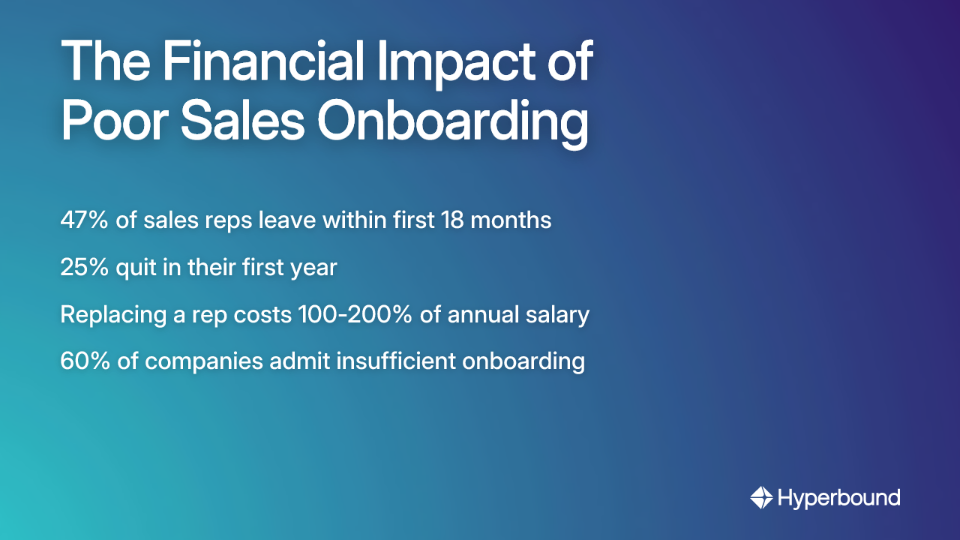
This revolving door isn't just disruptive—it's incredibly expensive. Replacing a single sales rep can cost between 100% to 200% of their annual salary. For a seller earning $75,000, that means a loss of $75,000-$150,000 per departure. Some industry experts place this figure even higher, between 100% to 500% of a seller's compensation when you factor in lost productivity, recruiting costs, and the time it takes for new hires to reach full productivity.
Meanwhile, organizations seem aware of the problem but struggle to address it. A sobering 60% of companies admit their sales onboarding programs are insufficient. This self-awareness hasn't translated into meaningful change.
The Confidence Killer: How Poor Onboarding Sabotages Performance and Morale
Beyond the financial impact, there's a profound human cost. The emotional toll of being thrown into deep waters without proper preparation is summed up by one sales rep:
"I almost want to cry finding all this out. I can't believe I have been put through such hell when there's other companies out there that actually train their sales team." - Sales Rep on Reddit
When new hires are left to "figure it out," several things happen:
- Their confidence plummets when they inevitably struggle
- They develop bad habits that become difficult to correct
- They miss out on building relationships with teammates
- They take significantly longer to reach full productivity
The result is a demoralized team member who feels set up for failure. This ripple effect extends beyond the individual, creating a culture where everyone expects to struggle and where turnover is normalized.
According to Gallup, only 12% of employees strongly agree their company excels at onboarding. However, those with exceptional onboarding experiences are nearly 3 times more likely to report high job satisfaction and commitment to their organization.
The contrast between companies with strong and poor onboarding couldn't be clearer:
"Mine does! I had 7 (!!!!) weeks of onboarding and training. My company takes a ton of pride in its training." - Sales Rep on Reddit
The question isn't whether you can afford to invest in proper onboarding. It's whether you can afford not to.

The Anatomy of a Winning Sales Onboarding Program
Before Day One: The Power of Pre-boarding
Effective onboarding begins before your new hire's first day. This "pre-boarding" phase builds excitement and reduces first-day anxiety:
- Send a welcome package with company swag and a personalized note
- Provide access to key information about company culture and values
- Connect them with their assigned mentor or buddy
- Give early access to non-critical systems to handle administrative tasks
This approach immediately signals that you're invested in their success and ensures they arrive excited rather than anxious on day one.
The First 30 Days: Building a Foundation with a Sales Bootcamp
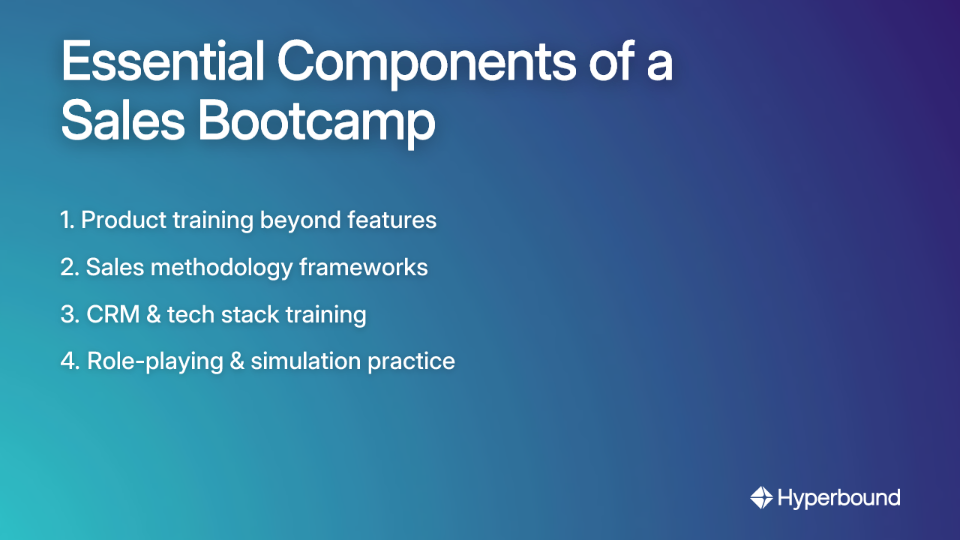
The first month should be structured as an intensive bootcamp focused on building core competencies through four key components:
- Product Training That Goes Beyond Features Most companies offer surface-level product training, but exceptional onboarding dives deeper: "Sales training should be about the market and the product. What's the market gap. How you solve it. Why you do it better than others. Why now." - Sales Leader on Reddit Effective product training includes:
- The market problems your product solves
- Your unique value proposition
- Competitive positioning
- Customer success stories and use cases
- Hands-on product experience
- Sales Methodology Training Only 49% of organizations have a clearly defined sales process. This creates a chaotic experience where reps are expected to succeed without a roadmap. Your bootcamp should include:
- Your company's sales methodology (SPIN, Challenger, etc.)
- Structured frameworks for discovery calls, demos, and handling objections
- Call frameworks and messaging templates
- Formal certification through established programs like Sandler Sales training or Dale Carnegie Sales Advantage
- CRM & Tech Stack Training Nothing frustrates new hires more than struggling with unfamiliar tools: "I did some programming for a bit and this software is kinda convoluted and imo not straightforward like it should be." - Sales Rep on Reddit Provide hands-on training for:
- Your CRM system with documented processes
- Sales enablement platforms
- Communication tools and prospecting software
- Data and reporting dashboards
- Role-Playing & Simulations Theoretical knowledge isn't enough. Create safe spaces to practice through:
- Structured role-play scenarios for common sales situations
- Recorded practice calls with feedback
- Shadowing of top performers
- Guided call reviews of both successful and unsuccessful interactions
Beyond the Bootcamp: Integrating Continuous Learning and Support
Remember: onboarding isn't a one-time event but a process that can extend up to 12 months.
After the initial bootcamp, implement:
- Incremental Goals: Break down large targets (like quota) into weekly and monthly milestones
- Self-Paced Learning Resources: Create a library of on-demand training materials
- Regular Check-ins: Schedule structured check-ins at 30, 60, and 90 days
- Progressive Responsibility: Gradually increase complexity of assignments as confidence grows
Key Pillars of a High-Impact Sales Onboarding Strategy
Pillar 1: Structured, Role-Specific Training (Not Just Product Dumps)
The contrast between ineffective and effective onboarding is stark:
"The vast majority of places seem to only offer half-hearted product training with basic 'overcoming objections' training." - Sales Rep on Reddit
Versus:
"I had 7 (!!!!) weeks of onboarding and training. My company takes a ton of pride in its training." - Sales Rep on Reddit
Personalize training based on:
- Prior sales experience level
- Specific role (SDR vs. Account Executive)
- Learning style preferences
- Product complexity and sales cycle
Consider incorporating gamification elements like leaderboards and friendly competitions to make the process engaging and boost knowledge retention.
Pillar 2: Real-World Application and Technology Enablement
Theoretical knowledge alone won't prepare your reps for the sales floor. Effective onboarding bridges theory and practice through:
- AI-Powered Role-Play Tools: Leverage platforms like Hyperbound's AI Sales Roleplays to provide safe, repeatable, and low-pressure environments for practicing any sales conversation.
- Call Recording Libraries: Give new hires access to a library of successful sales calls to study
- Collaborative Learning Sessions: Schedule peer learning sessions where reps can share challenges and solutions
- Guided Territory Planning: Provide structured guidance for building their first territory or account plans
Pillar 3: Mentorship, Coaching, and Feedback Loops
The human element remains critical to successful onboarding:
- Dedicated Sales Coaches: Assign experienced sales coaches who are measured on the success of new hires
- Mentorship Programs: Pair new reps with successful veterans who can provide context and cultural guidance
- Regular Feedback Mechanisms: Create structured ways for new hires to receive and provide feedback
- Executive Involvement: Schedule time with leadership to reinforce company vision and values
A strong mentorship program addresses what many new reps crave:
"Sales training gives sales people 'the why' to learn the products." - Sales Leader on Reddit
Measuring What Matters: Tracking the ROI of Your Onboarding Program
To justify your investment in onboarding, track and report on these key metrics:
- Time to first meeting booked: Target within 9 days (vs. industry average of 14+)
- Ramp-to-sales-quota timeline: Aim for quota attainment by month four (vs. industry average of six)
- Certification completion rate: Target 96% completion within 21 days
- Time to first closed-won deal: Target within 32 days (vs. industry baseline of 45)
- Pitch score improvement: Track 10-percentage-point improvement from month one to three
- 1-year sales forecast accuracy: Measure how quickly new reps can accurately forecast their pipeline
Organizations with effective onboarding programs are 4x more likely to get new hires to full productivity within 3 months compared to those with poor or non-existent programs. This directly impacts your 1-year sales forecast reliability and overall team performance.
Implement sales scorecards that tie rep behavior to pipeline progression and revenue, making the impact of your training program tangible and measurable.
Stop Throwing Your Sales Talent Into the Deep End
The "sink or swim" approach to sales onboarding isn't a rite of passage—it's a costly failure of leadership that actively harms your revenue, talent retention, and company culture.
When new hires are left to figure things out on their own, many will simply leave:
"If any young people are reading this, bail ASAP if you don't receive sales training, don't even stay for a single month." - Sales Rep on Reddit
A strategic, structured, and supportive onboarding program is a competitive advantage. It accelerates performance, builds a winning culture, and maximizes the lifetime value of every sales hire.
Stop leaving your team's success to chance. Invest in a robust onboarding program and build a team of confident, competent sellers who are equipped to win from day one. Your bottom line—and your sales team—will thank you.
Frequently Asked Questions
What is a "sink or swim" sales onboarding approach?
A "sink or swim" sales onboarding approach is a method where new sales hires are given minimal training and resources and are expected to figure out their role and succeed on their own. This hands-off strategy often leads to high turnover, low morale, and poor performance because it fails to provide the structured support necessary for new reps to understand the product, market, and sales process.
Why is poor sales onboarding so costly for a company?
Poor sales onboarding is costly primarily due to high employee turnover, with replacement costs ranging from 100% to 200% of a rep's annual salary. Beyond direct replacement costs, it leads to lost productivity, missed revenue opportunities as new hires take longer to ramp up, and a negative impact on team morale and company culture.
How long should a sales onboarding program last?
An effective sales onboarding program is not a one-time event but a continuous process that can last up to 12 months. The most intensive phase, often a "bootcamp," typically covers the first 30-90 days, focusing on foundational knowledge. After this initial period, onboarding should transition into ongoing coaching, continuous learning, and mentorship to ensure long-term success and development.
What are the essential components of a new sales hire's first 30 days?
The essential components for a new sales hire's first 30 days should be structured as an intensive bootcamp covering four key areas: 1) In-depth product and market training, 2) The company's specific sales methodology, 3) Hands-on training with the CRM and tech stack, and 4) Practical application through role-playing and simulations. This foundation ensures new reps build core competencies and confidence quickly.
How can I measure the success of my sales onboarding program?
You can measure the success of your sales onboarding program by tracking key performance indicators (KPIs) that demonstrate a new hire's progress and effectiveness. Critical metrics to monitor include: time to first meeting booked, time to first closed deal, ramp time to full quota attainment, certification completion rates, and improvements in pitch scores over the first three months.
What is the role of technology in modern sales onboarding?
Technology plays a crucial role in modern sales onboarding by providing scalable and consistent training experiences. Tools like AI-powered role-play platforms offer safe environments for practice, while call recording libraries provide real-world examples. Learning Management Systems (LMS) can house on-demand training materials, and CRM systems ensure process adherence from day one.
What is the difference between sales training and sales onboarding?
Sales onboarding is the comprehensive, long-term process of integrating a new hire into the company, covering culture, processes, tools, and foundational knowledge. Sales training is a specific component within the onboarding process (and beyond) that focuses on developing particular skills, such as product knowledge or objection handling. Onboarding is the entire journey, while training consists of the specific lessons along the way.
Book a demo with Hyperbound


