.png)


.png)
You've started the Zoom call. It's two minutes past the hour. A few faces are in their boxes, but you're still missing key people. The silence is deafening. Do you start? Do you try to warm up the meeting with awkward small talk or dad jokes to break the tension? This is the modern meeting leader's dilemma.
"We'll wait a few more minutes for everyone to join" has become a standard phrase in virtual meetings. But this seemingly harmless courtesy comes with hidden costs - to your productivity, team dynamics, and organizational culture.
This article tackles the question: How long should you actually wait for latecomers, and what can you do to make those first few minutes productive rather than painfully awkward?
The Awkward Wait and Its Hidden Costs
The pre-meeting silence while waiting for latecomers creates a unique form of tension. Meeting hosts often feel anxious about making participants (especially new ones) feel welcomed, while also respecting the time of those who showed up punctually.
As one meeting facilitator shared on Reddit, "I was wondering how I can make participants, especially new ones feel welcomed, or how to warm up the meeting to make it not silent and awkward while waiting?" This concern is valid - no one wants to create an unwelcoming atmosphere or "lose people right off the bat."
But there's a counterargument worth considering: "Making accommodations for late arrival people is rewarding late arriving people for being late." This creates a cycle where punctuality becomes optional rather than expected.
The Science of Lateness: Why Waiting Erodes Meeting Success
The scale of this problem is staggering. Research published in SAGE Journals reveals that approximately 4.1 million of the nearly 11 million meetings held daily in the U.S. start late, primarily because attendees wait for one or more late arrivals.
This isn't just about wasted minutes. According to Conservation of Resources (CoR) Theory, when people wait, they perceive a loss of a valuable resource: their time. This perceived loss "results in a drain of personal resources, leading to reduced motivation and engagement during meetings."
The research is clear: attendees report feeling frustrated, upset, and disrespected when someone arrives 6 to 10 minutes late.
More importantly, late-starting meetings are fundamentally less effective. Groups that started late demonstrated "significantly less solution-focused communication, less idea elaboration, and fewer socioemotional support statements." This lateness diminishes group cohesion and derails the meeting's goals.
It's no wonder that 23% of workers believe that time spent in meetings is a waste - a perception likely worsened by chronic lateness.
A Practical Framework: How Long Should You Actually Wait?
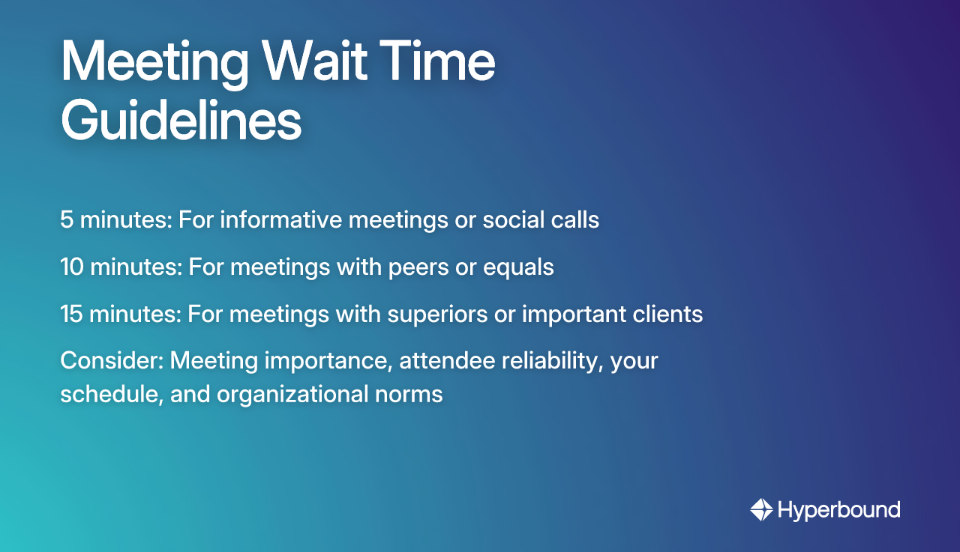
There's no one-size-fits-all answer. The appropriate wait time depends on several factors, and research suggests different timeframes for different scenarios:
Evidence-Based Wait Times by Meeting Type:
- 5 minutes: For informative meetings or social calls where the stakes are lower.
- 10 minutes: For meetings with equals/peers. This aligns with survey data showing 48% of respondents believe 10 minutes is a reasonable waiting period.
- 15 minutes: For appointments with superiors or important clients, where the key attendee's presence is non-negotiable.
Contextual Factors to Consider:
- Assess the Meeting's Importance: Is this for a crucial decision with key stakeholders, or a routine update that could be an email?
- Evaluate the Attendee's Reliability: Is this person consistently punctual and something is likely wrong, or are they a habitually late attendee where boundaries need to be enforced?
- Balance Your Own Schedule: If you have a packed day, your maximum wait time might be 10-15 minutes. If your schedule is flexible, you might extend it.
- Acknowledge Cultural and Organizational Norms: Some company cultures implicitly accept a few minutes of delay, while others prioritize strict punctuality. Adapt accordingly or work to change the norm.
From Reactive to Proactive: Strategies for Punctual and Productive Meetings
.png)
Rather than simply reacting to lateness, what if you could prevent it altogether? Here are evidence-based strategies for establishing a culture of punctuality:
Set Crystal Clear Expectations
In the meeting invitation, clearly state:
- The agenda and objectives
- Start and end times
- A firm statement: "To respect everyone's time, this meeting will begin promptly at [Time]. We will not be able to recap content for those who arrive late."
Encourage participants to join 5 minutes early to test their technology and be ready to engage.
The Golden Rule: Start On Time, Every Time
This is the single most effective strategy. Do not say, "Let's wait a few more minutes." This rewards lateness and punishes punctuality.
As one meeting participant noted on Reddit, "If you create a routine that always does non-consequential stuff for five minutes, more people will turn up five minutes in." Break this cycle by starting with meaningful content at the scheduled time.
Master the First 5 Minutes (The "Warm-Up")
Instead of awkward silence, use the time productively. This addresses the common dilemma of how to "warm up" the meeting:
- Use a countdown timer: Share your screen with a countdown timer video to build anticipation and clearly signal when the meeting will officially begin.
- Play music or a warm-up video: As one Reddit user suggested, "Make a warm up video and share it. Or just share some music." This creates a more relaxed atmosphere while people join.
- Engage with interactive tools: Use an interactive polling tool or a virtual whiteboard for engagement. Ask a simple poll question or icebreaker that people can respond to as they join.
- Dad jokes can work: Another Reddit user recommended, "Tell jokes. That's always a fun way to break the ice during that awkward pre-meeting silence. Dad jokes are great."
Reward Punctuality, Don't Just Punish Lateness
Share the most valuable and important content at the very beginning of the meeting. This creates a natural consequence for lateness (FOMO - fear of missing out).
Verbally acknowledge and thank the people who are there on time. This positive reinforcement helps establish punctuality as a valued behavior.
Managing the Transition: How to Start Without Alienating Latecomers
Even with perfect strategies, you'll still occasionally have late arrivals. Here's how to handle them gracefully:
The Graceful Start
At the scheduled time, simply say, "Welcome, everyone. In the interest of time, we're going to get started." This acknowledges both the importance of the topic and respect for everyone's time.
Handling Late Arrivals
When someone joins late, give a brief, quiet acknowledgment if necessary ("Hi, [Name]."), but do not stop and recap. Encourage them to mute their microphone and camera until they get their bearings to avoid disrupting the flow.
Consider designating a co-host who can privately message latecomers with any critical information they missed.
Addressing Chronic Lateness
Avoid public shaming. As one meeting facilitator wisely stated, "I never shame them in IRL or in Zoom. It just creates a sour climate."
Instead, address the issue with the individual privately. Explain the impact of their tardiness on the team and the project, and clarify future expectations.

Practical Alternatives to the Waiting Game
Instead of passively waiting for latecomers, consider these proactive approaches:
The Structured Buffer
Plan for a 5-minute buffer at the beginning of meetings, but make it intentional and productive:
- Share a compelling statistic or brief video related to the meeting topic to spark interest
- Use an interactive whiteboard for a quick brainstorming activity that people can join as they arrive
- Launch an interactive poll with a thought-provoking question relevant to the upcoming discussion
This approach respects punctual attendees by providing engagement while creating a natural entry point for latecomers.
The Two-Phase Meeting
Structure your meeting with an intentional two-phase approach:
- Phase 1 (First 5 minutes): Connections, context-setting, and lightweight engagement
- Phase 2 (The rest): Core content and decisions
This creates a natural transition point without explicitly "waiting" for anyone.
The Recorded Recap
For critical meetings where some participants truly cannot be on time due to legitimate scheduling conflicts:
- Record the first 5-10 minutes of the meeting
- Share the recording immediately after the meeting
- Make it clear this is an exception, not the rule
This allows latecomers to catch up on missed content without delaying everyone else.
Making It Work: Real-World Examples
Case Study 1: The Engineering Stand-Up A software engineering team was struggling with daily stand-ups regularly starting 5-7 minutes late. The team lead implemented a countdown timer visible to all participants and stated that the meeting would begin exactly when the timer reached zero, regardless of who was present. Within two weeks, tardiness dropped by 78%.
Case Study 2: The Executive Briefing A CEO was frustrated that her leadership team meetings always started late. She implemented a "first five minutes" policy where the most critical decisions were discussed immediately. When executives realized they were missing the chance to weigh in on important matters, punctuality improved dramatically.
Case Study 3: The Client Consultation A consulting firm found that waiting for late clients was eating into billable hours. They began sending calendar invites with a note that meetings would start precisely on time, with the first 5 minutes dedicated to the most valuable insights. Clients who previously arrived late began showing up early to not miss the high-value opening.
Conclusion: Reclaim Your Time, Respect Your Team
The 10-minute wait is rarely the best approach. It damages morale, reduces productivity, and establishes a culture where punctuality is optional rather than expected.
As research from SAGE Journals demonstrates, starting late doesn't just waste time—it fundamentally alters the quality of the meeting itself, reducing solution-focused communication and creative problem-solving.
The best strategy is contextual and proactive:
- Establish clear expectations about start times
- Begin promptly, every time
- Make the first few minutes engaging and valuable
- Handle latecomers respectfully but without disrupting the flow
- Address chronic lateness privately
By taking control of those critical first minutes—whether through a countdown timer, interactive warm-up activities, or strategically front-loading valuable content—you transform the dreaded pre-meeting silence into a productive, engaging experience.

Remember: As the meeting leader, you set the tone. By starting on time, communicating expectations clearly, and respecting the time of those who are punctual, you build a stronger, more efficient, and more respectful team culture.
Stop waiting for the meeting to start, and start leading it from the first second.
Frequently Asked Questions
How long should you wait for someone who is late to a meeting?
The ideal wait time depends on the context, but a general guideline is 5 minutes for informal meetings, 10 minutes for peer meetings, and up to 15 minutes for critical meetings with superiors or key clients. However, the most effective strategy is to cultivate a culture of punctuality by starting on time, every time. The decision to wait should also consider the meeting's importance, the attendee's reliability, and your own schedule.
Why is it bad to wait for latecomers?
Waiting for latecomers is detrimental because it wastes valuable time, reduces meeting effectiveness, and negatively impacts team morale. Research shows that when attendees are forced to wait, they perceive a loss of their time, leading to frustration and disengagement. Late-starting meetings exhibit less solution-focused communication and lower group cohesion, ultimately derailing the meeting's goals.
How can I start a meeting on time without being rude?
You can start meetings on time without seeming rude by setting clear expectations beforehand and using the first few minutes for engaging "warm-up" activities. In your meeting invitation, state that the meeting will begin promptly. When it's time to start, use a countdown timer, play music, or launch an interactive poll. When a latecomer arrives, offer a brief, quiet acknowledgment without stopping the meeting to recap, which respects the time of everyone present.
What should I do if a key stakeholder or my boss is late?
If a critical attendee like your boss is late, it is generally acceptable to wait up to 15 minutes. Use this time productively by engaging the present attendees with preparatory activities. You can begin by reviewing the agenda, asking introductory questions, or using an interactive whiteboard for a pre-discussion brainstorm. This respects the time of those who are present while allowing a grace period for the key person.
What is the best way to handle a team member who is chronically late?
The best way to handle a chronically late team member is to address the issue privately, focusing on the impact of their tardiness rather than shaming them publicly. Publicly calling someone out can create a negative team atmosphere. Instead, schedule a one-on-one conversation to explain how their lateness affects team productivity and meeting outcomes and to clarify future expectations.
What are some productive ways to use the first 5 minutes of a meeting?
Use the first five minutes for intentional, engaging activities that warm up the audience and set a positive tone, rather than waiting in awkward silence. Great options include sharing your screen with a countdown timer, playing light background music, launching an interactive poll related to the meeting topic, or posing an icebreaker question on a virtual whiteboard. These activities reward punctuality and create a smooth entry for anyone joining a minute or two late.
What strategies have you found effective for managing meeting start times? Share your experiences in the comments below.
Book a demo with Hyperbound


