.png)


.png)
Summary
- Successfully navigating the average of four objections per sale can increase close rates by up to 64%.
- Shift your mindset from 'handling' objections to 'understanding' them; they are opportunities to build trust, not roadblocks.
- Apply the 4-step framework to turn confrontations into productive conversations: Acknowledge & Validate, Probe Deeper, Reframe with Value, and Confirm Understanding.
- Master this framework through consistent, risk-free practice using an AI coaching platform to build conversational muscle memory.
You've just delivered what you thought was a flawless pitch. Then it happens—the prospect raises an objection. Your heart sinks as you feel the deal slipping away. Sound familiar?
For many sales professionals, objections feel like roadblocks standing between them and closed deals. In fact, in many industries, reps have to overcome an average of four objections before closing a sale. It's no wonder handling objections feels like an uphill battle.
But what if we've been thinking about objections all wrong?
The Critical Mindset Shift: From "Handling" to "Understanding"
The term "objection handling" itself creates problems. It implies confrontation—positioning you and your prospect as adversaries in a debate where someone has to win and someone has to lose.
This adversarial mindset is precisely why so many sales conversations go sideways when objections arise. As one experienced sales trainer notes, "It's human nature to immediately 'solve' the objection, when customers buy off how they feel, rather than think."
The truth is that objections aren't roadblocks—they're opportunities. An objection means:
- Your prospect is engaged enough to raise concerns
- They're thinking critically about your solution
- They're giving you valuable information about what matters to them
- You have a chance to deepen the conversation and build trust
Sales professionals who can successfully navigate objections can see close rates as high as 64%. The key isn't to "handle" objections—it's to transform them into meaningful conversations that move deals forward.
The 4-Step Framework for Conversational Objection Handling
After analyzing thousands of successful sales calls, we've identified a proven framework that turns tense objection moments into productive, deal-advancing conversations. This framework synthesizes best practices from multiple methodologies while remaining simple enough to apply in real-time pressure situations.
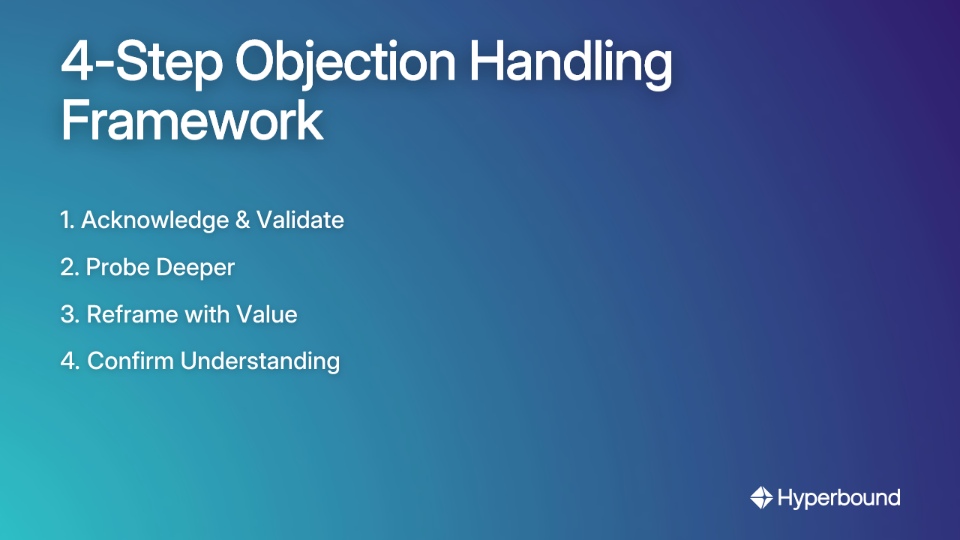
Step 1: Acknowledge & Validate
Goal: Disarm the prospect and diffuse confrontation by showing you're listening and on their side.
Why It Works: Validation makes prospects feel heard and lowers their defensive walls. It prevents you from jumping to a premature (and likely incorrect) solution.
Key Language Patterns:
- "That's a fair point. I can see why you'd be concerned about [the price]."
- "I appreciate you bringing that up. It's an important detail to discuss."
- "That makes perfect sense. A lot of our customers felt the same way initially."
- "That's a great observation. Can I ask you a couple of questions to understand where that's coming from?"
Step 2: Probe Deeper
Goal: Uncover the true motivation behind the stated objection.
Why It Works: You can't solve a problem you don't understand. "It's too expensive" rarely means just that—it's often a stand-in for "I don't see the value" or "I don't have budget approval."
Key Language Patterns:
- "When you say the solution is 'too expensive,' could you help me understand what you're comparing it to, or what budget you had in mind?"
- "What specific challenges are you facing that led to this concern?"
- "Could you walk me through your decision-making process for new tools like this?"
- "I hear your concern. What's the biggest obstacle for you in bringing this on board?"
Step 3: Reframe with Value
Goal: Address the root cause you uncovered by connecting it directly to a relevant value proposition.
Why It Works: This shifts the discussion from features or price to outcomes and ROI, tailoring your response to their specific concern rather than delivering a generic script.
Execution Tactics:
- Use Social Proof & Voice of Customer Data:
- "I understand the concern about implementation difficulty. One of our customers recently told us, 'We saw a positive ROI within the first quarter, and 80% of our team found the platform easy to implement.'"
- Focus on Investment, Not Cost:
- "Let's discuss the value this brings compared to the investment you're making."
- Connect to Their Problem:
- "You mentioned you're worried about team adoption. Our pricing reflects a comprehensive solution that includes a dedicated onboarding specialist. Let me walk you through how that directly translates to faster adoption and ROI for your business."
Step 4: Confirm Understanding
Goal: Close the loop on the objection and confirm resolution before moving forward.
Why It Works: It ensures alignment and prevents the same objection from reappearing later, creating a smooth transition to the next step.
Key Language Patterns:
- "Does that help clarify how we approach implementation?"
- "Based on that, how are you feeling about this part of the proposal now?"
- "Does this address your concern about the budget?"
- "With that in mind, does it make sense to proceed to [next step]?"
Putting the Framework into Practice: Common Scenarios
Let's see how this framework transforms real objection scenarios into productive conversations:
Scenario 1: "It's too expensive / We don't have the budget."
Acknowledge: "I understand completely. Budget is one of the most important factors in any decision like this."
Probe: "Just so I'm clear, is the concern about the overall cost of the investment, or is it more about the timing and how it fits into this quarter's budget?"
Reframe: "Many of our clients in the home improvement industry felt the same, but found that by using our tool, they were able to reduce project delays, which ultimately paid for the tool in under 6 months. If there was a way to make this investment on a monthly basis to align with your cash flow, is that something you might be interested in?"
Confirm: "Does thinking about it in terms of ROI help put the cost into perspective?"
Scenario 2: "I need to sleep on it."
Acknowledge: "I completely understand. It's a big decision, and it's smart to take some time to think it over."
Probe: "Of course. Just to make sure you have all the information you need while you're thinking, what part of our conversation is top of mind for you right now? Is it the pricing, the implementation timeline, or something else?"
Reframe: "That's a critical piece to consider. Let me send you a one-page summary that outlines exactly how we address [their point of hesitation], along with a case study from a similar company."
Confirm: "Would it be helpful to put 15 minutes on the calendar for Thursday morning? That way you have time to review, and I can be available to answer any new questions that come up."
The Path to Mastery: From Theory to Instinct with AI Coaching
Understanding this framework is one thing. Executing it flawlessly under pressure is another challenge entirely. When faced with objections in real-time, many reps revert to old defensive habits without realizing it.
To internalize these conversational techniques, sales professionals need:
- A safe space to practice and fail without risking actual deals
- Immediate feedback on their responses to objections
- Consistent reinforcement that builds muscle memory
This is where Hyperbound's AI coaching platform becomes a game-changer for sales teams looking to master responses to sales objections.
Practice Any Scenario with AI Sales Roleplays
With Hyperbound's AI Sales Roleplays, reps can practice the 4-step framework against an AI buyer programmed to raise any objection, from common price concerns to niche competitive questions. This provides unlimited, risk-free practice to build confidence without requiring manager supervision for every session.
The platform simulates real-world sales calls across the entire sales cycle, allowing reps to practice everything from discovery calls to objection handling, with AI-driven feedback on their performance.
Get Unbiased, Instant Feedback on Your Techniques
After a roleplay or even a real customer call, Hyperbound's AI Real Call Scoring analyzes the conversation to provide objective feedback. The system identifies if you:
- Jumped to a solution without probing deeper
- Successfully acknowledged the customer's concern
- Asked effective follow-up questions
- Reframed the objection with relevant value
The platform delivers instant, personalized coaching tips, helping reps self-correct and improve on their own time.
Scale Best Practices Across Your Team
For sales leaders, Hyperbound allows you to analyze top performers' successful objection handling techniques and build AI roleplays around them to train your entire team. This ensures everyone learns and applies the talk tracks proven to work with your specific customers and objections.
Conclusion: Transform Objections into Opportunities
.png)
The most successful sales professionals don't "handle" objections—they welcome them as opportunities to listen, learn, and build trust. By shifting your mindset and applying the 4-step framework—Acknowledge, Probe Deeper, Reframe with Value, and Confirm Understanding—you transform confrontations into conversations.
Remember what research tells us: on average, you'll need to overcome four objections before closing a deal. With this framework, each objection becomes not an obstacle but a stepping stone toward building deeper trust and moving the deal forward.
Mastering these techniques takes practice, but it's the single biggest lever you can pull to close more deals. With the right framework and modern tools to help you internalize it, every objection can become an opportunity to demonstrate your value and advance the conversation toward a successful close.
Frequently Asked Questions
What is objection handling in sales?
Objection handling in sales is the process of responding to concerns or questions raised by a prospect during the sales process. However, the most effective approach shifts from "handling" an objection, which can feel confrontational, to "understanding" it. This turns the objection into an opportunity to learn more about the prospect's needs, build trust, and demonstrate the value of your solution in a way that directly addresses their concerns.
Why is understanding sales objections better than just handling them?
Understanding an objection is better than simply handling it because it transforms a potential conflict into a collaborative conversation. When you focus on understanding, you listen more deeply to uncover the true root of the prospect's hesitation. This allows you to build trust, show empathy, and tailor your response to their specific needs, rather than delivering a generic rebuttal. An objection is a sign of engagement, and understanding it is key to advancing the deal.
What are the most common types of sales objections?
The most common sales objections typically revolve around four key areas: budget, authority, need, and timing (BANT). Examples include "It's too expensive" (budget), "I need to talk to my boss" (authority), "We're happy with our current solution" (need), and "Now isn't a good time" or "I need to sleep on it" (timing). While the specifics vary, most objections are a variation of one of these core concerns.
How do you respond to a price objection like "it's too expensive"?
To respond to a price objection, you should first acknowledge the concern, then probe deeper to understand the context before reframing the conversation around value and ROI. Use this framework:
- Acknowledge: "I understand, budget is a critical factor."
- Probe: "When you say it's expensive, could you help me understand what you're comparing it to?"
- Reframe: Connect the investment to the value it creates, such as cost savings or revenue generation. For example, "Many clients found it paid for itself within 6 months by reducing project delays."
- Confirm: "Does thinking about it in terms of ROI help put the cost into perspective?"
What is the 4-step framework for navigating sales objections?
The 4-step framework for navigating sales objections is a conversational process designed to turn objections into productive discussions. The steps are:
- Acknowledge & Validate: Show the prospect you are listening and that their concern is valid.
- Probe Deeper: Ask questions to uncover the real reason behind the stated objection.
- Reframe with Value: Connect your solution's value directly to the root cause you just uncovered.
- Confirm Understanding: Ensure the concern has been addressed before moving the conversation forward.
How can I improve my objection handling skills?
The most effective way to improve your objection handling skills is through consistent, realistic practice in a risk-free environment. Simply knowing the theory isn't enough to perform under pressure. Practicing with a coach, a teammate, or an AI coaching platform allows you to internalize frameworks and build muscle memory. This practice, combined with feedback on your performance, helps you move from theoretical knowledge to instinctive execution during real sales calls.
Ready to transform how your team handles objections? Learn more about Hyperbound's AI-powered sales coaching platform and see how it can help your reps master conversational objection handling through realistic practice and personalized feedback.
Book a demo with Hyperbound


