

.png)
Summary
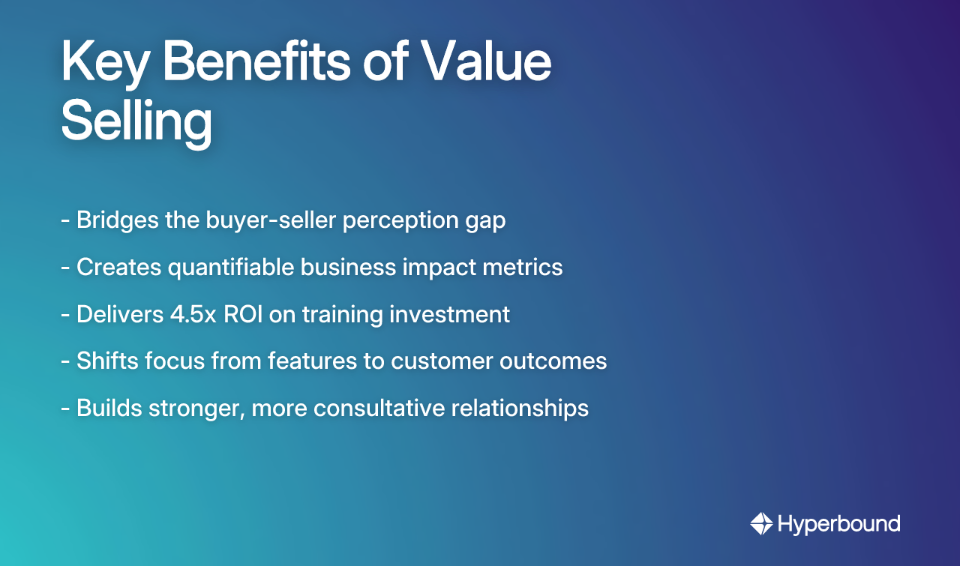
- Value selling is critical to bridge the perception gap where 65% of sellers believe they put buyers first, but only 23% of buyers agree.
- Effective value selling training delivers a significant impact, with companies reporting a $4.53 return on every dollar spent.
- The number one reason sales training fails is the disconnect between learning a framework and applying it consistently in real customer conversations.
- To make training effective, pair your methodology with a reinforcement tool. Hyperbound's AI Sales Roleplays provide the risk-free practice needed to master these skills and drive revenue.
You've sat through another day-long sales training session, filled pages with notes, and felt momentarily inspired... only to find yourself back at your desk, struggling to apply those concepts in actual customer conversations. Sound familiar?
"Sales training often feels ineffective without real-world application," as one sales professional noted in a recent forum discussion. The disconnect between theoretical frameworks and practical execution is the number one reason most sales training fails to deliver meaningful revenue impact.
The solution? Value selling methodologies that not only provide a strategic framework but are reinforced through consistent practice and coaching. This guide examines the seven most effective value selling training programs that demonstrably drive revenue, with particular attention to how modern AI coaching tools can bridge the gap between learning and mastery.
What Is Value Selling (And Why Does It Matter in 2026?)
Value selling is a buyer-first sales methodology focused on demonstrating the tangible, real-world outcomes and measurable business impact of your solution. Rather than leading with product features, value selling connects your offering directly to the buyer's specific challenges, goals, and desired outcomes.
This approach has become increasingly critical as B2B buying has evolved. According to LinkedIn's State of Sales Report, there's a massive perception gap: 65% of salespeople believe they put the buyer first, but only 23% of buyers agree. This disconnect is why value selling matters more than ever in 2026.
While consultative selling focuses on understanding needs through dialogue, value selling takes it further by explicitly linking solutions to quantifiable business impact (ROI, cost savings, efficiency gains). The results speak for themselves: companies implementing effective value selling training see a $4.53 return on every dollar spent on training, according to research from ValueSelling Associates.
The 7 Best Value Selling Training Programs for Revenue Growth
1. Hyperbound AI Coaching: The Reinforcement Layer for Any Methodology
Hyperbound isn't a standalone value selling methodology but rather the essential reinforcement layer that makes any sales methodology stick. It directly addresses the most common complaint about sales training: the lack of practical application and continuous reinforcement.
Core Capabilities:
- AI Sales Roleplays: Provides unlimited practice opportunities for value selling conversations across the entire sales cycle. Reps can practice discovery questions, value articulation, and objection handling with AI buyer personas that respond dynamically. This risk-free environment allows reps to master value selling techniques before engaging with real prospects.
- AI Real Call Scoring: Automatically analyzes actual sales conversations against your chosen value selling methodology to assess whether reps are applying the training effectively. This transforms subjective coaching into data-driven feedback tied directly to revenue outcomes.
- AI Coaching: Delivers immediate, personalized feedback on both roleplays and real calls. Instead of waiting for manager review, reps receive instant guidance on how to improve their value selling skills, accelerating the learning curve.
Why It Drives Revenue: Hyperbound addresses the critical gap between learning a methodology and mastering it through practice. By providing objective measurement of value selling behaviors and unlimited practice opportunities, it ensures consistent execution across the team. The result is measurable improvement in key metrics like conversion rates, deal sizes, and win rates regardless of which methodology you choose.

Learn more about Hyperbound AI Coaching
2. The ValueSelling Framework®
The ValueSelling Framework® is one of the most established value selling methodologies, known for its simplicity and effectiveness in aligning the entire revenue organization around a common language of value.
Core Components:
- ValueSelling Framework®: The foundational methodology that teaches reps to connect their solution to what the buyer values most.
- Vortex Prospecting®: A multi-channel approach to filling the sales funnel with qualified prospects receptive to value messaging.
- ValueSelling Account Planning: Strategies for identifying high-potential opportunities within existing accounts based on value creation.
Why It Drives Revenue: The methodology's strength lies in its simplicity and applicability across industries. Justworks, for example, achieved a 30% increase in win rates after implementing the framework. This success underscores the importance of reinforcement to ensure any new methodology is consistently applied.
3. Value-Added Selling
Developed by Tom Reilly and Paul Reilly, Value-Added Selling focuses on delivering value beyond the core product or service itself during every customer interaction. It positions the salesperson as a valuable resource who brings additional insights and benefits to the relationship.
Core Components:
- A four-part process: Create Value, Communicate Value, Convince Customers of Value, and Confirm Value
- Strong emphasis on pre-call planning and research to identify value opportunities
- Techniques for overcoming price objections by refocusing on total value delivered
Why It Drives Revenue: This approach is particularly effective in competitive or commoditized B2B markets where product differentiation is difficult. By focusing on the additional value the salesperson and company bring, reps can justify premium pricing and build stronger customer loyalty, directly impacting retention rates and customer lifetime value.
4. Solution Selling
Solution Selling, created by Michael Bosworth and later refined by Keith Eades, shifts the focus from pitching products to diagnosing customer problems and recommending comprehensive solutions. The methodology predates many modern approaches but remains relevant because of its problem-centric focus.
Core Components:
- Pain-based questioning techniques to uncover business problems
- A structured discovery process to diagnose before prescribing
- Solution development that combines products and services to address the complete problem
Why It Drives Revenue: Solution Selling builds deep, trust-based relationships by positioning reps as problem-solvers rather than product pushers. This approach leads to larger deal sizes as customers purchase complete solutions rather than individual products, and increases customer satisfaction by ensuring the solution truly addresses their needs.
5. SPIN Selling
Developed by Neil Rackham based on extensive research of 35,000 sales calls, SPIN Selling provides a questioning framework designed to uncover and develop buyer needs in complex sales scenarios.
Core Components:
The SPIN acronym represents the four types of questions salespeople should ask:
- Situation questions to understand the buyer's current context
- Problem questions to identify issues, dissatisfactions, and difficulties
- Implication questions to explore the consequences and effects of those problems
- Need-payoff questions to help the buyer articulate the value of solving the problem
Why It Drives Revenue: SPIN Selling is particularly effective for complex, high-value B2B sales with long decision cycles. By helping buyers fully realize the implications of their problems, it creates urgency and builds stronger value perception. The methodology's research-based approach makes it especially appealing to analytical sales leaders looking for proven techniques.
6. Target Account Selling (TAS)
Target Account Selling, now part of the Miller Heiman methodologies, takes a strategic approach focused on identifying and winning high-potential accounts through detailed account planning and team selling.
Core Components:
- Account qualification criteria to focus resources on winnable deals
- Competitive positioning strategies
- Stakeholder mapping and influence planning
- Team selling coordination playbooks
Why It Drives Revenue: By concentrating sales efforts on the accounts with the highest potential value, TAS maximizes selling efficiency and ensures that team resources are focused where they can have the biggest impact. This strategic focus typically results in higher win rates for strategic opportunities and larger average deal sizes.
7. The Challenger Sale
Based on research by CEB (now Gartner), The Challenger Sale identifies five sales rep profiles and argues that "Challengers" consistently outperform others, especially in complex selling environments. Rather than responding to stated needs, Challengers push buyers' thinking with new insights.
Core Components:
- Teaching for differentiation (bringing new perspectives to the customer)
- Tailoring for resonance (customizing the message to different stakeholders)
- Taking control of the sale (comfortable discussing money and pressuring the customer)
Why It Drives Revenue: The Challenger approach is particularly effective in today's information-rich environment where buyers have already conducted significant research before engaging with sales. By bringing unique insights and challenging conventional thinking, Challenger reps create value in the sales process itself and position themselves as trusted advisors rather than mere vendors.
How to Choose the Right Value Selling Program for Your Team
Selecting the optimal value selling training for your organization depends on several key factors:

- Sales Complexity: For transactional, shorter-cycle sales, ValueSelling or Value-Added Selling may be most appropriate. For complex enterprise deals, SPIN, Challenger, or TAS typically work better.
- Current Skill Gaps: Assess where your team struggles most. If discovery is weak, SPIN may help. If your team struggles with differentiation, Challenger might be the answer.
- Buyer Sophistication: More sophisticated buyers typically respond better to Challenger approaches, while less experienced buyers might benefit from the structured guidance of Solution Selling.
- Implementation Requirements: Consider the time investment and organizational change required. Some methodologies demand significant shifts in selling approach and CRM configuration.
Most importantly, remember that the methodology is only half the battle. As one sales professional noted, "Theoretical training without practical application leads to disconnect and frustration." This is where reinforcement tools like Hyperbound make the critical difference between a training event and actual behavior change that drives revenue.
Conclusion: From Training Event to Continuous Improvement
The most effective value selling programs are those that are consistently practiced, reinforced, and measured. One-time training events, regardless of methodology, rarely produce lasting change or meaningful revenue impact.
To maximize your return on training investment:
- Select a value selling methodology aligned with your sales complexity and buyer expectations
- Implement continuous reinforcement through tools like Hyperbound's AI coaching
- Measure adoption through call analytics and outcome metrics
- Provide ongoing coaching and feedback to refine skills over time
The methodologies provide the strategic framework—the "what" of value selling. Platforms like Hyperbound provide the practice field—the "how" that ensures consistent execution across your team. This combination is what truly drives revenue growth in 2026 and beyond.
Frequently Asked Questions
What is the main difference between value selling and consultative selling?
The main difference is that value selling explicitly quantifies the business impact of a solution, while consultative selling focuses more on understanding a buyer's needs through dialogue. Value selling takes the principles of consultative selling a step further. While a consultative seller is an expert at asking questions and diagnosing problems, a value seller translates that diagnosis into a clear business case, complete with metrics like ROI, cost savings, or efficiency gains.
How can AI coaching improve the adoption of value selling techniques?
AI coaching improves adoption by providing a risk-free environment for practice and delivering immediate, objective feedback on how well sellers apply value selling concepts. Traditional training often fails because there's no mechanism for consistent practice. AI coaching platforms like Hyperbound solve this by offering unlimited AI-powered roleplays to master value articulation and objection handling, and by analyzing actual sales calls to turn coaching into a data-driven science.
Which value selling methodology is best for a SaaS company?
There is no single "best" methodology; the right choice depends on your sales complexity, average contract value (ACV), and buyer sophistication. For SaaS companies with a high-velocity, transactional sales model, the ValueSelling Framework® might be ideal. For those selling complex, enterprise-level solutions, methodologies like The Challenger Sale or SPIN Selling are often more effective.
How do you measure the ROI of a value selling training program?
You measure the ROI of value selling training by tracking key sales metrics before and after implementation, such as win rates, average deal size, sales cycle length, and quota attainment. First, benchmark your current performance. After implementing the training and reinforcement program, monitor these metrics over several quarters to correlate the training investment with a tangible lift in revenue.
What is the most difficult part of implementing a value selling methodology?
The most difficult part is ensuring consistent adoption and changing ingrained selling habits across the entire team. Sales reps often revert to old, feature-focused habits under pressure. Overcoming this requires more than a one-time training event; it demands consistent reinforcement, ongoing coaching, and management buy-in, which is why pairing a methodology with a practice tool is critical for success.
When can a sales team expect to see results from value selling?
While early indicators like more confident conversations can appear within a month, most teams see significant, measurable results from a well-implemented value selling program within 3 to 6 months. Impacting lagging indicators like win rates and deal size takes time. The speed of results is directly tied to the quality of reinforcement; teams that practice consistently will see a faster and more significant impact.
Ready to transform your sales training from theoretical to practical? See how Hyperbound's AI Coaching can help your team master any value selling methodology through continuous practice and personalized feedback.

Book a demo with Hyperbound


