

.png)
Companies with structured onboarding see 73% higher quota attainment rates among new sales hires. Even more compelling, effective programs help sales reps achieve their first quota 50% faster. These aren't just impressive statistics—they're the difference between a sales team that struggles and one that thrives.
Yet, as many sales leaders have discovered, building an effective onboarding program is increasingly challenging. You're likely feeling overwhelmed by the variety of onboarding tools available, leading to confusion about which solutions will actually move the needle. Perhaps you're struggling to extract actionable feedback from call transcripts or implement a system that can analyze patterns across multiple calls for effective coaching.
This article won't just give you another generic list of tools. Instead, we'll provide a strategic framework for building a comprehensive onboarding tech stack that automates repetitive tasks, delivers consistent training, and—most importantly—prepares your new hires to win deals, faster.
Why Automating Sales Onboarding Is a Must-Have in 2025
In today's hybrid work environment, with rapid product updates and increasingly savvy buyers, the traditional "shadow a top rep" model is broken. Automation isn't just nice to have—it's essential for scaling excellence.
Here's why automation is transforming sales onboarding:
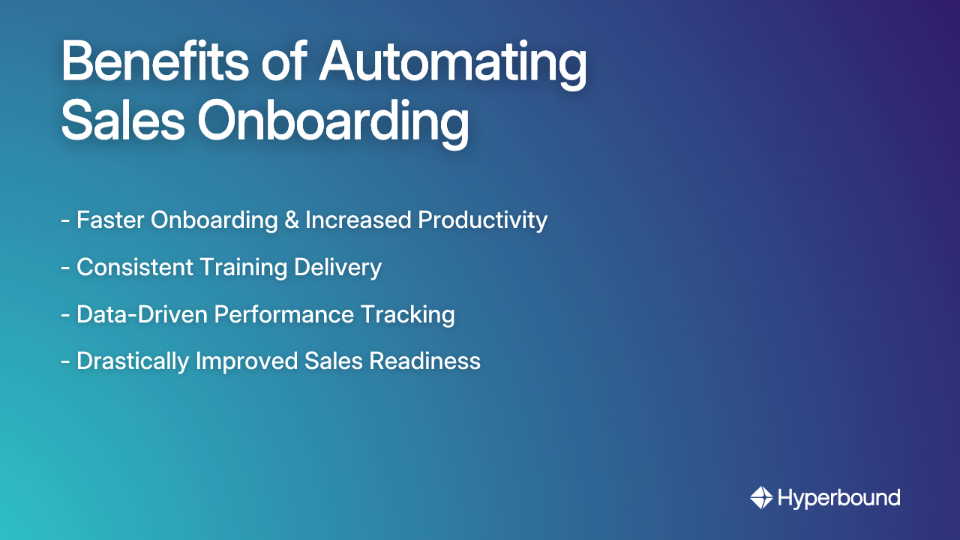
- Faster Onboarding & Increased Productivity: Automation familiarizes new hires with processes quickly, freeing managers from repetitive training to focus on high-level strategy. This means your new reps can start contributing to pipeline significantly sooner.
- Consistent Training Delivery: Every rep, regardless of location or manager, learns the same sales methodology, messaging, and best practices. This eliminates coaching gaps and bias that naturally occur in manual training approaches.
- Data-Driven Performance Tracking: Move beyond gut feelings. Modern tools provide managers with clear insights into a new hire's progress, highlighting specific skill gaps for targeted, effective training.
- Drastically Improved Sales Readiness: The right automation tools equip new hires with the resources and, crucially, the practice they need to be confident and effective in their very first customer interactions.
The 3 Pillars of a High-Performance Sales Onboarding Tech Stack
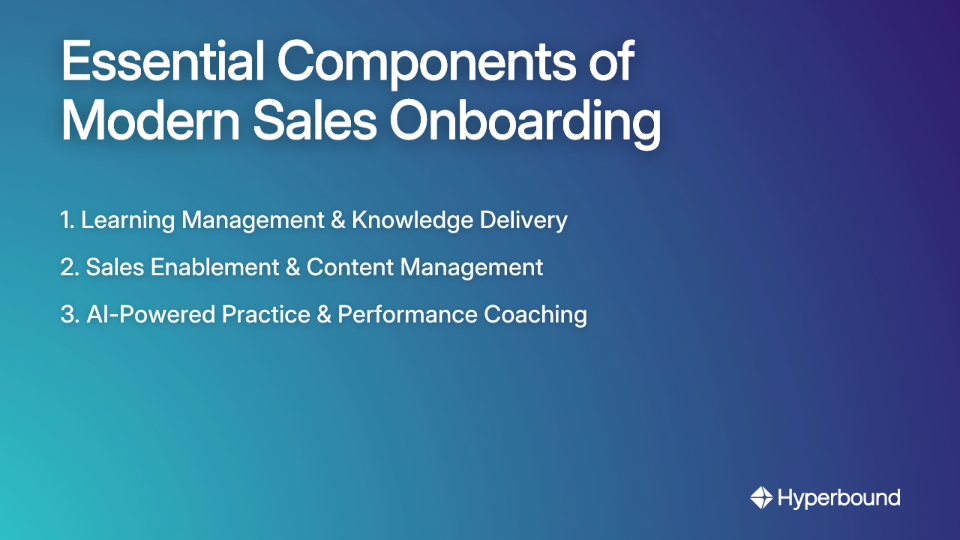
No single tool does it all. A world-class onboarding program integrates three types of platforms to guide a rep from knowing, to showing, to doing:
Pillar 1: Learning Management & Knowledge Delivery (The "Know")
This is the foundation for delivering structured content: product specs, company policies, market landscape, and your core sales methodology.
Key Features to Look For: Personalized learning paths, mobile-friendly design, gamification, and robust reporting.
Top Tools:
- Docebo: A popular choice for large organizations needing scalable and personalized L&D.
- TalentLMS: Often used to improve knowledge retention through gamification and drip-fed content.
- 360Learning: A tool for collaborative content creation, allowing subject matter experts to build training modules.
Pillar 2: Sales Enablement & Content Management (The "Show")
This pillar arms your reps with the right assets at the right time. It's their digital library for playbooks, battle cards, case studies, and marketing materials.
Key Features to Look For: Centralized content hub, seamless CRM integration, and analytics on content usage and effectiveness.
Top Tools:
- Allego: Focuses on just-in-time learning and peer-to-peer knowledge sharing, creating a library of best practices and win stories.
- Bigtincan (formerly Brainshark): Combines content management with video-based coaching and practice pitches.
Pillar 3: AI-Powered Practice & Performance Coaching (The "Do")
This is the most critical and modern pillar. It bridges the gap between passive learning and real-world execution. These tools provide a safe, scalable environment for reps to practice, fail, and master critical conversations.
Key Features to Look For: AI-driven role-playing scenarios, objective scoring against your methodology, real-time feedback, and integration with call recording software.
Top Tools:
- Hyperbound:
- Best for: Radically reducing ramp time by allowing reps to master sales conversations through hyper-realistic AI practice. Hyperbound users report up to a 50% reduction in ramp time.
- How it works:
- AI Sales Roleplays: New hires can practice cold calls, discovery, objection handling, and demos with dynamic AI buyer personas that respond realistically. This provides unlimited, risk-free practice to build muscle memory and confidence before ever speaking to a live prospect.
- AI Real Call Scoring: The platform automatically analyzes and scores both practice roleplays and real customer calls against your custom sales playbook. This saves managers hundreds of hours on manual call reviews and provides objective, consistent feedback.
- AI Coaching: Instead of waiting for a weekly 1:1, reps get instant, personalized feedback after every interaction, highlighting what they did well and where they can improve. This accelerates the learning loop and empowers reps to self-correct.
- Mindtickle: A platform for tracking sales competencies and readiness, helping to certify that reps are prepared before they engage with clients.
- Wonderway: Focuses on sales coaching automation with features that track performance and facilitate skill assessments.
How to Choose the Right Onboarding Tools for Your Team
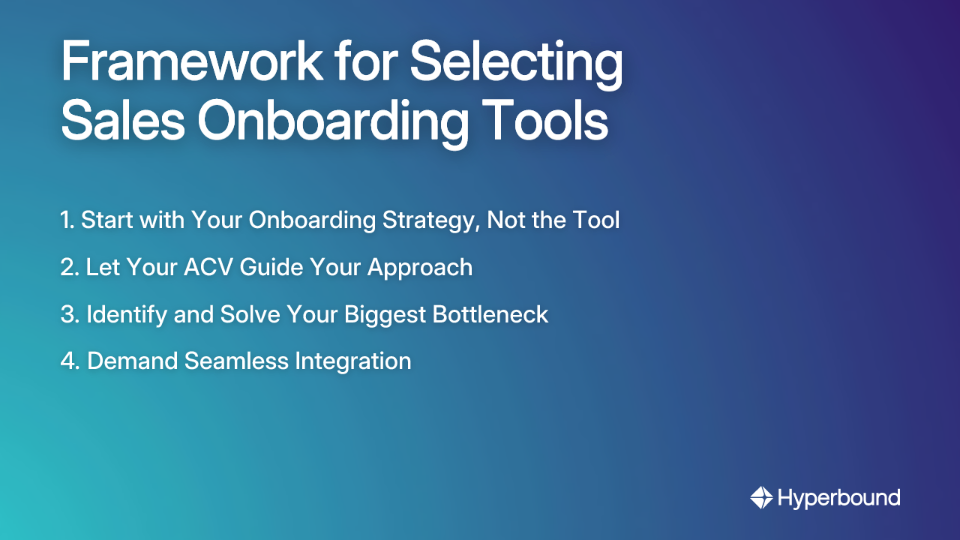
With so many options available, how do you select the right tools for your specific needs? Here's a framework to guide your decision:
1. Start with Your Onboarding Strategy, Not the Tool
Before you demo any software, map out your sales-specific onboarding plan. What should a rep know and be able to do at 30, 60, and 90 days? A clear plan makes tool selection considerably easier and more focused.
2. Let Your ACV Guide Your Approach
This directly addresses a common point of confusion among sales leaders. As one noted on Reddit, "I'd start by looking at your ACV, because that usually shapes the right approach."
- Low ACV / High-Volume Sales: Prioritize scalability and automation. You need a strong LMS (Pillar 1) and self-serve practice tools like Hyperbound's AI Roleplays (Pillar 3) to enable reps without heavy manager involvement.
- High ACV / Complex Sales: Focus on deep expertise and nuanced skill development. Advanced call analysis and coaching platforms like Hyperbound are crucial, often complemented by tools for collaborative learning (Allego) or readiness tracking (Mindtickle).
3. Identify and Solve Your Biggest Bottleneck
Where does your current process break down?
- Knowledge Gaps? → Start with a Pillar 1 tool (LMS).
- Reps Can't Find Content? → Focus on Pillar 2 (Sales Enablement).
- Reps Know the Theory but Fumble on Live Calls? → This is the most common and costly bottleneck. Prioritize a Pillar 3 tool for practice and performance coaching.
4. Demand Seamless Integration
To avoid a "fragmented onboarding experience" (a pain point frequently mentioned by sales leaders), ensure your chosen tools integrate with your core stack, especially your CRM and call recording platform (e.g., Gong, Salesloft). Data must flow freely to provide a holistic view of rep performance.
Build a System, Not a Silo
The most effective sales onboarding programs of 2025 won't rely on a single piece of software. They will be powered by a strategic, integrated tech stack that covers knowledge (The "Know"), resources (The "Show"), and practical application (The "Do").
The goal of automation is not to replace human coaching but to amplify it. By automating content delivery, call review, and practice, you free up your sales managers to focus on what they do best: strategic deal coaching and career development.
Many sales leaders on forums like Reddit express frustration with tools that provide transcripts but lack actionable insights, or platforms that analyze individual calls but miss patterns across conversations. This is why a comprehensive approach is crucial—each pillar reinforces the others, creating a seamless experience for both new hires and their managers.
For example, when a new rep completes product knowledge modules in your LMS (Pillar 1), they can immediately access relevant battle cards in your enablement platform (Pillar 2), then practice applying that knowledge in realistic AI roleplays (Pillar 3). The result is faster mastery and greater confidence when facing real prospects.
Investing in a modern onboarding stack is a direct investment in revenue, talent retention, and a winning sales culture. As competition for sales talent intensifies and buyer expectations continue to rise, organizations that arm their new hires with the right tools will gain a decisive advantage.
Frequently Asked Questions
Why is automating sales onboarding so critical today?
Automating sales onboarding is critical because it ensures consistent training, accelerates a new hire's time to productivity, and provides data-driven insights into their performance. In a hybrid work environment, traditional methods like shadowing are no longer scalable or effective. Automation delivers a standardized sales methodology to every rep, freeing up managers from repetitive tasks to focus on high-level strategic coaching, which leads to faster quota attainment.
What are the three pillars of a modern sales onboarding tech stack?
The three essential pillars are: 1) Learning Management & Knowledge Delivery (The "Know"), 2) Sales Enablement & Content Management (The "Show"), and 3) AI-Powered Practice & Performance Coaching (The "Do"). This framework ensures a comprehensive approach, taking a new hire from foundational knowledge to having the right assets, and finally to mastering real-world application in a safe practice environment.
How can I significantly reduce ramp time for new sales hires?
The most effective way to reduce ramp time is by providing new hires with ample opportunities for realistic, hands-on practice in a risk-free environment. The biggest delay often comes from a lack of confidence and experience. AI-powered practice platforms bridge this gap by allowing reps to master key conversations—like cold calls and objection handling—through unlimited AI roleplays, building the muscle memory needed for live calls much faster.
How does my company's ACV (Average Contract Value) influence my choice of onboarding tools?
Your ACV helps determine whether your onboarding strategy should prioritize scalability for high-volume sales or deep, nuanced skill development for complex deals. For teams with a low ACV, focus on scalable, automated solutions like a robust LMS and self-serve AI practice tools. For teams with a high ACV, prioritize advanced tools for call analysis and in-depth coaching on high-stakes interactions.
What is the difference between a sales enablement platform and an AI practice platform?
A sales enablement platform provides reps with the content they need to sell (the "Show"), while an AI practice platform gives them the environment to practice how to sell (the "Do"). Sales enablement is the library where reps find battle cards and case studies. An AI practice platform is the simulator where they apply that information in realistic sales scenarios to hone their conversational skills.
Does AI coaching replace the need for human sales managers?
No, AI coaching does not replace human managers; it amplifies their effectiveness. AI excels at handling time-consuming tasks like reviewing every call and providing instant, objective feedback. This frees up human managers to focus on higher-value activities that require strategic insight, such as deal strategy, career development, and personalized mentoring.
Book a demo with Hyperbound


