.png)


.png)
You've set up a new sales onboarding program with an AI role-playing tool, expecting it to transform how your team learns. But instead of dynamic, challenging conversations, you're met with robotic responses that simply agree with whatever your reps say. Your team isn't improving, and they're certainly not prepared for real sales conversations.
"I found it a bit unrealistic for B2B sales role-playing. Prospects often ask unexpected questions or take the conversation in different directions, which it doesn't really handle well," complains one sales professional.
If this sounds familiar, you're not alone. Many sales leaders are discovering that not all AI sales tools are created equal, especially when it comes to the critical task of onboarding and certifying new team members.
The High Stakes of Sales Onboarding
The statistics paint a sobering picture: the average ramp time for a new sales rep is still 6-9 months, according to Aircover.ai. Meanwhile, organizations with formal onboarding programs see 60% higher new hire productivity and 50% greater employee retention after two years, Aberdeen research shows.
Poor onboarding doesn't just lead to slow ramp times—it contributes to high turnover rates, missed quotas, and inconsistent customer experiences. The financial impact is enormous.
Fortunately, a new generation of AI tools is emerging that can transform sales onboarding from a lengthy, inconsistent process into a data-driven, scalable system. But identifying the right solution requires understanding what truly makes an AI onboarding platform effective.
Why Traditional Sales Onboarding Is Broken
Traditional onboarding methods rely heavily on shadowing calls, reading lengthy playbooks, and hoping managers find time for role-plays. This approach fails for several key reasons:
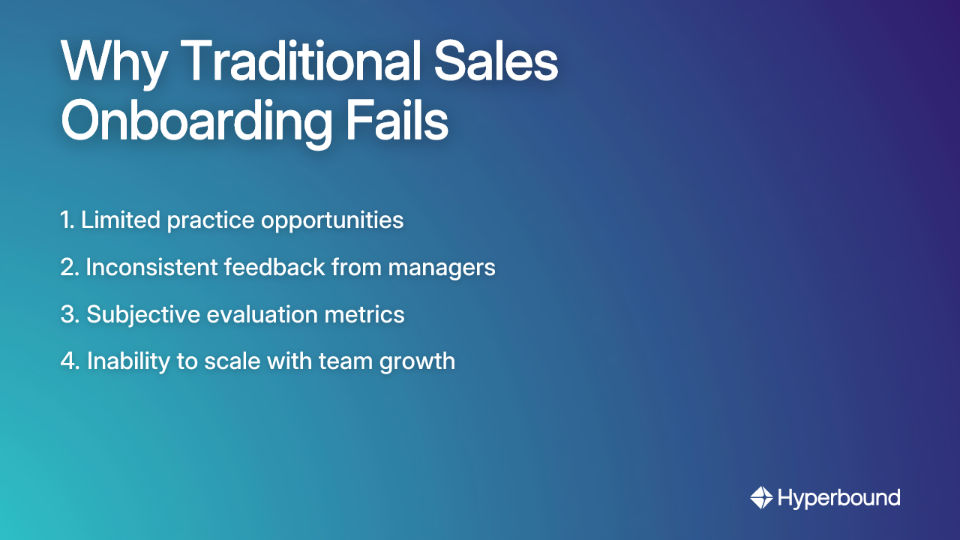
- Lack of consistent practice: New reps might participate in one or two role-plays before being thrown into real customer conversations
- Inconsistent feedback: Different managers provide varied (and sometimes contradictory) coaching
- No objective measurement: Certification is often subjective or based on knowledge tests rather than demonstrated skills
- Inability to scale: As teams grow, managers simply can't provide enough personalized coaching
Modern AI platforms solve these challenges by analyzing thousands of actual sales conversations, creating realistic practice environments, and providing objective, data-driven feedback that scales across the entire organization.
Essential Features of a Top-Tier AI Onboarding Platform
If you're evaluating AI tools for sales onboarding in 2025, here are the non-negotiable features you should demand:
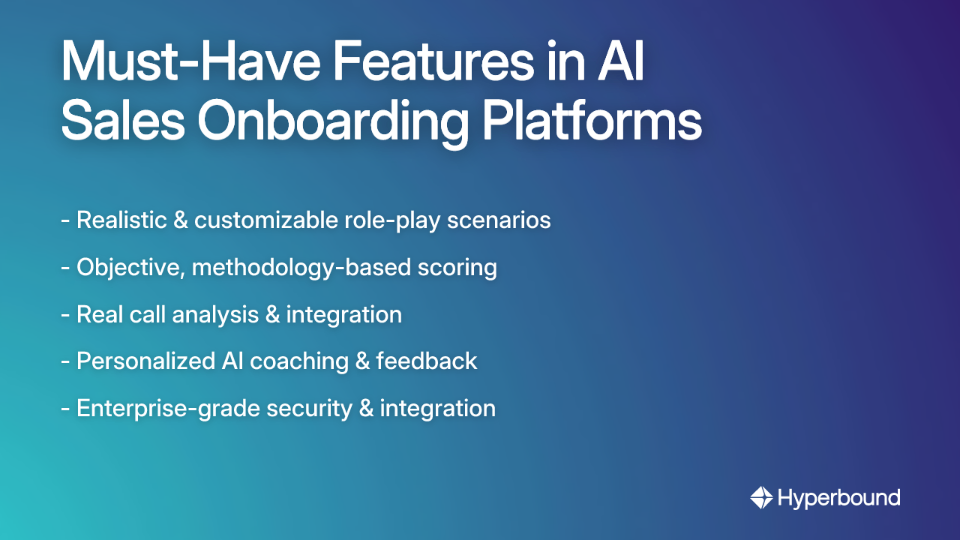
1. Realistic & Customizable AI Role-Play
Generic chatbots that offer simplistic responses won't prepare your team for real sales conversations. Look for platforms that allow you to:
- Create customized AI personas that mirror your ideal customer profiles
- Train the AI on your specific products, pricing, and competitive landscape
- Simulate different conversation types (cold calls, discovery, demos, etc.)
- Present realistic objections and unexpected questions
As one sales professional noted, "Not generic pre-built bots" is essential for effective practice.
2. Objective, Methodology-Based Scoring
The platform should automatically score practice sessions and real calls against your sales methodology (whether it's MEDDIC, SPIN, or your own custom framework). This provides:
- Clear, data-driven improvement paths for reps
- Objective certification criteria
- Consistency across managers and regions
3. Real Call Analysis & Integration
Your platform should seamlessly analyze actual customer conversations (from your call recording or conversation intelligence tools) to:
- Identify what's working with real customers
- Create a feedback loop between training and real-world performance
- Build role-play scenarios based on actual customer interactions
As one Reddit user suggested, "I think that can be fixed by training the model with call recording data."
4. Personalized AI Coaching & Feedback
Feedback must be instant and actionable. A top-tier tool will:
- Pinpoint exactly where a rep went wrong in a conversation
- Provide specific suggestions for improvement
- Reference your company's playbook and best practices
- Make reps feel like they're "actually improving," as one user put it
5. Enterprise Readiness
The platform must integrate with your existing tech stack (CRM, call recorders) and meet enterprise security standards like SOC 2 compliance.
The Top AI Tools for Sales Onboarding & Certification in 2025
Now that we know what to look for, let's examine the leading platforms that are setting the standard for AI-powered sales readiness:
1. Hyperbound: The Comprehensive Coaching & Practice Platform
Core Focus: Scaling coaching through hyper-realistic AI practice and automated call scoring across the entire sales and post-sales cycle.
Key Onboarding & Certification Features:
- AI Sales Roleplays: Offers diverse scenarios including outbound (cold calls, gatekeeper interactions), discovery, demos, and even post-sales (upsells, renewals). These are customized to your specific ICPs and playbook, addressing the common complaint that generic AI tools feel "robotic."
- Winning Behavior Analysis: Analyzes your organization's actual sales calls to build role-play scenarios based on what top reps are doing to win deals—directly addressing the need for training models built on real call data.
- AI Real Call Scoring: Automatically scores both practice and real customer calls against a custom scorecard, providing a unified view of rep performance and ensuring playbook adherence.
- AI Coaching: Delivers instant, personalized feedback aligned with company methodology, allowing reps to self-improve without waiting for managers.
Best For: Sales organizations looking to reduce ramp time for new hires, certify teams on new playbooks, and provide continuous, scalable coaching for SDRs, AEs, and CSMs.
2. Quantified.ai: A Tool for Regulated Industries
Core Focus: AI-driven practice, with a focus in Life Sciences and Finance.
Key Onboarding & Certification Features:
- Compliance Certification: Useful for enabling certification on new products or compliance materials.
- Simulations: Offers simulations that users find to be realistic for their needs.
Best For: Enterprises in regulated fields that need to ensure compliant messaging.
3. Second Nature: AI Simulations for Onboarding
Core Focus: AI-powered sales simulations for pre-call training.
Key Onboarding & Certification Features:
- AI Avatars: Provides AI avatars for reps to practice with in various sales situations.
- LMS Integration: Integrates with Learning Management Systems, making it suitable for structured corporate training programs.
Best For: Teams looking to integrate simulated call practice into a broader LMS-based training curriculum.
4. Gong & Chorus: Conversation Intelligence Tools
Core Focus: Analyzing past customer conversations to uncover insights, not for active practice.
Key Onboarding Features:
- Call Libraries: Allows new reps to study curated playlists of calls from top performers.
- Coaching from Live Deals: Helps managers identify coaching opportunities by reviewing completed calls.
Best For: Organizations focused on building a library of real-call examples as a primary teaching tool, rather than providing reps with a safe environment to practice and apply those learnings.
Your Playbook for Implementing an AI-Powered Onboarding Program
Ready to transform your onboarding with AI? Here's a practical implementation guide:
Step 1: Codify Your Sales Playbook
Before automating, document your:
- Product value propositions and use cases
- Buyer personas and their pain points
- Core sales methodology (SPIN, MEDDIC, etc.)
- Key sales plays for different scenarios
- Standardized messaging and objection handling
Step 2: Structure a 30-60-90 Day Plan
Organizations with structured onboarding report 24% higher win rates, according to G2 research. Here's what an AI-powered plan might look like:
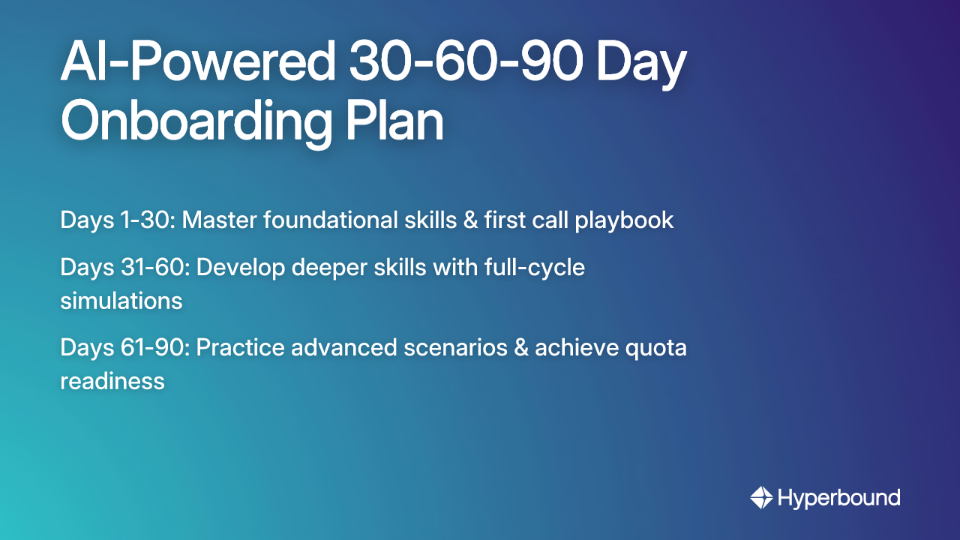
Days 1-30: Focus on foundational knowledge. Use AI role-plays for practicing elevator pitches, basic product overviews, and handling common objections. Goal: Certification on the "first call" playbook.
Days 31-60: Develop deeper skills. Use AI simulations for full discovery calls, product demos, and multi-stakeholder conversations. Begin using AI scoring on real calls.
Days 61-90: Master advanced scenarios. Practice competitive positioning, handling pricing objections, and negotiation. The goal is full quota readiness.
Step 3: Build Your AI Certification Gauntlet
Use a tool like Hyperbound to create role-play scenarios that reps must pass to become certified. For example, a new SDR might need to achieve an 85% score on three scenarios: a cold call to a gatekeeper, a discovery call with a director-level persona, and handling the "no budget" objection.
Step 4: Measure, Iterate, and Coach
Use analytics from your AI platform to:
- Track individual and team progress
- Identify common sticking points
- Free up manager time for high-level strategic coaching
The Future of Sales Readiness Is Here
Effective sales onboarding is no longer about just shadowing calls and reading documents—it's about providing scalable, repeatable, and data-driven practice opportunities that prepare reps for real-world success.
The ROI of implementing the right AI platform is clear: faster ramp times, higher quota attainment, increased rep retention, and a more consistent customer experience.
The gap between top-performing sales teams and the rest is widening. The organizations that embrace AI to certify and continuously develop their talent will win in 2025 and beyond. Stop leaving onboarding to chance and start building a data-driven sales enablement engine that transforms new hires into quota-crushing performers, faster than ever before.
Frequently Asked Questions
What is an AI sales onboarding platform?
An AI sales onboarding platform is a tool that uses artificial intelligence to create realistic, scalable, and data-driven training environments for new sales representatives. Unlike traditional methods that rely on shadowing and inconsistent manager role-plays, these platforms provide AI-powered simulations where reps can practice conversations, receive instant, objective feedback, and get certified on their company's specific sales methodology and playbooks.
Why is AI sales onboarding better than traditional methods?
AI sales onboarding is better than traditional methods because it provides consistent, scalable, and objective practice opportunities that traditional approaches lack. Traditional onboarding suffers from limited practice time, inconsistent feedback from different managers, subjective evaluations, and an inability to scale as teams grow. AI platforms solve these issues by offering unlimited role-play scenarios, data-driven scoring against a set methodology, and personalized coaching for every rep, significantly reducing ramp time.
What are the key features to look for in an AI sales onboarding tool?
The most important features for an AI sales onboarding tool are realistic and customizable AI role-play scenarios, objective scoring based on your sales methodology, and personalized AI coaching with actionable feedback. Additionally, a top-tier platform should be able to analyze real customer calls to inform training, integrate with your CRM and other tools, and meet enterprise-grade security standards like SOC 2 compliance.
How does an AI platform measure a sales rep's readiness?
An AI platform measures a sales rep's readiness through objective, data-driven scoring of their performance in simulated and real sales conversations. The platform scores reps against a pre-defined scorecard based on your company's sales methodology (e.g., MEDDIC, SPIN). Reps must achieve a target score in a series of certification scenarios—such as handling specific objections or running a discovery call—to prove they have mastered the required skills before engaging with real customers.
Can AI replace the need for sales managers in coaching?
No, AI does not replace sales managers; it enhances their coaching capabilities. AI handles the repetitive, foundational coaching—like practicing an elevator pitch or handling common objections—at scale. This frees up managers from tedious role-plays and provides them with rich performance data, allowing them to focus their time on higher-level strategic coaching, deal strategy, and personalized mentorship.
What is the difference between AI role-play tools and conversation intelligence tools?
AI role-play tools provide a safe environment for reps to proactively practice their sales skills, while conversation intelligence tools like Gong or Chorus retroactively analyze completed customer calls. Role-play platforms like Hyperbound are for active learning and skill development before a rep talks to a customer. Conversation intelligence tools are for reviewing past performance and identifying insights from real conversations. The most effective onboarding programs use both: insights from conversation intelligence tools are used to create realistic scenarios in the AI practice platform.
Book a demo with Hyperbound


