.png)


.png)
Summary
- Traditional sales enablement often fails because it prioritizes one-off content delivery over the practical, continuous improvement reps actually need.
- By 2026, leading organizations will shift to "always-on" enablement frameworks that are data-driven, technology-powered, and integrated directly into sales workflows.
- The most effective frameworks leverage AI for scalable coaching, personalized learning, and continuous certification to ensure reps are always ready for any sales scenario.
- Hyperbound's AI Sales Roleplays help implement these modern frameworks by providing reps with unlimited, realistic practice and instant feedback to master key conversations and reduce ramp time.
You've sat through another 60-minute recorded training session that was supposed to transform your sales approach. Instead, you're checking emails, barely listening to content that feels disconnected from your actual selling challenges. Sound familiar?
"Anything the sales enablement team provided was complete bullshit, completely worthless," one frustrated sales rep shared on Reddit. Another lamented, "The training 'material' is so shitty. Just recorded 30-60 minute 'training' sessions."
The hard truth? Many sales enablement efforts fail because they're built on outdated frameworks that prioritize content delivery over practical application and continuous improvement.
By 2026, the most successful sales organizations won't just have enablement programs—they'll implement comprehensive enablement frameworks that create systems of ongoing performance improvement, powered by data and emerging technology.
Before diving into the seven frameworks that will define sales success in 2026, let's establish what makes an enablement framework truly effective:
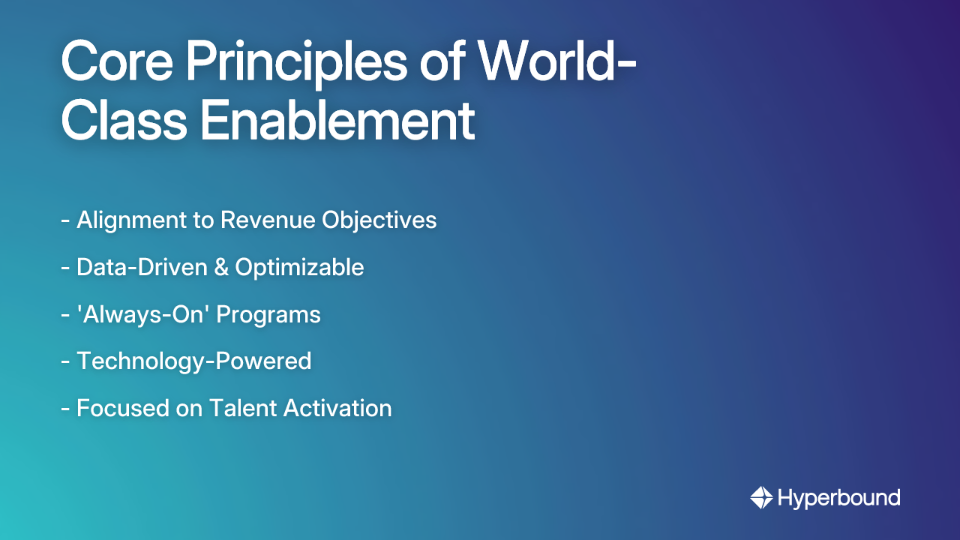
The Core Principles of a World-Class Enablement Framework
A modern framework isn't a tool you switch "every 6 months," creating what one rep described as "so many logins and bookmarked LMS type sites." Instead, it's built on stable principles:
- Alignment to Revenue Objectives: Every activity must directly contribute to sales goals, not just check training boxes. According to Gartner research, world-class enablement functions are essential for achieving predictable revenue.
- Data-Driven & Optimizable: Use data to measure impact and refine strategies in real-time, tracking not just completion rates but how opportunities advance through the funnel.
- "Always-On" Programs: Shift from one-off events to a culture of continuous learning and support. This counters the "learn at your own pace" model that reps often find isolating and ineffective.
- Technology-Powered: Leverage advanced tools not just for efficiency, but to enable new coaching and learning methodologies that weren't previously possible.
- Focused on Talent Activation: The ultimate goal is to activate the potential of every rep by focusing on Attitudes, Behaviors, and Competencies (ABCs).
Now, let's explore the frameworks that embody these principles and will define sales enablement excellence in 2026.
The Top 7 Modern Enablement Frameworks for 2026
1. The AI-Powered Coaching & Conversation Intelligence Framework
What it is: This framework moves coaching from a subjective, manager-led activity to a data-driven, scalable system. It uses AI to analyze thousands of real sales conversations to identify what works and then uses those insights to provide targeted feedback and practice.
Why it's crucial for 2026: It solves the scalability problem of coaching. One manager can't review every call, but AI can. It provides the objective, real-time feedback needed for continuous improvement.
Key Components:
- Conversation Intelligence: Tools analyze calls to track engagement, talk-time ratios, and mentions of key topics
- Automated Skill Gap Analysis: AI identifies individual rep weaknesses to create personalized coaching paths
- AI-Powered Simulations & Role-Playing: Instead of just analyzing past calls, this component allows reps to practice future scenarios
This framework directly addresses the desire for "recordings of real sales calls" that reps consistently rate as among the most valuable enablement resources.
Hyperbound exemplifies this framework by analyzing winning behaviors from top performers to create hyper-realistic AI Sales Roleplays. Reps can practice everything from cold calls to renewals in a safe environment, receiving instant, objective feedback aligned to their specific sales methodology.
2. The Integrated CRM & Enablement Framework
What it is: A framework where enablement lives inside the tools reps use every day, primarily the CRM. Instead of a separate portal, content, training, and coaching prompts are delivered contextually based on deal stage, industry, or customer profile.
Why it's crucial for 2026: It eliminates friction and drives adoption by embedding learning into the workflow. It solves the pain of having training materials scattered across "so many logins and bookmarked LMS type sites."
Key Components:
- Deep integration with CRMs like Salesforce
- Just-in-time delivery of battle cards, case studies, or training videos
- Triggered coaching interventions based on deal data
Sales reps consistently report higher adoption of enablement resources when they're delivered in the context of their daily work rather than requiring them to seek out separate systems.
3. The Personalized & Adaptive Learning Path Framework
What it is: This framework rejects the one-size-fits-all approach to training. It uses data from call analysis and performance metrics to create customized learning journeys for each rep, targeting their specific skill gaps.
Why it's crucial for 2026: It makes training relevant and efficient, respecting the time of experienced reps while providing foundational support for new hires. It ensures the training material is no longer "shitty" and generic.
Key Components:
- AI-driven platforms that diagnose skill gaps
- Micro-learning modules (short videos, interactive quizzes)
- Content that adapts based on rep performance
This approach recognizes that different reps need different types of support, and allocates enablement resources accordingly, rather than making everyone sit through the same training sessions regardless of their experience or competency level.
4. The Tech-Augmented Peer & Mentor Coaching Framework
What it is: A hybrid model that combines the irreplaceable value of human connection with technology for scale. It acknowledges that reps still want to "have someone train a rep. A real person," but uses tech to make that interaction more effective.
Why it's crucial for 2026: It fosters a culture of collaborative learning and builds trust. While AI provides data-driven insights, human mentors provide essential emotional support and nuanced feedback that AI cannot replicate.
Key Components:
- Using conversation intelligence platforms, like Hyperbound's AI Real Call Scoring, to surface best-practice calls for peer review
- Establishing a formal "Sales Advisory Council" to gather feedback from the front lines
- Structured mentorship programs with defined objectives
This framework addresses the sentiment expressed by one rep who said, "Their biggest selling point is 'learn at your own pace!' Lmao fuck that, have someone train a rep. A real person."
Hyperbound's AI Coaching platform facilitates this by surfacing top-performing calls and successful techniques, creating a library of excellence that powers a more data-driven mentorship culture.
5. The Data-Driven Content & Cadence Management Framework
What it is: A systematic approach to creating, distributing, and measuring the impact of sales content and outreach sequences. The focus is on streamlining access and ensuring reps are using the most effective messaging.
Why it's crucial for 2026: It closes the loop between content creation and sales results. It ensures that enablement's efforts aren't wasted and that sellers aren't bogged down searching for resources.
Key Components:
- Structured outreach and engagement strategies
- Analytics to track which content and sequences lead to meetings and deals
- A regular cadence for sharing updates and new resources
This framework ensures enablement teams focus on what actually drives results, not just what's easiest to produce or what leadership thinks might work.
6. The Continuous Sales Readiness & Certification Framework
What it is: This is an "always-on" framework that treats sales readiness not as an onboarding event, but as a continuous state. It's designed to prepare and certify reps for any scenario—new product launches, competitive threats, or messaging changes.
Why it's crucial for 2026: The pace of change is accelerating. This framework ensures the entire team can adapt quickly and execute new plays consistently. It directly addresses the need for enablement to focus on "specifics: combating up-and-coming competitors, framing new products/releases."
Key Components:
- Regular practice and certification on core talk tracks
- Objective scoring of readiness before reps engage with customers
- Just-in-time training for emerging competitive threats
Hyperbound's AI Sales Roleplays enhance this framework by allowing enablement leaders to scale new playbooks and messaging. They can build certification programs where reps must pass simulated scenarios with specific scores before they're considered "ready," ensuring consistent message delivery across the entire team.
7. The Talent Assessment & Hiring Enablement Framework
What it is: Extending enablement principles into the talent acquisition process. This framework uses sales simulation and objective assessment tools to identify top performers early in the hiring process, moving beyond resumes and interview charisma.
Why it's crucial for 2026: A single mis-hire can cost a company hundreds of thousands of dollars in lost revenue and recruiting costs. This framework makes hiring more of a science than an art.
Key Components:
- Standardized, realistic selling simulations for all candidates
- AI-powered scoring for objective skill evaluation
- Data-driven insights to predict on-the-job success
Hyperbound's AI Roleplay Hiring Assessments are designed specifically for this framework. They allow hiring managers to screen candidates at scale by observing how they actually perform in lifelike sales scenarios, reducing time-to-hire and improving the quality of sales talent from day one.
How to Choose and Implement the Right Framework
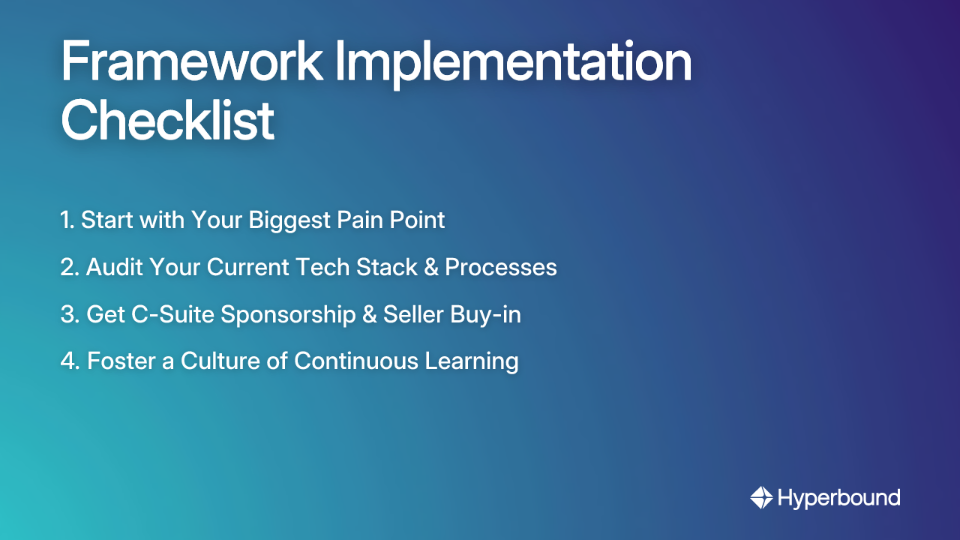
1. Start with Your Biggest Pain Point: Don't boil the ocean. Is your primary challenge long new hire ramp times? Inconsistent messaging on a new product? A lack of manager coaching bandwidth? Let the most pressing business need guide your choice.
2. Audit Your Current Tech Stack & Processes: The best framework is one that integrates into your team's existing workflow. Look for solutions that work with your CRM and call recording systems to avoid creating yet another silo.
3. Get C-Suite Sponsorship & Seller Buy-in: Enablement cannot succeed in a vacuum. It needs executive sponsorship to secure resources and must involve sellers in the design process to ensure the solution is valuable, not just another top-down mandate.
4. Foster a Culture of Continuous Learning: Technology is only an enabler. True success requires a cultural shift where coaching is seen as an ongoing opportunity for growth, not a punitive measure. Celebrate coaching successes to reinforce positive behaviors.
The Future of Sales Enablement is Here
The future of sales enablement is intelligent, integrated, and continuous. The days of static PDF playbooks and one-off training sessions are over. By 2026, the winning sales organizations will be those that have adopted dynamic frameworks built on AI, data, and a deep commitment to practical, ongoing skill development.
Frameworks built on AI-powered coaching and role-playing are no longer futuristic—they are the new standard for building high-performing teams. To see how you can reduce ramp time, drive playbook consistency, and scale world-class coaching across your entire organization, explore how Hyperbound is redefining sales readiness.
Remember the frustrated sales rep who called enablement "complete bullshit"? With these modern frameworks, we can finally deliver on the promise of enablement: turning every rep into a consistently high-performing asset who delivers predictable revenue quarter after quarter.
Frequently Asked Questions
What is a sales enablement framework?
A sales enablement framework is a comprehensive system of processes, tools, and content designed to consistently improve sales team performance and drive revenue. Unlike one-off training events, a framework provides an "always-on" structure for continuous learning, coaching, and talent development. It aligns all enablement activities with key business objectives, uses data to measure impact, and leverages technology to scale effective practices across the entire sales organization.
Why is traditional sales enablement often ineffective?
Traditional sales enablement often fails because it focuses on content delivery rather than practical application and continuous improvement. Many programs rely on outdated methods like long, recorded training sessions that feel disconnected from a rep's daily challenges. They lack data-driven insights, fail to provide personalized coaching, and are often scattered across multiple systems, leading to low adoption and wasted resources.
How does AI improve sales coaching?
AI improves sales coaching by making it scalable, objective, and data-driven. AI-powered tools, like conversation intelligence and sales simulations, can analyze thousands of sales calls to identify what top performers do differently. This allows for personalized feedback for every rep, targeted skill gap analysis, and the ability for reps to practice critical scenarios in a safe, simulated environment. It solves the problem of managers not having enough time to review every call.
What is the best sales enablement framework to start with?
The best framework to start with is the one that addresses your organization's most significant pain point. Instead of trying to implement everything at once, focus on a specific challenge. If new hire ramp time is too long, start with a Continuous Sales Readiness framework. If coaching is inconsistent, begin with an AI-Powered Coaching framework. A targeted approach ensures early wins and builds momentum for broader adoption.
How do you measure the ROI of a sales enablement framework?
You measure the ROI of a sales enablement framework by tracking key sales metrics that are directly tied to enablement activities. Move beyond simple completion rates. Focus on metrics like decreased ramp time for new hires, increased quota attainment, higher conversion rates at specific deal stages, and improved message consistency in sales calls. By connecting enablement efforts to tangible revenue outcomes, you can clearly demonstrate its value.
How can you ensure sales reps adopt a new enablement framework?
To ensure adoption, the framework must be integrated into the sales reps' daily workflow and demonstrably help them close more deals. Instead of forcing reps to log into separate systems, deliver content and coaching contextually within the CRM. Involve sellers in the design process to ensure the tools solve their real-world problems. Finally, foster a culture of continuous learning by celebrating wins and showcasing how the framework helps top performers succeed.
Book a demo with Hyperbound


