.png)


.png)
Summary
- The objection "your price is too high" is rarely about money; it's often a sign of a value mismatch, budget constraints, or a simple negotiation tactic.
- Overcome price objections using a 5-stage framework: Acknowledge the concern, Clarify the root cause, Reframe the conversation around value, and Validate the next steps.
- AI-driven coaching can boost objection handling success rates by up to 45% by reducing the traditional training process from hours to minutes.
- Mastering these conversations requires practice, and AI Sales Roleplays provide a safe, repeatable environment for reps to build confidence and turn objections into closed deals.
"Your price is too high."
Few phrases strike more fear into a salesperson's heart. This objection surfaces in virtually every sales cycle, regardless of industry or price point. Yet experienced sellers know a powerful secret: when prospects say your price is too high, they rarely mean it literally.
As one sales professional noted in a Reddit discussion, "If someone is saying that, they didn't see the value in your product. That's why it's so important to build the value first."
The ability to confidently handle pricing objections can be the difference between lost deals and consistent revenue. But this critical skill doesn't come naturally—as another sales rep mentioned in the same thread, "using this approach takes a bit of practice."
In today's high-stakes sales environment, teams can't afford to practice on live deals. Modern sales organizations are turning to specialized tools that provide safe, repeatable environments to master these crucial conversations before they happen in the real world.
Why "It's Too Expensive" Is Rarely About the Price Tag
Before diving into the tools, it's essential to understand that price objections are typically symptoms of deeper issues. According to research from Close.com, when prospects say, "It's too expensive," they're often expressing one of these underlying concerns:
.png)
Value Mismatch: The prospect doesn't yet understand how your solution's value justifies its cost. They haven't connected your offering to their specific goals, challenges, or desired outcomes.
Budget or Cash Flow Constraints: As one sales professional advised, "If they swear they see the value, but it's still too expensive, clarify if it's a lack of budget, cash flow issue, or lack of signing power."
Lack of Authority: Your contact might not have the final decision-making power and is hesitant to champion a high-ticket item to their superiors.
Desire for a Discount: Some buyers are simply testing to see if they can get a better deal through negotiation.
Misunderstanding of Scope: They might be comparing your comprehensive solution to a competitor's more basic offering. As one buyer candidly admitted, "If I'm able to buy something with the exact same specifications through someone else at a lower price, I'd probably do the same thing."
A 5-Stage Framework for Handling Any Objection
Before we explore the tools that can help your team practice, let's establish a proven framework for handling objections. A proven framework for successful objection handling follows five key stages:
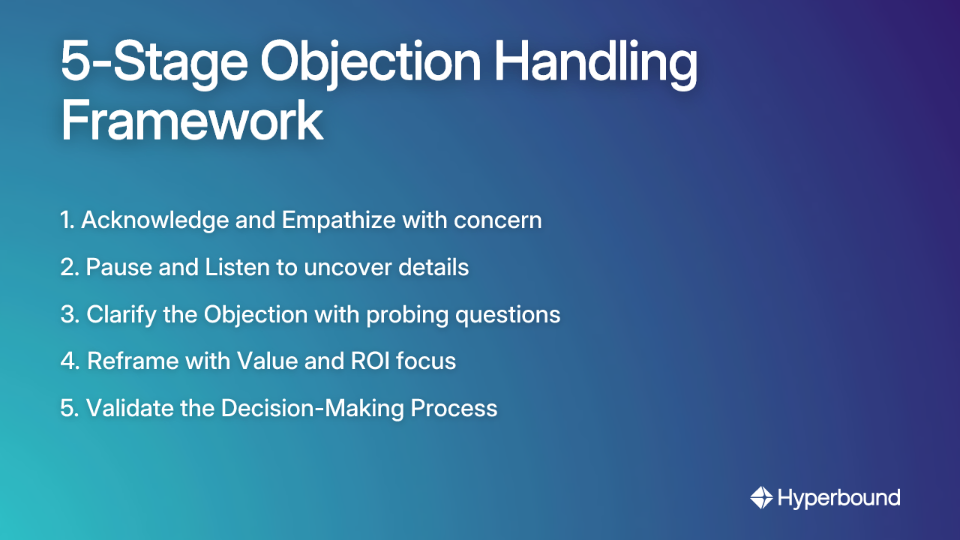
- Acknowledge and Empathize: Begin by showing you understand their concern. "I hear you. It's important to do your due diligence when it comes to price." This aligns with the "Empathize" step of the ECIR method (Empathize, Clarify, Iterate, Respond) popular among sales professionals.
- Pause and Listen: After acknowledging, be silent. This encourages the prospect to elaborate, often revealing the true objection behind their initial statement.
- Clarify the Objection: Ask qualifying questions to dig deeper. A powerful question suggested by a Reddit user is simply: "When you say the price is too high, compared to what?" This helps uncover the real context behind their objection.
- Reframe with Value: Shift the conversation away from cost and back to value. Quantify how your product increases revenue, reduces costs, or mitigates risk. Focus on outcomes and ROI rather than features.
- Validate the Decision-Making Process: Confirm you've addressed their concern and discuss next steps. Try a conditional close: "If we were able to find a way to make the price work with your budget, would you be prepared to move forward?"
Top 6 Tools to Practice Handling Price Objections in Real-Time
Now that you understand the psychology behind price objections and have a framework to address them, let's explore the tools that can help your team practice these conversations before facing them in high-stakes deals.
1. Hyperbound
Hyperbound is an advanced AI Sales Coaching platform designed to transform how sales teams learn, practice, and perform. It's particularly effective for mastering objection handling through:
AI Sales Roleplays: Reps can engage in unlimited practice sessions with AI buyer personas programmed to raise specific price objections. These roleplays are hyper-realistic and customized to your ideal customer profiles, products, and common competitive scenarios. The AI responds dynamically to different approaches, allowing reps to experiment with various techniques in a risk-free environment.
Instant, Personalized AI Coaching: After each roleplay, the platform provides immediate, objective feedback on the rep's handling of the objection. It analyzes their response against your company's sales methodology, tracks talk ratios, and identifies missed opportunities to reframe with value.
Real Call Scoring: Beyond practice, Hyperbound can analyze actual sales conversations (integrating with tools like Gong or Salesloft) to identify how reps handle objections in real customer interactions. This helps managers pinpoint specific coaching opportunities based on real performance data.
Post-Sales Applications: The platform extends to CSMs and Account Managers handling renewal pricing objections or upselling conversations, ensuring consistent objection handling across the entire customer journey.
2. Gong
Gong is a leading conversation intelligence platform that records, transcribes, and analyzes sales calls to improve team performance.
Call Analytics: Gong's AI identifies moments in past calls where price objections were raised, allowing managers to find both successful and unsuccessful examples for coaching sessions.
Pattern Recognition: The platform analyzes thousands of calls to reveal which objection handling approaches lead to successful outcomes versus those that derail deals, providing data-driven best practices.
While Gong excels at analysis of real calls and showcasing effective examples, it's less focused on proactive practice compared to purpose-built roleplay tools.
3. Second Nature
Second Nature offers AI-powered sales coaching with a virtual pitch partner for practicing sales conversations.
Conversational AI Training: Reps can practice handling various objections with an AI character named "Jenny," who responds naturally to their statements and questions.
Custom Role Plays & Scoring: Users can create personalized scenarios focused on price objections and receive objective scores on their performance.
Methodology Templates: The platform includes templates for various sales methodologies like SPIN and MEDDPICC to structure practice sessions around proven frameworks.
4. Chorus.ai (by ZoomInfo)
Similar to Gong, Chorus.ai analyzes customer-facing conversations to provide insights into sales performance.
Conversation Analytics: The platform identifies where objections occur in actual calls and how top performers successfully address them.
Coaching Playlists: Managers can create collections of best-practice examples for handling price objections to share with the team, facilitating peer learning.
Chorus primarily serves as an analysis and learning tool rather than a practice environment, making it complementary to roleplay-focused solutions.
5. Salesloft
Salesloft is a comprehensive sales engagement platform with features that support objection handling practice:
Conversation Intelligence: Similar to Gong and Chorus, Salesloft records and analyzes sales calls to identify objection patterns and successful responses.
Coach: The platform includes functionality for managers to review recorded calls and provide targeted feedback on handling objections.
While Salesloft offers valuable tools for call analysis and coaching, objection handling practice is just one component of its broader feature set.
6. Brainshark
Brainshark focuses on sales readiness through on-demand training and video coaching:
Video Coaching: Reps can record themselves responding to simulated price objections. Managers then review these submissions and provide asynchronous feedback.
On-Demand Training: The platform supports creating formal training modules specifically focused on objection handling strategies, providing consistent messaging across the organization.
Brainshark's approach is less interactive than AI-driven tools but offers structured practice with human coaching feedback.
How AI is Revolutionizing Objection Handling Practice
The emergence of AI-powered tools like Hyperbound represents a significant advancement in sales training. According to research from The Pedowitz Group, the contrast between traditional and AI-enhanced objection handling processes is striking:
Traditional Process: Typically requires 10–16 hours across multiple steps (cataloging objections, creating responses, training reps, monitoring performance, etc.)
AI-Enhanced Process: Takes only 30–60 minutes for AI to detect objections, suggest responses, and automatically track effectiveness.
The impact of implementing AI coaching for objection handling is equally impressive:
- Success Rate Improvement: +45% increase in the success rate of handling objections
- Effectiveness: Teams reach 75% objection handling effectiveness
- Support Coverage: 95% of calls can receive real-time guidance
AI isn't just about saving time; it's about providing scalable, consistent, and data-driven coaching that was previously impossible. These tools allow every rep to receive personalized feedback on their objection handling—something that would require an army of managers using traditional methods.
The Psychological Edge of Practice
The most valuable aspect of these tools is how they address the psychology of objection handling. Many sales professionals struggle with price objections not because they don't know what to say, but because the emotional pressure of the moment derails their thinking.
When reps have repeatedly practiced responding to price objections in a realistic environment, they develop muscle memory that kicks in during actual sales conversations. The confidence that comes from this preparation is immediately apparent to prospects.
This preparation addresses several psychological barriers:
- Emotional Reactivity: Unpracticed reps often become defensive when hearing objections, damaging rapport.
- Hesitation: Without practice, reps pause awkwardly or use filler words that undermine credibility.
- Script Dependence: Over-reliance on memorized responses sounds inauthentic and fails to address the prospect's specific concerns.
By practicing with AI tools that provide immediate feedback, reps develop the confidence to handle objections naturally and effectively.
Conclusion: From Dreading to Welcoming Objections
Price objections shouldn't be feared—they're opportunities to deepen the conversation and demonstrate your understanding of the prospect's business. Success hinges on understanding the buyer's true concerns, shifting the focus to value, and having the confidence to guide the conversation.
This confidence doesn't come from reading articles or attending a single training session—it comes from deliberate, ongoing practice. By leveraging modern AI coaching platforms like Hyperbound, sales leaders can equip their teams with the skills and readiness to turn price objections into closed deals.
When a rep has practiced handling price objections dozens of times in realistic scenarios, receiving coaching and refining their approach, they'll find themselves actually looking forward to hearing "your price is too high"—because they know it's just the beginning of a conversation that leads to demonstrating true value.
Remember: objections aren't roadblocks. They're requests for more information, and with the right practice tools, your team will be prepared to provide exactly that—transforming objections into opportunities, and prospects into customers.
Frequently Asked Questions
What is the best way to handle a price objection?
The best way to handle a price objection is to first acknowledge the customer's concern, then ask clarifying questions to understand the real issue behind the price, before reframing the conversation around value and ROI. This involves following a structured framework: Acknowledge and Empathize, Pause and Listen, Clarify the Objection (e.g., "Compared to what?"), Reframe with Value, and Validate the next steps. This approach shifts the focus from cost to the tangible benefits and outcomes your solution provides, addressing the root cause of the objection which is often a perceived lack of value.
Why do prospects say "your price is too high"?
Prospects say "your price is too high" not usually because of the literal cost, but to express underlying concerns such as a mismatch in perceived value, genuine budget constraints, a lack of decision-making authority, or a simple negotiation tactic. Understanding the true reason is key. They might not see how your solution's benefits justify the cost, they could be comparing it to a less comprehensive competitor, or they may simply be testing for a discount. Effective salespeople probe deeper to uncover and address this core issue.
How can AI tools help sales teams practice objection handling?
AI tools like Hyperbound help sales teams by providing a safe, realistic, and scalable environment where they can practice handling objections through AI-powered roleplays and receive instant, personalized feedback. Unlike traditional methods, AI sales coaching allows for unlimited practice sessions with AI buyer personas that are customized to your specific industry and customer profiles. The AI provides objective feedback on performance, analyzes talk tracks, and scores reps against proven methodologies, helping them build confidence and muscle memory before engaging with actual customers.
What is the 5-stage framework for handling objections?
The 5-stage framework for handling objections is: 1. Acknowledge and Empathize, 2. Pause and Listen, 3. Clarify the Objection, 4. Reframe with Value, and 5. Validate the Decision-Making Process. This structured approach ensures you don't react defensively. You start by showing you understand their concern, give them space to elaborate, ask questions to uncover the root cause, pivot the conversation back to the return on investment, and then confirm you've addressed their issue before discussing next steps.
What should you do if a prospect has a genuine budget constraint?
If a prospect has a genuine budget constraint but sees the value in your solution, you should explore creative options like flexible payment terms, a phased implementation, or a scaled-down initial package that fits their current budget while still delivering value. The first step is to confirm that the budget is the only obstacle and that they are otherwise ready to move forward. If so, work collaboratively to find a solution. This could involve breaking payments into monthly or quarterly installments or starting with a foundational version of your product with an upgrade path for the future. The goal is to build a partnership, not just close a transaction.
Why is practicing objection handling so important?
Practicing objection handling is crucial because it builds the confidence and "muscle memory" needed to respond effectively and calmly under the pressure of a live sales call. When salespeople are unprepared, they can become defensive or hesitate, which undermines credibility. Regular practice in a realistic, risk-free environment, such as with an AI coaching tool, allows reps to internalize effective responses. This preparation transforms objections from dreaded roadblocks into opportunities to engage more deeply with the prospect and demonstrate the full value of the solution.
.png)
Book a demo with Hyperbound


