.png)


.png)
Summary
- Generic chatbots like ChatGPT are ineffective for sales practice because they don't provide realistic objections or conversational challenges.
- Dedicated demo practice is essential for mastering objection handling, building conversational fluency, and reducing new hire ramp time without risking live deals.
- The best practice strategy combines analyzing real calls (Gong), perfecting demo flow (Storylane), and conducting peer role-plays with structured feedback.
- For scalable, realistic practice, AI coaching platforms like Hyperbound use specialized AI personas to simulate tough buyer conversations and provide instant, objective feedback.
Ever tried practicing a sales demo with ChatGPT, only for it to agree with everything you say and tell you you're right? You're not alone.
As one sales rep put it on Reddit, these generic AI tools are "unrealistic for B2B sales role-playing" because they can't handle "unexpected questions or take the conversation in different directions." Many find these tools lack the ability to "counter objections realistically," making practice unchallenging and ineffective.
Yet nailing your product demo is critical to closing deals. The challenge is finding a safe environment to practice without risking a real customer relationship or wasting your colleagues' time. This is especially true when transitioning from inbound to outbound sales, where the dynamic shifts dramatically.
Fortunately, a new generation of specialized tools has emerged that move beyond generic chatbots to provide realistic, safe, and scalable environments to practice every aspect of a demo call—from the opening pitch to handling tough objections.
In this article, we'll break down the top 5 tools and methods to help you and your team practice product demos without the pressure of a live customer, so you can step into every call with confidence.
Why Safe Practice for Demos is a Game-Changer
Product demos aren't just about showing features; they're about telling a compelling story and guiding a conversation. Here's why dedicated practice is essential:
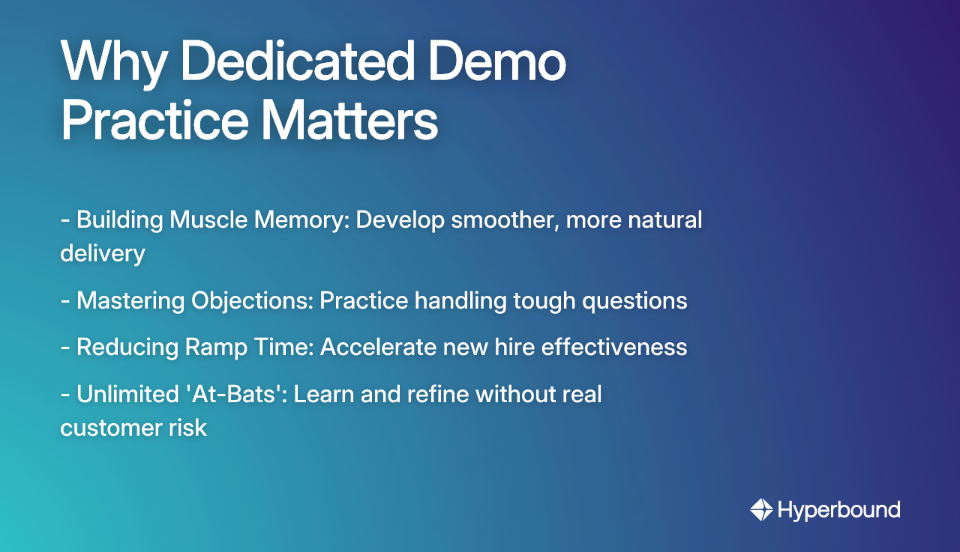
Building Muscle Memory: When you practice consistently, your delivery becomes smoother and more natural. You develop the conversational muscle memory needed to navigate the call without stumbling or getting flustered.
Mastering Objections: One of the biggest challenges in demos is handling unexpected questions and pushback. A safe practice environment allows you to encounter and respond to your most common objections until your answers become second nature.
Reducing Ramp Time: For new hires, the gap between training and real-world effectiveness can be huge. Practice tools accelerate this process, reducing ramp time and improving early performance metrics. For example, many reps find it "extremely useful in my onboarding process" to listen to successful calls and adopt proven techniques.
The Value of "At-Bats": While some believe "You need at bats with people. It's the unfortunate truth," practice tools provide unlimited, low-stakes at-bats. This allows reps to fail, learn, and refine their approach so that when they get in front of a real person, their chance of success is dramatically higher.
Let's dive into the tools that can help you master your demo before you ever face a real customer.
The Top 5 Tools to Practice Product Demo Calls
1. Hyperbound (For AI-Powered Conversational Practice)
Overview: Hyperbound is an advanced AI Sales Coaching platform that creates hyper-realistic, interactive role-playing scenarios. It's designed specifically to overcome the "robotic" and "generic" feel of other AI tools by analyzing your team's winning behaviors and building practice modules based on what actually works.
How it Helps Practice Demos: Hyperbound lets you practice the entire conversation around the demo, not just the presentation. Your reps engage with dynamic AI buyer personas that can ask tough questions, raise objections, and simulate the unpredictability of a real call.
Key Features:
- AI-Powered Roleplays: Practice a wide range of scenarios beyond just the demo, including cold calls, discovery, and objection handling. The platform offers specific roleplays for a Product Walkthrough or a Slide Deck Walkthrough.
- Objective Call Scoring & AI Coaching: After each practice session, reps receive instant, personalized feedback via an AI-powered scorecard that tracks metrics like talk ratios and key selling moments.
- Customizable Scenarios: Tailor roleplays to your specific Ideal Customer Profiles (ICPs), products, and common objections. You can even conduct multi-party roleplays to practice navigating conversations with multiple stakeholders.
Best For: Sales teams looking to scale coaching, reduce new hire ramp time, and ensure every rep can consistently handle the conversational challenges of a live product demo.
2. Gong / Chorus.ai (For Analyzing Real-World Examples)
Overview: While not strictly "practice" tools in the sense of a simulator, Gong and Chorus.ai are essential conversation intelligence platforms for a critical part of the learning process: reviewing and analyzing real demo calls.
How it Helps Practice Demos: These platforms record, transcribe, and analyze actual sales calls. This allows reps to review their own demo performance to identify weaknesses, and more importantly, to listen to the demos of top performers on the team to learn what excellence looks like. As one user noted, "When things didn't work out, I'd go back to Gong, listen to successful calls, and take bits from the successful BDR's and apply it to my strategies."
Key Features:
- Call Recording and Analysis: Captures all customer interactions and uses AI to pinpoint key moments, topics discussed, and talk patterns.
- Best Practice Libraries: Managers can create libraries of "best-in-class" demo calls, providing a clear benchmark for the rest of the team.
- Personalized Feedback: AI provides insights and identifies coaching opportunities for managers, helping to track rep progress over time.
Best For: Teams that want to establish a culture of continuous improvement by learning from real-world conversations. It's particularly powerful for onboarding new reps and for tenured reps looking to refine their techniques.
3. Storylane (For Perfecting Demo Flow and Narrative)
Overview: Storylane is a demo automation platform that allows you to create high-fidelity, interactive product demos without code. While its primary use is for creating leave-behinds or website demos, it's an excellent tool for practicing the flow of your demo.
How it Helps Practice Demos: By creating an interactive demo in Storylane, reps can practice their talk track and narrative without needing access to a live, and potentially buggy, product environment. It allows them to perfect the story they want to tell and ensure they hit all key value propositions in the right order.
Key Features:
- HTML Capture Technology: Records the actual front-end of your product, creating a highly authentic and stable environment to practice with.
- AI-Powered Content Generation: Can automatically generate captions and guides for the demo, helping reps structure their narrative.
- Guided Walkthroughs: Reps can practice guiding a "prospect" through the product journey, ensuring a smooth and logical presentation.
Best For: Sales and enablement teams who want to standardize the product demo narrative and provide reps with a stable, consistent environment to practice the visual and storytelling components of their presentation.
4. Walnut (For Creating and Collaborating on Interactive Demos)
Overview: Similar to Storylane, Walnut is a no-code platform for creating interactive and personalized product demos. It emphasizes ease of use and collaboration.
How it Helps Practice Demos: Walnut allows teams to build a library of demo templates that reps can then use for practice. A rep can run through the interactive demo on their own, practicing their script and timing. The collaboration features also allow for team-based practice sessions.
Key Features:
- No-Code Editor: Quickly capture screens and create a flawless version of your product demo, removing the risk of unexpected errors or data issues.
- Collaboration Features: Enables multi-user editing and sharing, so teams can work together to build the perfect demo and provide feedback on practice runs.
- Live Call Integration: Allows reps to seamlessly switch between their prepared interactive demo and a live product screen if needed.
Best For: Established sales teams that need an easy-to-use tool to create, share, and practice with standardized demo flows, with a strong focus on team collaboration.
5. Peer Roleplaying (The Classic Method, Supercharged with Tech)
Overview: The original method—practicing with a teammate—is still incredibly valuable. It forces you to interact with a real person who can provide immediate, nuanced feedback.
How it Helps Practice Demos: A colleague can play the role of a specific customer persona, bringing up relevant objections and asking challenging questions. This helps reps prepare for the human element of a sales call.
How to Supercharge it with Tech:
- Use a Framework: Don't just "wing it." Use a tool like Hyperbound to create a custom scorecard for your sales methodology. The peer who is observing can use this scorecard to provide structured, objective feedback, moving beyond "that felt good."
- Record the Session: Use a tool like Gong or even Zoom to record the peer role-play session. This allows the rep to self-critique their performance afterward and for managers to review it.
- Incorporate Real Objections: Use your conversation intelligence platform to pull the most common objections from real calls and feed them into your peer role-play scenarios.
Best For: All teams. It's a free, accessible method for practicing the human-to-human dynamics of a sales call. When combined with the scoring and analysis tools mentioned above, it becomes a highly effective and data-driven practice strategy.
How to Choose the Right Demo Practice Tool
Selecting the right tool depends on your specific needs:
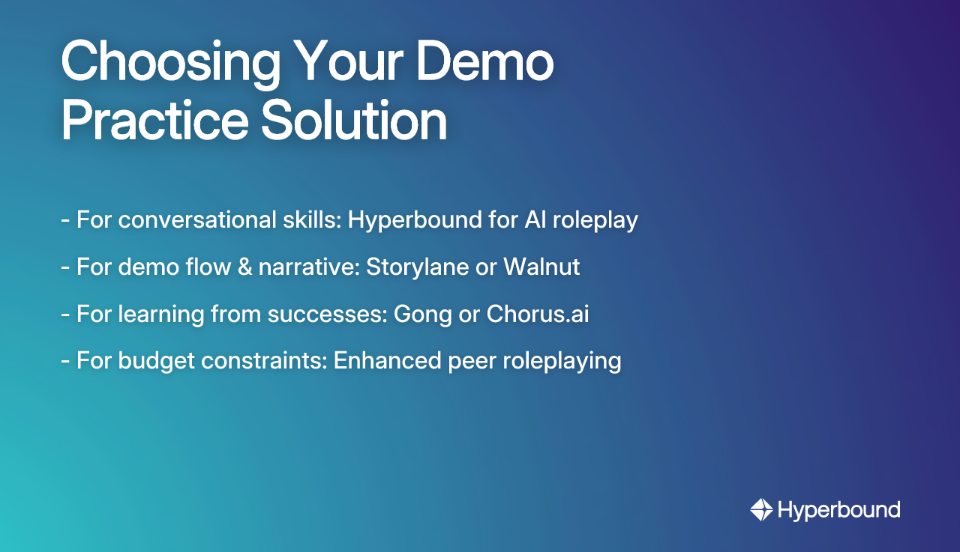
- If you need to improve conversational skills... and want reps to practice handling objections and unexpected questions in a scalable way, an AI role-playing tool like Hyperbound is your best bet.
- If you need to improve the demo flow and narrative... and want a stable environment to practice the presentation itself, a demo creation platform like Storylane or Walnut is ideal.
- If you want to learn from what already works... and build a culture of learning from real-world wins and losses, a conversation intelligence platform like Gong is essential.
- If you're on a budget... start with Peer Roleplaying but elevate it by using a structured scorecard and recording the sessions for review.
Conclusion
Mastering the product demo requires deliberate practice. Waiting to practice on live prospects is a recipe for lost deals and slow ramp times.
The tools available today have evolved far beyond generic chatbots. From hyper-realistic AI simulations that challenge your reps to platforms that let you learn from every real-world conversation, there's no excuse for being unprepared. By investing in the right practice tools, you empower your team with the confidence and skills needed to turn every demo into a closing opportunity.
Frequently Asked Questions
Why is practicing product demos important?
Practicing product demos is crucial for building the conversational muscle memory needed to deliver a smooth presentation, master objection handling, and reduce ramp time for new hires. Consistent practice in a safe environment allows sales reps to refine their delivery and navigate unexpected questions without the risk of losing a real customer, leading to higher close rates.
What is the best way to practice for a sales demo?
The best way to practice for a sales demo is by using a combination of methods, including AI-powered role-playing tools for conversational skills, demo creation platforms for perfecting the narrative, and analyzing real calls with conversation intelligence software. A blended approach ensures you are prepared for both the conversational and presentational aspects of the demo.
How can AI help with product demo practice?
Specialized AI tools can significantly improve product demo practice by providing realistic, interactive buyer personas that challenge reps with unexpected questions and objections. Unlike generic chatbots, AI sales coaching platforms create dynamic conversational scenarios that offer a scalable way for reps to get unlimited "at-bats" and receive instant, objective feedback on their performance.
Why isn't ChatGPT good for sales role-playing?
ChatGPT and other generic AI chatbots are generally not effective for sales role-playing because they are designed to be agreeable and fail to provide the realistic pushback that occurs in real sales conversations. For effective practice, you need a tool that can simulate a skeptical buyer and counter objections realistically.
How can I practice handling difficult objections in a demo?
The most effective way to practice handling objections is through repeated role-playing with an AI sales simulator or a well-prepared colleague. AI platforms allow you to practice against specific, common objections in a safe environment until your responses become second nature. You can also use a tool like Gong to identify your most frequent objections and feed them into your practice scenarios.
What's the difference between using Gong and an AI role-play tool?
Gong and other conversation intelligence tools help you analyze past, real-world demo calls to learn what works, while AI role-play tools provide a simulated environment to actively practice and apply those learnings before a live call. Gong is for reviewing game film to find winning strategies; an AI role-player is for running drills to perfect your execution of those strategies.
Ready to see how AI can transform your demo practice from a chore into a competitive advantage? Try Hyperbound's free interactive AI roleplay demo and experience the future of sales coaching.
Book a demo with Hyperbound


