.png)


.png)
Summary
- Gartner predicts 60% of large enterprises will use AI simulations by 2026, as the technology can slash rep ramp time by up to 60%.
- Unlike subjective live roleplays, AI provides scalable, on-demand practice with objective scoring and realistic scenarios that increase rep confidence by 275%.
- This data-driven approach connects training directly to business impact, with teams using AI reporting up to 20% revenue growth and 15% shorter sales cycles.
- Hyperbound's AI Sales Roleplays provide a safe, repeatable environment for reps to master skills, freeing up managers to focus on high-level strategy and deal coaching.
You've been there before. The conference room falls silent as two sales reps awkwardly face each other, one playing the reluctant prospect, the other fumbling through a pitch while the entire team watches. Traditional live roleplays have been a sales training staple for decades – but they're also time-consuming, inconsistent, and often create performance anxiety rather than confidence.
Many sales leaders rightfully question: "Is AI sales coaching just hyped up?" "Can a machine really provide the nuanced, context-based coaching needed for a complex discovery call?" "Do these tools actually help in real-life sales situations, or do reps get no value out of them?"
These concerns are valid, especially given early iterations of sales technology that promised much but delivered little. However, the landscape has dramatically evolved. Modern AI-powered sales practice isn't just a marginal improvement – it's a fundamental leap forward in how sales teams develop, measure, and apply crucial selling skills.
According to Gartner, by 2026, 60% of large enterprises will use AI-based simulations in employee development strategies, a massive increase from less than 10% in 2022. This rapid adoption isn't happening by accident – it's because the technology is delivering measurable advantages over traditional training methods.
Let's explore the five key reasons why AI-powered sales practice is outperforming traditional live roleplays in today's competitive selling environment.
.png)
1. Unparalleled Scalability & On-Demand Availability
The traditional roleplay model creates an inevitable bottleneck: a manager can only coach one rep at a time. This limitation has serious consequences:
- New hires wait days or weeks between practice opportunities
- Tenured reps rarely get reinforcement on core skills
- Critical product launches and new messaging roll out inconsistently
- Manager time gets consumed by basic skills coaching
AI simulation removes these constraints entirely. With platforms like Hyperbound's AI Sales Roleplays, reps can practice anytime they need to – before their morning cold calls, minutes before a crucial demo, or when preparing for a competitive deal.
This unlimited access translates to tangible business outcomes. AI-powered simulations can reduce time-to-competency by up to 60%. Meanwhile, sales managers report saving approximately 30% of their coaching time by automating repetitive talk track practice, allowing them to focus on high-level strategy and complex deal coaching.

For organizations scaling rapidly or managing remote teams, this advantage becomes even more pronounced. A single manager can effectively coach dozens of reps simultaneously through AI, ensuring consistent skill development across the entire organization.
2. Objective, Consistent, and Unbiased Evaluation
One of the most significant limitations of live roleplays is their inherent subjectivity. Consider these common scenarios:
- Manager A focuses heavily on discovery techniques, while Manager B emphasizes closing language
- A peer playing the prospect goes easy on their colleague to avoid awkwardness
- Different evaluators have varying standards for what constitutes "good" in each skill area
- Personal relationships influence feedback quality and honesty
This inconsistency creates confusion for reps and uneven skill development across teams. In contrast, AI provides perfectly standardized evaluations based on clarity, empathy, confidence, and accuracy – every time.
When every rep is measured against the same gold-standard playbook, organizations can ensure uniform training experiences regardless of location, tenure, or reporting structure. This is particularly valuable when rolling out new sales methodologies or messaging frameworks that require consistent adoption.
Hyperbound leverages this advantage through AI-Powered Scorecards that provide immediate, objective feedback on every interaction. The platform tracks crucial performance metrics like talk ratios, questions asked, and whether key selling moments were effectively executed. This data-driven approach removes the guesswork from coaching and creates a single standard for excellence that every rep can understand and work toward.
3. Hyper-Realistic Scenarios for True "Real Learning"
A common criticism of AI coaching is that it's "awful at context-based coaching" and can't replicate the nuance of real conversations. This perception stems from earlier generations of technology that relied on rigid scripts and limited response patterns.
Today's advanced AI creates dynamic, responsive, and deeply realistic practice environments that can simulate the complexity of actual sales conversations. Modern platforms can:
- Adapt responses based on the specific industry, company size, and role of the simulated buyer
- Generate unexpected objections that force reps to think on their feet
- Change emotional tone based on how effectively the rep is building rapport
- Simulate multiple stakeholders with different priorities and communication styles
This realism translates directly to confidence and knowledge retention. Interactive simulation training leads to reps being 275% more confident in applying learned skills compared to traditional methods. Furthermore, organizations using AI for sales training report a 50% increase in retention rates of training information.
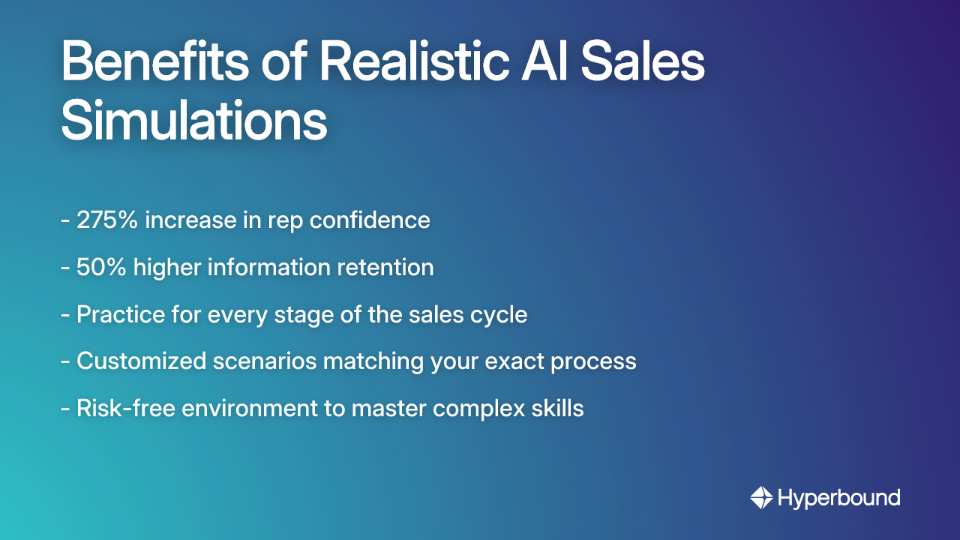
Hyperbound exemplifies this capability by allowing teams to build customizable scenarios that mirror their exact sales process. Reps can practice everything from cold calls and discovery conversations to complex multi-stakeholder negotiations and renewal discussions. This comprehensive approach ensures that sales training knowledge transfers to real-world situations, creating what learning experts call "real learning" – skills that are immediately applicable in actual customer interactions.
4. Instant, Granular Feedback that Drives Behavior Change
In traditional roleplays, feedback is almost always delayed. The rep completes the entire simulation before receiving input, by which time specific moments of opportunity or error are less impactful. The feedback itself is often high-level, with comments like "you sounded hesitant" or "good energy" rather than precise, actionable guidance.
AI delivers personalized feedback in the moment of need:
- Highlighting exact points where a rep missed an opportunity to ask a deeper discovery question
- Identifying when messaging veered off-track from the approved playbook
- Pinpointing instances where the rep used weak language or filler words
- Suggesting alternative phrasing for handling specific objections more effectively
This immediate learning loop accelerates skill development dramatically. As Michelle Richardson of The Brooks Group notes, "AI is transforming sales training from a labor-intensive, one-time event into a personalized, continuous learning journey."
Hyperbound's AI Coaching feature exemplifies this approach by delivering instant, personalized feedback after every practice session. It can identify precisely where a rep failed to uncover a key pain point or used ineffective language when handling an objection. This level of specificity empowers reps to self-correct and improve continuously without waiting for their manager's calendar to open up for a coaching session.
5. Data-Driven Insights and Measurable Business Impact
Perhaps the most compelling advantage of AI-powered practice is its ability to connect training directly to business outcomes. With traditional roleplays, it's nearly impossible to correlate practice performance with real-world results or demonstrate ROI. Did that one-hour session actually contribute to hitting quota? The data simply isn't available.
AI bridges this gap by providing comprehensive analytics that link practice to performance. The results are compelling:
- 83% of sales teams using AI saw revenue growth this year compared to 66% not using AI
- Companies implementing AI in sales training have seen revenue growth upwards of 20% within the first year
- AI coaching has been shown to reduce sales cycle times by 15%
- Other reported impacts include 15-20% productivity increases and a 40% improvement in first-call resolution
These aren't just vanity metrics – they answer the fundamental question many sales leaders ask: "Could these tools actually play a role in improving sales outcomes?" The data overwhelmingly suggests they can.
Hyperbound provides a comprehensive analytics dashboard to track individual and team progress, identify systemic skill gaps, and measure the impact of training initiatives. Furthermore, with AI Real Call Scoring, organizations can analyze actual customer conversations to verify if the skills honed in AI roleplays are being effectively applied with real prospects, creating a holistic coaching loop that drives measurable business results.
Empowering Your Coaches, Supercharging Your Reps
While the advantages of AI-powered practice are clear, it's important to understand that the technology isn't meant to replace human coaches – it's designed to empower them. By automating the foundational, repetitive aspects of call coaching, AI frees up sales managers to focus on strategic deal reviews, career mentorship, and the human elements of leadership that no technology can replicate.
This human-AI partnership creates a powerful force multiplier for sales organizations:
- Managers coach more strategically, focusing on complex scenarios rather than basic skills
- Reps receive consistent, objective feedback that accelerates their development
- Organizations gain visibility into skill gaps and training effectiveness at scale
- Teams develop a common language and standard for what "good" looks like
The most successful implementations view AI as an extension of the coaching team rather than a replacement for it. As one sales leader put it, "It's like having an assistant coach working with every rep, every day, helping them master the fundamentals so our managers can focus on the advanced strategies."

Conclusion: The Future of Sales Excellence
AI-powered sales practice is no longer a futuristic concept – it's a proven competitive advantage. It outperforms traditional live roleplays by being more scalable, objective, realistic, responsive, and measurable.
For sales organizations facing pressure to ramp reps faster, increase win rates, and do more with limited resources, AI practice platforms like Hyperbound offer a compelling solution. By codifying what your best reps do and scaling those behaviors to your entire team, you create a systematic approach to sales excellence that traditional training simply cannot match.
The question is no longer whether AI will transform sales training – it's whether your organization will lead or follow in adopting this game-changing technology. Those who embrace it now will develop more skilled, confident, and consistent sales teams that can outperform the competition in an increasingly challenging market.
Frequently Asked Questions
What is AI-powered sales practice?
AI-powered sales practice is a training method where sales representatives interact with an AI-driven simulator that plays the role of a customer or prospect. This technology allows reps to practice sales conversations—like cold calls, discovery sessions, or objection handling—in a safe, on-demand environment. Unlike static scripts, modern AI can dynamically respond to the rep's approach, creating realistic and interactive learning experiences without needing a manager or peer to be present.
How does AI sales coaching improve on traditional role-playing?
AI sales coaching improves on traditional role-playing by offering unparalleled scalability, objective and consistent evaluations, and instant, data-driven feedback. While live roleplays are limited by manager availability and subjective feedback, AI allows reps to practice anytime, anywhere. Every session is scored against a consistent, unbiased standard, and reps receive immediate, granular feedback on their performance. This accelerates skill development and ensures uniform training across the entire team.
Can AI sales simulations feel realistic?
Yes, modern AI sales simulations are designed to be hyper-realistic by adapting to the conversation's context. Advanced platforms can simulate specific buyer personas, industries, and company sizes. The AI can generate unexpected objections, change its emotional tone based on the rep's rapport-building skills, and even simulate multiple stakeholders in a complex deal. This level of realism helps reps build confidence and retain information far more effectively than with scripted or predictable roleplays.
Will AI replace human sales coaches?
No, AI is not designed to replace human sales coaches but rather to empower them. AI excels at automating the repetitive, foundational aspects of coaching, such as practicing talk tracks and basic objection handling. This frees up sales managers' time, allowing them to focus on high-level strategic coaching, complex deal reviews, and career mentorship—the human elements where they add the most value. It acts as an assistant coach for every rep.
How is the effectiveness of AI sales training measured?
The effectiveness of AI sales training is measured through data-driven analytics that connect practice performance directly to real-world business outcomes. AI platforms provide dashboards that track individual and team progress on key skills. This data can be correlated with actual sales metrics like revenue growth, reduced sales cycle times, and increased win rates. By analyzing real customer calls, platforms can also verify if the skills learned in simulations are being applied effectively, closing the loop between training and performance.
What are the main benefits of using AI for sales roleplays?
The main benefits include faster onboarding and ramp time for new hires, consistent skill development across the entire team, increased rep confidence, and measurable improvements in sales performance. Organizations using AI sales practice report significant reductions in time-to-competency, higher retention of training information, and direct impacts on revenue. Because practice is available on-demand, reps can continuously refine their skills, leading to more effective customer conversations and better business results.
Stop burning valuable manager and rep time on inefficient, inconsistent roleplays. It's time to leverage AI to build a team that is always prepared, always learning, and always ready to win.
Book a demo with Hyperbound


