.png)


.png)
Summary
- The average sales rep ramp time has surged by 32% in four years, now taking 5.7 months and costing companies up to three times a rep's base salary.
- The primary cause of slow onboarding is the gap between theoretical product training and the practical skills needed for real-world sales conversations.
- To slash ramp time, sales leaders must build an integrated tech stack featuring AI-powered tools for simulation, conversation intelligence, and knowledge management.
- Companies can cut ramp time in half by using AI Sales Roleplays to provide reps with unlimited, risk-free practice and instant, objective feedback on their performance.
You've seen the alarming stats: The average sales rep ramp time has surged by 32% in just four years, climbing from 4.3 months in 2020 to 5.7 months in 2024. For sales leaders, this isn't just a delay—it's a massive financial drain that can cost up to three times a new AE's base salary in lost productivity and training resources.
If you've been in sales management, these frustrations probably sound familiar:
"If onboarding takes 4 weeks and the company's usual sales cycle is 4-6 months and ramp-up is just 90 days, the new hire is disadvantaged from the start." - Sales Director on Reddit
"Most onboarding is product-focused. The ICP, problems the solution solves, and practical examples are left to in the field." - Sales Manager on Reddit
The good news? By 2026, an integrated tech stack of AI-powered tools will be the key to slashing these bloated ramp times and getting new hires productive faster than ever before. Let's dive into the top 10 tools that will revolutionize sales rep onboarding in the next two years.
The Escalating Crisis of Slow Ramp-Up
Before we explore solutions, let's understand what's at stake. Sales Rep Ramp Time—the duration it takes for new team members to transition from onboarding to full productivity—has become a critical competitive battleground.
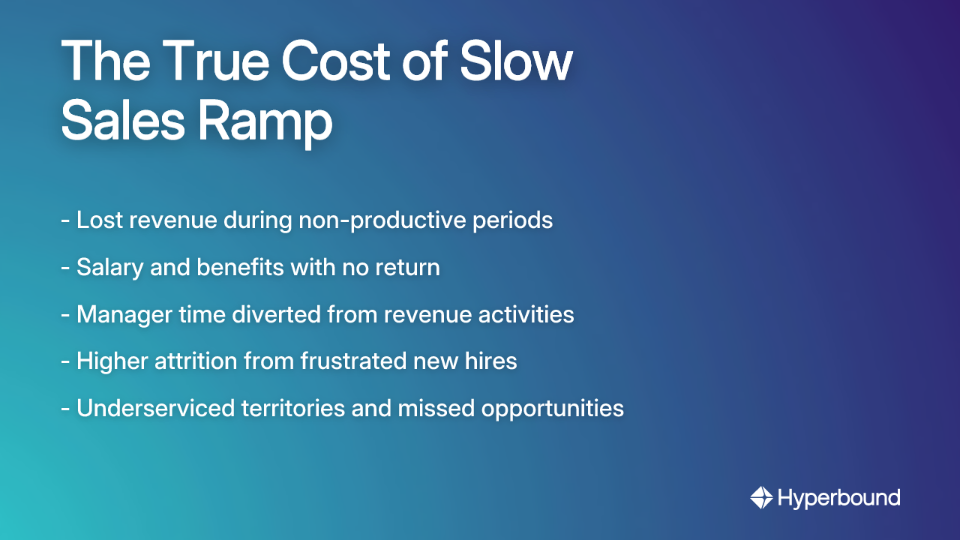
The costs of slow onboarding extend far beyond the obvious:
- Salary and benefits paid during non-productive periods
- Lost revenue opportunities while territories sit under-serviced
- Training resources and manager time diverted from revenue-generating activities
- Higher attrition as frustrated new hires leave before becoming productive
The root causes typically include:
- Information overload: New reps buried under product specs and internal processes
- Fragmented resources: Critical information scattered across drives, wikis, and docs
- Theory-to-practice gap: Traditional training doesn't prepare reps for real conversations
- Tribal knowledge: Vital sales tactics locked in the heads of veteran reps
The Top 10 Tools to Slash Sales Rep Ramp Time in 2026
1. AI-Powered Roleplay & Simulation Platforms
The days of shadowing busy colleagues or awkward roleplays with managers are over. By 2026, AI-powered simulation platforms will be the cornerstone of effective onboarding.
These platforms provide a safe, repeatable environment for reps to practice every stage of the sales cycle—from cold calls to objection handling—with AI buyer personas that respond dynamically and realistically.
Example Tool: Hyperbound
Hyperbound's AI Sales Roleplays allow you to create hyper-realistic practice scenarios based on your specific ICP, products, and sales methodology. Reps get instant, objective feedback from AI-Powered Scorecards that track talk ratios and key selling moments, allowing for rapid self-correction.
One company, GetAccept, reported a 50% faster ramp-up after implementing AI roleplay tools for their new hires.
Other Notable Players: Second Nature
2. Conversation Intelligence & AI Coaching Tools
The best training resource is often hidden in plain sight: your existing sales calls. Conversation Intelligence platforms record, transcribe, and analyze real sales conversations to identify what's working and what's not.
Example Tools: Hyperbound, Gong, and Chorus
While Gong and Chorus analyze call libraries to find winning patterns, Hyperbound's AI Real Call Scoring automates the QA process by scoring live calls against your custom methodology. Its AI Coaching feature delivers immediate, personalized feedback, allowing reps to self-correct without waiting for a 1:1 review, dramatically accelerating their learning curve.
3. Sales Engagement Platforms (SEPs)
New reps often struggle with the "what do I do next?" question. Sales Engagement Platforms solve this by providing a structured framework for execution.
These platforms guide reps through multi-step, multi-channel outreach sequences (emails, calls, social touches), ensuring they follow the proven sales playbook from day one.
Example Tools: Outreach, SalesLoft
Ramp Benefit: New hires can immediately see what a successful cadence looks like and begin executing, rather than building their workflow from scratch.
4. Sales Enablement & Knowledge Management Platforms
Many organizations struggle with what one sales leader on Reddit called "tribal knowledge fueled internal systems"—vital information scattered across the organization or locked in veterans' heads.
Modern knowledge management platforms centralize playbooks, case studies, battle cards, and training materials in one easily searchable place.
Example Tools: Seismic, Highspot
Ramp Benefit: Instead of asking colleagues for the latest deck or pricing sheet, a new rep can instantly find the correct, up-to-date information, saving time and preventing embarrassing mistakes.
5. Customer Relationship Management (CRM) Systems
While not new, next-generation CRMs will become even more critical for reducing ramp time by 2026.
A well-configured CRM provides a clear view of a rep's territory and account history, helping them get up to speed on their book of business quickly. It enforces the company's Methods and Procedures (M&Ps) and creates a consistent sales process.
Example Tool: Salesforce
Ramp Benefit: New hires can quickly understand their territory, see successful deal patterns, and build on existing account relationships.
6. Data & Prospecting Intelligence Tools
One common onboarding failure point comes from insufficient account allocation. As one sales director on Reddit bluntly put it: "The most common reason I see AEs fail to ramp/onboard is that there was never a sufficient account list for them to target to begin with."
Data intelligence platforms provide accurate contact data, firmographics, and buying signals to ensure reps are targeting the right people at the right companies.
Example Tools: ZoomInfo, LinkedIn Sales Navigator
Ramp Benefit: Allows new reps to build a high-quality pipeline faster, leading to quicker wins and a boost in confidence.
7. Autonomous Prospecting Tools
By 2026, AI-powered autonomous prospecting tools will handle much of the repetitive, top-of-funnel work that traditionally bogs down new reps.
These tools automate research, data sourcing, and initial outreach, allowing new hires to focus on high-value activities like talking to interested prospects.
Example Tool: Sailebot®
Ramp Benefit: Frees up mental bandwidth and calendar time for new hires to focus on learning conversation skills and managing active opportunities.
8. Document Automation & e-Signature Tools
The proposal and contract phase can be a major bottleneck for new reps unfamiliar with internal processes. Document automation tools templatize proposals, quotes, and contracts, and simplify the signature process.
Example Tool: PandaDoc
Ramp Benefit: Reduces administrative overhead and ensures consistency and professionalism in crucial bottom-of-funnel documents.
9. Asynchronous Video Messaging Platforms
Standing out in a crowded inbox is challenging for new reps. Asynchronous video messaging enables reps to easily record and send personalized video messages for prospecting, follow-ups, or deal explanations.
Example Tool: Vidyard
Ramp Benefit: Provides a modern tool for new reps to quickly build rapport and differentiate themselves, a skill that can accelerate their first few meetings.
10. AI-Powered Hiring Assessment Tools
Perhaps the most overlooked tool for reducing ramp time addresses the root cause: hiring the wrong person. As one Reddit user noted, "Companies have no idea what they're hiring for and have very flawed interview or hiring practices."
AI assessment tools use standardized, AI-driven roleplays to evaluate a candidate's practical selling skills, not just their interview performance.
Example Tool: Hyperbound
Hyperbound's AI Roleplay Hiring Assessments allow you to screen candidates at scale by having them perform a realistic sales pitch or objection handling scenario. The AI provides objective, data-driven scoring on their performance, helping you identify top talent with the core skills to ramp quickly.
Beyond Tools: Building a Tech-Enabled Onboarding Framework
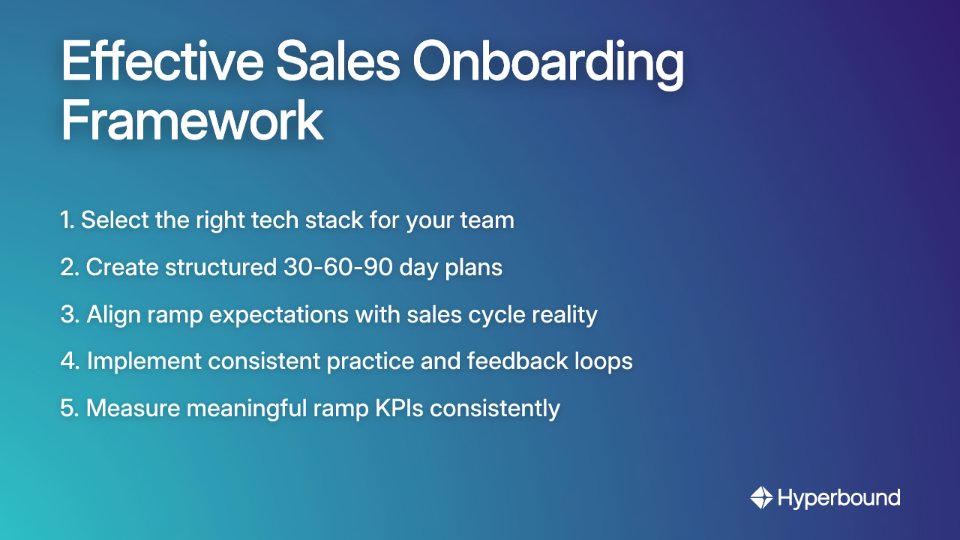
While the right tools are essential, they must be integrated into a cohesive onboarding strategy:
Implement a structured 30-60-90 day plan:
- Days 1-30: Focus on learning (product, ICP, tools). Use knowledge management systems and practice with AI Roleplays.
- Days 31-60: Focus on application. Start using the SEP for outreach and have live calls analyzed by AI Call Scoring.
- Days 61-90: Focus on refinement and closing. Analyze performance data and identify skill gaps for targeted coaching.
Align ramp time with reality: Use a realistic formula like Average Length of Sales Cycle + 90 Days to set ramp quotas and expectations.
Measure what matters: Track key ramp KPIs like time to first qualified meeting, time to first deal closed, and ramp quota attainment percentage over time.
The Future of Sales Onboarding
In 2026, slashing sales rep ramp time is no longer about better slide decks; it's about building an intelligent, interconnected ecosystem of tools. From hiring the right talent with AI assessments to providing endless, safe practice with AI roleplays and offering real-time feedback with AI coaching, technology is the key to unlocking rep potential faster than ever before.
The goal is to move beyond simply training reps to truly enabling them. The right tech stack empowers new hires to learn, practice, and perform simultaneously, turning the costly ramp-up period into a rapid ascent to productivity.
Is your onboarding tech stack built for 2026? Evaluate where AI-driven practice and coaching can fill the gaps in your current process and cut your ramp time in half.

Frequently Asked Questions
What is sales rep ramp time and why is it a critical metric?
Sales rep ramp time is the period it takes for a new salesperson to complete their training and become fully productive, consistently meeting their sales quota. It is a critical metric because a longer ramp time directly translates to significant costs, including lost revenue opportunities, training expenses, and the new hire's salary, with no immediate return on investment.
How can AI tools specifically help reduce sales ramp time?
AI tools reduce sales ramp time by providing scalable, personalized, and data-driven training experiences. They allow new reps to practice realistic sales scenarios, receive instant feedback, and access critical information on demand, bridging the gap between theory and real-world application much faster than traditional methods like shadowing.
What are the most essential tools for a modern sales onboarding tech stack?
A modern sales onboarding tech stack should include tools for practice, coaching, execution, and knowledge management. The most essential categories are AI-powered roleplay platforms (like Hyperbound), conversation intelligence tools, sales engagement platforms (SEPs), and centralized knowledge management systems. This integrated ecosystem ensures new hires can learn, practice, and execute efficiently.
What is a realistic ramp-up time for a new AE?
A realistic ramp-up time for a new Account Executive (AE) can be calculated using the formula: Average Length of Your Sales Cycle + 90 Days. This approach aligns performance expectations with the reality of your business, preventing new hires from becoming discouraged by unrealistic targets.
How can we bridge the gap between training theory and real sales conversations?
The most effective way to bridge the gap between theory and practice is through consistent, realistic simulation and immediate feedback. AI-powered roleplay platforms allow reps to practice handling objections and delivering value propositions in a safe environment. Following this, AI call scoring tools can analyze their first live calls to provide data-driven feedback, creating a rapid learning loop that builds confidence and competence.
Beyond tools, what is the most important element of a successful onboarding program?
Beyond tools, the most important element is a structured and integrated framework, such as a 30-60-90 day plan. Technology is an enabler, but it must be embedded within a clear strategy that guides the new hire from learning (Days 1-30) to application (Days 31-60) and refinement (Days 61-90).
Book a demo with Hyperbound


