.png)



Every revenue team has a version of it.
The weekly pipeline meeting.The forecast call.The one-on-one deal review.
A manager pulls up the CRM. A rep walks through their top opportunities. Close dates are confirmed. Risks are discussed. Confidence levels are shared.
“How do you feel about this one?”
Reps summarize conversations from memory. They describe where things stand. They explain what the buyer said, what the objections were, and why they believe the deal is still on track.
It’s structured. It’s disciplined. It’s familiar.
But at its core, most deal reviews are narrative-driven. They rely on how well a rep can tell the story of a deal — and how much a manager trusts that interpretation.
That doesn’t make them useless.
It makes them subjective.
.png)
The Problem with Opinion-Based Inspection
Opinion isn’t the enemy.
But it is inconsistent.
In most deal reviews, managers rely on a mix of rep confidence, selective call memory, and past experience. A confident rep can make a deal sound strong. A cautious rep can make a healthy deal sound fragile. Two managers can hear the same summary and walk away with different interpretations.
Confidence becomes a proxy for deal health.
But confidence isn’t evidence.
A rep might believe pricing landed well. A manager might assume stakeholder alignment is solid. The CRM might show the deal sitting comfortably in Commit.
And yet, the actual buyer behavior across the last few conversations might tell a different story.
When inspection is driven primarily by opinion, coaching becomes reactive. Risk is often recognized after momentum has already shifted. Intervention happens when close dates move — not when execution begins to drift.
That’s the structural flaw.
Opinion explains how a deal feels.
It doesn’t reliably explain how a deal is actually performing.
Evidence Changes the Conversation
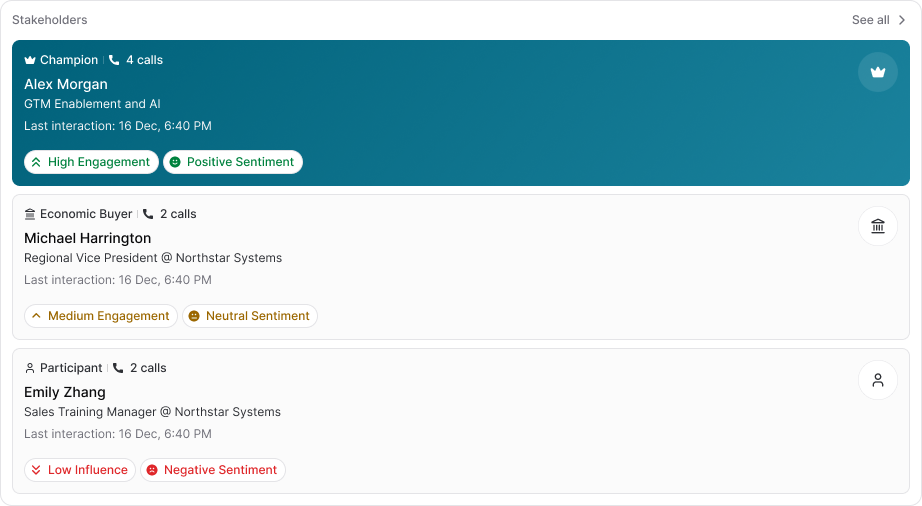
Now imagine that the deal review isn’t anchored in how the rep feels — but in what actually happened across the last five buyer conversations.
Instead of asking, “How confident are you?” the conversation starts with observable signals:
Has executive engagement increased or decreased?Are the same objections resurfacing?Is pricing pressure compounding?Has urgency been reinforced — or softened?
When inspection is grounded in behavior, the tone of the conversation shifts.
There’s less debating interpretation. Less storytelling. Fewer assumptions. The focus moves from narrative to patterns.
Evidence creates consistency.
Two managers looking at the same execution signals should reach similar conclusions. Coaching becomes less about personal intuition and more about objective reinforcement. Risk surfaces earlier because it’s tied to observable drift — not forecast movement.
The deal review stops being a storytelling session.
It becomes a diagnostic conversation.
From Evidence to Intervention
Evidence alone isn’t the finish line.
It’s the starting point.
If a deal review surfaces that pricing resistance is increasing, the next question shouldn’t be, “That’s concerning.”
It should be, “What are we going to do about it before the next call?”
This is where most teams stall.
Even when objective signals are visible, there’s often no structured path from insight to action. The evidence is discussed. Notes are taken. The meeting ends. And the rep moves on to their next call without targeted preparation tied to what just surfaced.
Intervention requires more than awareness.
It requires guidance.
What behavior needs to change?What objection needs to be practiced?What stakeholder dynamic needs to be addressed differently?
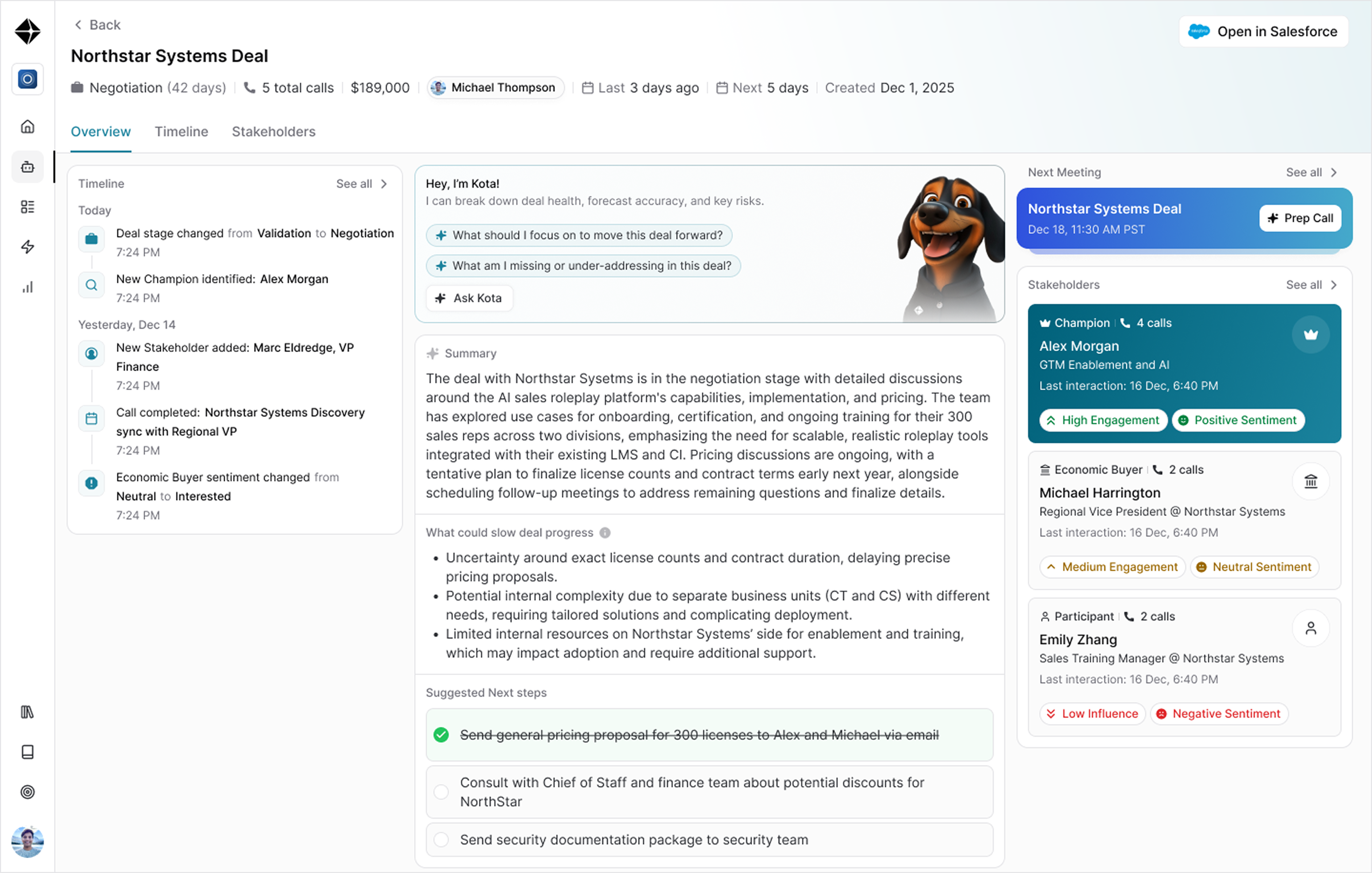
When deal reviews connect evidence directly to next steps — and to preparation inside the live opportunity — the conversation shifts from analysis to execution.
That’s when outcomes start to move.

The New Deal Review Workflow
The new deal review doesn’t start with confidence levels.
It starts with execution signals.
Managers walk into the conversation already grounded in observable patterns across calls. They can see where engagement is strengthening or weakening. They can see whether objections are compounding. They can see where urgency is drifting.
The conversation becomes focused and directional.
Instead of debating whether a deal “feels good,” the team aligns on what the evidence shows. Instead of revisiting what happened two weeks ago, they focus on what needs to happen before the next conversation.
The workflow shifts from:
Narrative → Interpretation → Hope
to:
Evidence → Alignment → Intervention
Over time, that shift compounds.
Fewer surprises at commit.Less debating in forecast meetings.More consistent coaching across managers.
Deal reviews become strategic checkpoints — not speculative updates.
From Narrative to Outcomes
Opinion explains.
Evidence clarifies.
Intervention changes outcomes.
The traditional deal review was built for a world where visibility was scarce. Reps told the story. Managers interpreted it. Decisions were made based on experience and instinct.
But revenue teams don’t lack visibility anymore.
What they lack is a consistent way to connect execution to outcomes — and to intervene while deals are still winnable.
The new deal review isn’t about better storytelling.
It’s about better signals.
Signals grounded in real buyer behavior. Signals that surface risk early. Signals that point directly to what needs to change before the next conversation.
When deal reviews move from opinion to evidence to action, they stop being a ritual.
They become a lever.
Book a demo with Hyperbound


