.png)


.png)
You've just wrapped up another sales call and you're feeling that familiar frustration. Despite your best efforts, the conversation felt more like an interrogation than a dialogue. Your prospect gave short, clipped answers to your questions, and you never managed to peel back the layers of the onion to understand their real needs.
If this sounds familiar, you're not alone. Many sales professionals struggle with questioning techniques that inadvertently shut down conversations rather than open them up.
"When you just ask yes/no questions, it shuts down conversations," notes one sales professional in an online discussion. Another admits, "I often get excited and am guilty of piling the questions on top of each other and sort of answering for them as I add more questions."
The good news? There's a simple yet powerful framework that can transform your sales conversations: The TED Method.
What is the TED Method?
The TED Method is an elegant questioning framework designed to elicit detailed, thoughtful responses from your prospects without making them feel like they're being interrogated. TED stands for:
- Tell me...
- Explain to me...
- Describe...
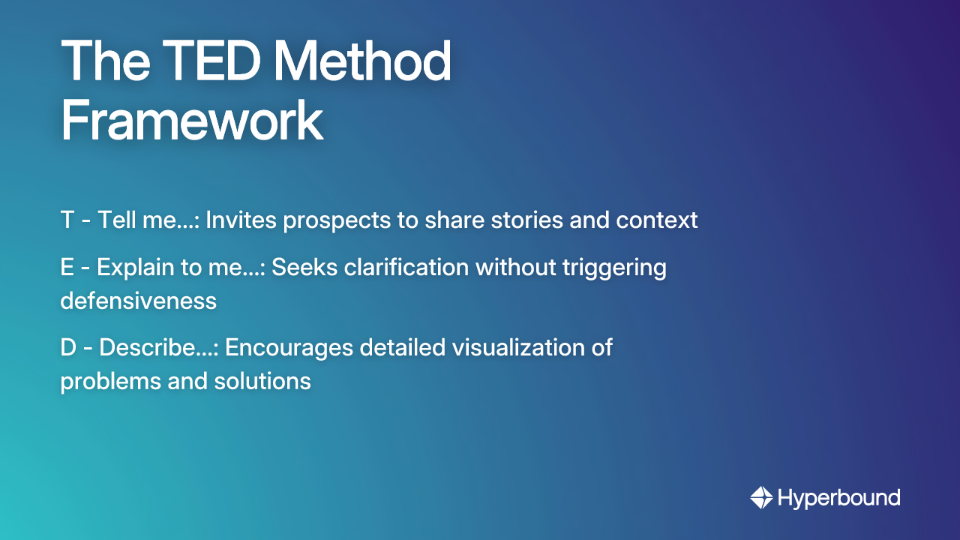
These three simple question starters act as springboard questions that naturally encourage elaboration while maintaining a conversational tone. Unlike direct questions that can feel abrasive, TED questions create an environment where prospects feel comfortable sharing deeper insights.
According to research, TED questioning yields 37% more detailed information than closed inquiries and sales conversations using open-ended approaches like TED are rated 43% more engaging by prospects.
Let's break down each component of the TED framework:
T - "Tell me..."
This prompt invites your prospect to share stories, perspectives, and broad context. It opens the door to larger conversations and helps establish rapport.
Examples:
- "Tell me about the challenges you're facing with your current supplier."
- "Tell me about your role and how you fit into the decision-making process."
- "Tell me about what prompted you to look for a solution now."
E - "Explain to me..."
Many sales experts caution that "'Why' questions are always the heaviest and should be seldom used." The "Explain to me..." prompt serves as a perfect alternative, seeking clarification and reasoning without the defensive reaction that "Why?" often triggers.
Examples:
- "Explain to me how the delay in delivery impacts your overall operations."
- "Explain to me what success would look like for this initiative."
- "Explain to me how your team currently approaches this challenge."
D - "Describe..."
This prompt encourages your prospect to paint a picture, helping you visualize their problems, goals, and ideal solutions. It's particularly effective at uncovering emotional aspects of their situation.
Examples:
- "Describe the ideal solution you envision for this issue."
- "Describe what happens when the system fails."
- "Describe how your team reacted the last time this problem occurred."
Why TED Outperforms Traditional Questioning Approaches
The strength of the TED method lies in its ability to overcome common challenges in sales conversations:
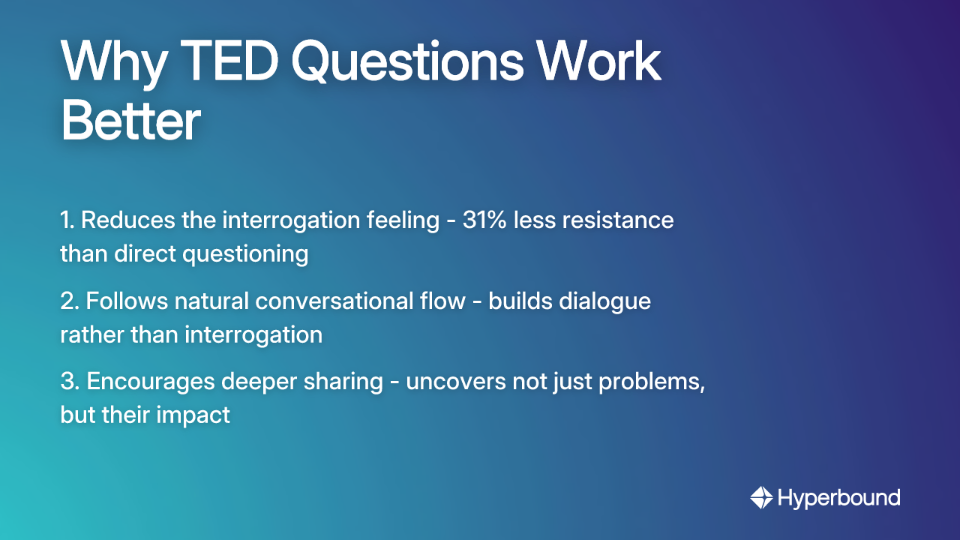
- It reduces the interrogation feeling When one sales professional noted that "questions are abrasive by nature," they highlighted a key issue that TED questions address. The collaborative nature of TED questions leads to 31% less resistance compared to more direct questioning styles.
- It naturally follows conversational flow Rather than firing a series of disconnected questions, TED prompts build upon each other in a natural progression, creating a dialogue rather than an interrogation.
- It encourages deeper sharing The open-ended nature of TED questions invites prospects to share more than just surface-level answers, allowing you to understand not just what their problems are, but how those problems affect them.
TED vs. SPIN: Complementary Approaches for Goal-Oriented Questioning
Many salespeople are familiar with the SPIN selling methodology (Situation, Problem, Implication, Need-Payoff). Rather than replacing SPIN, the TED framework can enhance it by providing a more conversational way to implement SPIN's principles.
Here's how to integrate TED questioning into the SPIN framework:
Situation Questions:
- Instead of: "Who is your current provider?"
- Try: "Tell me about your experience working with your current provider."
Problem Questions:
- Instead of: "Are you having trouble with delivery times?"
- Try: "Describe the challenges you're facing with your current delivery process."
Implication Questions:
- Instead of: "Does that delay cause issues for your customers?"
- Try: "Explain to me how those delivery delays impact your relationship with customers."
Need-Payoff Questions:
- Instead of: "Would faster delivery help you?"
- Try: "Describe what improved delivery times would mean for your business."
This integration creates what sales expert Neil Rackham might call "the best of both worlds" – the strategic progression of SPIN combined with the conversational finesse of TED.

Putting TED Into Practice: A Guide for Every Sales Scenario
The TED Method is versatile enough to be effective throughout the entire sales process. Here's how to apply it at different stages:
Initial Discovery & Rapport Building
- "Tell me about your role and your primary goals for this quarter."
- "Describe your ideal working relationship with a vendor."
- "Tell me about your experience in this industry."
These questions help establish rapport while gathering valuable background information. As one sales professional put it, "Let them do the talking" – TED questions naturally facilitate this.
Problem & Pain Point Exploration
- "Explain to me what happens when this issue occurs."
- "Tell me about how this problem affects your team's productivity."
- "Describe the impact this has had on your bottom line."
These questions help you understand not just the technical aspects of a problem, but its business impact – crucial information for positioning your solution.
Solution Development & Vision Building
- "Describe your ideal outcome for this project."
- "Tell me about what you'd hope to achieve in the first six months."
- "Explain to me which features would deliver the most value to your team."
By understanding their vision, you can tailor your solution presentation to align with their goals, making it more relevant and compelling.
Handling Objections
- "Tell me more about your concerns regarding the budget."
- "Explain to me what aspect of the timeline seems challenging."
- "Describe what would need to change for this to be a perfect fit for you."
These questions transform objections from roadblocks into opportunities for deeper understanding and problem-solving.
Best Practices for Mastering the TED Method
1. Use a Nurturing Statement or Softener
As one sales professional advises, "Questions are abrasive by nature, so always put a nurturing statement before the question." This creates a buffer that makes your questions feel less confrontational:
- "I appreciate you sharing that. Tell me more about..."
- "That's an interesting point. Explain to me how..."
- "I understand this is a priority for you. Describe what success would look like..."
2. Listen Actively
The TED Method is only effective if you genuinely listen to the responses. Don't just wait for your turn to speak – really absorb what your prospect is saying, and let their answer guide your next question.
A quiet assumptive close often comes naturally when you've been actively listening throughout the conversation. The prospect feels understood and is more likely to move forward with someone who has demonstrated such understanding.
3. Avoid Question Stacking
Remember the sales professional who admitted to "piling the questions on top of each other"? This is a common mistake that undermines the effectiveness of even well-phrased questions.
Ask one TED question, then give your prospect ample time to respond. Follow up with a relevant question based on their answer, rather than moving to your next pre-planned question.
4. Balance Open and Closed Questions
While TED questions are primarily open-ended questions, there's still a place for closed-ended questions in your sales toolkit. As one sales professional noted, "Yes and no questions can be just as effective" when used strategically.
Use closed-ended questions to confirm understanding or to get specific commitments:
- "So if I understand correctly, delivery time is your primary concern?"
- "Would next Tuesday work for a follow-up conversation?"
Your Action Plan: Starting With TED Today
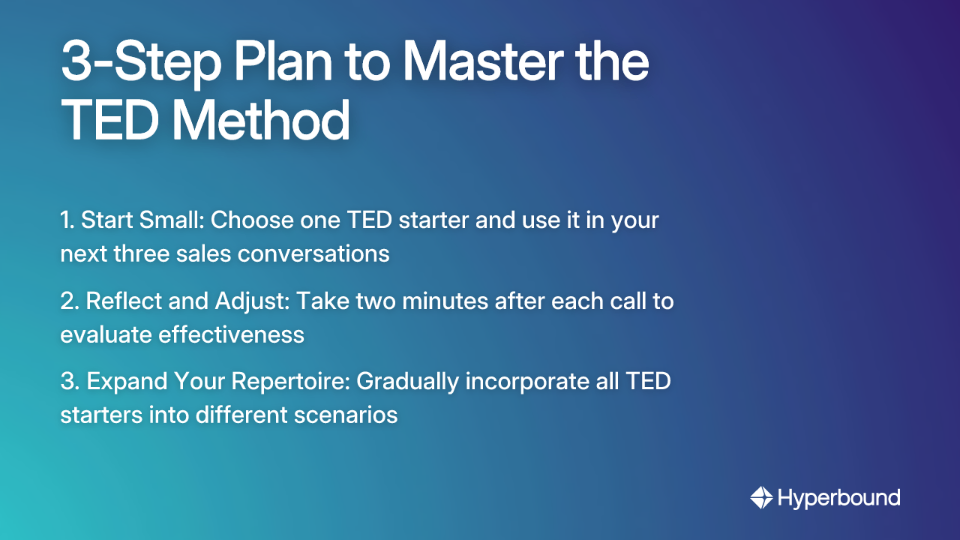
Ready to transform your sales conversations with the TED Method? Here's a simple three-step plan:
- Start Small: Choose one TED question starter ("Tell me," "Explain to me," or "Describe") and incorporate it into your next three sales conversations. Note the responses you get.
- Reflect and Adjust: After each call, take two minutes to reflect on how your TED question worked. Did it elicit more detailed information? Did the conversation flow more naturally? What could you improve?
- Expand Your Repertoire: As you become comfortable with one TED starter, begin incorporating the others. Develop a set of go-to TED questions for different sales scenarios.
To accelerate this learning process, platforms like Hyperbound allow you to practice these techniques in realistic AI-powered roleplays. This provides a safe environment to hone your skills and receive instant feedback before speaking to a live prospect. Furthermore, tools that offer AI real call scoring can help you analyze how well you're applying these methods in actual conversations.
Conclusion: From Interrogation to Conversation
The big general rules of sales questioning are evolving. Today's prospects expect authentic conversations, not scripted interrogations. The TED Method provides a framework that aligns with this expectation, allowing you to gather the information you need while building rapport and trust.
By incorporating Tell, Explain, and Describe questions into your sales approach, you can transform your conversations from one-sided interrogations into collaborative dialogues that uncover true needs and build genuine connections.
As you master this approach, you'll find yourself naturally able to peel back the layers of the onion, uncovering deeper insights that help you position your solution more effectively and close deals more confidently.
Remember what makes the TED Method so powerful: it's not just about asking better questions – it's about fostering better conversations that lead to better outcomes for both you and your prospect.
So for your next sales call, set aside the traditional questioning playbook and try the TED Method instead. Tell, explain, and describe your way to more meaningful sales conversations – and watch your results transform.
Frequently Asked Questions
What is the TED Method in sales?
The TED Method is a sales questioning framework that uses the phrases "Tell me...", "Explain to me...", and "Describe..." to encourage detailed, open-ended responses from prospects. It is designed to transform a sales call from an interrogation into a collaborative dialogue. By using these prompts, you invite prospects to share stories, context, and deeper insights about their challenges and goals, fostering a more natural and productive conversation.
Why is the TED Method more effective than asking direct questions?
The TED Method is more effective because it feels less confrontational and abrasive than direct questions, which often put prospects on the defensive. This approach reduces the "interrogation feeling" and encourages prospects to share more detailed information. Unlike simple yes/no questions that can shut down a conversation, TED prompts open up dialogue, helping you uncover not just the problem, but its full impact on the prospect's business.
How does the TED Method relate to SPIN selling?
The TED Method does not replace SPIN selling; it complements and enhances it by providing a more conversational way to ask SPIN questions. You can integrate TED prompts into each stage of the SPIN framework (Situation, Problem, Implication, Need-Payoff). For example, instead of a direct Problem question like "Are you having trouble with X?", you could use a TED approach: "Describe the challenges you're facing with X." This combines SPIN's strategic structure with TED's conversational flow.
When is the best time to use TED questions in the sales process?
The TED Method is versatile and can be used effectively throughout the entire sales process, from initial discovery to handling objections. In the beginning, use it for rapport building and understanding the prospect's role ("Tell me about your goals..."). During problem exploration, use it to uncover pain points ("Explain what happens when..."). It's also valuable for co-creating a solution ("Describe your ideal outcome...") and for exploring objections non-confrontationally ("Tell me more about your concerns...").
What are some common mistakes to avoid when using the TED Method?
Three common mistakes to avoid are stacking multiple questions at once, failing to actively listen to the response, and not using a "softener" statement before asking. It's crucial to ask one question at a time and give the prospect space to answer fully. Active listening is key, as their answer should guide your next question. Additionally, using a nurturing phrase like "That's an interesting point. Explain to me..." can make the question feel even more collaborative and less like an interrogation.
Can I still ask closed-ended (yes/no) questions?
Yes, closed-ended questions still have an important role in sales conversations and should be used strategically alongside the TED Method. While TED questions are great for exploration and discovery, closed-ended questions are essential for confirming your understanding ("So, the main issue is delivery time, correct?") or securing a commitment ("Would next Tuesday work for our follow-up call?"). The key is to strike a balance between open-ended discovery and targeted, closed-ended confirmation.

Book a demo with Hyperbound


