.png)


.png)
Summary
- A major disconnect exists between sales reps and managers on skill proficiency—for example, 85% of sellers feel strong at prospecting, while only 44% of managers agree.
- To accurately identify skill gaps, move beyond unreliable self-assessments by combining manager feedback, CRM data, and practical performance reviews.
- The goal is to visualize the performance gap with a skills matrix, which allows you to create targeted, high-impact training plans instead of generic ones.
- AI-powered tools provide objective skill measurement through realistic sales roleplays, helping you gather the hard data needed to close performance gaps.
You know your sales team has potential, but you're battling high frustration and burnout. Reps are struggling to hit targets, and you suspect a skill gap is to blame. The problem is, how do you prove it? The environment changes so quickly with AI and other emerging technologies, and as one manager noted, "the assessment of skills within the team is most challenging as we have no hard metrics to measure against."
This struggle is common. Without a clear process for identifying skill gaps, you risk investing in the wrong training, further frustrating your team and wasting valuable resources.
A skill gap analysis identifies the disparity between the skills your sales team currently possesses and the skills they need to excel in their roles and meet business objectives. As TalentLMS notes, it's a crucial tool for strategic workforce planning and protecting L&D investments.
The urgency for conducting this analysis has never been greater. According to Salesloft, there's a significant disconnect between how sellers and managers view performance. For example, 85% of sellers rate themselves strong in prospecting, but only 44% of managers believe their reps effectively spot risks. This perception gap can hide critical weaknesses in your team.
Let's dive into a comprehensive 7-step framework that will provide a clear, actionable solution to these challenges.
Step 1: Define Your Goals and Identify Critical Future Skills
Before measuring anything, you must define what success looks like. Start by aligning your analysis with broader business objectives.
As outlined by TalentLMS, first define the scope and goals. Are you assessing an individual, a team, or the entire sales organization? What specific outcome do you want to achieve (e.g., improve conversion rates, increase customer satisfaction)?
.png)
Next, identify the core competencies that are non-negotiable for success on your team. Move beyond generic sales skills and focus on what's essential for your market and your buyers.
Salesloft's research points to critical skills for 2025: adaptability, prospecting, executive engagement, and risk detection. They found that 44% of managers say adaptability is the most crucial soft skill, yet it's often overlooked in training.
Don't forget to consider rapidly changing technology needs. Skills related to AI, data analytics, and digital literacy are no longer optional. UseWaggle.ai lists a lack of digital literacy and data analytics understanding as common gaps in modern sales teams.
Step 2: Gather Multi-Faceted Data (Beyond Simple Surveys)
Self-assessments are notoriously unreliable. As one HR professional shared, "We conducted a self-report 'skill assessment' on our IT division and 85% of them said that they were highly skilled in analytics." This highlights the need for a multi-source approach to data collection.
Combine these qualitative and quantitative methods:
- Manager & Peer Feedback: Compare reps' self-assessments with manager evaluations to spot perception gaps. Use structured feedback and competency frameworks for consistency, as suggested by Morgan McKinley.
- Self-Assessments (with a twist): Instead of simple surveys, implement a collaborative approach. A sales manager recommended, "using a simple heat map where team members self-assess their proficiency levels." This creates a visual skills matrix and fosters open discussion.
- One-on-One Conversations: To get rich qualitative data, conduct one-on-one meetings. Ask about team members' "comfort level with both emerging technologies and fundamental skills." Building rapport and being transparent about how the data will be used is crucial for gathering accurate insights.
- Analyze CRM Data: Use your existing data. Predictable Profits advises analyzing CRM data for trends in sales outcomes, customer interactions, and conversion rates to uncover objective training needs.
Step 3: Conduct Practical Assessments and Performance Reviews
To get past self-reporting bias and address the "lack of hard metrics," you need to observe skills in action.
AI-Powered Sales Simulations & Role-Playing: To get an objective measure of skills, move beyond traditional role-playing. Platforms like Hyperbound allow you to create hyper-realistic AI Sales Roleplays where reps can practice critical conversations in a safe environment. This provides a scalable way to assess skills like objection handling, prospecting, and discovery against your team's specific playbook.
Deal and Call Reviews: Regularly review closed deals (both won and lost) and listen to call recordings. This provides concrete evidence of where reps excel and where they struggle in the sales process.
Formal Testing: While not always popular, formal testing can provide objective data. As one HR professional put it, "This isn't popular, but far more thorough, is to actually test - yes test- individuals' knowledge, skills, and abilities." This can be especially useful for product knowledge or technical skills.

Step 4: Analyze the Data to Visualize the Performance Gap
Now, bring all your data points together—self-assessments, manager feedback, CRM data, and practical assessments.
The goal is to clearly see the performance gap: the difference between current behavior and desired behavior.
Visualize the Gaps: Address the challenge of "difficulty in visualizing skill gaps" by using the skills matrix or heat map created in Step 2 to plot proficiency levels across the team. This makes it easy to spot both individual weaknesses and team-wide trends.
Leverage AI and Technology: Don't just rely on spreadsheets. Salesloft recommends using AI for insights. However, note that adoption is low: Only 6% of sellers utilize AI for task prioritization, indicating a huge opportunity. AI can help analyze call recordings at scale or identify patterns in CRM data that humans might miss. Tools like Hyperbound's AI Real Call Scoring can automatically analyze and score both practice roleplays and actual customer calls against your methodology, providing objective, data-driven insights into specific skill gaps.
Step 5: Create a Targeted and Collaborative Action Plan
You can't fix everything at once. Prioritize the skill gaps that have the biggest impact on your business goals, a key recommendation from TalentLMS.
Develop your intervention strategy with these components:
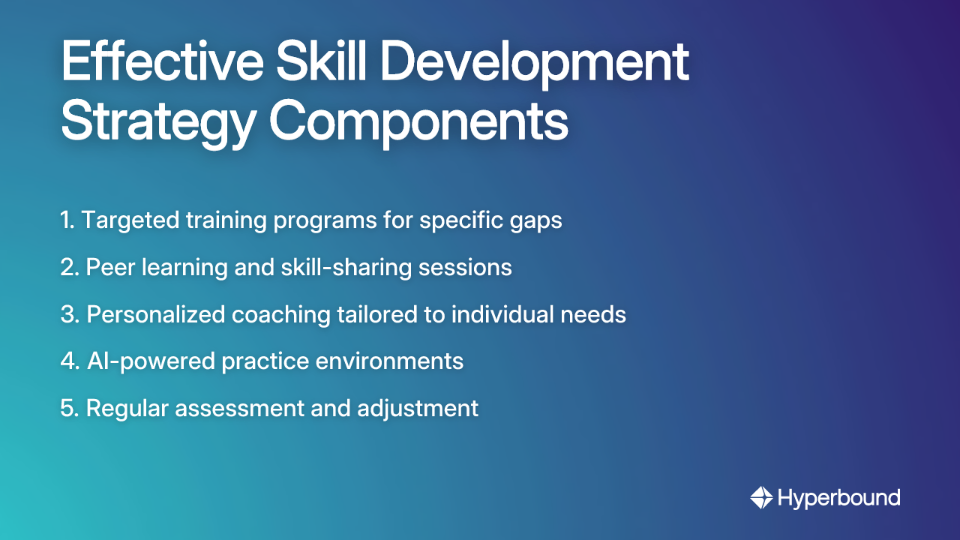
Targeted Training Programs: For identified skill gaps, develop specific training. UseWaggle.ai suggests a mix of methods like workshops, mentorship, e-learning, and even virtual reality for immersive scenarios.
Empower with Peer Learning: Implement skill-sharing sessions where team members with specific strengths can teach others. This "builds both technical and leadership capabilities while fostering team collaboration," according to experienced managers.
Personalized Coaching: Generic coaching is ineffective. Salesloft's data shows that 37% of sellers rarely or never receive personalized coaching, and only 21% find their coaching effective. Use the data from your analysis to tailor coaching to each rep's specific needs. AI coaching platforms can scale this personalization, delivering instant, targeted feedback after each practice scenario or real call, helping reps improve faster.
Step 6: Assess Your Processes and Tech Stack
Sometimes, the problem isn't a lack of skill but a broken process or a cumbersome tech stack. Look beyond the rep for non-training solutions.
Evaluate Process Compliance: Salesloft found that 40% of sellers frequently deviate from the defined sales process. Is your process too rigid, or is it not being reinforced? Consider creating flexible playbooks that allow for adaptation.
Simplify the Tech Stack: Are your tools helping or hindering? According to Salesloft, 40% of managers state sellers lack effectiveness in using available tools due to complexity. Overloading reps with too many tools creates confusion. Audit your tech stack to ensure it simplifies workflows, not complicates them.
This is a critical non-training solution that can have a massive impact on performance without requiring additional skill development.
Step 7: Make It a Continuous Cycle of Improvement
The market, your products, and your buyers are constantly changing. A skill gap analysis should not be a one-time event.
As TalentLMS suggests, make skill gap analysis an ongoing activity. Schedule regular check-ins (quarterly or bi-annually) to reassess skills and adjust your training plan.
Foster a Learning Culture: Leadership must champion continuous learning. UseWaggle.ai emphasizes that management must lead the way in creating a learning-first culture where feedback is encouraged.
Track Progress Indicators: To address the challenge of measuring improvement without hard metrics, "focus on progress indicators like completed projects, peer feedback, and practical application of new skills," as recommended by experienced managers.
Measure Coaching Effectiveness: Don't just coach; measure its impact. Salesloft's data reveals a major gap: 94% of managers report coaching is part of their process, but 53% of sellers receive coaching quarterly or less. Increase the frequency and quality of coaching and tie it directly to the skill gaps you've identified. This is where leveraging AI can bridge the gap, providing reps with on-demand practice and feedback to reinforce coaching between manager one-on-ones.
Conclusion
An effective skill gap assessment process is a powerful tool for sales managers. By following these 7 steps—defining goals, gathering multi-faceted data, conducting practical assessments, analyzing the performance gap, creating a targeted action plan, assessing processes, and making it a continuous cycle—you can transform your team's performance.
This approach moves your team from frustrated and burnt out to confident and empowered. It improves productivity, enhances innovation, and reduces employee turnover by showing your team you are invested in their development.
Start today by defining the single most critical skill your team needs for success in the next quarter. Your journey to building a high-performing sales team begins with that one simple question.

Frequently Asked Questions
What is a sales skill gap analysis?
A sales skill gap analysis is a process used to identify the specific skills your sales team needs to meet business goals versus the skills they currently possess. It helps pinpoint weaknesses in areas like prospecting, objection handling, or using new technologies, allowing you to create targeted training and coaching plans instead of generic ones.
Why is a skill gap analysis important for sales teams?
A skill gap analysis is crucial because it helps diagnose the root causes of underperformance, reduces costly employee turnover, and ensures your training investments are effective. Without it, you risk wasting resources on the wrong training, failing to address critical weaknesses, and allowing a disconnect between manager and seller perceptions of performance to grow.
How can I accurately measure sales skills without hard metrics?
To accurately measure sales skills, you should use a multi-faceted approach that combines manager feedback, CRM data analysis, and practical assessments like AI-powered role-playing or call reviews. Relying solely on self-assessments is often unreliable. Objective methods like analyzing call recordings or using AI simulation tools provide concrete data on how reps perform in real-world scenarios, revealing true proficiency levels.
What are the most critical sales skills to assess today?
The most critical sales skills to assess today include adaptability, prospecting, executive engagement, risk detection, and digital literacy with tools like AI and CRM platforms. While fundamental selling skills remain important, the modern sales environment demands adaptability to changing markets and technologies. As noted in the article, many managers now consider adaptability the most crucial soft skill for success.
How often should you conduct a skill gap analysis?
A skill gap analysis should not be a one-time event but a continuous process, ideally conducted quarterly or bi-annually. The market, your products, and buyer behaviors are constantly evolving. Regular assessments ensure your training and coaching strategies remain relevant and aligned with current business objectives, fostering a culture of continuous improvement.
What is a skills matrix and how does it help?
A skills matrix is a visual tool, often a chart or heat map, that maps the required skills for a role against the current proficiency levels of each team member. It provides a clear, at-a-glance overview of your team's collective strengths and weaknesses. This visualization makes it easy to spot team-wide trends, identify subject matter experts for peer learning, and prioritize training for the most significant gaps.
How can AI help with a skill gap analysis?
AI can significantly enhance a skill gap analysis by providing objective, scalable ways to assess skills and analyze performance data. For example, AI-powered sales simulations offer a safe and consistent environment for reps to practice, while AI call scoring tools can analyze thousands of real customer conversations to identify specific areas for improvement, such as adherence to a sales methodology. This automates a previously manual process and provides data-driven insights.
Book a demo with Hyperbound


