.png)


.png)
You stare at the clock, desperately hoping for an escape as your coworker launches into another lengthy story about their weekend. Or perhaps you're trapped in a corner at a networking event while someone explains the intricate details of their USB device collection. We've all been there – caught in one-sided conversations that drain our energy and productivity.
According to research published in the Proceedings of the National Academy of Sciences, most conversations don't end when people want them to. In fact, less than 2% of conversations conclude when both parties want them to! This disconnect creates that all-too-familiar awkward tension: you're ready to wrap it up, but the other person seems prepared to talk indefinitely.
The good news? You don't need to give someone the cold shoulder or sacrifice your productivity to maintain your reputation as a friendly colleague. With the right social skills and scripts ready to deploy, you can gracefully exit any conversation while preserving relationships.
The Psychology of a Graceful Exit: Why Is This So Hard?
Before diving into specific scripts, let's understand why ending conversations feels so challenging. Most of us fear being perceived as rude, dismissive, or socially inept. In workplace settings, this concern intensifies – no one wants to develop an office-wide persona as the unfriendly colleague, especially in a white collar environment where relationships matter.
The key to a smooth exit lies in understanding both verbal and non-verbal signals:
- Verbal cues: Short, monosyllabic responses and checking for natural pauses
- Non-verbal signals: Looking at your watch, turning your feet toward the door, or gathering your belongings
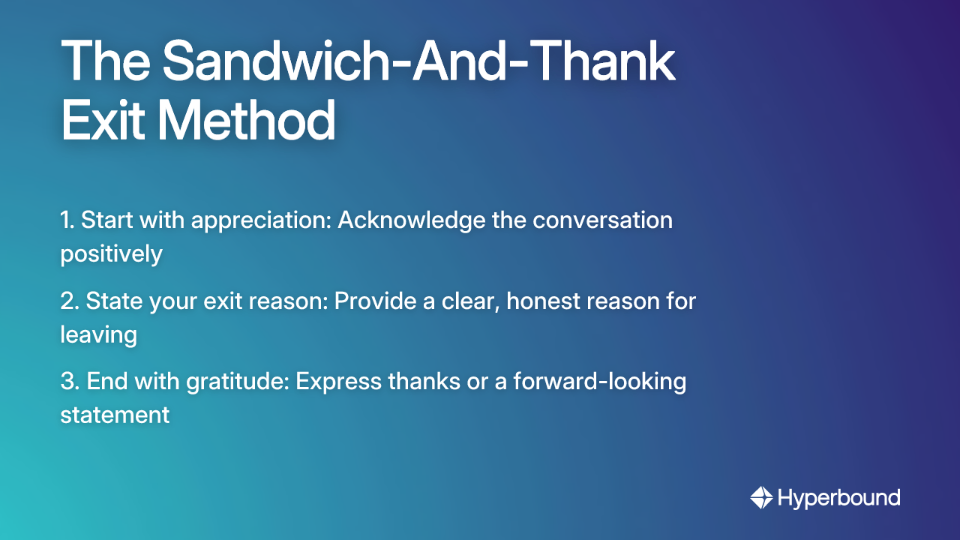
The most effective conversation exits follow what experts call the "Sandwich-And-Thank" method:
- Start with appreciation: Acknowledge the conversation positively
- State your exit reason: Provide a clear, honest reason for leaving
- End with gratitude: Express thanks or a forward-looking statement
This framework works because it validates the interaction while firmly establishing boundaries.
5 Scenarios and the Scripts to Escape Them
Scenario 1: The Workplace Interruption
Chatty coworkers can be the bane of productivity, especially in open office environments. This becomes particularly frustrating when you have pressing deadlines and they're in lower-stress positions with more time to socialize.
For Peer Colleagues:
"I appreciate you sharing that update about the project. I need to focus on this deadline right now, but let's continue this conversation during lunch?"
For More Senior Colleagues:
"That's a valuable perspective. I want to give it the attention it deserves, but I'm in the middle of completing the quarterly report. Could we schedule 15 minutes to discuss this tomorrow?"
For Persistent Interrupters:
"I notice you have thoughts to share, and I'd like to hear them, but I need to finish explaining this point first since it's critical to our next steps."
Pro Tip: If you're frequently interrupted, create a visible "focus signal" like wearing headphones or placing a small item (like a red USB device) on your desk to indicate you're in deep work mode.
Scenario 2: The Never-Ending Social Small Talk
One of the most challenging scenarios occurs when you need to end a conversation but aren't physically leaving the venue – like at a party or networking event.
The Mingle Strategy:
"It's been great catching up with you! I promised myself I'd meet at least five new people tonight, so I should continue mingling. Let's connect again before the event ends."
The Host Check-in:
"I've really enjoyed our conversation about marketing strategies. I should check in with the host/other attendees. Hope to continue this discussion next time!"
The Refreshment Run:
"This discussion about industry trends has been enlightening! I'm going to refresh my drink – can I get you anything while I'm up?" (Then don't return to the same conversation cluster)
The Introduction Handoff:
"Sarah, have you met Alex? He's also working in software development. I think you two would have a lot to talk about!" (This passes the conversational baton while you step away)
Scenario 3: The Monologue on a Topic You Don't Care About
We've all been cornered by someone passionate about a subject we have zero interest in. Maybe it's cryptocurrency, fantasy football stats, or the intricacies of their collection of vintage office supplies. Here's how to escape without crushing their enthusiasm.
The Honest Redirect:
"That's fascinating! I'll admit this isn't my area of expertise, but I appreciate you sharing your passion. I need to step away now, but I'd love to introduce you to Jamie who's actually quite interested in this topic."
The Neutral Exit:
"Thanks for explaining how blockchain works. It's clearly something you know a lot about! I should get going to prepare for my afternoon meeting, but it was great learning something new."
The Positive Pivot:
"I had no idea stamp collecting was so complex! I appreciate you sharing your knowledge. I need to catch up with a few other people before I leave, but this was genuinely interesting."
Pro Tip: When someone is monologuing about a topic, they're often more interested in sharing their enthusiasm than judging your response. This makes it easier to exit without worry about offending them.
Scenario 4: The Persistent Talker Who Misses All the Cues
Some people simply don't pick up on subtle social cues that a conversation has run its course. For these situations, assertive communication becomes necessary – not to be confused with being rude.
The Standing Exit:
(While physically standing up) "This has been a productive discussion about the quarterly reports. I have another commitment now, but let's schedule time to continue if needed."
The Direct Approach:
"I've enjoyed our chat, but I need to get back to my tasks now. Let's catch up again soon!" (Delivered with a genuine smile and confident body language)
For Close Relationships:
"I value our friendship, but I've noticed our conversations sometimes become one-sided. Would you mind if we tried to balance how much each of us speaks? I'd love to share what's happening in my life too."
The Scheduled Alternative:
"This topic deserves more time than I can give it right now. Could we schedule a proper coffee catch-up next week instead?"
Pro Tip: For the most persistent talkers, combine verbal cues with non-verbal signals. Stand up, gather your belongings, or even gently touch your watch while delivering your exit line.

Scenario 5: Ending Digital Conversations
One-sided conversations don't just happen in person. Text messages, social media chats, and email threads can also drag on unnecessarily. The digital world presents unique challenges since you can't rely on body language.
The Clear Closure:
"Thanks for the information! I need to focus on other tasks now, but I'll review this and get back to you by Thursday if I have questions."
The Time-Bound Response:
"I appreciate your detailed message. I only have a moment now, but wanted to acknowledge I received this. I'll respond more thoroughly tomorrow."
The Definitive End:
"This has been a helpful exchange! I have everything I need now, so unless you need anything else from me, we can consider this matter resolved. Thanks again!"
Pro Tip: Digital communications often create pressure for immediate responses. Setting clear expectations about when you'll respond fully helps manage these interactions without being tethered to never-ending conversations.
What NOT to Do: Avoiding the Social Faux Pas
While learning how to end conversations skillfully, it's equally important to know what to avoid:
- Don't abruptly walk away without acknowledgment – this creates uncomfortable tension and damages relationships
- Don't interrupt mid-sentence to announce your departure – wait for a natural pause
- Don't make up transparent excuses – being caught in an obvious lie is more damaging than politely stating you need to move on
- Don't look at your phone while someone is speaking – this signals disrespect rather than a desire to conclude
- Don't promise follow-ups you don't intend to deliver – saying "Let's continue this later" creates an expectation
Take Back Your Time, Politely
Mastering the art of conversation exits isn't about being non-sociable or dismissive – it's about managing your time and energy effectively while maintaining positive relationships. By having these scripts ready, you transform potentially awkward moments into smooth transitions.
Remember that most people understand the value of time and focus, especially in professional settings. Your colleagues in a white collar environment likely face similar challenges with one-sided conversations and will appreciate clear, respectful boundaries.
The scripts provided here can be adapted to your personal style and the specific dynamics of your relationships. The key is to practice them until they feel natural. Rehearsing them before entering situations where you anticipate needing an exit strategy can be incredibly effective. For professionals looking to hone these skills, platforms like Hyperbound's AI Sales Roleplays offer a safe environment to practice difficult conversations and receive instant feedback, building confidence for real-world interactions.
As you implement these techniques, you'll likely discover an unexpected benefit: when you become skilled at ending conversations gracefully, you'll feel more comfortable initiating them too. The knowledge that you can exit smoothly reduces the anxiety of engagement.
With practice, you'll develop an office-wide persona as someone who is both approachable and respectful of boundaries – a valuable reputation in any professional or social context.
Key Takeaways for Escaping One-Sided Conversations
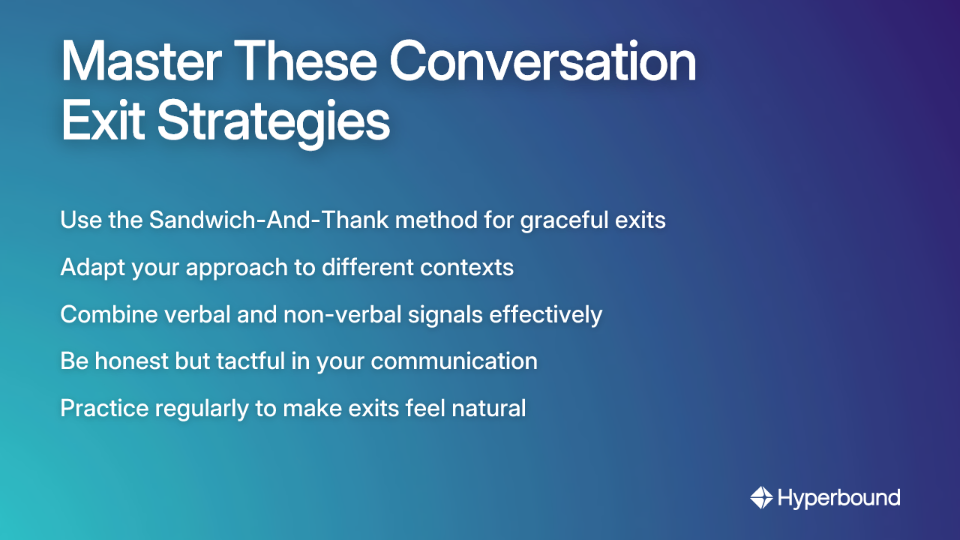
- Use the Sandwich-And-Thank method – start with appreciation, state your reason for leaving, end with gratitude
- Match your script to the context – workplace interactions require different approaches than social gatherings
- Combine verbal and non-verbal signals – your body language should reinforce your words
- Be honest but tactful – transparent communication is more respectful than obvious excuses
- Practice makes perfect – the more you use these scripts, the more natural they'll become
By mastering these conversation exit strategies, you transform from feeling trapped by chatty coworkers to confidently managing your interactions and productivity. The ability to gracefully conclude conversations is not just a social skill – it's an essential tool for professional success and personal well-being in our increasingly connected world.
Remember, ending a conversation isn't about rejecting the other person; it's about respecting both their time and yours. With the right approach, you can escape one-sided conversations while strengthening, rather than damaging, your relationships.
Frequently Asked Questions
What is the best way to end a conversation politely?
The best way to end a conversation politely is to use the "Sandwich-And-Thank" method. This involves starting with a positive comment about the conversation, clearly stating your reason for leaving, and ending with a thank you or a forward-looking statement. For example: "I've really enjoyed this chat, but I need to get back to a deadline. Thanks for the insights!" This approach validates the other person while clearly and respectfully setting a boundary.
Why is it so hard to end a conversation?
Ending conversations is often difficult because we fear being perceived as rude, dismissive, or socially awkward. This social anxiety is heightened in professional settings where maintaining good relationships is crucial for collaboration and career advancement. We worry about damaging our reputation or offending a colleague, which can lead us to stay in conversations long after we're ready to leave.
How do you end a conversation with a boss or senior colleague?
To end a conversation with a senior colleague, show respect for their time and suggest a follow-up. Acknowledge the importance of their input and propose a more formal, scheduled time to continue. For instance, say: "That's a valuable perspective. I want to give it the attention it deserves, but I'm in the middle of something urgent. Could we schedule 15 minutes to discuss this properly tomorrow?" This shows you value their contribution while protecting your current focus.
What if someone doesn't take the hint when I try to end a conversation?
If someone misses subtle cues, you need to be more direct and combine verbal statements with clear non-verbal signals. Don't be afraid to be assertive (not aggressive). Stand up, begin to gather your belongings, or turn your body towards the exit as you deliver your closing line. For example, while standing up, say: "It was great talking, but I really must get back to my desk now." The physical action reinforces your words and makes your intention unmistakable.
How can I end a conversation at a networking event without seeming rude?
At a networking event, you can politely exit by stating your intention to mingle, introducing the person to someone else, or excusing yourself to get a drink. These strategies are socially accepted in such environments. For example, "It's been great chatting! I promised myself I'd meet a few new people tonight, so I'm going to circulate. Let's connect on LinkedIn." This is a positive and forward-looking way to disengage and move on.
What are some non-verbal cues I can use to signal a conversation is ending?
Key non-verbal cues to signal a conversation's end include looking at your watch, turning your feet toward the door, gathering your belongings, and breaking eye contact more frequently. These actions subtly communicate your intention to leave without you having to say anything. When combined with a verbal exit line, they create a powerful and clear message that the conversation is concluding, making the transition smoother for both parties.

Book a demo with Hyperbound


