.png)


.png)
Summary
- Traditional sales training is ineffective, with reps forgetting 87% of what they learn within a month due to a lack of practice and reinforcement.
- To create lasting skills, training must be structured around three pillars: a core Methodology, safe and deliberate Practice, and continuous Reinforcement.
- AI-powered platforms like Hyperbound can bridge the gap between theory and execution by providing scalable practice environments and automated coaching, turning training into measurable performance.
Your team just wrapped up an expensive two-day sales training bootcamp. The energy is high, the binders are fresh, and everyone's excited about the new techniques they've learned. But fast forward 30 days, and your reps are back to their old habits. The binder sits on a shelf, the new talk tracks are forgotten, and your investment feels like a sunk cost.
Sound familiar?
You're not alone. According to research, companies spend billions annually on formal sales training, yet 87% of the information is forgotten within just 30 days. The harsh reality is that traditional sales training programs are fundamentally broken—they deliver information without the infrastructure needed to transform that information into lasting skills.
As one sales professional noted on Reddit, "Theoretical training is not practical unless applied in real sales situations." This sentiment captures the core problem: knowing what to do isn't enough; your team needs to develop the muscle memory to execute consistently under pressure.
But what if you could structure your formal sales training to overcome these hurdles? A modern framework built on three pillars—Methodology, Practice, and Reinforcement—can turn training from a temporary event into a continuous engine for sales growth.
The Multi-Billion Dollar Problem: Why Traditional Sales Training Fails
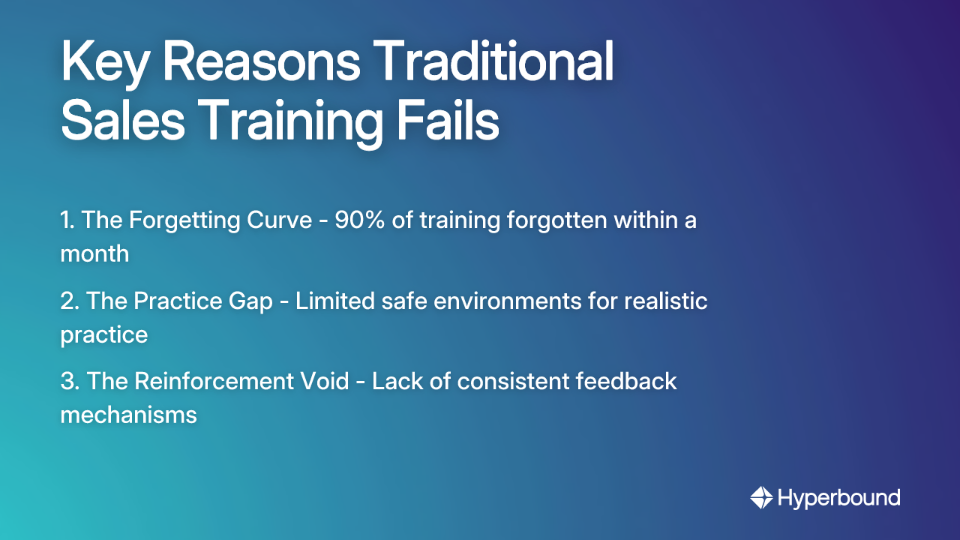
Before we can fix formal sales training, we need to understand why it fails so consistently. Three primary factors are responsible:
The Forgetting Curve
In 1885, psychologist Hermann Ebbinghaus discovered what we now call the "forgetting curve"—humans rapidly forget information without reinforcement. Without deliberate application and review, we lose:
- 50% of new information within 24 hours
- 70% within a week
- Nearly 90% within a month
This explains why that expensive sales kickoff or bootcamp, despite being engaging and informative at the moment, rarely creates lasting change.
The Practice Gap
"Sales is learn on the job," is a common worldview expressed by sales leaders. While there's truth here, practicing on live prospects is incredibly risky. It burns leads, damages brand reputation, and creates what many new reps describe as "overwhelming anxiety about making sales calls."
Traditional role-play scenarios with peers or managers attempt to address this, but they're often:
- Awkward and inauthentic
- Limited by manager availability
- Too infrequent to build real skill
Without a safe, realistic environment to practice repeatedly, new techniques remain theoretical rather than practical.
The Reinforcement Void
After a training session, reps are typically left to implement new techniques on their own. Managers, despite best intentions, don't have the capacity to review every call and provide timely feedback.
As one sales leader noted on Reddit, there's a critical "lack of tools to assess and improve representative skill gaps beyond individual calls." Without consistent reinforcement, reps naturally revert to comfortable patterns, rendering the training investment largely wasted.
The Modern Framework: Three Pillars for Training That Sticks
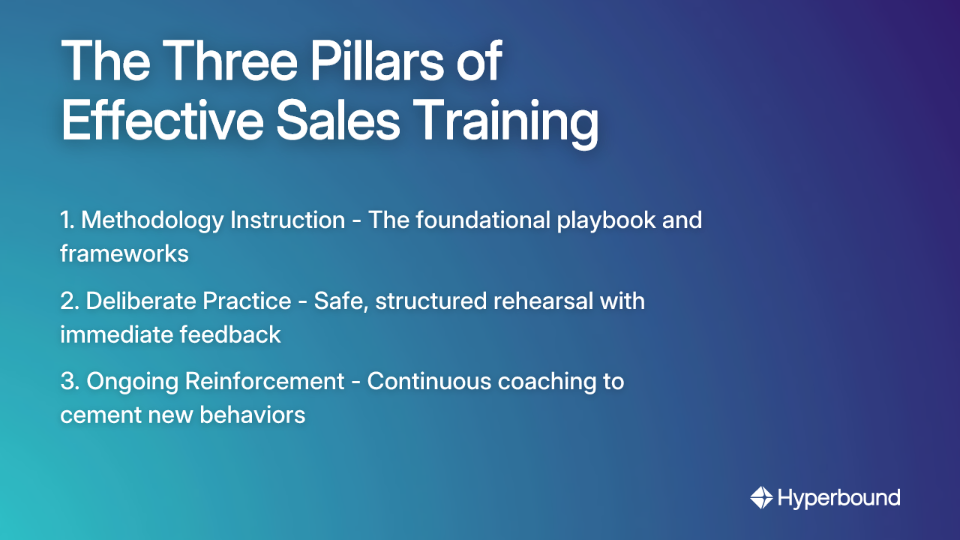
To overcome these fundamental challenges, effective formal sales training must be restructured around three essential pillars:
Pillar 1: Methodology Instruction (The Playbook)
This is the foundation of your training program—the core concepts, processes, and techniques your team needs to understand. Whether you're teaching The Challenger Sale, SPIN Selling, or a custom methodology, this pillar establishes a shared language and framework.
While this pillar is necessary, it's where most training programs begin and end. Information alone—no matter how brilliant—doesn't create behavior change. That's why the next two pillars are critical.
Pillar 2: Deliberate Practice (The Rehearsal)
This is where knowledge transforms into skill. Deliberate practice isn't just repetition; it's focused, structured practice with immediate feedback in a safe environment.
Deliberate practice is the bridge between knowing and doing. It's also the component most formal sales training programs fail to include adequately.
Pillar 3: Ongoing Reinforcement (The Performance Review)
The final pillar ensures new skills transfer from practice to live calls and become permanent through continuous coaching and reinforcement. This addresses the forgetting curve by regularly revisiting concepts and providing ongoing feedback on real-world performance.
When all three pillars work together, sales teams develop lasting skills that translate directly to improved performance. Let's explore how to implement each pillar effectively.
Deep Dive: The Three Pillars in Action
Pillar 1: Methodology Instruction — Building the Foundation
While this article won't focus extensively on specific sales methodologies (that's a topic for another day), it's important to recognize that your chosen methodology should:
- Align with your target buyers and market position
- Provide clear frameworks for key sales conversations
- Establish specific behaviors and talk tracks to master
The delivery method matters less than the content quality—whether through live workshops, online courses, or internal training sessions, ensure your methodology instruction is:
- Concise and actionable
- Relevant to your specific selling environment
- Reinforced with clear examples and scenarios
Remember that this pillar, while necessary, is insufficient alone. As one sales professional noted on Reddit, there's a widespread "belief that theoretical training is not practical unless applied in real sales situations."
That's where the second pillar becomes essential.
Pillar 2: Deliberate Practice — From Theory to Skill
Deliberate practice is the most critical—and often missing—component in formal sales training. It's what transforms theoretical knowledge into practical skill.
Traditional approaches to practice in sales training typically include:
- Role-playing with peers or managers: While better than nothing, these sessions often feel artificial, lack realism, and are limited by manager availability.
- Call shadowing: Valuable for observation but provides no active practice opportunity for the rep.
- "Learning on the job": The sink-or-swim approach that risks burning leads and creating anxiety in reps.
Modern solutions have emerged to address these limitations, with AI-powered practice environments leading the way. Hyperbound's AI Sales Roleplays exemplify this approach by providing:
- Unlimited, risk-free practice: Reps can rehearse cold calls, discovery, objection handling, and renewal conversations with dynamic AI buyer personas that respond realistically.
- Customizable scenarios: Tailored to your specific ICPs, products, and sales methodology, ensuring practice is directly relevant to daily work.
- Instant, objective feedback: After each session, reps receive an AI-powered scorecard that tracks talk ratios, adherence to key talk tracks, and areas for improvement.
This type of deliberate practice environment directly addresses the fear and anxiety many reps experience around making sales calls. As one Reddit user expressed, there's an "overwhelming pressure to start selling without sufficient preparation" in many sales organizations. AI-powered practice provides a safe space to develop confidence and competence before engaging live prospects.

Pillar 3: Ongoing Reinforcement — Making Skills Permanent
Even with excellent methodology training and deliberate practice, skills will fade without consistent reinforcement. This final pillar ensures that new behaviors stick and continuously improve over time.
The challenge: Managers can't be on every call. This creates inconsistent feedback and leads to skill decay. Many organizations struggle with what one sales leader described as the "difficulty in getting actionable feedback from call transcripts."
Modern solution: AI-powered call analysis and coaching tools have revolutionized this pillar. As Forbes notes, AI is transforming how sales teams approach ongoing coaching and reinforcement.
Hyperbound's AI Real Call Scoring and AI Coaching capabilities exemplify this approach:
- Automated call analysis: The system analyzes real customer conversations against your custom methodology, scoring calls objectively and identifying coaching opportunities.
- Personalized feedback: Reps receive instant, tailored coaching after each interaction, highlighting missed opportunities, weak responses, and deviations from best practices.
- Trend identification: The platform identifies patterns across multiple calls, addressing the need for "tools that analyze patterns across multiple calls for effective coaching."
This technology-enabled approach to reinforcement creates a continuous feedback loop that cements new skills and prevents regression to old habits.

The Measurable Impact: What Effective Training Looks Like
When formal sales training incorporates all three pillars—methodology, practice, and reinforcement—the results are substantial and measurable. According to NAW.org research:
- Companies implementing effective training saw a 12.6% average top-line sales growth
- One distributor achieved a 1.8 margin point increase after negotiation skills training
- Another saw a 2.5x increase in new account generation from trained reps versus untrained peers
By combining strong methodology with AI-powered deliberate practice and reinforcement, modern training programs like Hyperbound help teams achieve 3x faster skill mastery and retention. This translates directly to:
- Reduced ramp time for new hires
- Improved quota attainment across the team
- Higher win rates and deal sizes
- More consistent execution of sales playbooks
From Event to Engine: Transforming Your Sales Training Approach
Stop investing in one-off training events that are forgotten in a week. The key to formal sales training that actually sticks lies in creating a continuous learning cycle:
- Establish your methodology - Choose and teach a sales approach that aligns with your market and buyers
- Enable deliberate practice - Provide safe, realistic environments for reps to master new techniques
- Ensure ongoing reinforcement - Implement systems for continuous feedback and coaching
By leveraging technology to create safe practice environments and provide scalable coaching, you can finally build a sales team that not only learns but consistently executes at a high level.
Ready to build a formal sales training program that delivers lasting results? See how Hyperbound's AI Sales Coaching platform can bring the three pillars to life for your team, providing the practice and reinforcement components that traditional training programs miss.
Frequently Asked Questions
Why does most formal sales training fail?
Most formal sales training fails because it focuses only on delivering information without providing the necessary structure for practice and reinforcement, leading to knowledge being forgotten quickly. The core issues are the "forgetting curve," where reps forget up to 87% of information within 30 days; the "practice gap," which leaves reps to practice on live, high-stakes prospects; and the "reinforcement void," where a lack of consistent coaching allows reps to revert to old habits.
What are the three pillars of an effective sales training program?
The three essential pillars of an effective sales training program are Methodology Instruction, Deliberate Practice, and Ongoing Reinforcement. Methodology Instruction provides the core playbook and sales framework. Deliberate Practice offers a safe, structured environment for reps to rehearse and master skills. Ongoing Reinforcement uses continuous coaching and feedback on real-world performance to ensure the new skills stick and are applied consistently.
What is deliberate practice in the context of sales?
Deliberate practice in sales is a structured, focused rehearsal of specific sales skills, such as objection handling or discovery calls, in a safe, low-stakes environment with immediate feedback. Unlike traditional role-playing, which can be infrequent and artificial, deliberate practice involves repeated, targeted exercises designed to build muscle memory. Modern tools like AI sales simulators enable reps to practice anytime, receive objective feedback, and build confidence before engaging with real prospects.
How does the "forgetting curve" impact sales training?
The "forgetting curve" demonstrates that without reinforcement, sales reps will forget nearly 90% of what they learned in a training session within just one month. This psychological principle is the primary reason why one-off training events rarely lead to lasting behavior change. To overcome it, training must be a continuous process that includes ongoing practice and consistent reinforcement to embed knowledge into long-term memory and daily habits.
How can AI improve sales training and coaching?
AI improves sales training by providing scalable, personalized, and objective platforms for both practice and reinforcement. AI-powered tools can create realistic sales role-play scenarios for reps to practice in a risk-free environment, offering instant feedback on their performance. For coaching, AI can analyze real customer calls, score them against a company's methodology, and provide targeted feedback to reps and managers, ensuring new skills are consistently applied and improved upon.
How can you measure the ROI of a modern sales training program?
The ROI of a modern sales training program can be measured through key performance indicators such as reduced new hire ramp time, increased quota attainment, higher win rates, and improved consistency in executing sales plays. By implementing a system with all three pillars (Methodology, Practice, Reinforcement), organizations can track skill development and its direct impact on sales outcomes, leading to significant top-line growth and improved margins.
Book a demo with Hyperbound


