.png)


.png)
Summary
- Proving sales training ROI is a major challenge because it's difficult to connect traditional training activities to concrete business outcomes.
- To demonstrate impact, design a training plan with measurement built-in by first defining clear business objectives and collecting baseline performance data.
- Track both leading indicators (changes in rep behavior) and lagging indicators (business results like win rates), using a control group to isolate the training's effect.
- Leverage tools that automatically generate performance data, like Hyperbound's AI Sales Roleplays, to provide the objective metrics needed to connect practice to performance.
You've invested thousands in sales training activities, but when the C-suite asks for proof of impact, you're left scrambling for evidence beyond completion rates and satisfaction surveys. Sound familiar?
"Measuring ROI for L&D things is so important and every minute and penny needs to be tracked... but to get the data to fill in those variables and do the math is like pulling teeth," laments one frustrated learning professional on Reddit. Another notes, "You'll be hard pressed to find a correlation between your courses and on-the-job performance."
This disconnect isn't just frustrating—it's threatening your budget and credibility. Traditional sales training often operates as a "black box" with fuzzy connections between activities and outcomes.
But what if you could design a sales training activity plan with measurement built in from the start? One that clearly demonstrates the path from training dollars to revenue impact?
This guide provides a step-by-step framework for creating sales training activities that not only improve skills but generate the data needed to prove ROI to even the most skeptical executives.
Why Measuring Sales Training ROI Matters (But Feels Impossible)
Before diving into the how, let's address the why. According to The Brooks Group, measuring sales training ROI is crucial for:
- Justifying investment: Transforming your training department from a cost center to a profit driver
- Gaining leadership buy-in: Speaking the quantitative language that resonates with the C-suite
- Driving continuous improvement: Identifying what's working and what needs refinement
Yet many sales enablement professionals struggle because:
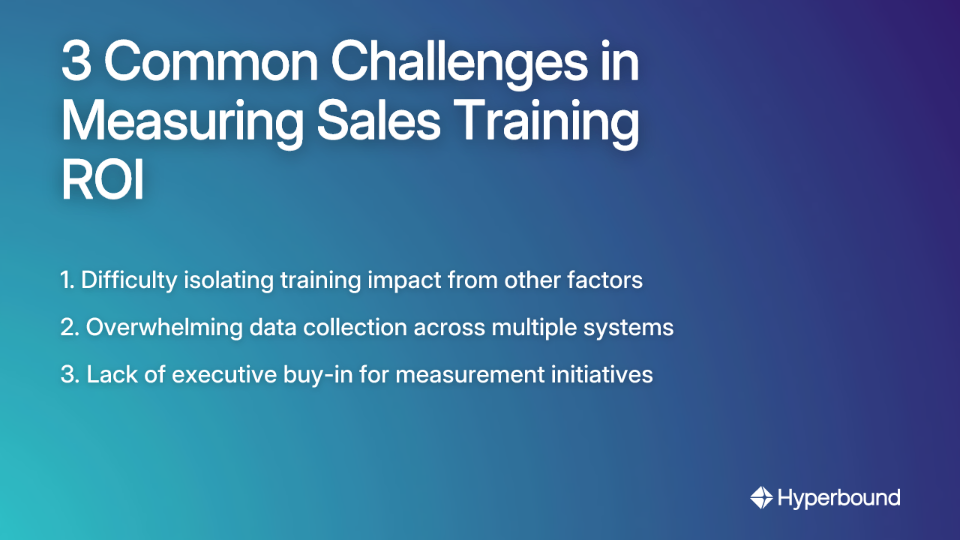
- Isolating training impact is difficult: Multiple factors influence sales performance, making it hard to attribute improvements solely to training
- Data collection feels overwhelming: Critical metrics often live in different systems or aren't tracked consistently
- Leadership support is lacking: Without executive buy-in, comprehensive measurement initiatives rarely succeed
The solution? A systematic approach that builds measurement into your training activities from day one.
The 4-Step Framework for ROI-Driven Sales Training
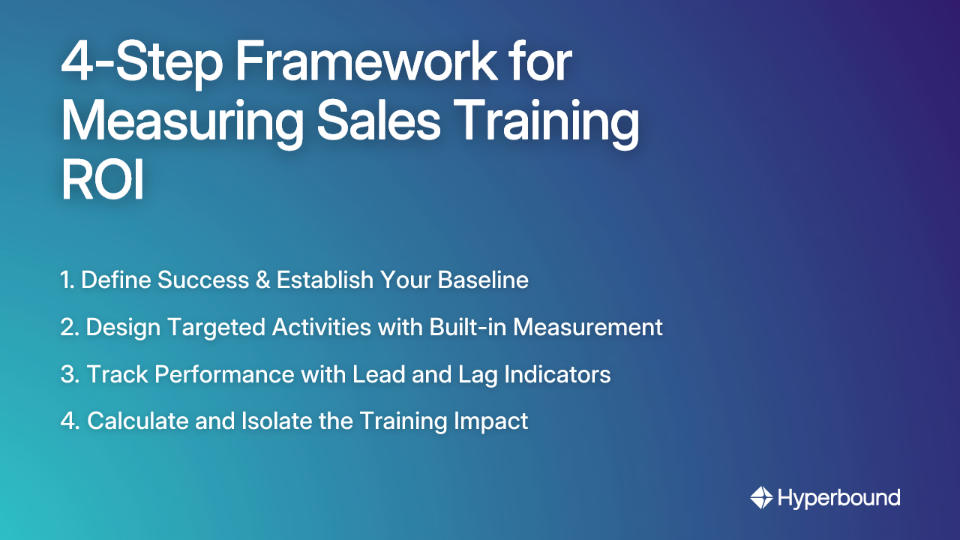
Step 1: Define Success & Establish Your Baseline
Before launching any sales training activity, you need clarity on what "success" looks like and where you're starting from.
Start with the end in mind: Work with leadership and sales managers to define specific, measurable objectives, such as:
- "Increase meeting book rate for new SDRs by 15% within 90 days"
- "Decrease average sales cycle length for AEs by 10% this quarter"
- "Improve discovery call-to-opportunity conversion rate by 20%"
Gather your baseline metrics: You can't demonstrate improvement without knowing your starting point. Collect at least 3-6 months of pre-training data across three categories:
- Performance metrics (lagging indicators): Win rate, average deal size, sales cycle length, quota attainment
- Activity metrics (leading indicators): Number of cold calls, emails sent, demos scheduled per rep
- Skill-based metrics: Conduct pre-training assessments to benchmark current abilities through observation, quizzes, or simulated scenarios
Pro tip: Document not just the metrics but also how and where this data is collected. This creates your measurement blueprint for post-training comparison.
Step 2: Design Targeted Activities with Built-in Measurement
Now comes the critical difference between traditional training and ROI-focused training: designing practice activities that automatically generate performance data.
1. AI-Powered Roleplays for Scalable Practice
Instead of inconsistent peer roleplays that yield no measurable data, consider AI-driven practice environments.
Hyperbound's AI Sales Roleplays allow reps to practice everything from cold calls to renewal conversations against AI buyer personas that respond dynamically. The key advantage for ROI measurement is the built-in data capture—reps receive instant, objective feedback via AI-Powered Scorecards that track key selling moments, talk track adherence, and conversation metrics. This provides both skill baseline and improvement tracking over time.
2. Structured Real Call Reviews
Address the common pain point of needing "feedback on actual calls" by implementing a structured review process.
Create a standardized scoring rubric to evaluate real sales conversations. For maximum efficiency, tools like Hyperbound's AI Real Call Scoring can automatically analyze your team's actual customer conversations, scoring calls against your methodology and surfacing coachable moments.
This approach gives you data on both practice performance (roleplays) and real-world application (customer calls), creating a clear connection between training and on-the-job behavior.
3. CRM Simulation-Based Training
For process-oriented training (like Salesforce usage or opportunity management), create sandbox environments where reps practice workflows without risking real data.
Measure completion rates and accuracy in performing key tasks within the simulation, then correlate this with improved CRM hygiene in actual accounts.
Step 3: Track Performance with Lead and Lag Indicators
A robust measurement plan tracks both short-term behavioral changes and long-term business results, using the framework recommended by RAIN Sales Training.
Lead Indicators (Predictive Measures)
These early signals show if your training is being adopted and applied:
- Behavioral adoption: Are reps using the new skills? Measure this through AI conversation intelligence tools like Hyperbound, which automatically tracks talk track adherence on real calls, or through manager observation scorecards
- Knowledge retention: Use post-training assessments and quizzes
- CRM activity metrics: Track increases in key activities (e.g., discovery calls logged, proposals sent)
- Rep confidence: Deploy pre/post-training surveys to measure changes in confidence levels
Lag Indicators (Business Impact)
These show the ultimate impact on business outcomes:
- Win rate: Has the lead-to-close ratio improved?
- Average deal size: Are reps closing larger deals?
- Sales cycle length: Are deals closing faster?
- Revenue growth: The ultimate measure of success
The key is connecting these two types of indicators to tell a complete story: "After implementing the discovery call training, reps asked 40% more pain-focused questions (lead indicator), which led to a 15% increase in opportunity-to-close rate (lag indicator)."
Step 4: Calculate and Isolate the Training Impact
To address the common challenge that "correlation does not imply causation," you need methods to isolate your training's specific impact.
Use a Control Group (Pilot Program)
The most scientifically valid approach is to apply training to one group of reps (the pilot group) and compare their performance against an untrained control group over the same period. This helps isolate training as the key variable affecting performance.
For example, if both groups see a 5% performance increase but your trained group sees a 15% increase, you can reasonably attribute the additional 10% improvement to your training program.
Pre- and Post-Measurement
If a control group isn't feasible, rely on strong pre- and post-training data. Track metrics for at least one full sales cycle after the program to measure sustained change.
Be transparent about other factors that might influence results during this period, such as market changes, product updates, or leadership shifts.
A Practical Guide to Metrics for Key Sales Training Activities
Different sales training activities require different measurement approaches. Here's a quick-reference guide for common training scenarios:
Cold Calling / Prospecting Training
Goal: Book more qualified meetings Metrics to Track:
- Call-to-meeting conversion rate
- Adherence to opening script/value proposition
- Talk-to-listen ratio
- Number of targeted questions asked
How AI Helps: Hyperbound's AI Roleplays score reps on their ability to deliver the opener and handle initial brush-offs, while AI Real Call Scoring tracks these metrics on live calls, providing before-and-after comparisons.
Discovery Call Training
Goal: Uncover deep customer pain and qualify opportunities effectively Metrics to Track:
- Number of pain-oriented questions asked
- Lead-to-opportunity conversion rate
- Pipeline coverage generated
- MEDDICC/BANT criteria captured per call
How AI Helps: AI can identify whether reps are asking questions from your prescribed methodology and summarize key buying signals from the conversation, creating clear pre/post training comparison data.
Objection Handling Training
Goal: Effectively navigate and resolve common customer objections Metrics to Track:
- Success rate in overcoming specific objections (e.g., price, timing)
- Improvement in roleplay scores for objection scenarios
- Reduction in deals lost to specific objections
How AI Helps: Create specific roleplay scenarios for your top 5 objections, allowing reps to practice until they master the talk tracks, with clear scoring showing improvement over time.
Presenting Your Sales Training ROI to Leadership
Now that you've collected robust data, it's time to present it effectively to secure continued investment.
The Simple ROI Calculation
Follow this step-by-step formula from The Brooks Group:
- Calculate Increased Revenue: (Post-Training Revenue) - (Baseline Revenue)
- Determine Net Profit: (Increased Revenue) - (Total Training Costs)
- Calculate ROI Percentage: (Net Profit / Total Training Costs) x 100
For example, if your training costs $20,000 and generated $100,000 in additional profit, the ROI is ($100,000 / $20,000) * 100 = 500%.
Telling the Full Story with The Kirkpatrick Model
While the ROI calculation is powerful, executives also need context. The Kirkpatrick Model provides a comprehensive framework to present training impact:
- Level 1: Reaction: Did they like the training? (Completion rates, satisfaction surveys)
- Level 2: Learning: Did they learn the material? (Assessment scores, skill benchmark improvements)
- Level 3: Behavior: Are they applying it on the job? (CRM activity, call scores)
- Level 4: Results: Did it impact business metrics? (Win rates, deal size)
- Level 5: ROI: Was it worth the cost? (The final ROI calculation)
Your Executive ROI Presentation Template
- The Business Challenge: Start with baseline metrics and the problem you aimed to solve
- "Our new hire ramp time was 9 months, and first-year quota attainment was 45%"
- The Training Initiative: Briefly describe the program, participants, and total cost
- The Results (Lead & Lag Indicators):
- Show immediate behavior changes: "Post-training, reps increased discovery questions by 30%"
- Show business outcomes: "The trained group's win rate improved by 12% compared to the control group"
- The Financial ROI: Present the final ROI percentage
- Next Steps & Recommendations: Propose how to build on this success
Conclusion: From Training Activities to Strategic Investment
By following this framework, you transform sales training from a necessary expense into a strategic investment with measurable returns. The key shifts include:
- Starting with the end in mind: Defining success metrics before designing training
- Building measurement into activities: Using tools like Hyperbound's AI Sales Roleplays and AI Call Scoring to generate data automatically
- Connecting behavior to outcomes: Linking lead indicators (what reps do) to lag indicators (business results)
- Isolating training impact: Using control groups or robust pre/post measurements
- Presenting ROI strategically: Telling a complete story that resonates with executives
With this approach, you'll never again struggle to justify your training budget. Instead, you'll confidently demonstrate how each sales training activity contributes to the metrics that matter most: revenue and growth.
Remember that measuring ROI isn't just about defending your budget—it's about continuously improving your training to create maximum impact for your sales organization. Each measurement cycle provides insights for making your next sales training activity even more effective.
Ready to implement a sales training activity plan with built-in ROI measurement? Start with a single high-priority sales skill, apply this framework, and watch how quickly you can move from "trust me, it works" to "here's exactly how it's driving revenue."
Frequently Asked Questions
What is the first step to measuring sales training ROI?
The first and most critical step is to define specific, measurable business objectives and establish a baseline of current performance. Before launching any training, you must know what you're trying to improve (e.g., "increase meeting book rate by 15%") and where your team is starting from by collecting at least 3-6 months of pre-training data on performance, activity, and skill metrics.
Why is measuring sales training ROI so difficult?
Measuring sales training ROI is difficult primarily due to three challenges: 1) isolating the impact of training from other variables like market changes or new products, 2) the overwhelming task of collecting consistent data across different systems, and 3) a lack of executive buy-in for comprehensive measurement initiatives.
How can you prove sales training caused a performance increase?
To prove causation, you must isolate the training's impact. The most effective method is using a control group, where you train one group of reps and compare their performance against an untrained group. If a control group isn't possible, use a robust pre- and post-measurement system, tracking metrics for at least one full sales cycle after the program while acknowledging other potential influencing factors.
What are the best metrics for tracking sales training success?
The best approach is to track both lead and lag indicators. Lead indicators are early signals of behavior change, such as adherence to a new talk track or increased CRM activity. Lag indicators are the ultimate business outcomes, such as improved win rates, larger average deal sizes, or shorter sales cycles. Connecting these two tells a complete story of training impact.
How do you calculate the ROI of a sales training program?
You can calculate sales training ROI with a simple formula: ROI % = (Net Profit from Training / Total Training Costs) x 100. First, calculate the increased revenue attributable to the training, then subtract the total training costs to find the net profit. This final percentage clearly communicates the financial return on your training investment.
How can AI help measure sales training effectiveness?
AI can significantly improve measurement by automatically generating objective performance data at scale. AI-powered tools like sales roleplay simulators and real call scoring can track skill application, adherence to methodology, and specific behavioral metrics (e.g., talk-to-listen ratio) on both practice and live calls. This provides a clear, data-backed connection between training activities and on-the-job performance.
Book a demo with Hyperbound


