

.png)
You've been through the standard sales training. You've got the three-ring binder filled with scripts for every scenario. You've practiced your pitch until you could recite it in your sleep. And now, as you sit across from a potential client, you feel like a character in Fallout trying to pass a speech check—desperately hoping your memorized lines will somehow convince them to buy.
But instead of engagement, you see the prospect's eyes glaze over. They've heard this pitch before. And now you're scrambling, flipping through mental pages of rebuttals, wondering which pre-written objection handling technique might save this increasingly awkward conversation.
This isn't selling. It's performing—and not very well.
The Problem with the Playbook: Why Scripts Don't Work
Traditional sales training has its roots in the 1930s automobile industry, where sales managers sought to standardize customer interactions through scripts. This assembly-line approach made sense for selling commoditized products in a simpler time. But in today's complex B2B landscape, this outdated model is fundamentally flawed.
Why do scripts fail so consistently in real-world sales conversations?
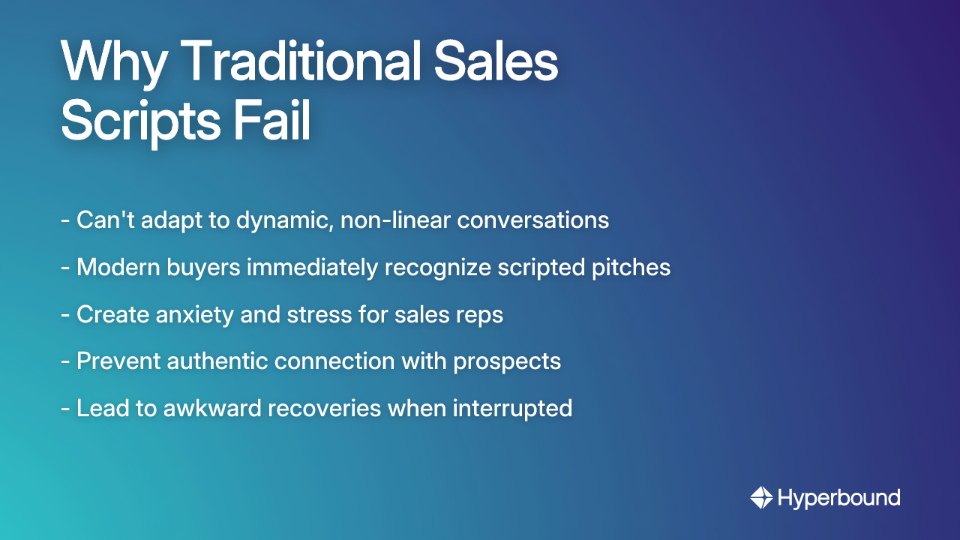
Scripts can't adapt to dynamic conversations. Real human interactions don't follow a linear path. They meander, circle back, and take unexpected turns. When a prospect interrupts with a question that wasn't in your script, the mental gymnastics required to get back on track often lead to awkward pauses and disjointed responses.
Traditional sales training often focuses on rote memorization of scripts and product pitches, which fails to engage sales reps in authentic conversations. This inability to flow naturally with the conversation makes you sound robotic and untrustworthy.
Prospects can smell a script from a mile away. Today's buyers are sophisticated and have likely sat through countless sales pitches. They can immediately tell when you're reciting rather than conversing, which creates skepticism about both you and your offering. As CBS News reports, "Many prospects find scripted interactions manipulative and unethical, damaging credibility."
The emotional toll is significant. New sales reps especially feel overwhelmed and pressured to memorize techniques, leading to stress and anxiety when they inevitably go off-script. The constant rejection that comes from sounding inauthentic creates a need for ongoing motivational training just to keep reps from burning out.
Even when selling a commoditized product with few differentiating features, relying on magic dust in the form of perfectly memorized pitches rarely works. Instead of creating warm leads, this approach often turns potential clients cold.
From Scripted to Skilled: Building Your Conversational Toolkit
The solution isn't to abandon preparation altogether but to shift from memorizing scripts to developing a flexible conversational toolkit. This means having talking points as a guide rather than verbatim lines to recite.
Modern, skills-based training focuses on building core competencies that can be applied to any sales situation, rather than attempting to script every possible scenario. The most successful sales professionals master these essential skills:
- Active Listening: Instead of waiting for your turn to speak, genuinely absorb what the prospect is saying. Summarize their points back to them and ask clarifying questions that demonstrate your understanding.
- Empathy: Put yourself in the prospect's shoes to understand their challenges, goals, and fears. This builds trust and shows you're genuinely interested in solving their problems.
- Adaptability: Be prepared to pivot your approach based on the flow of the conversation and buyer dynamics. If one angle isn't resonating, smoothly transition to a different approach.
- Storytelling: Make product benefits relatable by weaving them into compelling narratives about how similar clients overcame challenges. Stories are remembered long after features are forgotten.
- Curiosity: Drive deeper understanding through genuine questions about the prospect's situation. The goal is discovery, not confirmation of what you already believe.
.png)
A healthcare technology company exemplifies this modern approach by conducting active listening workshops where reps participate in role-playing scenarios with immediate feedback from coaches. Rather than memorizing responses to predetermined questions, reps learn to identify underlying concerns and address them authentically.
The Psychology of the Conversation: Connecting, Not Pitching
The most significant shift in effective sales training is moving from "What am I selling?" to "Why are they buying?" This psychological perspective transforms the interaction from pitch to partnership.
Understanding prospect psychology is infinitely more valuable than perfecting your delivery of product pitches. Gary Morgan Coach explains that successful sales conversations leverage several psychological principles:
- Build Rapport First: Before rushing to solutions, establish a genuine connection. Listen to understand, paraphrase their points, and find common ground to create a foundation of trust.
- Leverage Reciprocity: Offer value before asking for anything in return. Share an insight or solve a small problem for them, creating a natural inclination to reciprocate.
- Harness Social Proof: Share relevant success stories that help prospects envision similar outcomes for themselves, reducing perceived risk through the experiences of others.
- Uncover True Pain Points: Go beyond surface-level problems to understand what's truly driving decision-making. Is it fear of falling behind competitors? Personal career advancement? Cost reduction imperatives from leadership?
- Balance Emotion with Logic: Appeal to emotion through storytelling about outcomes, then justify the decision with logical data points and ROI calculations that make the emotional decision defensible.
When you understand these psychological principles, you don't need to memorize a script—you can craft moment-specific responses that resonate because they're aligned with how the prospect actually thinks and makes decisions.
Developing Authentic Responses and Handling Objections with Confidence
One of the most challenging aspects of moving beyond scripts is learning to handle objections confidently without pre-memorized rebuttals. Effective objection handling isn't about having the perfect comeback; it's about understanding the underlying concern and addressing it authentically.
Instead of memorizing twenty different ways to respond to "your price is too high," focus on developing a framework for understanding what's behind that objection. Is it a genuine budget constraint? A value perception issue? A negotiation tactic? Each requires a different approach that can't be scripted in advance.
Modern sales training methods are evolving to develop these skills in ways that transcend traditional role-play:
- AI-Powered Role-Play: Platforms like Hyperbound allow reps to practice handling difficult conversations with hyper-realistic AI buyer personas. These AI simulations respond differently each time, providing a safe environment to master new talk tracks and get real-time, unbiased feedback without the pressure of practicing on actual customers.
- Conversation Intelligence: Leading platforms can now analyze real sales calls to identify what top performers say differently when handling objections or conducting discovery. For instance, Hyperbound's AI Real Call Scoring provides data-driven insights to help reps understand what works in actual conversations, not just in theory.
- Respectful Pushback: Sometimes the most effective approach is gentle challenging of a prospect's assumptions or misperceptions. This positions you as a consultant rather than just another vendor trying to double tap them with follow-up calls after initial rejection.

Beyond the Classroom: Self-Directed Learning and Mentorship
Even the best formal training programs can't prepare you for every situation you'll encounter with gatekeepers and decision-makers. The most successful sales professionals recognize that continuous enablement and self-directed learning are essential.
Microlearning has emerged as a particularly effective approach. Rather than overwhelming reps with day-long training sessions, this method enhances retention by breaking down information into bite-sized modules. These can be consumed just before specific sales activities, like preparing for a crucial meeting or sending effective follow-ups.
Finding mentors within your organization can fill the gaps when formal training falls short. Identify successful colleagues who consistently close deals with approaches you admire, and ask if you can listen in on their calls or get feedback on your approach. Most top performers are happy to share their wisdom if asked respectfully.
Create your own real-world simulations by recording yourself and analyzing the results. Practice explaining complex concepts simply, handling common objections, and conducting Q&A sessions as if you were facing an actual prospect. This self-coaching approach builds confidence that no script ever could.
Ditch the Script, Embrace the Conversation
The future of sales isn't about memorizing the perfect closing line or having an answer for every possible objection. It's about developing the skills to have authentic, value-driven conversations with prospects who can tell the difference between a rehearsed pitch and genuine interest in solving their problems.
Modern, skills-based training recognizes that sales success comes from understanding human psychology, actively listening to uncover needs, and confidently adapting your approach based on the conversation's flow. No script can capture the nuance of a real human connection.
So put down the three-ring binder. Stop trying to pass the Fallout speech check. Instead, focus on one core skill like active listening this week. Find a mentor who can provide feedback on your approach. Embrace continuous learning as the path to sales excellence.
Because in the end, people don't buy from scripts. They buy from people they trust to solve their problems.
Frequently Asked Questions
Why do traditional sales scripts fail in modern sales?
Traditional sales scripts fail because they are rigid and cannot adapt to the dynamic, non-linear nature of modern sales conversations. Prospects today can easily recognize a scripted pitch, which makes the salesperson seem inauthentic and untrustworthy. Scripts prevent genuine connection and create anxiety for reps when conversations go off-track.
What should I use instead of a sales script?
Instead of a rigid sales script, you should develop a flexible conversational toolkit built around key talking points and core communication skills. This approach allows you to guide the conversation without being locked into verbatim lines, empowering you to listen actively and respond authentically to the prospect's unique needs.
What are the most important conversational skills for sales?
The most important conversational skills for modern sales professionals are active listening, empathy, adaptability, storytelling, and curiosity. Mastering these skills allows you to move beyond pitching features and connect with prospects on a human level, understand their true pain points, and frame your solution in a compelling and relevant way.
How can I handle sales objections without a script?
You can handle objections without a script by focusing on understanding the underlying concern behind the objection rather than reciting a pre-memorized rebuttal. Use active listening and curiosity to ask clarifying questions to determine if the objection is about budget, value, or timing. This framework-based approach is far more effective than a one-size-fits-all scripted response.
What is AI-powered sales role-play?
AI-powered sales role-play is a modern training tool that allows sales reps to practice difficult conversations with hyper-realistic AI buyer personas in a safe, risk-free environment. Unlike traditional role-play, AI simulations provide unbiased, real-time feedback and adapt their responses, helping reps master new talk tracks and build confidence without practicing on live customers.
How can new sales reps be trained effectively without scripts?
New sales reps can be trained effectively by focusing on core skills and psychological principles rather than rote memorization. Modern methods like AI-powered role-playing, analyzing real calls with conversation intelligence, and mentorship from top performers are highly effective. This skills-based approach equips new reps with the adaptability and confidence needed for real-world success.

Book a demo with Hyperbound


