

Summary
- The most effective financial advisors succeed by shifting from a "seller" to a trusted "advisor" mindset, focusing on building long-term relationships through genuine value.
- Master client conversations across three key stages: Acquisition (discovery, objection handling), Adoption (onboarding), and Lifecycle Management (performance reviews, wealth transfer).
- With an estimated $100 trillion wealth transfer looming, the ability to skillfully navigate sensitive family conversations is a critical skill for retaining assets across generations.
- Financial advisors can gain confidence and master these high-stakes conversations by using AI Sales Roleplays to practice without risking real client relationships.
You've just wrapped up a prospect meeting that went completely sideways. Despite your preparation, you stumbled over your value proposition, failed to address key objections, and left feeling like you've blown a significant opportunity. That sinking feeling in your stomach is all too familiar for many financial advisors.
"I stopped thinking of it as sales and started thinking of it as proper advice that anyone would be happy to receive," shares one experienced CFP on Reddit. This mindset shift captures the essence of successful sales training for financial services professionals – moving from transaction-focused selling to relationship-centered advising.
The truth is that most financial advisors didn't enter the profession to become salespeople. Yet your ability to effectively communicate value, build trust, and guide clients through complex financial decisions directly impacts both your clients' success and your practice's growth.
The Mindset Shift: From Seller to Advisor
The first step in mastering sales as a financial advisor isn't learning closing tactics – it's embracing a fundamental mindset shift.
"Clients can see through BS better than you think. If it feels like sales to them, they are less likely to implement," notes one advisor with decades of experience. This insight highlights why traditional high-pressure sales techniques often fail in wealth management contexts.
Instead of approaching client interactions as opportunities to sell products, successful advisors view them as opportunities to provide genuine value. This shift from self-interest to client-interest fundamentally transforms how you communicate, listen, and build relationships.
When you truly operate from a place of service rather than sales, several things happen:
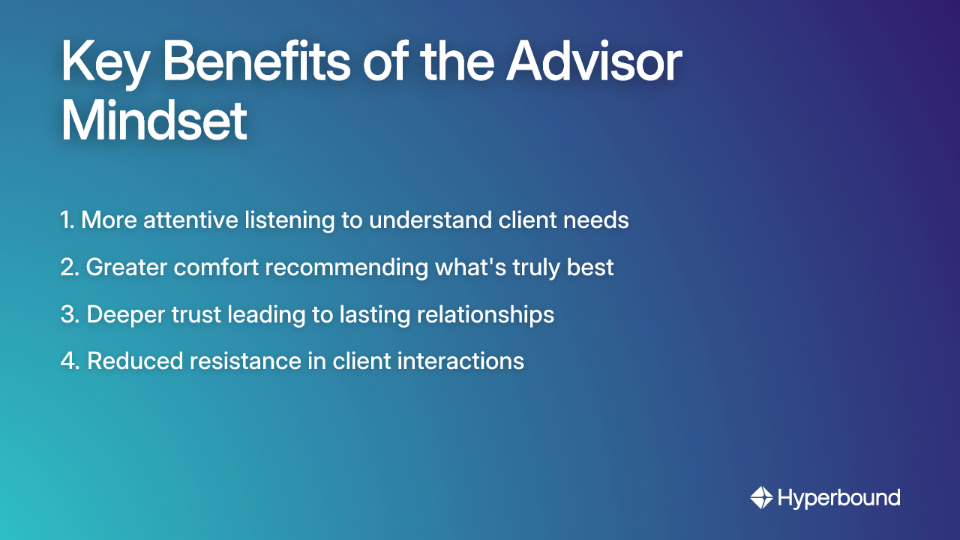
- You listen more intently to understand client needs
- You're more comfortable recommending what's actually best (even when it's not the most profitable option)
- You build deeper trust that leads to long-term relationships and referrals
- You experience less resistance and anxiety in your client interactions
As one wealth manager put it, "I was trained to be an aggressive closer and it worked alright. I switched to lead with empathy." This evolution represents the gold standard in financial advisor sales training – maintaining business growth while truly putting clients first.
The Client Lifecycle Sales Framework
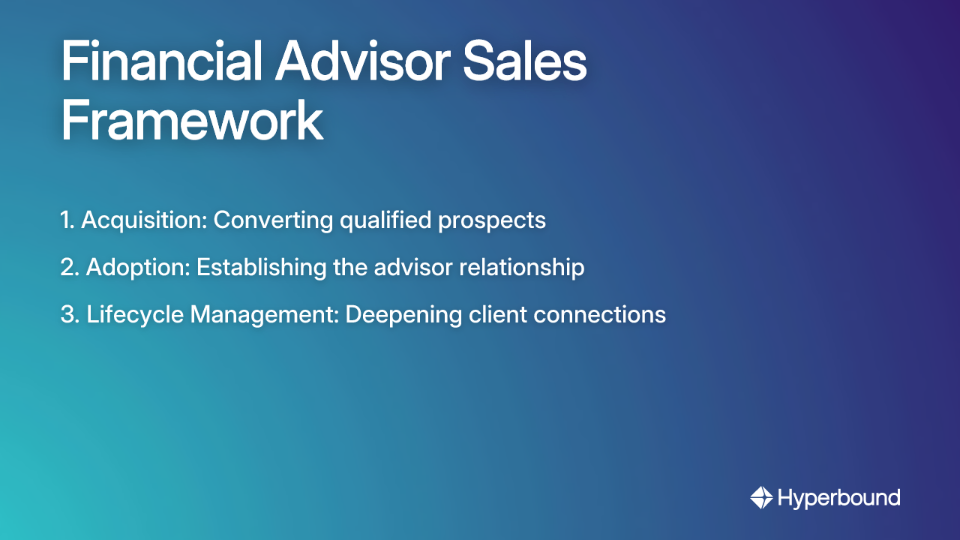
To master sales conversations across the entire client journey, we've developed a comprehensive framework based on three critical stages of the client lifecycle:
- Acquisition: Attracting and converting qualified prospects
- Adoption: Onboarding and establishing the advisor relationship
- Lifecycle Management: Deepening relationships and navigating complex wealth needs
Let's explore each stage and the specific conversation skills required for success.
Stage 1: Mastering the Acquisition Conversation
The acquisition stage is where you convert prospects into clients while establishing the foundation for a trusted advisor relationship. The goal is not just getting a signature, but beginning a meaningful financial partnership.
Key Acquisition Challenges
Financial advisors face unique challenges during acquisition:
- Overcoming the "salesy" perception that creates immediate resistance
- Explaining complex financial concepts in accessible ways
- Establishing credibility and expertise quickly
- Managing anxiety around rejection ("starvation anxiety")
Critical Acquisition Conversations
The Discovery Call
The discovery conversation is your opportunity to deeply understand a prospect's financial situation, goals, and concerns. Rather than pitching your services immediately, focus on asking thoughtful questions and active listening.
"Listening to clients is such an underrated part of the process. So many sales people can't shut up long enough to listen," observes one successful advisor. This insight highlights why AI practice tools like Hyperbound can be valuable for financial advisors – they allow you to practice discovery conversations and receive feedback on your questioning techniques and listening skills.
Effective discovery calls follow a structure:
- Build rapport: Connect personally before diving into finances
- Ask powerful questions: Move beyond surface-level data to understand motivations, fears, and aspirations
- Actively listen: Pay attention to both what is said and unsaid
- Confirm understanding: Summarize what you've heard to ensure alignment
The Value Proposition Presentation
After discovery, you'll present your proposed approach. This is where many advisors falter by overcomplicating their message.
"The best closers I've met in the business are able to explain complex strategies in a very basic way," notes one advisor. "Too many salespeople want to sound smart and say words that mean nothing to the prospect."
Your value proposition should:
- Directly address the specific needs identified in discovery
- Explain complex concepts using simple language and relatable analogies
- Focus on outcomes rather than products or services
- Differentiate your approach from alternatives (including doing nothing)
Objection Handling
Financial decisions involve significant emotional and practical considerations, making objection handling a crucial skill. Common objections include concerns about fees, market performance, and the value of professional management.
The most effective approach follows a four-step process:
- Listen completely to the objection without interrupting
- Acknowledge the concern with empathy
- Respond with evidence and context
- Confirm that you've addressed their concern
"The only way to take the anxiety out of getting a no is to get a lot of no's," shares one advisor. This highlights the importance of practice – the more comfortable you become with objections, the less emotionally reactive you'll be when they arise.
Stage 2: Nailing the Adoption Conversation
Once a prospect becomes a client, the relationship enters the critical adoption phase. This is where you solidify trust and establish working patterns that will define your ongoing relationship.
"Once they've signed the dotted line to let me be their planner, I'm not selling anymore. I'm helping," explains one CFP. This mindset is essential during adoption, where your focus shifts from convincing to implementing.
Key Adoption Conversations
The Onboarding Meeting
The first meeting after commitment sets the tone for your entire relationship. Key elements include:
- Setting clear expectations: Outline communication cadence, service levels, and what success looks like
- Explaining your process: Walk through your approach and next steps
- Addressing immediate concerns: Answer any lingering questions
- Establishing action items: Clarify what you need from them and what they can expect from you
The Initial Plan Presentation
When presenting your comprehensive financial plan or investment strategy, focus on:
- Breaking down complex recommendations into manageable parts
- Connecting recommendations directly to the client's stated goals
- Setting realistic expectations about timelines and outcomes
- Creating clear implementation priorities
Stage 3: Excelling in Lifecycle Management & Wealth Transfer
The lifecycle management stage is where long-term client value is created. This phase includes ongoing review meetings, additional planning opportunities, and the crucial wealth transfer conversations that will determine whether your client relationships extend to the next generation.
The Great Wealth Transfer Challenge
The most significant opportunity (and challenge) for today's financial advisors is the impending wealth transfer. An estimated $100 trillion will transfer to younger generations by 2048, according to AdvisorHub. Yet these conversations are fraught with emotional complexity.
"Nearly everyone is uncomfortable thinking about their own mortality, let alone discussing it," explains David Handler of Kirkland & Ellis in a FamilyWealthReport interview.
Research from RBC Wealth Management shows 65% of wealth givers and 94% of receivers want professional help with wealth transfer conversations – presenting a massive opportunity for advisors who can skillfully facilitate these discussions.
Key Lifecycle Management Conversations
Performance Review Meetings
Regular review meetings should balance technical performance discussion with emotional reassurance. Effective reviews:
- Begin with personal connection before diving into numbers
- Put performance in proper context (goals, benchmarks, time horizon)
- Address concerns proactively rather than defensively
- Recalibrate expectations and strategy as needed
The Wealth Transfer Discussion
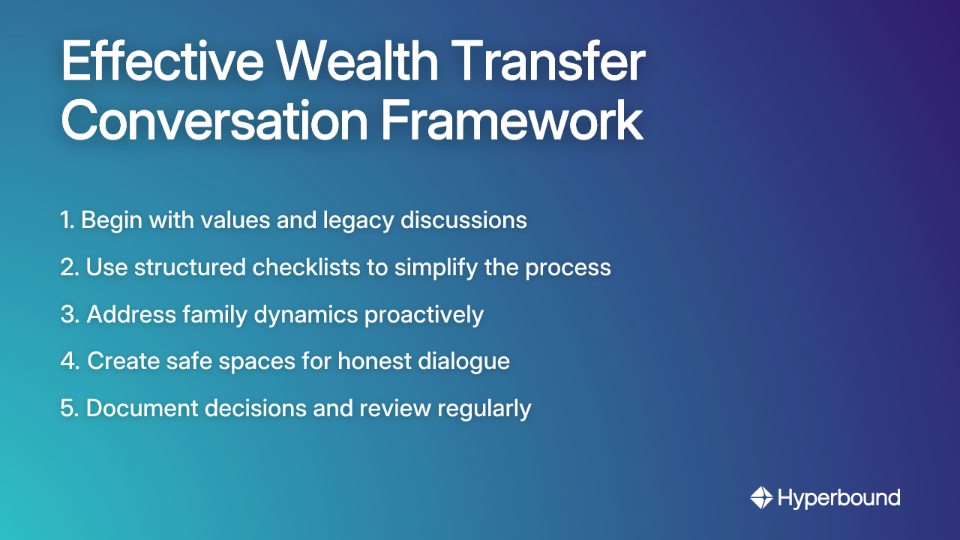
The wealth transfer conversation requires exceptional sensitivity and facilitation skills. Robert Stern of RBC recommends a "gradualist approach" that makes these discussions more manageable:
- Start with values and legacy rather than technical details
- Use checklists and frameworks to demystify the process
- Address family dynamics proactively
- Create a safe space for honest dialogue among family members
- Document decisions and revisit regularly
As Steve Lockshin notes regarding inheritance discussions, "What's fair is not equal, and what's equal is not fair." Navigating these nuanced family dynamics requires both emotional intelligence and technical expertise.
Implementing This Framework: The Power of AI-Powered Practice
Understanding this framework is only the first step. The challenge for most advisors is gaining enough experience with these critical conversations without "royally screwing up prospect meetings" in the process.
Traditional role-playing with senior advisors, while valuable, has limitations. It's time-consuming, dependent on others' availability, and often doesn't provide objective feedback. This is where modern technology offers a compelling solution.
AI-Powered Practice for Financial Advisors
Platforms like Hyperbound now provide financial advisors with the ability to practice critical client conversations through AI-powered roleplays. These tools allow you to:
- Practice without risk: Master challenging conversations like fee discussions, market volatility explanations, and wealth transfer planning before facing real clients.
- Receive objective feedback: AI coaching tools provide data-driven insights on your talk patterns, question quality, and emotional intelligence – helping you identify specific improvement areas.
- Analyze real client conversations: Using AI Call Scoring, you can review your actual client meetings to identify what's working and what needs refinement, all while ensuring regulatory compliance.
- Scale your development: Practice consistently on your schedule, rather than depending on others' availability.
Industry research shows that organizations using AI sales coaching see up to a 20-25% improvement in rep proficiency and 15% faster ramp time – critical advantages in today's competitive wealth management landscape.

Conclusion: From Sales Anxiety to Advisory Confidence
The journey from anxiety-producing sales conversations to confident advisory discussions isn't achieved through a single training program or book. It requires a systematic approach to mastering the specific conversations that define each stage of the client lifecycle.
By understanding the unique requirements of acquisition, adoption, and lifecycle management conversations – and leveraging modern tools like AI coaching to accelerate your learning – you can transform your practice and your client relationships.
Remember what one veteran advisor shared: "Being genuine and honest makes sales relatively easy once you know your products in and out." When you combine deep product knowledge with authentic client focus and well-practiced conversation skills, you create the foundation for exceptional client relationships and practice growth.
The most successful financial advisors aren't necessarily the best salespeople – they're the best advisors. By mastering these critical conversations, you position yourself to provide truly valuable guidance that clients will gladly pay for, implement, and refer to others.
Frequently Asked Questions
Why is the mindset shift from seller to advisor so important for financial advisors?
The mindset shift from seller to advisor is crucial because it builds client trust and leads to long-term relationships. When you prioritize providing genuine value over making a sale, clients are more receptive to your advice, leading to better implementation of financial plans, increased referrals, and less anxiety in your client interactions.
What are the three key stages of the client lifecycle sales framework?
The three key stages are Acquisition, Adoption, and Lifecycle Management. Acquisition focuses on converting prospects into clients. Adoption involves onboarding new clients and establishing the relationship. Lifecycle Management is about deepening the relationship over time through ongoing reviews and complex planning, such as wealth transfer.
How can financial advisors get better at handling client objections?
Financial advisors can improve their objection handling by following a four-step process: listen completely, acknowledge the concern with empathy, respond with evidence and context, and confirm the concern has been addressed. Practicing these conversations, especially with AI tools, helps remove the anxiety and emotional reaction to objections.
What is the most effective way to explain complex financial concepts to clients?
The most effective way is to use simple language and relatable analogies, focusing on outcomes rather than technical jargon. By breaking down complex strategies into basic, understandable terms, you build confidence and ensure the client truly understands the value you are providing, which is a key trait of the best advisors.
Why are wealth transfer conversations a major opportunity for advisors?
Wealth transfer conversations are a major opportunity because an estimated $100 trillion will be passed to younger generations in the coming decades. Most families want professional guidance to navigate these emotionally complex discussions, allowing advisors who master these skills to retain assets across generations and provide immense value.
How can AI-powered practice tools help financial advisors?
AI-powered practice tools help financial advisors by providing a risk-free environment to master critical conversations. These platforms allow you to practice handling fee objections, discussing market volatility, and navigating wealth transfer talks. You receive objective, data-driven feedback on your performance, helping you identify specific areas for improvement and accelerate your development without jeopardizing real client relationships.
Book a demo with Hyperbound


