.png)


.png)
Summary
- Companies waste billions on sales training, with roughly 90% of new skills forgotten within a year because training is treated as a one-time event instead of a continuous process.
- The primary reasons for failure include a lack of manager reinforcement, training content disconnected from real-world sales scenarios, and no clear strategy or executive buy-in.
- To make training effective, organizations must shift to a culture of continuous learning, empower managers to be effective coaches, and tie training directly to strategic business goals.
- A key part of effective training is providing realistic practice; AI-powered platforms like Hyperbound allow reps to master conversations in a safe, repeatable environment.
You've been there before. Another "revolutionary" sales training session where the so-called expert rolls in with new acronyms and methodologies that have your team rolling their eyes. As one frustrated sales rep put it, "Every six months, our sales enablement team rolls in a so-called 'sales expert' with their own ideas and acronyms. It takes the AEs all 3 days just to learn the new acronyms, let alone the new methods."
And the results? Usually the same. Initial enthusiasm followed by a quick return to old habits and minimal lasting impact on your bottom line.
It's not just you. This is happening everywhere. U.S. companies spend up to $5,000 per rep on sales training annually, with 95% investing in some form of sales education. Yet the Wall Street Journal reports that approximately 90% of new skills learned in training are lost within a year.
That's billions of dollars spent with almost nothing to show for it.
This article will break down why most sales training initiatives crash and burn—and provide a clear, actionable blueprint to transform your training from a fleeting event into a sustainable driver of revenue.
The Sobering Reality: Why Your Investment Isn't Paying Off
The average sales organization spends $2,326 per salesperson annually on training. Despite this investment, a significant 43.5% of organizations feel their training programs need improvement.
This gap between spending and results isn't random. A McKinsey global survey of 1,200 respondents found that fast-growing companies are 80% more likely than slow-growing ones to achieve commercial success from their sales training programs.
The difference comes down to how training is approached, implemented, and reinforced. Let's examine the five fundamental failures that doom most sales training initiatives from the start.
The Core Failures: A Diagnosis of Ineffective Sales Training
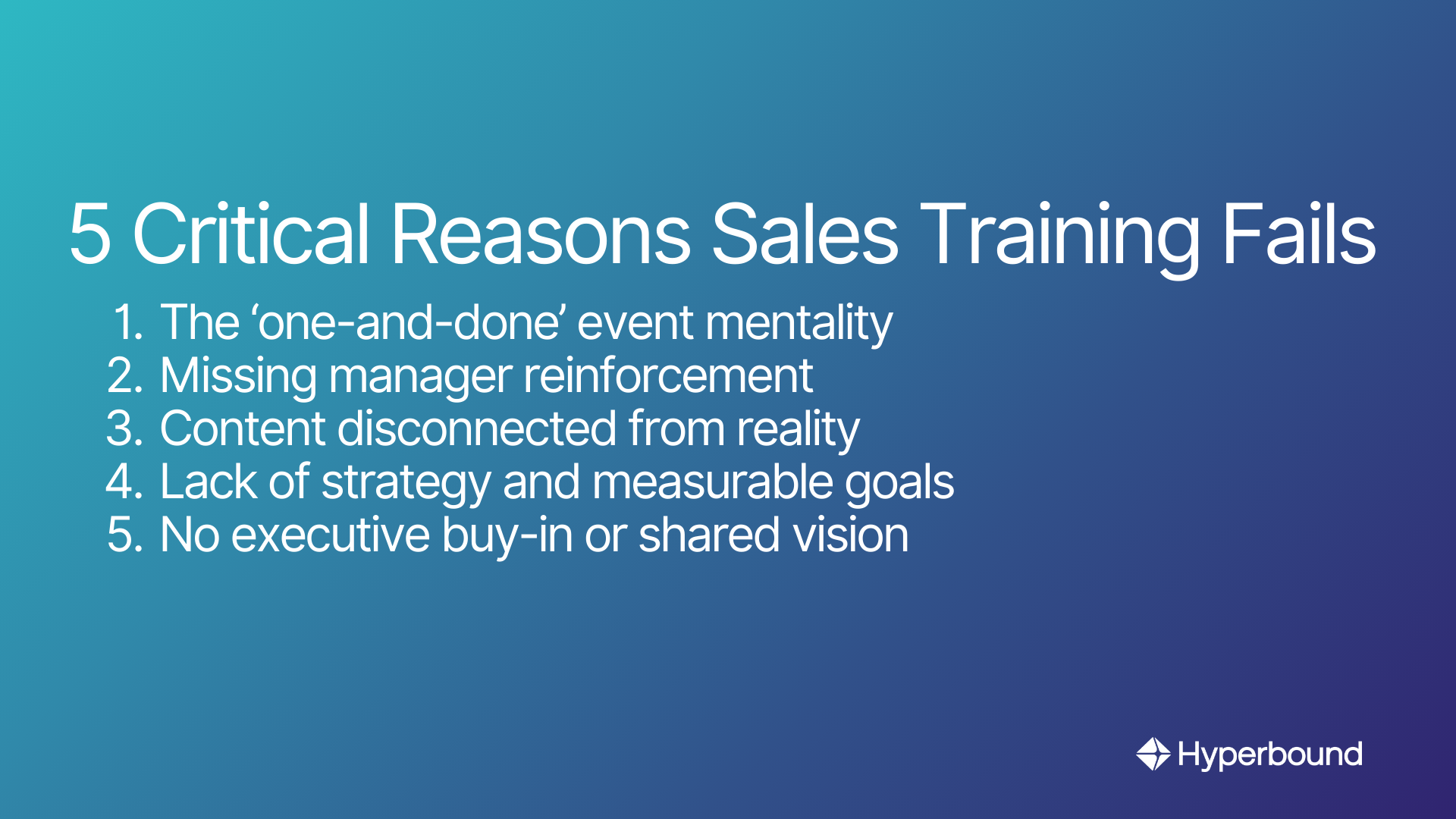
Failure #1: The "One-and-Done" Event Mentality
Most companies treat sales training as a one-time event—a workshop, seminar, or conference that supposedly equips reps with everything they need to know. As one sales rep pointed out on Reddit, "We can't expect someone to sit in a week course and retain the knowledge and apply it forever. The only way is with constant refreshers."
This approach ignores the reality of knowledge decay and the need for continuous reinforcement. Companies focus on the "what" (the selling framework) but not the "how" (the process of learning, practicing, and adopting it over time).
Failure #2: The Missing Link - Manager Reinforcement
"While a week-long training session is great, if the managers aren't coaching and helping the reps stick with the plan it is a waste," noted a sales professional.
Research from Nisbet Associates shows employees reporting to effective coaches are 40% more engaged and show 38% more discretionary effort. Yet most companies neglect to train managers on how to coach and reinforce the new sales methodologies.
Without this critical reinforcement loop, even the best training content quickly fades from memory and practice.
Failure #3: Content Disconnected from Reality
"Most sales training assumes a logical situation when most true sales scenarios, especially the hard ones, the conversation and responses from the prospect can be far from logical," explained one rep.
Training often presents idealized scenarios that bear little resemblance to the chaotic reality of actual sales conversations. Additionally, many programs confuse product training with sales training. They teach features and specifications instead of the critical skills needed to uncover needs, build relationships, and handle objections.
The result? Reps can recite product specs but struggle to navigate real-world sales conversations effectively. Without a safe and repeatable way to practice, they are forced to learn on live calls, which can risk deals and revenue.

Failure #4: A Lack of Strategy and Measurable Goals
According to research by Nisbet Associates, "Strategic sales clarity accounts for 31% of the difference between high and low performing sales organizations." Yet training is often implemented without first answering critical strategic questions:
- Who are our ideal clients?
- What is our unique value proposition?
- How are we positioned in the marketplace?
Furthermore, there are rarely clear metrics to track training effectiveness, making it impossible to measure ROI and adjust as needed.
Failure #5: No Executive Buy-In or Shared Vision
Without leadership alignment and visible executive sponsorship, training is not prioritized. Reps see it as optional or another short-lived initiative, leading to poor engagement and a failure to change behavior.
As SBI Growth notes, executive sponsorship is crucial for communicating the importance of skill improvement. When leadership treats training as a check-the-box exercise rather than a strategic priority, the organization follows suit.
The Blueprint for Success: How to Fix Sales Training for Good
Now that we understand why most sales training fails, let's examine the five key solutions to create lasting, impactful programs that deliver measurable results.
.png)
Solution #1: Shift to a Continuous Learning Culture
Make training "Always On." Treat it as an ongoing process of development, not a one-off event. Richardson, a leader in sales training, recommends implementing a certification-based approach with required recertification, ensuring sales professionals engage in ongoing skill development.
A global services firm that implemented this approach linked their tiered certification program to over $100 million of incremental sales opportunities, according to McKinsey.
Practical Step: Schedule quarterly refreshers focusing on different aspects of your sales methodology, reinforced by weekly micro-learning sessions during team meetings.
Solution #2: Empower Sales Managers as Master Coaches
Sales managers are the linchpin of successful training implementation. Invest in training them first, equipping them with the skills to coach their teams effectively.
"A good sales manager will build time for reinforcement and coaching into their sales operating system," notes a sales professional. This ongoing feedback loop is essential for translating training into daily practice.
Practical Step: Train managers to conduct weekly coaching sessions with each rep, focusing on applying specific elements of the sales methodology to current deals in the pipeline.
Solution #3: Customize and Personalize the Learning Experience
One-size-fits-all training is destined to fail. Make training relevant, digestible, and immediately applicable to your specific sales environment.
This means:
- Using real-world applications, relevant role-plays, and case studies that mirror the actual challenges your team faces. Modern sales readiness platforms like Hyperbound allow you to create hyper-realistic AI roleplays based on your own winning calls, giving reps a safe space to practice and master conversations before talking to a customer.
- Focusing training on specific behaviors needed to drive desired results:
- To find new opportunities, train on prospecting and call planning
- To improve win rates, train on qualification and differentiation
- To achieve higher margins, train on selling on value and negotiating
Practical Step: Conduct stakeholder interviews to identify the most pressing sales challenges, then tailor training content to address those specific issues with real examples from your industry and marketplace.
Solution #4: Build a Complete, Integrated Training System
Treat training as a structured, end-to-end process that includes:
- Assessment: Identify skills gaps via surveys and performance data
- Goal Setting: Establish clear, measurable performance goals
- Curriculum Development: Address critical skill gaps
- Engaging Methods: Use a blend of in-person, digital, role-playing, and gamification
- Tools and Resources: Equip teams with sales playbooks and quick reference guides
- Coaching: Implement regular coaching sessions
- Continuous Learning: Offer ongoing refreshers
- Performance Evaluation: Track metrics like conversion rates, deal sizes, and win rates
- Recognition: Celebrate success to maintain motivation
- Continuous Improvement: Regularly update the framework based on results
Practical Step: Create a learning management system (LMS) that houses all training materials, tracks completion, and measures results against established KPIs.
Solution #5: Lead from the Top with Strategy and Sponsorship
Begin with a clear sales strategy and secure unwavering executive sponsorship. Leadership must clearly articulate the "why" behind the training, linking it to organizational objectives and communicating the benefits repeatedly.
As Nisbet Associates emphasizes, when executives champion training initiatives and actively participate, the entire organization understands that skill development is a top priority.
Practical Step: Have executives participate in the training themselves and publicly commit to the methodology, reinforcing its importance during company meetings and communications.
From Wasted Cost to Strategic Investment
The difference between failed training and successful training lies in moving from a one-time event to a continuous, manager-led, strategically-aligned process that reflects the reality of your sales environment.
Companies that view training as a strategic investment in their people—rather than a check-box activity—are the ones that consistently outperform their competitors. As noted by SBI Growth, "How we sell makes a huge difference."
Frequently Asked Questions
Why does most sales training fail?
Most sales training fails because it is treated as a single, "one-and-done" event rather than a continuous process. This approach lacks the necessary reinforcement, manager-led coaching, and strategic alignment required for long-term behavioral change, causing reps to quickly revert to old habits.
How can you make sales training more effective?
To make sales training effective, shift to a continuous learning culture with regular refreshers and micro-learning. Empower sales managers with the coaching skills to reinforce the training, customize the content to your team's real-world challenges, and ensure the program is sponsored by executive leadership and tied to clear business goals.
What is the role of sales managers in training?
The sales manager's role is to act as the primary coach, translating training concepts into daily practice. They are the critical link for reinforcement, providing ongoing feedback during pipeline reviews and one-on-one sessions to ensure new skills are applied consistently and correctly.
How do you measure the effectiveness of sales training?
You measure the effectiveness of sales training by tracking specific business outcomes, not just course completion. Establish clear KPIs before the training begins, such as improvements in win rates, average deal size, sales cycle length, or conversion rates, to calculate a clear return on investment (ROI).
What is the difference between product training and sales training?
Product training focuses on what you sell (e.g., features, specifications, and use cases), while sales training focuses on how you sell. Sales training builds crucial skills like prospecting, uncovering customer needs, handling objections, negotiating, and closing deals, which are essential for navigating real-world customer conversations.
How can AI improve sales training?
AI can significantly improve sales training by providing a safe, scalable, and realistic environment for practice. AI-powered role-playing platforms allow reps to practice handling difficult objections and mastering sales conversations in simulated scenarios without risking live deals, leading to faster skill development and increased confidence.

Book a demo with Hyperbound


