

.png)
Summary
- The Training Trap: Up to 87% of skills from traditional sales training are forgotten within a month, making one-off events a poor investment.
- The Modern Shift: Top-performing teams move from isolated training events to a culture of continuous skills development integrated into their daily workflow.
- A New Playbook: Build lasting skills by scaling deliberate practice, using data-driven coaching, and creating a system for collaborative learning.
- Scale Practice with AI: Use AI to give reps unlimited, on-demand practice in realistic scenarios. Platforms like Hyperbound help reps master their craft by turning theoretical knowledge into muscle memory.
"The only training that was worth a damn was actually doing the job and falling on my face." - Sales professional on Reddit
Sound familiar? For most sales professionals, this sentiment resonates on a visceral level. We've all sat through those polished training sessions, nodding along to theoretical frameworks while secretly wondering: "But how do I actually use this tomorrow?"
Here's the uncomfortable truth: It's a well-documented phenomenon based on decades of research—up to 87% of new skills are forgotten within a month if not practiced immediately. That expensive sales training program? Your team has likely forgotten most of it before the next quarter even begins.
This isn't just frustrating—it's expensive. Companies spend billions annually on sales training that evaporates before creating real value. But high-growth sales teams have discovered a better way.
The most successful organizations are shifting from isolated sales training events to a culture of continuous sales skills development. The difference isn't just semantic—it represents a fundamental paradigm shift in how top-performing teams build and maintain selling excellence.
Let's explore what sets them apart and how your team can make the transition.
The Great Disconnect: Why Traditional Sales Training Fails
Traditional training often falls short for three key reasons:
Training Is Theoretical, Selling Is Practical
Many sales training programs operate in an idealized world where prospects respond perfectly to scripted questions, objections follow predictable patterns, and deals close on schedule. But real sales conversations are messy, unpredictable, and nuanced.
"Sales training needs to connect theory with practical applications effectively," notes one sales professional, adding that "participants often find theoretical training disconnected from real-world practices." (Reddit)
The gap between classroom theory and real-world application is wide. While training might cover what to say about pricing objections, it rarely prepares reps for the emotional intelligence required to read a prospect's tone or the quick thinking needed to pivot when conversations go sideways.
Low Engagement and Retention
Let's be honest: sales reps are coin-operated. Any activity that doesn't directly contribute to hitting quota is viewed skeptically at best. Traditional training sessions are often seen as a distraction from selling time, leading to low engagement.
Even when engagement is high, the forgetting curve works against us. Without immediate application and reinforcement, that 87% knowledge loss means most of your training investment evaporates within weeks.
.png)
One-Size-Fits-None Approach
Traditional training typically delivers the same content to everyone, regardless of experience level, learning style, or specific skill gaps. The new SDR and the veteran AE sit through identical sessions despite having entirely different needs.
"Scripts should just be suggestions," argues one sales professional. "Assuming they are built around asking good questions." (Reddit) This highlights the need for flexibility and personalization that mass training rarely provides.
The Paradigm Shift: Embracing Continuous Sales Skills Development
High-growth teams have fundamentally reimagined how selling excellence is cultivated. They understand that development is a process, not an event.
Development Is a Process, Not an Event
Sales skills development is an ongoing journey integrated into the daily workflow. Rather than treating training as a periodic box to check, high-growth teams embed learning opportunities into regular activities.
This approach acknowledges a fundamental truth: mastery comes from repetition and refinement over time. Just as elite athletes train daily to maintain peak performance, elite salespeople need regular practice to sharpen their skills.
According to SalesRoads, "Sales reps are crucial architects of customer experience and value creation, necessitating ongoing skill development." In today's competitive landscape, continuous improvement isn't optional—it's essential for survival and growth.
Focusing on the Skills that Matter
High-growth teams concentrate their development efforts on core competencies that directly impact results:
- Communication and Active Listening: The foundation of understanding customer needs and building trust
- Prospecting: Consistently identifying and engaging potential customers
- Objection Handling: Turning concerns into opportunities through empathetic response
- Personalization in sales: Tailoring approaches to enhance engagement and relevance
- CRM and Pipeline Management: Effectively using tools to manage opportunities and forecast accurately
These skills require constant refinement, and high-growth teams create systems to develop them continuously rather than sporadically.
The High-Growth Playbook: 3 Pillars of a Modern Skills Development Program
To transform your approach from traditional training to continuous development, high-growth teams focus on three key pillars:
1. Scale Deliberate Practice with AI-Powered Role-Playing
The Challenge: One-on-one coaching and manual role-playing are highly effective but impossible to scale. Sales managers simply don't have enough time, and reps don't get enough practice repetitions to build true mastery.
The Solution: Hyperbound AI Sales Roleplays make elite practice scalable for every rep. This technology provides a safe, repeatable environment to "fall on your face" without risking live deals—exactly what our Reddit sales professional identified as the most valuable training experience.
Implementation Steps:
- Analyze Winning Behaviors: Use AI to analyze your top reps' calls and identify what works in your specific selling environment.
- Create Realistic Scenarios: Build a comprehensive call library of hyper-realistic AI roleplays for every stage of your sales cycle—from cold calls and discovery to demos, objection handling, and renewals.
- Practice On-Demand: Enable reps to practice anytime, getting unlimited repetitions to master new messaging or custom scripts.
- Get Instant Feedback: Provide immediate, objective feedback through AI-powered scorecards that track talk ratios, methodology adherence, and key selling moments.
This approach directly addresses the primary pain point identified in our user research: "Sales training often feels ineffective without real-world application." By giving reps a realistic practice environment, skills become ingrained through repetition rather than forgotten after a single training session.
2. Supercharge Coaching with Data, Not Guesswork
The Challenge: Traditional coaching is often based on gut feel and a small, random sample of calls. It's subjective, inconsistent, and inefficient.
The Solution: AI-driven call analysis and coaching empower managers to become strategic coaches, not call reviewers.
Implementation Steps:
- Automate Call QA: Use Hyperbound's AI Real Call Scoring to automatically analyze and score 100% of real sales conversations against your playbook, providing objective insights into team performance.
- Deliver Personalized Feedback: Implement AI Coaching to deliver instant, personalized feedback on every call, identifying missed opportunities and reinforcing best practices.
- Elevate 1-on-1s: Transform manager coaching sessions by using AI-generated insights to focus on strategy and complex deal support rather than basic skill correction.
This approach addresses another key pain point: "Lack of mentorship can hinder sales professionals' development." By augmenting human coaching with AI-driven insights, every rep gets consistent feedback and guidance, even when manager bandwidth is limited.
3. Foster a Culture of Collaborative Learning
The Challenge: Top performers' skills are often siloed, and tribal knowledge is hard to transfer across the team.
The Solution: Create systems for sharing best practices and learning from peers—which user research consistently identifies as highly effective.
Implementation Steps:
- Build a Best-Practice Library: Use platforms like Hyperbound to automatically surface top-performing calls and successful techniques that can be shared across the team.
- Run Team-Based Call Reviews: Use AI-flagged moments from real calls as discussion points in team meetings to facilitate peer learning.
- Use Leaderboards: Gamify the learning process to motivate reps and foster healthy competition around skill development.
This approach directly addresses the finding that "Many sales professionals find that learning from others is more effective than trial and error." (Reddit) By systematizing collaborative learning, teams accelerate individual development and build a stronger collective knowledge base.
The Bottom Line: Measuring the ROI of Continuous Development
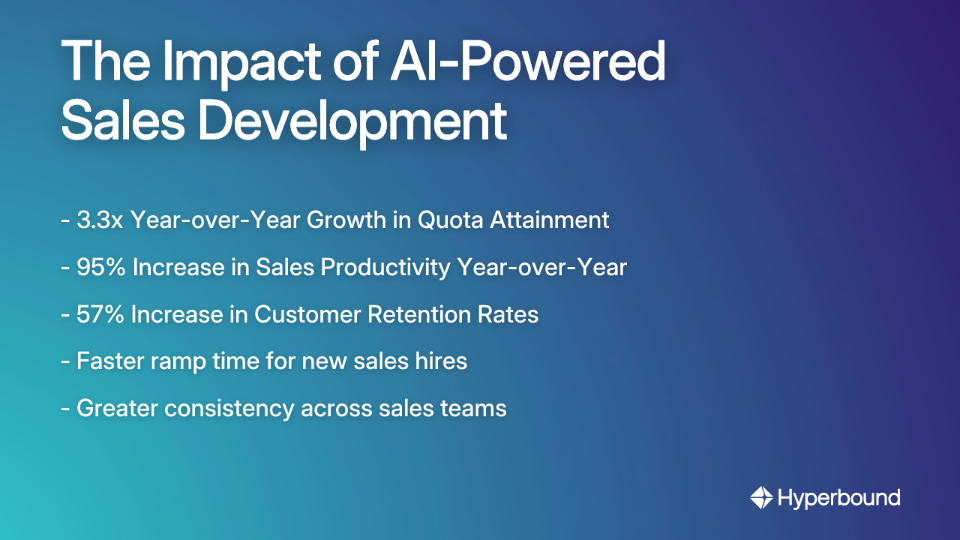
The shift to continuous, AI-powered skill development isn't just about better training—it drives tangible business outcomes.
Industry research shows that organizations using AI in coaching have seen remarkable results:
- 3.3x Year-over-Year Growth in Quota Attainment
- 95% Increase in Sales Productivity Year-over-Year
- 57% Increase in Customer Retention Rates
These outcomes stem from two key advantages of continuous development:
Faster Ramp Time and Increased Consistency
Continuous practice helps new hires become productive and quota-achieving faster by providing more realistic practice opportunities. This addresses one of the most expensive challenges in sales: the lengthy time-to-productivity for new reps.
Additionally, this approach ensures every rep—from new SDRs to tenured AEs—adheres to the same high-performing playbook, driving consistency across the organization. For CROs and sales leaders, this consistency is invaluable for predictable revenue growth.
From Training to Transformation: Making the Shift
The choice isn't between training or no training. The real distinction lies in viewing training as a one-time event versus embedding skill development into the daily fabric of your sales organization.
Foundational training provides the what; continuous development builds the how.
High-growth teams don't just train their reps; they build systems that enable constant practice, feedback, and refinement. They close the gap between knowing and doing.
Is your team stuck in a cycle of ineffective training events? Consider how a culture of continuous development, powered by AI tools like Hyperbound, can transform your team's performance and drive predictable growth.
Because in today's competitive landscape, it's not the best product that wins—it's the best sales team.
Frequently Asked Questions
What is the difference between sales training and sales skills development?
Sales skills development is a continuous process integrated into daily workflows, whereas traditional sales training is typically a one-time event. The key difference is the shift from isolated learning sessions to an ongoing culture of practice, feedback, and refinement. This approach actively combats the "forgetting curve"—where 87% of new skills are lost within a month—by building lasting mastery through consistent application.
Why do most traditional sales training programs fail?
Most traditional sales training programs fail for three main reasons: they are too theoretical and disconnected from real-world selling, they suffer from low engagement and poor knowledge retention, and they use a one-size-fits-all approach that ignores individual skill gaps and experience levels. This leads to a significant waste of investment as reps quickly forget what they've learned.
How can AI help with sales skills development?
AI revolutionizes sales skills development by providing scalable, data-driven solutions for practice and coaching. AI-powered role-playing tools offer a safe, on-demand environment for reps to practice any sales scenario until they achieve mastery. Additionally, AI can analyze 100% of real sales calls to provide objective feedback, identify skill gaps, and surface winning behaviors, allowing managers to become more strategic coaches.
What are the key pillars of a modern sales development program?
A modern sales development program is built on three core pillars: 1) Scalable deliberate practice using AI-powered role-playing to build muscle memory, 2) Data-driven coaching that uses AI analysis of real calls to provide personalized feedback, and 3) A culture of collaborative learning where best practices are systematically identified and shared across the team.
How can you ensure sales reps adopt new training and tools?
To ensure adoption, new tools must be integrated into the sales workflow and demonstrate clear value to the reps. This can be achieved through gamification like leaderboards, creating realistic practice scenarios that mirror their daily challenges, and using AI to provide instant, actionable feedback. When reps see a direct link between practice and improved performance (and commission), adoption naturally follows.
Is AI-powered role-playing effective for experienced sales reps?
Yes, AI-powered role-playing is highly effective for experienced reps. While new hires use it for foundational skills, veteran salespeople can use it to master new product messaging, practice navigating complex enterprise deals, refine techniques for handling sophisticated objections, or adapt to new market conditions. It provides a consistent environment to sharpen their skills and stay at peak performance.
How does this approach improve sales team ramp time?
A continuous development approach drastically shortens new hire ramp time by providing on-demand, realistic practice. Instead of waiting weeks or months to gain experience on live calls, new reps can run hundreds of AI-powered simulations covering every stage of the sales cycle. This allows them to master the playbook, build confidence, and become quota-achieving much faster than through traditional methods alone.
Ready to transform your approach to sales development? Explore how Hyperbound can help your team build a continuous skills development program that drives measurable results.

Book a demo with Hyperbound


