

.png)
Summary
- The $4.6 billion sales training industry struggles with a major flaw: reps forget up to 77% of information within a week due to a lack of practical application.
- Effective sales growth hinges on continuous development (building skills through practice) rather than one-off training events that only transfer knowledge.
- The most effective way to turn theory into revenue is through a cycle of skill assessment, deliberate practice, consistent coaching, and measurement.
- Bridge the knowing-doing gap by using AI Sales Roleplays to practice critical conversations in a safe, repeatable environment with instant, personalized feedback.
You've read "Fanatical Prospecting," watched hours of YouTube videos, and listened to countless podcasts. But when it's time to actually pick up the phone, you freeze. You're told the "best way to learn is to do," but also that "if you just prospect... with no real training, you will fail." This frustrating paradox is where most sales careers stall before they even begin.
The global sales training market is a massive $4.6 billion industry. Yet, the results are often dismal. 70% of B2B sales reps forget the information they learned within a week of training. If not reinforced, 77% of learning is forgotten within 6 days. This isn't just a training problem; it's an application and development problem.
This article will dissect why this gap exists and provide a practical framework for turning theoretical knowledge into tangible sales results.
The Billion-Dollar Problem: The Illusion of "Check-Box" Sales Training
Sales training is intended to improve seller capabilities, drive behavior change, and maximize sales success. It should be treated as a change management initiative, not a one-time event.
Yet many organizations fall into the trap of "check-box training"—one-off sessions designed to tick a box rather than facilitate genuine, long-term change. As one sales professional put it, these trainings are "absolutely useless unless you actually do the selling."
The most common failures of traditional sales training include:
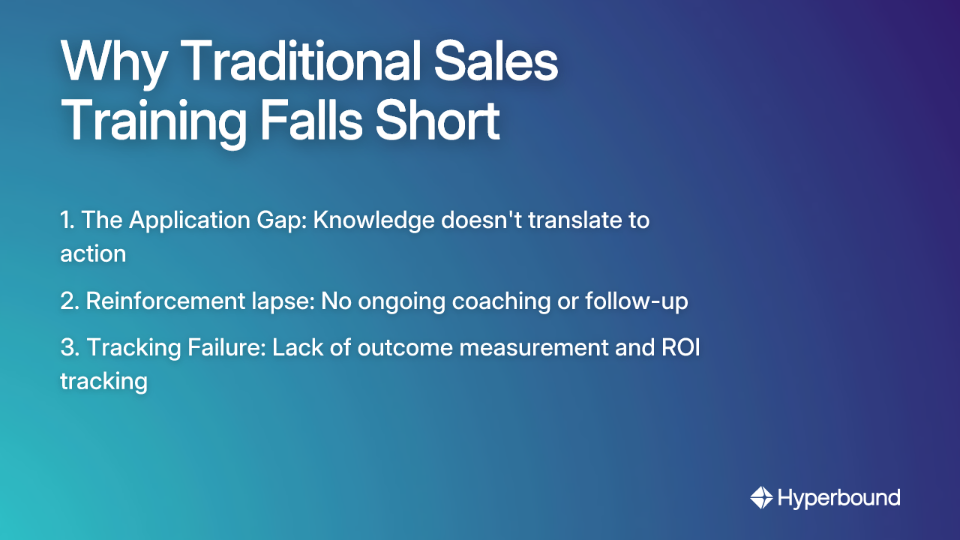
- The Application Gap: There's a massive disconnect between knowledge transfer and real-world application. Learning about objection handling techniques in a classroom is vastly different from implementing them on a high-stakes call.
- Reinforcement Lapse: Without ongoing coaching and follow-up, new behaviors are never adopted. The training becomes just another forgotten corporate event.
- Tracking Failure: Most training isn't measured against outcomes, so ROI remains unknown. Companies continue investing in programs without clear evidence of effectiveness.
Training vs. Development: The Critical Distinction Most Companies Miss
To understand why most sales training fails, we need to clarify an essential distinction:
Training = Knowledge Transfer This is about providing skills and information. Examples include learning a new prospecting script or the steps of the Challenger Sale methodology.
Development = Competency Transfer This is about nurturing a salesperson's overall capabilities and wisdom over time. It's about building business acumen, strategic thinking, and adaptability.
Sales training excels at knowledge transfer but often fails at competency transfer. True competency requires practice, experience, and reflection.
According to Gartner, leaders must shift from "sales training" to "sales learning," emphasizing a continuous environment over traditional, event-based methods. They also recommend "Just-in-Time Learning" to provide sellers with information exactly when they need it.
This shift addresses the common pain of "knowing a lot of theory but not applying practical skills" that many salespeople experience.
The Modern Sales Skillset: What Top Performers Actually Master
Feeling overwhelmed by the sheer number of skills you need to excel in sales? You're not alone. 72% of sellers feel overwhelmed by the number of skills they need for excellence.
Let's break it down into manageable categories:
.png)
Foundational Communication Skills
- Active Listening: The ability to understand the prospect's needs before responding. Build trust by applying what you learn rather than just waiting for your turn to speak.
- Communication & Delivery: How you say something is often more important than what you say. A LinkedIn poll found 77% of respondents believe delivery is more crucial than the message.
- Storytelling: Using a hero's journey framework to narrate how your solution transformed a client's business. Stories stick when features and benefits fade from memory.
Strategic Sales Skills
- Prospecting: Identifying and initiating contact with quality leads. Requires strategy, persistence, and resilience. As one Reddit user bluntly put it, "Get a sales job and start with cold calling."
- Objection Handling: Addressing client concerns with empathy and skill to build stronger relationships rather than seeing objections as roadblocks.
- Strong Discovery: Focusing on deep, curious questions to fully understand the prospect's world before pitching. The quality of your discovery directly impacts your close rate.
- CRM & Pipeline Management: Effectively managing customer data and sales progress using a CRM. This includes segmentation and follow-up scheduling.
Advanced Competencies & Personal Effectiveness
- Mentalizing & Tactical Flexibility: Understanding the buyer's true motivations and adapting your strategy on the fly to meet their needs.
- Business Acumen: Understanding how businesses work. Read financial reports and engage with senior stakeholders to build this capability.
- Coachability & Reflection: Being open to feedback and regularly self-assessing to enable continuous improvement. One sales professional recommends to "capture that in your journal. After a few weeks, you might spot a pattern in YOUR behavior that may need some improvement."
- High Adversity Quotient (AQ): Fostering resilience to stay motivated through challenges and rejection. As one seasoned salesperson advises, "Get out there and screw up a lot. You learn much more from mistakes/losses than wins and praise."
The Bridge to Mastery: A Practical Framework for Turning Theory into Revenue
This is not just about learning; it's about creating a system for growth that bridges the gap between knowledge and application.
Step 1: Skill Assessment & Goal Setting (Know Your Gaps)
Based on the skills outlined above, honestly assess where you (or your team) stand. Use Gartner's four-step framework:
- Identify and prioritize the skills needed for your specific sales strategy.
- Create a workforce plan to upskill the existing team.
- Initiate activities to attract and retain talent.
- Track results and evaluate effectiveness.
Step 2: Deliberate Practice & Application (Bridge Learning and Doing)
- AI-Powered Role-Playing: While practicing with managers is valuable, it's not always scalable. AI Sales Roleplays from Hyperbound provide a safe, on-demand environment to practice any scenario—from cold calls to objection handling—with realistic AI buyer personas. This allows for unlimited repetitions to build muscle memory without taking up manager time.
- AI-Driven Call Reviews: Manually reviewing calls is time-consuming. Platforms that offer AI Real Call Scoring can analyze your conversations against a winning methodology, providing instant, objective feedback. This helps identify specific areas for improvement and tracks progress over time, creating a powerful feedback loop.
- "Laying the Planks": Mastery comes from repetition. Focus on one skill at a time until it becomes a solid foundation. As one HubSpot article suggests, build your competencies one "plank" at a time.
Step 3: Consistent Reinforcement & Coaching (Make It Stick)
- Coaching is Crucial: Sellers who receive effective coaching are 63% more likely to be Top Performers, according to research cited by RAIN Group.
- Reinforcement Methods: Ensure retention through assignments, gamification, peer discussions, and manager follow-ups after any formal training.
Step 4: Measurement & Feedback (Track What Matters)
- Move beyond vanity metrics. Track metrics that align with strategic goals and demonstrate ROI.
- Establish feedback loops through regular coaching sessions to discuss experiences and refine approaches.
Choosing Your Tools: Smart Resources for Continuous Growth
Books or podcasts may be helpful to extract an idea or two, but they're not magic bullets. Frame these resources as supplements to your development framework, not standalone solutions.
AI Platforms for Deliberate Practice
To truly bridge the gap between knowing and doing, reps need a place to practice safely and get immediate feedback.
- Hyperbound: An AI Sales Coaching platform that helps teams practice conversations through hyper-realistic AI roleplays. It analyzes real sales calls to identify winning behaviors, scores performance against your playbook, and delivers personalized coaching to reduce ramp time and drive consistent performance.
Structured Programs for Foundational Skills
- Salesforce SDR Professional Certification: A free course focused on effective prospecting strategies.
- Dale Carnegie Sales Training: An intensive course focused on building long-term customer relationships.
- Rain Group Foundations of Consultative Selling: Focuses on understanding buyer needs and presenting effective proposals.
The Power of Internal Resources
Don't overlook what's right in front of you. As one sales professional advised, "I personally mostly use the library of resource my company has. I would recommend asking to see if your company has one."
Self-Directed Learning
Frame books and podcasts as tools for generating ideas to test within your development framework, not as rigid instruction manuals. Choose wisely and apply immediately.
Bridging the Gap: From Knowledge to Revenue
True sales mastery isn't achieved in a two-day workshop. It's forged in the continuous, disciplined cycle of learning, applying skills in the real world, reflecting on successes and failures, and receiving targeted coaching.
The fear of failure keeps many salespeople stuck in perpetual preparation mode. But as one Reddit user bluntly put it, "Get out there and screw up a lot." Reframe failure as the most valuable data source for development. The goal isn't to be perfect from day one; it's to be better than you were yesterday.
Stop searching for the single "best" training course and start building your own personal system for continuous skill development. The gap between knowing and doing narrows with each deliberate practice session, each coaching conversation, and each reflection on real-world application.
Your success in sales doesn't depend on what you know—it depends on what you consistently do with what you know.

Frequently Asked Questions
What is the main problem with traditional sales training?
The main problem with traditional sales training is the "application gap"—a significant disconnect between learning theoretical knowledge and applying it effectively in real-world sales scenarios. Most training is treated as a one-time event with little to no follow-up. As a result, sellers forget as much as 70-77% of what they learn within a week, meaning the investment rarely translates to improved performance.
Why does sales training often fail to produce results?
Sales training often fails because it focuses on knowledge transfer rather than competency development. It provides information but doesn't offer a structured way for reps to practice, receive feedback, and reinforce new skills until they become second nature. Without a system for deliberate practice and continuous coaching, the initial knowledge gained from a training session is quickly lost.
What is the difference between sales training and sales development?
Sales training focuses on knowledge transfer, which is about providing specific skills and information like a new script or methodology. Sales development, on the other hand, is about competency transfer—nurturing a salesperson's overall capabilities, business acumen, and adaptability over time through continuous practice and experience. Development is an ongoing process, while training is often a one-time event.
How can I practice sales skills without risking real deals?
You can practice sales skills in a risk-free environment using AI-powered role-playing platforms. Tools like Hyperbound's AI Sales Roleplays allow you to practice any sales scenario with realistic AI buyer personas. This provides a safe, on-demand space to build muscle memory through repetition, receive instant feedback, and refine your approach without the pressure of a live customer call.
What are the most important sales skills to master today?
The most important sales skills can be grouped into four key categories: foundational communication (active listening, delivery), strategic sales skills (prospecting, objection handling), advanced competencies (business acumen, resilience), and technical proficiency (CRM, pipeline management). Mastering a blend of these skills is crucial for top performance.
How can I effectively bridge the gap between knowing and doing in sales?
You can bridge the gap by implementing a personal development framework. First, assess your skills to identify gaps. Second, engage in deliberate practice using tools like AI role-playing. Third, ensure consistent reinforcement through coaching and follow-up. Finally, measure your progress with relevant metrics and feedback loops. This transforms learning from a passive activity into an active, results-oriented system.
Book a demo with Hyperbound


