.png)


.png)
Summary
- Elite sales teams don't practice on live deals; they use deliberate practice in simulated environments to master skills without risking quota.
- This article provides 10 high-impact simulator exercises, including drills for handling objections, competitive positioning, and advanced discovery.
- A structured approach to practice, powered by tools like Hyperbound's AI Sales Roleplays, helps reduce ramp time and ensures consistent playbook execution across your team.
You've heard the complaints: AI simulations feel "robotic," "unrealistic," and can't replicate the "awkward silences" or "emotional dynamics" of a real call. Many believe you can only improve with actual "at bats" with live prospects. While there's truth to these concerns, elite sales teams understand something crucial: waiting for live calls to practice is slow, risky, and expensive.
Enter deliberate practice – the scientifically-backed method that separates average performers from experts. Unlike simple repetition, deliberate practice involves breaking down complex skills into manageable components, practicing them systematically with immediate feedback, and gradually increasing difficulty as you improve. This is how athletes, musicians, and yes, top sales professionals achieve mastery.
Modern sales simulators provide the perfect environment for deliberate practice. They offer a safe space where reps can make costly mistakes in simulation, not on quota-carrying calls. When implemented correctly, simulator practice becomes the training ground where elite sales teams are built.
Here are 10 high-impact simulator practice exercises that top-performing sales organizations use daily to sharpen their skills:
.png)
1. Master Your Entire Playbook with Hyperbound AI Roleplays
Elite sales teams don't leave practice to chance. They use platforms like Hyperbound to create a systematic approach to practicing every stage of the sales cycle.
Implementation Steps:
- Analyze Winning Behaviors: Hyperbound's AI analyzes your team's actual sales calls to identify the talk tracks and behaviors of your top performers, ensuring practice is based on what's already working.
- Create Hyper-Realistic Scenarios: Build custom AI Sales Roleplays for your specific ICPs, products, and competitive landscape. Create simulations for cold calls, discovery, demos, objection handling, renewals, and upsells.
- Practice On-Demand: Reps can get more "at bats" in a single afternoon than they might in a week of live calls. The AI buyer personas respond dynamically and realistically, countering the "robotic" feel users often complain about.
- Get Instant, Objective Feedback: After each simulation, reps receive an AI-powered scorecard tracking key metrics like talk ratio, methodology adherence, and effectiveness in key selling moments.
Expected Outcomes: Reduced new hire ramp time, consistent message delivery across the team, and increased confidence in handling any sales conversation.
Measurement Criteria: Track improvement in roleplay performance scores over time and measure correlation between practice frequency and real-world metrics like meetings booked or close rates.
2. Objection Battle Card Drills
This exercise moves beyond memorizing responses to internalizing the logic behind overcoming a prospect's hesitation.
Implementation Steps:
- Identify Top Objections: Create a list of the 5-10 most common objections your team faces (e.g., price, competitor loyalty, timing, "need to talk to my boss").
- Develop Frameworks, Not Scripts: For each objection, create a "battle card" with a framework like: Listen/Acknowledge → Clarify/Probe → Reframe/Respond with Value.
- Simulate: Run roleplays where one person acts as the prospect raising specific objections. The rep must use the framework to navigate the conversation naturally.
Expected Outcomes: Reps become confident and calm when faced with objections, seeing them as opportunities for discussion rather than roadblocks.
Measurement Criteria: Track the percentage of objections successfully navigated in simulations without resorting to discounts or giving up.
3. Competitive Positioning Drills
This drill prepares reps to confidently differentiate your solution without "bashing" the competition.
Implementation Steps:
- Map the Landscape: Identify your top 2-3 competitors and their primary USPs.
- Create "They Say, We Say" Scenarios: Simulate a prospect saying, "We're also looking at Competitor X, and they offer [competitor feature]."
- Practice the Pivot: The rep's goal is to acknowledge the competitor's strength, then pivot back to your unique value proposition. For example: "Competitor X is a great tool for [task], and many of our customers used them before switching. What they found was that while [task] was covered, they struggled with [problem your solution solves]. That's why we focused on..."
Expected Outcomes: Reps can clearly and persuasively articulate your product's unique value in a competitive landscape.
Measurement Criteria: Evaluate reps on their ability to reframe the conversation back to your solution's strengths without disparaging competitors.
4. Advanced Discovery Questioning
This exercise trains reps to go beyond surface-level pain points and uncover deep, strategic business challenges.
Implementation Steps:
- Develop Question Tiers: Create a list of open-ended questions that move from broad to specific (e.g., current situation → problem → impact → ideal future state).
- Simulate "The Reluctant Revealer": Practice a scenario where the buyer gives vague, one-word answers. The rep's task is to use probing follow-up questions and build trust to encourage the prospect to share more.
- Focus on "Why": Coach reps to ask "why" or "tell me more about that" at least three times in a discovery call to get to the root cause of a problem.
Expected Outcomes: Improved information gathering that leads to highly tailored demos and proposals that resonate with the buyer's core needs.
Measurement Criteria: Assess the quality and depth of the "pain points" and "business goals" uncovered during the roleplay.

5. The "Demo Derailment" Simulation
A great demo isn't a monologue; it's a conversation. This drill prepares reps for inevitable interruptions.
Implementation Steps:
- Prepare a Standard Demo Flow: The rep starts with their typical product demo.
- Introduce Interruptions: The "buyer" interrupts with challenging questions, such as: "That feature looks complicated," "How is this different from what we have now?" or "Can you just show me the pricing page?"
- Practice the A-B-C Method: The rep must Acknowledge the question, Briefly answer it and tie it back to a previously discussed pain point, and Continue the demo flow.
Expected Outcomes: Reps can maintain control of the demo while creating an engaging, conversational experience, and handle objections in real-time.
Measurement Criteria: The rep's ability to stay on track and complete the demo's key value points despite frequent interruptions.
6. The Multi-Stakeholder Gauntlet
This simulates the reality of B2B sales where you need to win over multiple people with different priorities.
Implementation Steps:
- Assign Roles: In a group setting (or with a sophisticated AI simulator like Hyperbound), assign roles: a CFO focused on ROI, an IT lead concerned with security and integration, and an end-user focused on usability.
- Run a Meeting: The sales rep must lead a meeting and address the diverse needs and potential conflicts of each stakeholder.
- Build Consensus: The goal is not just to present, but to facilitate a conversation that builds consensus and identifies a clear path for next steps.
Expected Outcomes: Reps develop the crucial skill of navigating complex buying committees and managing different priorities.
Measurement Criteria: Evaluate the rep's ability to engage all stakeholders and articulate a value proposition that appeals to each of their unique concerns.
7. The "Sudden Change" Drill
Deals are often fragile. This exercise builds resilience for when a key player changes during the sales cycle.
Implementation Steps:
- Set the Scene: The rep is deep in a sales cycle with their champion.
- Introduce the Twist: The manager informs the rep, "Your champion just left the company. Their boss, who you've never met, is taking over the evaluation. You have one call to get them up to speed."
- Execute the Re-Engagement: The rep must practice concisely summarizing the progress made, re-validating the business case with the new decision-maker, and adapting their approach to the new stakeholder's personality and priorities.
Expected Outcomes: Improved adaptability and the ability to salvage deals that might otherwise be lost to organizational changes.
Measurement Criteria: The rep's ability to quickly build rapport and re-establish momentum in the sales cycle.
8. High-Stakes Negotiation & Closing
This exercise focuses on the final, critical moments of a deal.
Implementation Steps:
- Simulate Last-Minute Objections: The prospect is ready to sign but suddenly says, "We just need a 15% discount," or "Legal has a few redlines we need to review."
- Practice Value-Based Negotiation: The rep must practice negotiating without immediately caving on price. This includes exploring trade-offs (e.g., longer contract term for a small discount) and reinforcing the ROI of the solution.
- Practice Closing Techniques: Train on different closing techniques (e.g., assumptive close, summary close) and apply them in the simulation.
Expected Outcomes: Reps maintain pricing integrity, protect margins, and become more confident in asking for the business.
Measurement Criteria: The ability to close the simulated deal while preserving as much of the original contract value as possible.
9. The Disengaged Virtual Buyer
In the age of Zoom fatigue, this is a critical skill for simulator practice.
Implementation Steps:
- Set the Virtual Scene: The "buyer" in a video call simulation is instructed to be disengaged—looking at their phone, typing loudly, etc.
- Deploy Re-Engagement Tactics: The rep must practice techniques to pull the buyer back in, including:
- Asking direct, open-ended questions: "Jane, how do you see this fitting into your current workflow?"
- Using pattern interrupts: "Let me pause here. On a scale of 1-5, how relevant is this to the challenges we discussed?"
- Introducing visual aids or interactive elements.
Expected Outcomes: Reps develop a toolkit of strategies to keep buyers engaged and maintain control of virtual sales calls.
Measurement Criteria: The number of successful re-engagement attempts made by the rep during the simulation.
10. Upsell & Renewal Conversations
This exercise is crucial for Account Managers and CSMs, focusing on customer retention and expansion, as highlighted in Hyperbound's AI Post-Sales Roleplays.
Implementation Steps:
- Use Post-Sales Scenarios: Simulate conversations critical to the customer lifecycle:
- Renewal: A customer's contract is up, and they are questioning the price increase.
- Upsell: During a QBR, the rep identifies an opportunity to introduce a new product or service tier.
- Difficult Conversation: Practice de-escalating a situation with an unhappy customer.
Expected Outcomes: Post-sales teams become more proficient at communicating value, handling pricing objections, reducing churn, and identifying expansion revenue opportunities.
Measurement Criteria: Success rates of simulated renewal negotiations and upsell attempts; effectiveness in de-escalating customer complaints.
Making Practice Perfect: Building a Culture of Deliberate Practice
The power of these exercises comes not just from doing them once, but from integrating them into your team's daily routine. To build a culture of deliberate practice:
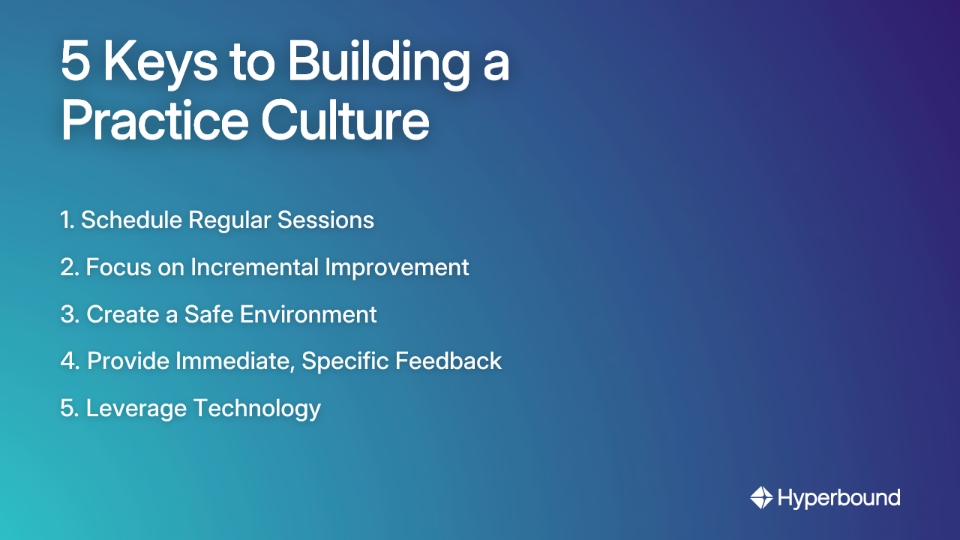
- Schedule Regular Sessions: Block time for simulator practice as religiously as you would for prospecting or team meetings.
- Focus on Incremental Improvement: Don't try to fix everything at once. Target specific skills for improvement in each session.
- Create a Safe Environment: Encourage experimentation and normalize mistakes during practice.
- Provide Immediate, Specific Feedback: The shorter the feedback loop, the more effective the learning.
- Leverage Technology: Platforms like Hyperbound that provide objective scoring, AI-driven insights, and on-demand practice can dramatically scale your team's ability to engage in deliberate practice.
Top-performing sales teams aren't born; they're built. The difference between average and elite often comes down to a commitment to consistent, deliberate practice through simulator exercises. These 10 exercises provide a clear roadmap for any team looking to sharpen their skills without the risk and cost of practicing on live deals.
Ready to stop practicing on your customers? Hyperbound's AI Sales Coaching platform provides the tools to implement all of these exercises at scale. With hyper-realistic AI roleplays tailored to your business, instant AI-driven feedback, and real-call scoring, you can reduce ramp time, drive playbook consistency, and build a truly elite sales force.
Book a demo with Hyperbound


