

.png)
Summary
- The average sales ramp time has surged to 5.7 months, costing companies up to 3x a rep's base salary in lost productivity and revenue.
- Key drivers of this slow ramp include information overload, a lack of practical training, and misaligned expectations, which contribute to rep burnout and high attrition.
- Slash ramp time by implementing a structured 30-60-90 day plan, establishing a mentorship program, and offering supportive compensation during the initial months.
- Leverage technology like AI Sales Roleplays to provide reps with unlimited, risk-free practice, which has been shown to cut ramp time in half.
You've just hired a promising new Account Executive. You've invested in their recruitment, onboarding, and training. Yet, six months later, they're still not hitting quota. The rep is stressed about their financial situation without commission, your existing team is picking up the slack, and your revenue targets are falling behind. What went wrong?
Welcome to the costly reality of slow sales ramp time – a problem that's getting worse, not better.
The "Sink or Swim" Reality of Sales Onboarding
"One month baby, sink or swim.""Two months, quota or gtfo.""Honestly, I was so scared of losing my job that I just went as hard as I could."
These are real comments from sales professionals on Reddit, describing the high-pressure reality of sales onboarding today. New reps are thrown into the deep end with minimal training, expected to perform immediately, and living in constant fear of job loss if they don't deliver quickly enough.
Sales ramp time – the period a new sales representative needs to become fully productive – has climbed to an alarming 5.7 months on average, a 32% increase over just the last four years, according to research from Sailes.
This isn't just a minor inconvenience – it's a significant financial drain and a culture killer that affects your entire organization.
The Snowball Effect: Quantifying the True Cost of a Slow Ramp
The financial impact of slow ramp time is staggering when you examine both direct and indirect costs:
Direct Financial Costs
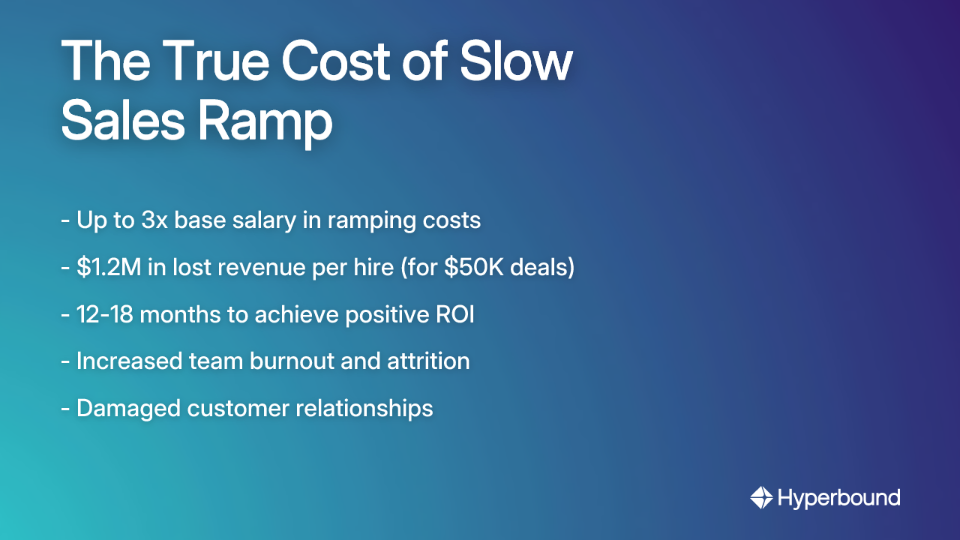
- The Sunk Cost of Ramping: The average cost to ramp a new sales hire is up to three times their base salary. This includes salary, benefits, and training expenses during their non-productive period.
- Massive Opportunity Costs: For a company with an average deal size of $50,000 that closes four deals monthly per rep, a 6-month ramp period can result in $1,200,000 in lost revenue per hire.
- Delayed ROI: It typically takes 12-18 months for a new hire to generate a positive ROI. For startups and scaling companies, this delay severely impacts cash flow and defers critical growth initiatives.
The Human Costs
Beyond the balance sheet, slow ramp time creates significant human costs:
- Higher Attrition: When new reps struggle during extended ramp periods without adequate support or financial stability, they're more likely to leave, restarting the costly hiring cycle.
- Team Burnout: Your top performers are forced to pick up the slack for ramping reps, leading to burnout and potentially impacting their own performance.
- Damaged Customer Trust: Unprepared reps create poor early interactions with prospects, damaging customer trust before relationships can even form.
Why Is Ramping Up So Hard? Diagnosing the Core Challenges
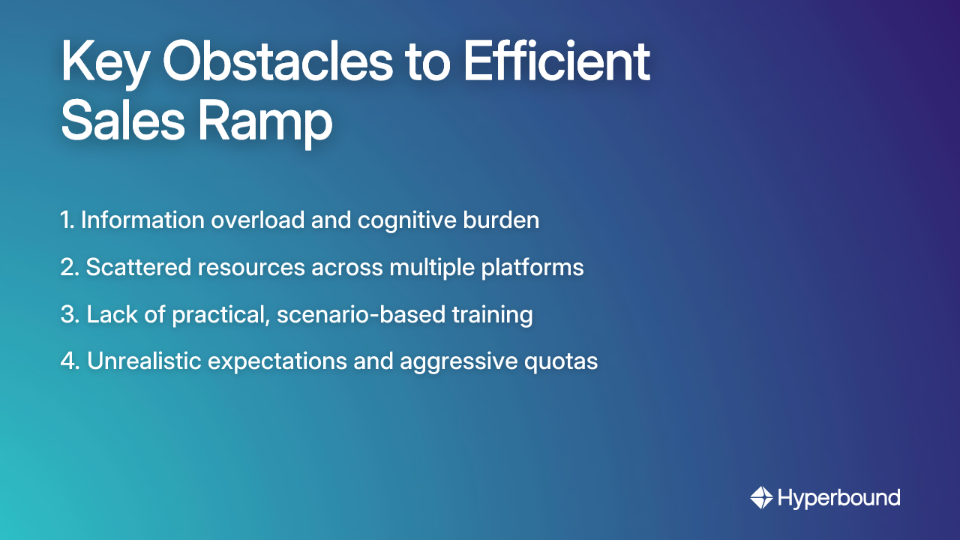
Understanding why ramp time has become such a challenge is the first step toward fixing it. Here are the key obstacles new sales reps face:
Information Overload
New reps are bombarded with vast amounts of data—product specifications, competitor information, CRM processes, pricing structures—making it nearly impossible to retain and apply it effectively when selling. As Hyperbound notes, this cognitive overload slows down learning and application.
Fragmented and Inaccessible Resources
Sales enablement materials are often scattered across different platforms (wikis, shared drives, LMS, email). This forces reps to waste precious time searching for information instead of practicing and selling. One study found that sales reps spend up to 30% of their time just looking for the resources they need.
Lack of Practical, Scenario-Based Training
Traditional onboarding focuses heavily on theory but fails to prepare reps for the nuances of real-world sales conversations. Without practical application, reps take longer to develop the confidence and skills needed for effective selling.
Misaligned Expectations
Companies often fail to set realistic ramp expectations based on their specific market and sales cycle. According to RevGenius, the benchmark for calculating average ramp time should be the company's normal sales cycle length plus 90 days. Ignoring this leads to the aggressive quotas and high-pressure situations that many reps complain about.
The Blueprint for Faster Productivity: 5 Strategies to Slash Ramp Time
The good news? With the right approach, you can dramatically reduce ramp time while improving retention and performance. Here's your actionable blueprint:
1. Provide a Structured Onboarding Program
- Develop a clear 30-60-90 day plan with specific, measurable goals for each phase.
- Cover essential areas: product training, market and competition overview, CRM and sales tools training, and role-playing with experienced reps.
- Centralize all resources into a single source of truth, like a comprehensive sales playbook, to enhance accessibility and reduce time wasted searching.
2. Implement a Mentor Program
Pair new reps with experienced, high-performing sellers. Research from Harvard Business Review confirms the significant impact of mentorship on the sales learning curve. Mentors provide:
- Real-world guidance that goes beyond formal training
- Faster assimilation into team culture and processes
- A safe space to ask questions and seek advice
3. Align Compensation with the Ramp Period
Directly address the financial stress felt by new reps by establishing a supportive compensation plan:
- Guaranteed OTE or Commission Draw: Offer a fixed, guaranteed salary during the ramp period to reduce financial pressure and allow reps to focus on learning, not just surviving.
- Reduced and Tiered Quotas: Start with lower, achievable quotas that gradually increase over time. A tiered commission structure can also incentivize early success.
4. Track Progress with Actionable KPIs
Use sales enablement tools to monitor progress in real-time. Don't wait for quarterly reviews to identify challenges. Key KPIs to monitor include:
- Time to First Sale: How quickly a rep closes their first deal.
- Progress to Quota: Percentage of quota met each month.
- Sales Activity Metrics: Calls made, meetings set, demos completed.
- Sales Conversion Rate: Effectiveness in moving deals through the pipeline.
- Average Sales Cycle Length: How a new rep's cycle compares to the team average.
5. Integrate Learning into the Flow of Work (LIFOW)
Move beyond one-off training sessions. Provide just-in-time resources and micro-learnings that reps can access within their daily workflow (e.g., in the CRM). This learning in the flow of work approach enhances knowledge retention and accelerates productivity.
The Force Multiplier: How AI and Technology Are Revolutionizing Onboarding
While process improvements are crucial, technology—especially AI—is proving to be a game-changer for reducing ramp time:
AI-Driven Coaching and Role-Playing
- AI Call Scoring & Coaching tools analyze sales calls to identify patterns of successful behavior, highlighting best practices for new reps to mimic.
- AI Sales Roleplays allow reps to practice handling objections and navigating difficult conversations in a safe, zero-risk environment, receiving instant feedback for rapid improvement.
- Case Study: GetAccept partnered with Hyperbound's AI platform and achieved a 50% reduction in ramp time for its SDRs, while freeing up managers to focus on strategic coaching.
Autonomous Prospecting and Sales Automation
AI-powered tools can manage initial outreach and pipeline building, allowing new AEs to focus on learning the product and engaging in high-value conversations rather than tedious cold prospecting. Automating top-of-funnel activities helps ensure that new reps have a steady stream of opportunities to practice on, accelerating their path to real-world experience and quota attainment.

Centralized and Intelligent Knowledge Repositories
AI-enabled CRMs and sales enablement platforms give AEs instant access to past deals, customer personas, and relevant case studies, helping them understand winning strategies more effectively.
From Cost Center to Revenue Driver: The Path Forward
A slow sales ramp is not an inevitable cost of doing business—it's a solvable problem with significant ROI potential.
The path to faster productivity lies in a dual approach: a thoughtful, human-centric onboarding process built on structure, mentorship, and fair compensation, amplified by modern technology that provides scalable coaching and automates low-value tasks.
By implementing the strategies outlined in this article, you can:
- Reduce your ramp time by 50% or more
- Decrease turnover and improve team morale
- Accelerate revenue generation and improve cash flow
- Create a competitive advantage in talent acquisition and retention
Stop treating onboarding as a checklist. Invest in a strategic ramp-up program to empower your new hires, achieve predictable revenue faster, and build a more resilient, high-performing sales team.
Your new reps shouldn't have to "sink or swim." With the right approach, they can sail smoothly toward success—and bring your company's revenue goals along with them.

Frequently Asked Questions (FAQ)
What is sales ramp time and what is the average?
Sales ramp time is the duration it takes for a new sales representative to become fully productive and consistently meet their quota. The current industry average has climbed to an alarming 5.7 months, meaning companies pay a full salary for nearly half a year before seeing a return on their investment.
How do you calculate sales ramp time?
A simple and effective way to calculate sales ramp time is to take your company's average sales cycle length and add 90 days (three months). For example, if your typical sales cycle is 60 days, a realistic ramp time would be 150 days (about five months). This formula accounts for initial training (the first 90 days) plus the time required to close their first full cycle of deals.
Why is a long sales ramp time so costly?
A long sales ramp time is costly due to direct expenses like salary without full productivity, massive lost revenue opportunities, and a delayed ROI on the new hire. The costs can reach up to three times the rep's base salary. Beyond the direct financial impact, it also leads to higher employee turnover, burnout among top performers, and damaged customer relationships.
What are the most effective ways to reduce sales ramp time?
The most effective strategies involve a combination of process and technology. Key tactics include creating a structured 30-60-90 day onboarding program, implementing a mentorship system, aligning compensation with the ramp period to reduce stress, and leveraging AI-powered training tools for scalable practice.
How can AI help new sales reps ramp up faster?
AI can significantly accelerate sales ramp-up by providing scalable coaching, safe role-playing environments, and automating low-value tasks. AI call coaching tools can analyze conversations to provide instant feedback, while AI role-play simulators allow reps to practice handling objections without risking live deals. This allows them to build skills and confidence much faster than traditional methods.
What should be included in a 30-60-90 day plan for a new sales rep?
A 30-60-90 day plan should set clear, progressive goals focusing on learning in the first month, practical application in the second, and autonomous execution in the third.
- First 30 Days (Learning): Focus on absorbing information, such as completing product training, understanding the ideal customer profile, and mastering the CRM.
- Next 30 Days (Application): Begin applying knowledge by making initial calls, setting a target number of meetings, and co-presenting demos.
- Final 30 Days (Execution): Move towards full productivity by managing the full sales cycle independently and hitting a tiered, introductory quota.
Book a demo with Hyperbound


