

.png)
Summary
- Traditional coaching struggles to scale, with managers reviewing only 5-10% of calls and reps forgetting 70% of training material within a week.
- The most effective strategy is a hybrid model that combines technology for data analysis and practice with human oversight for strategic coaching.
- Implement a workflow where AI analyzes all sales calls, reps use AI simulations to practice skills, and managers use the resulting data for targeted 1:1s.
- Hyperbound enables this hybrid approach with AI Sales Roleplays for scalable practice and AI Real Call Scoring to provide data-driven coaching insights.
You've seen it before. You spend big on a new sales training platform, excited by the demo, only for it to become "another tab my reps ignored." In fact, a common experience is seeing as few as 15% of people actually logging in after rolling out a big-name tool.
The reality is that many 'all-in-one' platforms fail to maintain long-term engagement, and sales leaders are left asking: what actually works?
If you're trying to improve your team's close rates—the percentage of leads they successfully convert into customers—you're faced with a choice that feels increasingly binary: stick with traditional, human-led coaching or invest in modern, AI-powered practice tools.
But is this the right question to ask?
The Old Guard: The Strengths and Limits of Traditional Sales Coaching
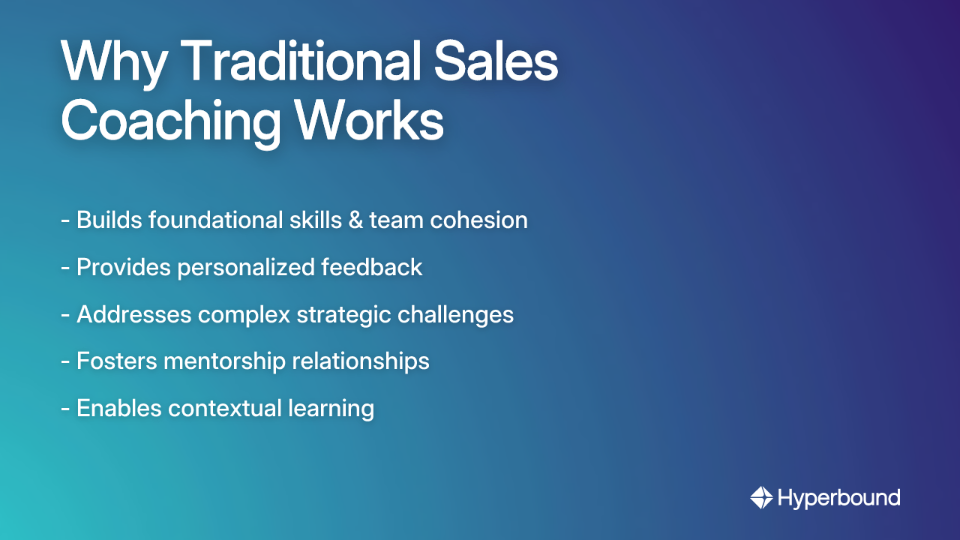
Traditional sales coaching has earned its place in the sales leader's toolkit for good reason. When consistently delivered, it drives measurable results:
- Teams receiving regular sales coaching experience 16.7% higher revenue growth than those without it
- 75% of reps who receive consistent coaching hit their quotas
- 80% of reps report that coaching increases their job satisfaction, improving retention
The time-tested approaches—role-playing exercises, call shadowing, and in-person coaching sessions—build foundational skills while fostering team cohesion. These methods have produced generations of successful sales professionals.
But the traditional coaching model is showing serious cracks:
The Scalability Problem
Sales managers can typically review only 5-10% of sales interactions, leaving a massive blind spot in performance assessment. As teams grow or become more distributed, this limitation becomes increasingly problematic.
"Our managers were spending hours reviewing calls, but could only cover a fraction of what was happening," shares a sales director from a mid-market SaaS company. "We were missing critical coaching opportunities."
The Forgetting Curve
Without consistent reinforcement, the effectiveness of even the best coaching sessions plummets. Research shows that reps forget 70% of information within a week of a training session. One-off coaching moments, however brilliant, struggle to create lasting change.
The Consistency Challenge
Perhaps most troubling is the inconsistency of traditional coaching. The quality and frequency of coaching sessions can vary wildly between managers, creating an uneven playing field for reps. Some receive world-class guidance while others get by with periodic check-ins at best.
This is especially true for remote and geographically dispersed teams, where coaching often becomes an afterthought rather than a consistent practice.
The New Wave: How AI-Powered Practice Tools Are Changing the Game
Modern sales practice tools promise to solve the limitations that have long plagued traditional coaching. Their value proposition is compelling:
- New hires achieve productivity 40% faster with structured, technology-enabled training
- Teams using AI-powered training see 20-30% higher success rates
- Practice tools can analyze 100% of interactions, leaving no performance blind spots
But beyond the statistics, these tools are designed to address specific pains that sales leaders face daily:
From "Another Ignored Tab" to Daily Engagement
The most common complaint about sales tools? Low engagement. As one sales leader put it, most platforms "looked great in a demo but then just became another tab my reps ignored."
The solution has emerged in tools focused on micro-scenarios rather than lengthy training sessions. "Instead of dumping frameworks into a 90-minute video, we gave reps micro-scenarios they could practice in 5–10 minutes," shares a successful sales enablement manager. This approach aligns with how modern professionals actually learn and retain information.
Advanced platforms like Hyperbound have pioneered this approach with AI-powered role-plays and bite-sized coaching modules that reps can complete between calls.
From Scattered Resources to Centralized Knowledge
Another pain point: "Having one centralized place where new reps could find every script, process, and piece of training they needed instead of hunting through different logins."
Tools like Trainual have addressed this by creating comprehensive knowledge repositories where teams can document all SOPs, scripts, and playbooks. The result? "Now when we onboard someone new, they can actually contribute by day 3 instead of sitting through weeks of scattered training sessions."
From Theoretical to Practical Learning
Perhaps most importantly, modern tools provide realistic practice environments. AI sales role-play simulators like Hyperbound allow reps to practice with custom AI personas that mimic tough prospects.
One sales leader describes this as "the first thing they actually stick with because it feels like practicing with a tough prospect." These tools provide "instant scoring and coaching takeaways" that reinforce good habits immediately, rather than waiting for the next coaching session.
The Tool Landscape
The sales practice tool ecosystem has evolved into several distinct categories:
.png)
- AI Sales Role-Play & Coaching: Tools like Hyperbound specialize in tailored AI simulations with personalized feedback and built-in speech coaching.
- Conversation Intelligence: Platforms like Hyperbound and Gong excel at recording, transcribing, and analyzing calls, providing data-driven insights into performance patterns.
- Autonomous AI Coaching: Newer entrants like Oliv AI use autonomous agents for pre-meeting preparation and post-call scoring, promising to improve close rates by up to 25%.
The Winning Formula: A Hybrid Approach to Boosting Close Rates
Here's the truth that gets lost in the "tools versus coaching" debate: The most successful sales organizations don't choose one over the other—they intelligently integrate both.
The most effective approach uses technology to make human coaches more effective. Tools provide the what (data, insights, performance gaps), and coaches provide the why (context, motivation, strategic guidance).
This hybrid model directly addresses what users consistently identify as crucial: tools that "plug right into daily workflows" rather than creating additional work.
A Practical Hybrid Workflow
What does this look like in practice? Here's a step-by-step workflow that leverages both technology and human coaching:
- Capture & Analyze (The Tech)All sales calls are automatically recorded and analyzed by a conversation intelligence tool like Hyperbound or Gong. The platform analyzes 100% of interactions, flagging skill gaps, successful tactics, and "best moments from call recordings."
- Practice & Refine (The Tech)Based on the AI's analysis (e.g., poor objection handling), a rep is assigned targeted practice. They use an AI role-play tool like Hyperbound to run through realistic "micro-scenarios" until their performance improves, receiving instant AI-generated feedback.
- Coach & Strategize (The Human)The sales manager enters their 1:1 meeting equipped with data. They use the "Rep View dashboard" to review the rep's call recordings and simulation scores. The conversation shifts from "How are things going?" to "I saw the AI flagged your talk-listen ratio on the ACME call. Let's review that moment and discuss strategy."
Best Practices for Data-Driven Coaching
To maximize the effectiveness of this hybrid approach:
- Focus on the Middle: The biggest lift in team performance comes from elevating your core, average performers, not just focusing on top or bottom reps.
- Maintain a Positive Feedback Loop: Aim for a ratio of 5.6 positive comments for every negative one to keep reps motivated and receptive.
- Collaborate on Goals: Use performance data to collaboratively set clear, measurable improvement objectives with each rep.
- Personalize Your Approach: Use insights from the tools to understand each rep's unique challenges and tailor coaching to their specific needs.
Stop Choosing, Start Integrating
The debate over "Sales Practice Tools vs. Traditional Coaching" presents a false choice. The path to sustainably higher close rates lies in a hybrid model where technology provides scalable data and practice, and managers provide high-impact, strategic human coaching.
If you're a sales leader looking to improve close rates, start by auditing your current process. Are your tools gathering dust? Are your coaching sessions lacking data-driven focus?
Look for tools that don't just offer features but integrate seamlessly into daily workflows and solve specific team pain points. Remember that the goal isn't to replace your coaches but to supercharge them with data and insights.
Empower your coaches with the insights of a data scientist and give your reps a flight simulator to practice in. That's how you build a team that doesn't just meet quotas, but consistently shatters them.
Frequently Asked Questions
What is the difference between traditional sales coaching and AI-powered practice tools?
The main difference lies in scalability and data. Traditional coaching provides personalized, human-led guidance that is difficult to scale, while AI-powered tools offer automated, data-driven practice and analysis for an entire team. While managers can only review 5-10% of calls, AI can analyze 100% of interactions to provide objective feedback and identify skill gaps consistently.
Why is a hybrid approach to sales coaching more effective?
A hybrid approach is more effective because it combines the scalable, data-driven insights of AI tools with the strategic, contextual guidance of human coaches. Technology handles the heavy lifting of call analysis and provides a platform for reps to practice, freeing up managers to focus on high-impact coaching sessions that are informed by objective data.
How do AI sales tools improve rep engagement with training?
AI sales tools improve engagement by offering practice in short, relevant, and interactive formats, such as "micro-scenarios" and AI role-plays, that fit directly into a rep's daily workflow. Unlike lengthy training videos, bite-sized practice modules feel practical and immediately applicable, which drives adoption and helps reps build skills faster.
What are the main limitations of traditional sales coaching?
The primary limitations of traditional coaching are its lack of scalability, inconsistency across managers, and the "forgetting curve." Managers have limited time to review calls, leading to performance blind spots. Coaching quality can vary, and without consistent reinforcement, reps forget up to 70% of information from a training session within a week.
How does AI help with sales role-playing?
AI enhances sales role-playing by providing a realistic, on-demand simulator where reps can practice handling objections and refining their pitch with custom AI personas at any time. This allows for unlimited, safe practice without taking up manager time. Tools like Hyperbound provide instant, objective feedback and performance scoring, helping reps build confidence and muscle memory before real calls.
Will AI sales tools replace human sales coaches?
No, AI sales tools are not designed to replace human coaches but to augment their abilities. They handle the data analysis and repetitive practice, allowing managers to focus on high-level strategy, motivation, and mentorship. In this hybrid model, AI provides the what (performance data), while the human coach provides the why (context and strategic guidance).

Book a demo with Hyperbound


