.png)


.png)
Summary
- Reframe your mindset: View sales objections not as roadblocks, but as valuable opportunities to understand your prospect's priorities and concerns.
- Preparation is key: The most effective strategy for handling objections is mastering your responses before a live call. Structured practice can improve technique retention by up to 80%.
- Ask clarifying questions: When faced with common stalls like "it's too expensive" or "I'll think about it," use diagnostic questions to uncover the real issue behind the initial objection.
- Practice makes perfect: Build confidence and master your delivery in a risk-free environment with AI Sales Roleplays to turn objections into wins.
Ever notice how the most challenging part of sales conversations isn't your pitch—it's handling the inevitable objections that follow?
You're not alone. Many sales professionals fear their tone might negatively impact the conversation or struggle to identify the real reasons behind a prospect's hesitation. When a prospect says, "It's too expensive," they rarely mean just that—there's usually a deeper concern hiding beneath the surface.
The truth is, objections aren't roadblocks—they're opportunities. Each objection gives you valuable insight into your prospect's thinking and priorities. But knowing exactly how to respond in the moment? That's where most of us get stuck.
This comprehensive guide provides 27 proven responses to the most common sales objections, enhanced with AI-powered insights from thousands of successful sales conversations. Each script includes notes on tone, pacing, and strategic follow-up questions based on what actually works in real-world sales situations.
Let's transform those dreaded objections into your greatest selling opportunities.
The Foundational Response to Any Objection
1. The Most Important Response: Practice Before the Call
The Objection: Any objection you aren't prepared for.
The Response (Your Internal Strategy):
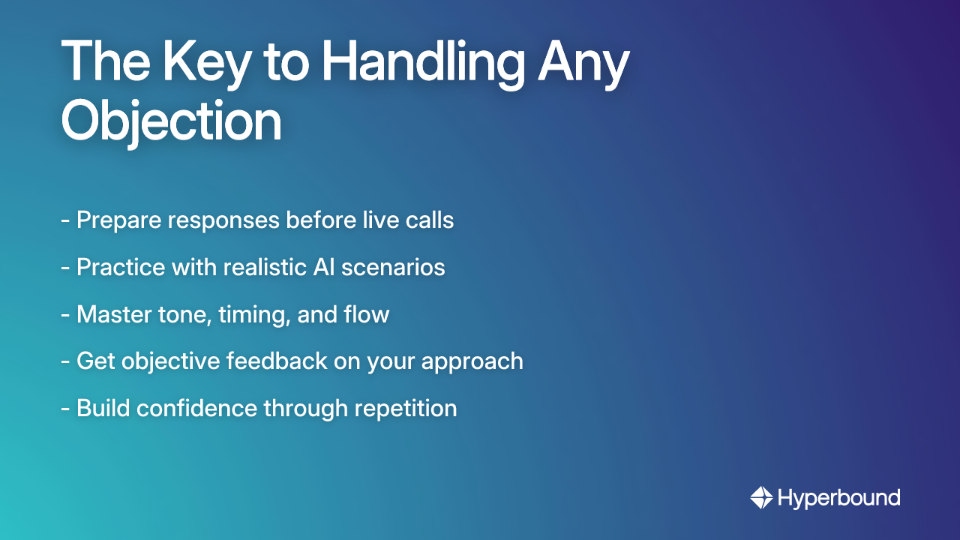
The most effective way to handle objections is to master your responses before you ever face them on a live call. Top performers don't just know the scripts; they've internalized the flow, tone, and timing through deliberate practice.
How Hyperbound Helps:
Instead of risking live deals, Hyperbound's AI Sales Roleplays let you simulate any sales scenario with AI buyer personas that respond realistically. You can:
- Practice any conversation type: cold calls, discovery, demos, and specific objection scenarios
- Get instant feedback through AI-Powered Scorecards that track your talk ratio and objection handling
- Master your message in a risk-free environment before facing real prospects
Sales professionals using structured practice see up to 80% better retention of objection handling techniques compared to those who simply read scripts.

Price & Budget Objections
2. "It's too expensive."
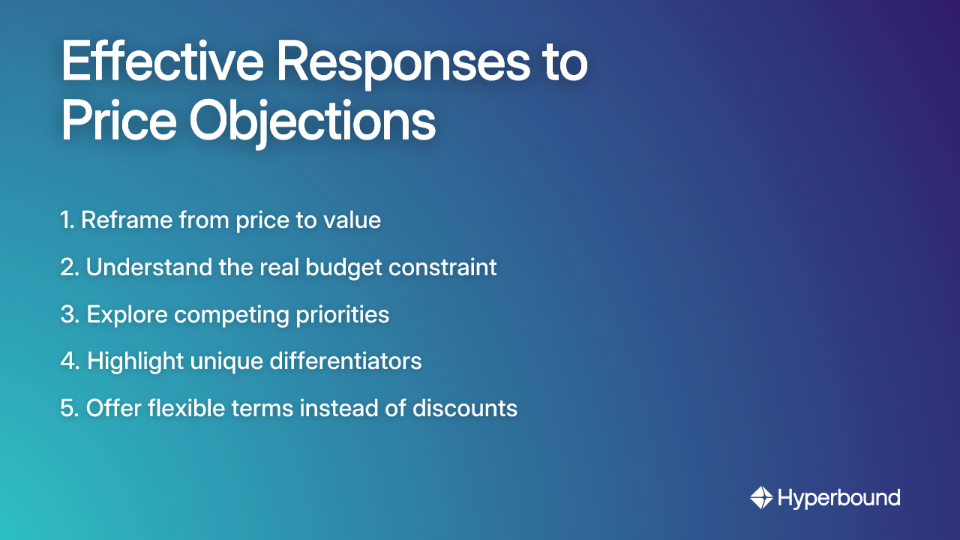
Script: "I understand. When you say it's expensive, are you comparing it to a specific competitor, or is it more than you've budgeted for this kind of solution?"
Hyperbound AI Insight: Our AI Real Call Scoring shows that top reps immediately reframe this from price to value. After their initial response, 85% of successful calls follow up with a diagnostic question about the cost of the prospect's current problem: "I see. To help me understand, how much does [the problem you solve] currently cost your business per quarter?"
3. "We don't have the budget for this right now."
Script: "That's completely fair, many companies plan their budgets well in advance. Setting aside the budget for a moment, do you feel our solution could effectively solve [Problem X] for you?"
Hyperbound AI Insight: This is a test of your value proposition. The goal isn't to find the money today, but to make your solution a "must-have" for the next budget cycle. A calm, consultative tone of voice is critical. Reps who successfully navigate this objection often slow their speaking pace by 10-15%.
4. "I need to use this budget elsewhere."
Script: "I hear you. Could you help me understand what initiatives are currently taking priority? It would be helpful to see where solving [Problem X] fits into your roadmap."
Hyperbound AI Insight: Successful reps use this as an extended discovery phase opportunity. Our AI Coaching tool highlights that asking about competing priorities, and then connecting your solution's ROI back to helping those initiatives succeed, is a top-tier tactic.
5. "I can get a similar solution for cheaper."
Script: "That's a valid point, and there are definitely other options out there. While some clients have told us they were initially focused on price, they ultimately chose us because of [Your Unique Differentiator 1] and [Your Unique Differentiator 2], which ended up saving them more in the long run. Could we explore how those might impact you?"
Hyperbound AI Insight: Never disparage a competitor. The most effective reps acknowledge the competitor and pivot confidently to their unique value. Practice this specific scenario in a Hyperbound roleplay to perfect your pivot without sounding defensive.
6. "I need a significant discount to make this work."
Script: "I appreciate you sharing what it would take to get this done. We typically don't discount, as our pricing reflects the full value and support we provide. However, we can sometimes be flexible on payment terms or implementation packages. Would exploring those options be helpful?"
Hyperbound AI Insight: Analysis shows that immediately caving to a discount request devalues your product. Offering flexibility on terms, rather than price, maintains your product's perceived value and often satisfies the prospect's need for a "win."
Timing & Urgency Objections
7. "This isn't a priority for me right now."
Script: "I understand. What are your top 2-3 priorities for this quarter? I'd like to understand how solving [Problem X] compares."
Hyperbound AI Insight: This question is crucial. It shows you're listening and respects their time. Top-performing reps use a patient, inquisitive tone. Our data shows that if a prospect shares their priorities, the chance of booking a future meeting increases by over 50%.
8. "Call me back next quarter."
Script: "Happy to do that. Just so I'm prepared for our next conversation, what do you expect will have changed by then that will make this a better time to connect?"
Hyperbound AI Insight: This question gently pushes back and filters out "tire-kickers." It forces the prospect to articulate a concrete reason for the delay. If they can't, it's often a sign of low interest, and you can politely ask if it makes sense to close the loop for now.
9. "I'm too busy right now."
Script: "I completely understand, and I don't want to take up your time unnecessarily. That's why I reached out—our solution is designed to save teams like yours [X hours] per week by automating [Specific Task]. Would finding 15 minutes in the next few weeks to explore that be worthwhile?"
Hyperbound AI Insight: Directly connect your product's value to their stated problem (being busy). Keep this response under 30 seconds. Brevity is key when someone is genuinely busy.
10. "We'll think about it."
Script: "Of course. When people say they need to 'think about it,' it usually means there's a specific concern about either the price, the fit, or the timing. To make sure I've given you all the information you need, which of those is top of mind for you?"
Hyperbound AI Insight: This is a classic stall. Top reps address it head-on with a calm, direct question. Practice this in a Hyperbound roleplay to nail the confident, non-confrontational tone of voice required.
Competition Objections
11. "We're already working with [Competitor]."
Script: "That's great, they're a well-known company. We actually have a number of clients who switched over from [Competitor]. They were typically looking to solve [Your Key Differentiator]. Is that something you've ever experienced?"
Hyperbound AI Insight: This is a soft, non-confrontational way to introduce doubt. Mentioning that others have switched provides powerful social proof. The key is to focus on a problem your competitor doesn't solve well.
12. "I'm locked into a contract with a competitor."
Script: "I understand, and we'd never ask you to break a contract. When does your current contract expire? We could schedule a preliminary discussion 60-90 days beforehand to evaluate if a switch might make sense for you then. That way, you're not scrambling when the renewal comes up."
Hyperbound AI Insight: Play the long game. This shows respect for their current commitments and positions you as a strategic future partner. Reps who successfully set future meetings have a 70% higher likelihood of eventually winning the deal.
13. "We're happy with our current solution."
Script: "I'm glad to hear that. It's always good when a solution is working. Out of curiosity, what are the top 1-2 things you like most about it? And if there was one thing you could improve, what would it be?"
Hyperbound AI Insight: This addresses the "complacency" pain point many sales reps encounter. It validates their choice while gently probing for cracks. The "one thing you could improve" question is the most crucial part of this script, as it opens the door for you to introduce your value.
14. "[Competitor] has X feature and you don't."
Script: "That's an important feature. Can you walk me through how you envision your team using that feature and what specific outcome it would help you achieve?"
Hyperbound AI Insight: Often, a prospect asks for a feature but is really trying to solve an underlying business problem. By understanding the "why" behind the feature request, you can often demonstrate how your solution achieves the same outcome, possibly in a more efficient way.
Trust & Authority Objections
15. "I've never heard of your company."
Script: "I understand. We're [brief, one-sentence description of your company]. We've helped over [Number] companies like [Similar Company 1] and [Well-Known Client] to achieve [Specific Outcome]. I can send over a case study if you'd like, but the best way to see how it works is a quick 15-minute demo."
Hyperbound AI Insight: Lead with social proof. Naming a competitor or a well-known brand in their space instantly builds credibility. Keep your company description concise and focused on results.
16. "I need to talk this over with my boss/team/stakeholders."
Script: "That makes perfect sense. Important decisions should be made with the whole team's input. To help you prepare for that conversation, what do you anticipate their biggest questions or concerns will be? Perhaps we could even schedule a brief call with them together to address everything at once."
Hyperbound AI Insight: Don't just accept this and wait. Equip your champion to sell internally. Offering to join the next call positions you as a helpful partner and gives you direct access to the decision maker. Hyperbound's multi-party roleplays are designed to help reps practice navigating these complex group dynamics.
17. "Just send me some information."
Script: "I can definitely do that. To make sure I don't waste your time with irrelevant information, could you tell me what specific aspects of our conversation were most interesting to you? That way, I can tailor what I send."
Hyperbound AI Insight: This is a classic brush-off. By asking for clarification, you force a moment of engagement and can better gauge their actual interest level. Top reps use this to re-engage, not just to end the call.
18. "I'm not the right person to speak with."
Script: "Thank you for letting me know. To ensure I'm reaching out to the right person, could you point me in the direction of the individual or department that typically handles [Area of Responsibility, e.g., 'sales team productivity' or 'customer retention']?"
Hyperbound AI Insight: Always be grateful and ask for a referral. Reps who get a warm hand-off from an internal contact have a significantly higher chance of booking a meeting with the correct stakeholder.
Need & Fit Objections
19. "I don't see the value." / "I don't see how this can help me."
Script: "That's fair—it seems I haven't done a good enough job of connecting our solution to your specific goals yet. Based on our conversation, you mentioned that [Stated Goal/Pain Point] is a challenge. How are you currently trying to solve that?"
Hyperbound AI Insight: Take ownership of the communication gap. This disarms the prospect and re-opens the discovery phase. Our AI Coaching often flags this as a critical moment where reps need to stop pitching and start asking better questions.
20. "We don't have that problem." / "We're not interested."
Script: "I appreciate the direct feedback. It seems I may have made an incorrect assumption about your business. For my own learning, could you share what your top priorities are right now? It helps me understand the market better."
Hyperbound AI Insight: This is a low-pressure way to gather intelligence. Even if the deal is lost, you can learn something valuable for your next call. It shows humility and can sometimes uncover a misunderstanding that re-opens the conversation.
21. "Your product is missing [X Feature]."
Script: "Thank you for that feedback. Can you tell me a bit more about how that feature would ideally work for your team and what it would help you accomplish?"
Hyperbound AI Insight: Similar to competitor feature objections, focus on the "why." You might discover their desired outcome can be achieved with your existing feature set, or it could be valuable feedback for your product team.
22. "Your solution seems too complicated."
Script: "That's valuable feedback, and the last thing we want is to create more work for you. Onboarding is actually something we've streamlined significantly. We provide a dedicated manager and clients are typically up and running within [Timeframe]. Could I show you what that 3-step implementation process looks like?"
Hyperbound AI Insight: Address the fear of implementation head-on. Use specifics (dedicated manager, clear timeframe, simple process) to counter the vague feeling of "complicated."

Mastering Objection Handling Through Practice
Objection handling is more than memorizing scripts—it's about developing the ability to listen actively, respond authentically, and guide conversations toward mutual understanding. The best sales professionals practice consistently, analyze their performance, and continuously refine their approach.
With tools like Hyperbound's AI Sales Roleplays, you can practice these scenarios in a risk-free environment, receive objective feedback through AI Real Call Scoring, and develop the confidence to handle any objection that comes your way.
Remember: When a prospect raises an objection, they're not saying no—they're asking for more information in a way that addresses their specific concerns. Master these responses, and you'll transform objections from conversation stoppers into conversation starters that ultimately lead to more closed deals.
Frequently Asked Questions
What is the best way to handle sales objections?
The most effective way to handle sales objections is to prepare and practice your responses before you get on a live call. This proactive approach involves internalizing proven scripts and mastering the tone and timing of your delivery. By practicing in a risk-free environment, you build the confidence and muscle memory to respond effectively under pressure, turning potential roadblocks into opportunities.
Why is practicing objection handling so important?
Practicing objection handling is crucial because it helps you internalize responses, master your tone, and build the confidence to navigate difficult conversations without risking live deals. Simply reading scripts is not enough. Deliberate practice, especially with realistic AI roleplay scenarios, improves retention of techniques by up to 80% and ensures you sound natural and convincing when it matters most.
How should I respond when a prospect says "it's too expensive"?
When a prospect says "it's too expensive," you should first acknowledge their concern and then ask a clarifying question to understand the root cause. A great response is: "I understand. When you say it's expensive, are you comparing it to a specific competitor, or is it more than you've budgeted for?" This shifts the conversation from price to value and helps you diagnose the real concern behind the price tag.
What should I do if a prospect wants to "think about it"?
If a prospect wants to "think about it," you should gently probe to uncover the specific concern that is causing them to hesitate. This is often a stall tactic, so address it directly by saying, "Of course. When people say they need to 'think about it,' it usually means there's a specific concern about either the price, the fit, or the timing. Which of those is top of mind for you?" This helps you identify the real objection so you can address it immediately.
How can I handle objections without sounding defensive?
To handle objections without sounding defensive, always start by acknowledging the prospect's point of view, maintain a calm and consultative tone, and ask questions instead of making statements. Phrases like "That's a valid point" or "I hear you" show you are listening and respect their concern. The key is to treat objections as requests for more information, not as personal attacks.
How can AI help with objection handling?
AI can help you master objection handling by providing a risk-free environment to practice any scenario, offering instant, objective feedback on your performance, and analyzing real-world call data to identify what works. Tools like Hyperbound's AI Sales Roleplays allow you to simulate calls with realistic AI buyers. Afterward, AI-powered scorecards can analyze your tone, talk ratio, and the effectiveness of your responses, enabling rapid, targeted improvement.
Book a demo with Hyperbound


