.png)


.png)
Summary
- Effective sales dashboards are tailored to their audience—executives, managers, or reps—to provide actionable insights instead of overwhelming data.
- Structure your dashboard around four key metric categories: Quantity (activity), Quality (effectiveness), Productivity (speed), and Outcomes (business impact).
- Organizations with unified analytics are 28% more confident in measuring performance; focus on 5-9 core KPIs to drive clear, data-based decisions.
- Use dashboard insights to identify skill gaps and accelerate rep development with targeted practice in an AI Sales Roleplay platform.
Are you drowning in sales data but starving for actionable insights? Many sales leaders feel overwhelmed, staring at dashboards where the "pipeline information is often too vague" or the metrics don't seem to drive productive behavior. The struggle is real, as sales leaders often lack the tools to effectively "study their craft."
The "one-size-fits-all" dashboard is a myth. As one sales operations professional aptly put it, "business models, sales processes, leadership is all different and can have a wide variety of needs." What works for one team might completely miss the mark for another.
This guide will cut through the noise. We'll provide a clear framework for selecting the right metrics for your team, building dashboards that provide high-level, actionable information, and ultimately driving predictable revenue growth in 2026.
Why Your Sales Dashboard Isn't Working (And How to Fix It)
A dashboard is more than a data repository; it's a decision-making tool. Its purpose is to align the entire sales organization on the metrics vital for company growth. Yet many dashboards fail to deliver on this promise.
The Strategic Purpose of Dashboards
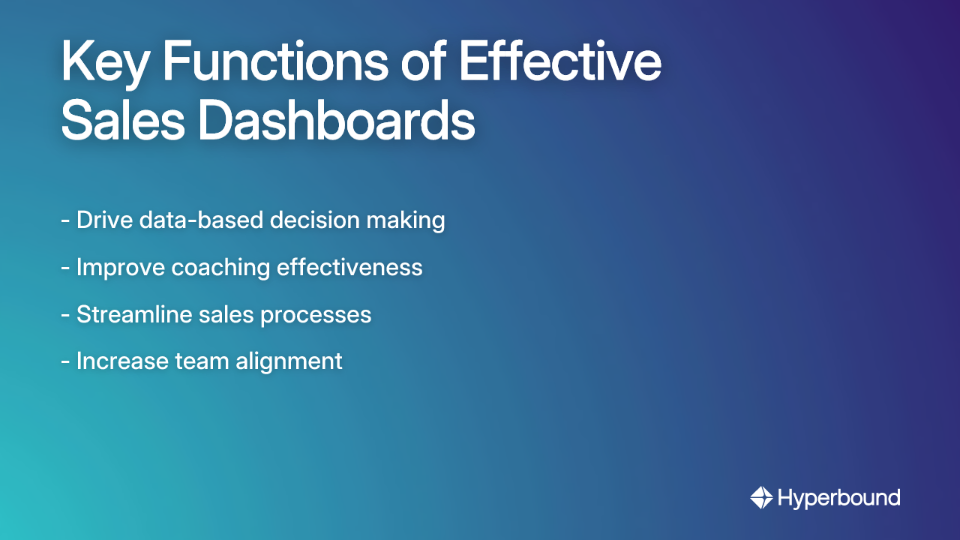
Effective dashboards should:
- Drive data-based decision-making: Studies show that go-to-market organizations with unified analytics are 28% more confident in measuring team performance.
- Improve coaching: Use performance data and call insights for smarter, more targeted coaching. AI coaching platforms like Hyperbound analyze call data to provide objective feedback, helping managers scale their coaching efforts effectively.
- Streamline processes: Analyze workflows to identify and remove bottlenecks that lengthen the sales cycle length.
The Audience-First Approach
The biggest mistake is creating a single dashboard for everyone. As one Reddit user emphasized, "Understanding your audience can really help with the dashboard build." Different roles need different insights:
- Sales Leadership Dashboard (CEO/VP): Needs a high-level "State of the Union." Focus on Current Quarter Forecast, Top Opportunities, and overall business health metrics.
- Sales Manager Dashboard: Needs tactical insights into team and pipeline health. Focus on pipeline by stage, team activity, and rep performance.
- Sales Rep Dashboard: Needs to show individual progress to quota, activity levels, and personal pipeline.
"The point of a dashboard is to provide high-level overview of actionable information," reminds a sales operations professional on Reddit. When you tailor your dashboards to specific audiences, you ensure everyone gets the insights they need without drowning in irrelevant data.
The Core Four: A Framework for Your 2026 Sales Metrics
To build truly effective dashboards, you need a balanced set of metrics. Let's break down essential metrics into four clear categories:
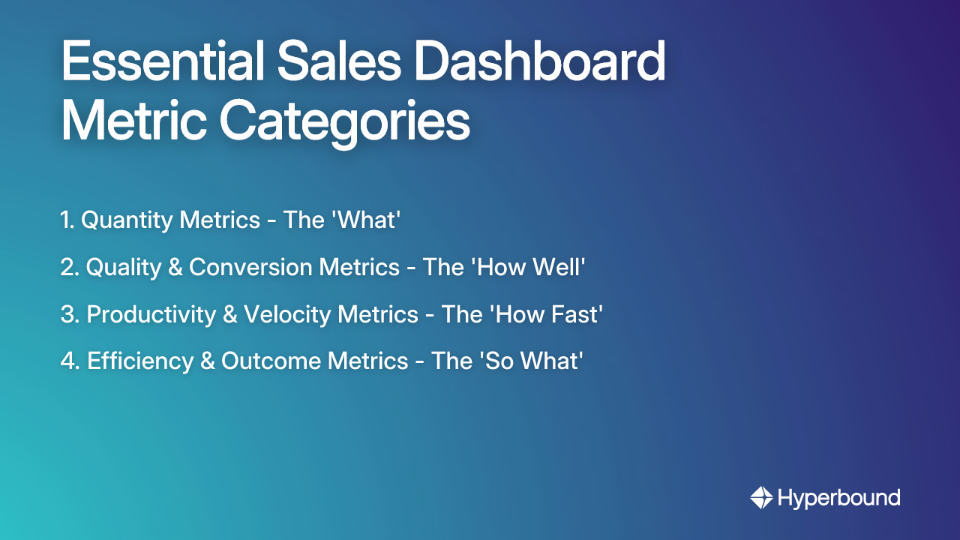
Category 1: Quantity Metrics (The 'What') - Measuring Activity Volume
These metrics measure the volume of sales activities and are often leading indicators of future performance:
- Number of Calls Made / Emails Sent: The foundational activity metric.
- Meetings Booked: A stronger indicator of progress than raw outreach numbers.
- New Leads in Pipeline / Net New Leads Created: The fuel for future sales. Tracking this quarterly is essential for meeting sales targets, according to Salesforce.
- New Opportunities Created: Tracks how many leads have been qualified (Marketing Qualified Leads to Sales Qualified Leads).
Category 2: Quality & Conversion Metrics (The 'How Well') - Measuring Effectiveness
These metrics evaluate the impact of your sales strategies and help identify weak points in the sales funnel:
- Conversion Rate (Lead-to-Deal): The ultimate measure of sales process efficiency.
- Formula:
(Number of deals closed) / (Number of leads) x 100. - Actionable Insight: As a Reddit user noted, "Focus on stages with the biggest drop-off. Helps identify weak points." (Source)
- Formula:
- Win Rate (Opportunity-to-Close): Of the opportunities your team works, how many become closed won business?
- Customer Satisfaction (CSAT) & Net Promoter Score (NPS): Crucial for understanding post-sale health and identifying opportunities for referrals and retention.
Category 3: Productivity & Velocity Metrics (The 'How Fast') - Measuring Efficiency
These metrics assess the efficiency and speed of your sales process:
- Average Sales Cycle Length: The average time from first contact to a closed deal. A long cycle can indicate a need for "better content or decision-stage nudges," according to sales professionals on Reddit.
- Pipeline Velocity: An "incredible way to find bottlenecks and low performing salespeople," as one sales leader put it. It measures how quickly deals are moving through the pipeline.
- Lead Response Time: The time it takes for a rep to follow up with an inbound lead. Crucial for conversion.
- Average Rep Ramp Time: The time it takes for a new hire to become fully productive. Essential for scaling teams. Platforms like Hyperbound use AI-powered roleplays to significantly reduce ramp time by allowing new hires to practice critical conversations in a safe environment.

Category 4: Efficiency & Outcome Metrics (The 'So What') - Measuring Business Impact
These metrics analyze how effectively resources are contributing to revenue and overall business health:
- Annual Contract Value (ACV): Measures the average value of a customer contract over one year.
- Customer Lifetime Value (CLV): The total revenue a business can expect from a single customer account.
- Formula:
(Average purchase value/year) x (Average purchases/year) x (Average customer lifespan).
- Formula:
- Customer Churn Rate: The percentage of customers who stop doing business with you over a period.
- Net Revenue Retention: Measures revenue from existing customers, accounting for upsells, cross-sells, and churn.
From Theory to Practice: Actionable Dashboard Examples for Every Need
Let's move from theory to practice with concrete dashboard examples tailored to different needs, inspired by Geckoboard's dashboard examples:
Example 1: The Monthly KPI Dashboard
Focus: High-level performance against monthly and quarterly targets.
Audience: Sales Manager, Sales Director, CEO.
Key Metrics: Performance to Monthly Revenue Target (%), Total Value of Pipeline, Deals Closed This Month, Historical Revenue (MoM).
This dashboard answers the critical question: "Are we on track to hit our revenue goals this month/quarter?"
Example 2: The Team Overview Dashboard
Focus: Individual team performance and coaching opportunities.
Audience: Sales Manager, Sales Team.
Key Metrics: Rep Leaderboard (by revenue), Individual Progress to Target, Conversion Rate (by rep), Average Deal Size (by rep).
This dashboard helps identify which reps need coaching and in what areas, making it invaluable for sales managers focused on team development.
Example 3: The Live Monitoring Dashboard
Focus: Real-time operations, ideal for high-velocity sales environments.
Audience: Sales Manager, Inside Sales Team.
Key Metrics: Average Close Time, Unassigned Leads, Lead Response Time, Current Call Queue.
Perfect for managers who need to make in-the-moment decisions about resource allocation and prioritization.
Example 4: The Orders vs. Invoices Dashboard
Focus: For businesses with a lag between order and payment.
Audience: Sales Manager, Finance Director.
Key Metrics: Invoices Issued This Month, Purchase Orders Placed This Month, Total Unbilled Orders (Order Book).
Especially useful for manufacturing, furniture, or other industries with extended fulfillment timelines.
Common Pitfalls and Best Practices for Dashboard Success
Common Pitfalls to Avoid:
- Data Overload: Overwhelming users with too many metrics, leading to a "visibility gap" where there is data but no insight, as warned by Forecast.io.
- Vague Pipeline Information: Failing to break down the pipeline by stage, closing period, or product, making it impossible to diagnose issues.
- Ignoring Historical Data: Missing opportunities for trend analysis by only focusing on the present moment.
- The Tyranny of Metrics: Using poorly defined metrics that incentivize the wrong behaviors. As one sales leader on Reddit pointed out, "Metrics influence behavior, and if they are poorly defined or mismanaged, they can lead to counterproductive outcomes."
Best Practices for Dashboard Success:
- Focus on Actionable KPIs: Every metric should answer a question or prompt an action.
- Keep It Simple: Use clean layouts, clear labels, and a strong visual hierarchy.
- Use Visualizations: Employ charts and graphs to make complex data easy to digest.
- Ensure Real-Time (or Regular) Updates: Stale data leads to bad decisions.
- Review and Iterate: Regularly gather feedback from your team to ensure the dashboard remains relevant and effective.
Frequently Asked Questions
What is the main purpose of a sales dashboard?
The main purpose of a sales dashboard is to provide a visual, at-a-glance overview of key performance indicators (KPIs) to enable quick, data-driven decision-making. It transforms raw data into actionable insights, helping to align the sales team, improve coaching, and streamline processes by highlighting progress toward goals and identifying potential issues before they escalate.
How do I choose the right metrics for my sales dashboard?
To choose the right metrics, focus on a balanced set of KPIs that cover four key areas: Quantity (activity volume), Quality (effectiveness), Productivity (speed), and Outcomes (business impact). Always start by defining your business goals and the needs of the dashboard's audience (e.g., CEO, sales manager, or rep). Select metrics that are actionable and directly tied to achieving those goals, avoiding "vanity metrics" that don't drive productive behavior.
What is the biggest mistake to avoid when creating a sales dashboard?
The biggest mistake is creating a one-size-fits-all dashboard that overwhelms users with irrelevant data. Different roles require different insights; a CEO needs a high-level strategic overview, while a sales rep needs to see their individual progress and activity pipeline. Tailoring dashboards to the specific audience ensures the information is relevant, actionable, and doesn't lead to data overload.
How many metrics should a sales dashboard have?
A good sales dashboard should ideally feature between 5 and 9 key metrics. The goal is clarity, not complexity. Too few metrics may not tell the whole story, while too many can cause confusion and inaction. Focus on the most critical KPIs that provide a clear, actionable snapshot of performance for a specific role or goal.
What is the difference between a leading and a lagging indicator in sales?
A leading indicator predicts future performance, while a lagging indicator measures past results. For example, the number of calls made (a leading indicator) is an input activity that can help predict future sales. In contrast, total revenue closed (a lagging indicator) measures the outcome of past activities. A balanced dashboard includes both to track current efforts and measure historical success.
How can a sales dashboard improve team coaching?
A sales dashboard improves coaching by providing objective data that pinpoints specific areas where individual reps or the team as a whole need support. Managers can use metrics like conversion rates by stage, average sales cycle length, or win rates to identify skill gaps. This data allows for targeted, evidence-based coaching conversations instead of relying on gut feelings, leading to more effective team development.
How often should my team review our sales dashboards?
The ideal frequency depends on your role and sales cycle. Generally, sales reps and managers in a high-velocity environment should review their dashboards daily to make real-time adjustments. Senior leadership might conduct a deeper review on a weekly or bi-weekly basis to track progress against quarterly goals. The key is to establish a consistent cadence that integrates the dashboard into your team's regular workflow.
Building a Dashboard That Drives Revenue
An effective sales manager dashboard in 2026 is not a static report; it's a dynamic tool. It must be tailored to its audience, focused on a balanced set of metrics across quantity, quality, productivity, and outcomes, and designed to provide actionable insights.
The future of sales management relies on data-driven leadership. By moving beyond simple data dumps and building truly insightful dashboards, you empower your team, streamline your processes, and create a predictable engine for revenue growth. Integrating insights from AI coaching tools like Hyperbound can take your dashboards to the next level, connecting team performance metrics directly to the specific skills and behaviors that drive success.
Remember that the most successful dashboards evolve over time. Start with the metrics that matter most to your specific business context, gather feedback regularly, and refine your approach as your team's needs change. The first step is to ask what your team needs to see to be successful—and then build from there.
Book a demo with Hyperbound


