.png)


.png)
You're in a crucial sales call. The prospect is asking tough questions. Your palms are sweaty. You carefully choose your next words, hoping they'll unlock the path to a closed deal—but instead, you see their expression change. Interest fades. The conversation stalls.
Sound familiar? You just failed a real-life "Fallout speech check."
"I just feel like I'm not passing the Fallout speech check for lack of a better term," confessed one sales rep on Reddit. And they're not alone. Many reps feel this uncertainty—that sinking feeling when you can't quite read the room or adapt your approach mid-conversation.
What is a "Speech Check"? (And Why Your Sales Strategy Needs One)
For the uninitiated, in the video game Fallout: New Vegas, a "Speech Check" allows you to resolve conflicts, gain information, and unlock new paths through dialogue alone. Unlike other games where success might be random, in New Vegas, your Speech skill is a hard number. If you've invested enough points (e.g., 30/100), you succeed 100% of the time.
As Fallout developer Joshua Sawyer explained, "It does not feel good to invest in a skill and then have the game say 'actually, you suck at that.'"
This is the perfect metaphor for sales conversations. Success shouldn't feel like a roll of the dice. It should be the reliable outcome of well-honed skills.
The good news? Just like in Fallout, your "Speech" skill in sales isn't fixed—it can be leveled up through practice, awareness, and strategic frameworks that help you navigate any conversation.
Leveling Up Your "Charisma": How to Read Your Prospect in Real-Time
Before you can adapt your approach, you need to quickly identify what type of person you're talking to. This isn't about manipulation—it's about effective communication with your warm leads.
Think of this as your first skill check: Personality Analysis.
According to personality analysis research, most prospects fall into one of four categories:
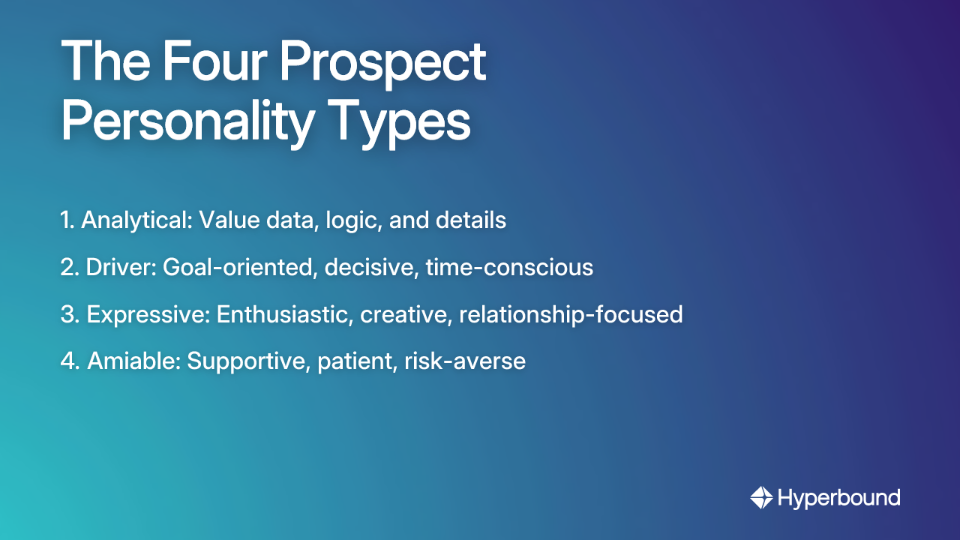
- Analytical: They value data, logic, and details. They'll ask specific, technical questions about your commoditized product. With these prospects, avoid the "magic dust" of hype—provide case studies, stats, and a clear, logical process.
- Driver: Goal-oriented, decisive, and time-conscious. They'll cut to the chase and focus on results. Be direct, concise, and emphasize ROI in your product pitches.
- Expressive: Enthusiastic, creative, and relationship-focused. They love stories and the big picture. Build personal connections and share compelling narratives.
- Amiable: Supportive, patient, and risk-averse. They need trust, guarantees, and testimonials. Move deliberately and focus on security.
To identify these types mid-conversation:
- Listen to their language: Do they say "I feel" (Expressive/Amiable) or "I think" (Analytical/Driver)?
- Note their questions: Are they asking about implementation details (Analytical) or results and timelines (Driver)?
- Observe their pace: Do they speak quickly (Driver) or thoughtfully (Amiable/Analytical)?
This skill helps you double tap your communication effectiveness by tailoring your approach on the fly, rather than using a one-size-fits-all script.

Mastering the Dialogue Tree: Frameworks for Better Conversations
Now that you can identify personality types, let's level up your dialogue skills to handle gatekeepers and decision-makers alike.
Active Listening
This is more than just hearing words; it's full engagement that helps you identify buying signals:
- Pay complete attention: Close other tabs, silence notifications.
- Paraphrase and summarize: "So, if I understand correctly, your main challenge is..." This confirms you're listening and gives them a chance to clarify.
- Observe non-verbal cues: Pay attention to tone of voice, pauses, and energy changes.
As one experienced sales professional advises, "The prospect should be talking 70% of the time while you listen actively."
Asking the Right Questions
Your questions are your most powerful tools for passing any speech check:
.png)
- Avoid yes/no questions:
- Weak: "Are you satisfied with your current solution?"
- Strong: "What challenges are you facing with your current solution?"
- Use the SPIN Technique for structured discovery questions:
- S (Situation): "How do you currently manage your lead follow-up process?"
- P (Problem): "What's the biggest challenge with that approach?"
- I (Implication): "How does that delay impact your team's quota attainment?"
- N (Need-Payoff): "If you could automate that process and save 10 hours weekly, what would that mean for your revenue goals?"
These proven frameworks help ensure you're collecting the right information while building rapport.
Building Authentic Rapport
One of the best pieces of advice from sales professionals on Reddit is to "Talk to them like they're your favorite cousin that just showed up on Thanksgiving." This shifts your mindset from a rigid script to a natural, human conversation.
This approach works especially well for handling the initial tension in calls and creating moment-specific responses that feel genuine rather than rehearsed.
Decoding the Script: Recognizing Buying Signals vs. Objections
Here's where many reps fail their speech check: misinterpreting prospect responses. What seems like resistance could actually be interest.
As Sales Gravy points out, "The man who gives you objections is not tough to sell; you can do a lot with that guy." Think of this as a selling-Ju-Jitsu move: using the energy of their objection to move the conversation forward.
Distinguishing Signals from Obstacles:
- Buying Signals: Specific questions about pricing, implementation, or contract terms; bringing in other decision-makers; requesting a detailed Q&A session.
- Objections: "It's too expensive." "We're happy with our current provider." "I don't have time right now."
Objection Handling with the "Feel, Felt, Found" Method:
- Feel: "I understand how you feel about the price." (Validates their concern)
- Felt: "Other clients have felt the same way initially." (Shows they're not alone)
- Found: "What they found was that by implementing our solution, they increased efficiency by 20%, generating an ROI that paid for the platform in under 6 months." (Pivots to value)
This framework transforms objection handling from a defensive stance to an opportunity for deeper engagement. With skills-based training platforms like Hyperbound's AI Sales Roleplays, your reps can practice these scenarios until the response becomes second nature.
Knowing When to Push (and When to Reload a Save)
The final skill check is about pacing and pressure: knowing when to move forward and when to pull back.
Reading the Room:
- Are they leaning in (physically or metaphorically) or pulling away?
- Is their tone becoming more enthusiastic or hesitant?
- Are they asking deeper questions or giving shorter responses?
Push vs. Pull Back:
- Push forward when you see clear buying signals and the prospect is engaged. Guide them toward the next step with confidence.
- Pull back when they seem hesitant or confused. Ask more exploratory questions: "It sounds like there might still be some uncertainty. What's on your mind?"
The Follow-Up Save:
Think of effective follow-ups as your "reload a save" option in Fallout. A well-timed, personalized follow-up can salvage a conversation that didn't quite land the first time. As sales research shows, many reps overlook this crucial step, losing potential deals that just needed more nurturing.
From Lone Wanderer to Master Negotiator
Success in sales conversations isn't about luck or a perfect script—it's about building skills that let you navigate any dialogue with confidence:
- Personality Analysis (Charisma): Quickly identify and adapt to prospect types
- Active Listening (Perception): Fully engage and understand underlying needs
- Strategic Questioning (Intelligence): Guide the conversation productively
- Objection Handling (Speech): Transform resistance into opportunity
Like any skill in Fallout, these abilities improve with practice. AI-powered roleplays offer a safe and effective way to run real-world simulations, allowing you to have dozens of conversations, test different approaches, and gather instant feedback without risking live deals.
Every sales call is an opportunity to level up your skills. With enough practice, you'll pass any speech check that comes your way—no luck required.
So the next time you're facing that crucial moment in a sales conversation, remember: this isn't a random dice roll. You've invested in your skills. You know what to say and how to adapt.
Now go out there and ace that speech check.
Book a demo with Hyperbound


