

.png)
Summary
- Companies with high-performing coaches achieve 53% higher win rates, but scaling effective coaching is a major challenge that leads to high rep turnover.
- A data-driven, three-step coaching framework—identify winning behaviors, create personalized practice, and implement continuous feedback—transforms coaching from a subjective art into a scalable science.
- Implement this framework by analyzing real sales calls to find what works, then use AI Sales Roleplays to let reps practice those skills in a risk-free environment.
Every sales manager knows their top reps are doing something different, but bottling that magic to coach the rest of the team feels impossible. The common wisdom is that reps "learn by doing," but what happens when that "doing" involves losing deals or, as one rep put it, "[developing] bad habits just by doing without any feedback"?
Traditional sales coaching faces critical challenges:
- It's time-consuming and difficult to scale, especially for larger or remote teams
- Feedback is often subjective and delivered too late to be effective
- Reps perceive coaching as "homework" that takes time away from selling
- Companies lacking proper coaching systems face "insanely high turnover," with the cost to replace a single rep averaging around $195,000
But there's good news: sellers with high-performing coaches achieve 53% higher win rates. The key is having a structured, repeatable framework that transforms coaching from a subjective art into a data-driven science.
This article introduces a practical, three-step coaching framework specifically designed to improve close rates:
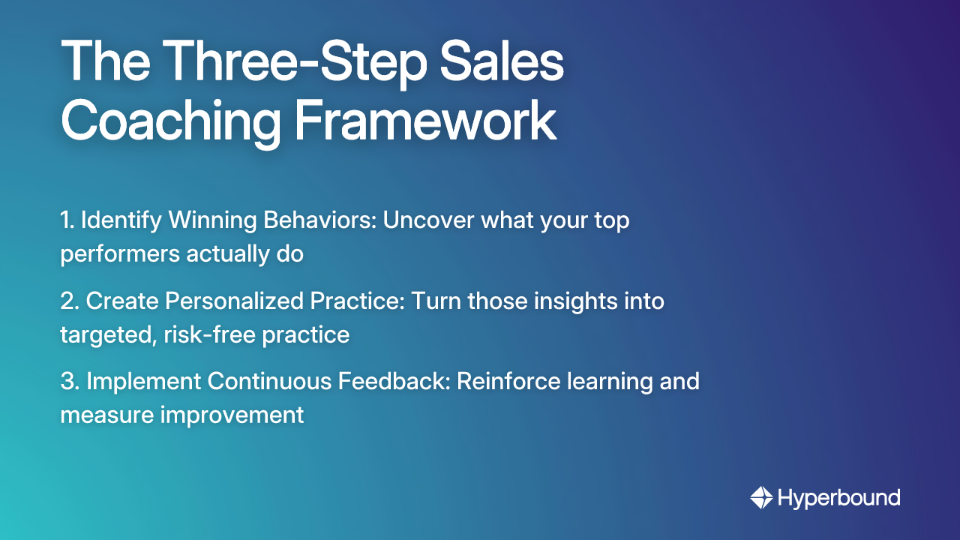
- Identify Winning Behaviors: Uncover what your top performers actually do
- Create Personalized Practice: Turn those insights into targeted, risk-free practice
- Implement Continuous Feedback: Reinforce learning and measure improvement over time
Let's dive into each step and see how you can implement this framework to coach reps toward consistently better results.
Step 1: Identify Winning Behaviors from Your Top Performers
You can't replicate success if you can't define it. This step moves you from gut feelings to a data-backed blueprint of what actually works on your team.
The Challenge with Traditional Methods
Most managers rely on limited approaches to understand what makes top performers successful:
- Manual call reviews are time-intensive and not scalable
- Peer shadowing can be helpful but lacks structured, objective data
- Managers are often too busy to provide the depth of analysis needed
As a result, coaching advice tends to be generic and ineffective: "Ask more open-ended questions" or "Build more rapport."
A Data-Driven Approach
The first step to building a scalable coaching program is to automate the analysis of your team's real-world conversations. Hyperbound's AI Real Call Scoring technology can automatically analyze thousands of sales calls, transforming raw conversations into structured coaching insights without requiring managers to listen to every minute of every call.
This technology identifies key moments, talk tracks, and behaviors that consistently lead to success, saving manager time by extracting key moments, objections, and buying signals, allowing for quick, high-impact reviews.
Key Winning Behaviors to Identify
Based on research from CirrusInsight, here are specific winning behaviors to look for:
.png)
- Active Listening: What is the talk-to-listen ratio of your top reps? Do they consistently pause for 3-5 seconds after a prospect speaks?
- Skillful Questioning: How many open-ended discovery questions do they ask before pitching? What specific questions consistently uncover budget and timeline?
- Building Trust: What language do they use to establish credibility early in the call? How do they demonstrate understanding of industry challenges?
- Objection Handling: What are the exact phrases they use to successfully navigate pricing objections? How do they address competitor comparisons?
By systematically identifying these patterns, you transform vague coaching advice ("be a better listener") into specific, actionable guidance ("increase your listen-to-talk ratio from 30:70 to 60:40 by asking two follow-up questions after each prospect response").
With these winning behaviors identified, you're ready for step two: creating practice opportunities that focus specifically on these skills.
.png)
Step 2: Create Personalized Practice Scenarios for Each Rep
Once you've identified what makes your top performers successful, the next step is to pinpoint specific skill gaps for each rep and create targeted practice opportunities to close those gaps.
The Power of Risk-Free Practice
Most sales leaders subscribe to the "learning by doing" worldview, but this approach has significant drawbacks. As one sales rep noted in a Reddit discussion, the goal should be "giving them a low-stakes space to practice high-stakes moments" to "accelerate the 'learning by doing' process...but without the cost of lost deals or trust."
Generic coaching advice like "ask more open-ended questions" is ineffective. Instead, personalized coaching that sounds like, "In your last three discovery calls, you asked only two open-ended questions before pitching. Let's focus on using 'Tell me more' after qualifying pain," drives real improvement.
The Challenge of Scaling Personalized Practice
The traditional approach to personalized practice has significant limitations:
- Managers don't have time to roleplay with every rep on every scenario
- Peer roleplay can feel awkward and often lacks structured feedback
- Traditional LMS roleplay scenarios are rigid and don't adapt to the rep's responses
AI-Powered Roleplays: Scaling Personalized Practice
Hyperbound's AI Sales Roleplays allow managers to scale personalized practice across their entire team. Based on the winning behaviors and skill gaps identified in Step 1, you can create hyper-realistic AI simulations that provide:
- Customizable Scenarios: Tailor roleplays to your specific ICPs, products, and sales methodology so reps practice handling the exact objections they face daily
- Diverse Roleplay Types: Comprehensive practice across the entire sales cycle:
- Outbound: Cold calls, gatekeeper interactions, voicemails
- Inbound: Discovery calls, demo calls, objection handling
- Post-Sales: Upsell, cross-sell, renewal conversations
Implementing Effective Practice Scenarios
Here's how to create effective practice scenarios for your team:
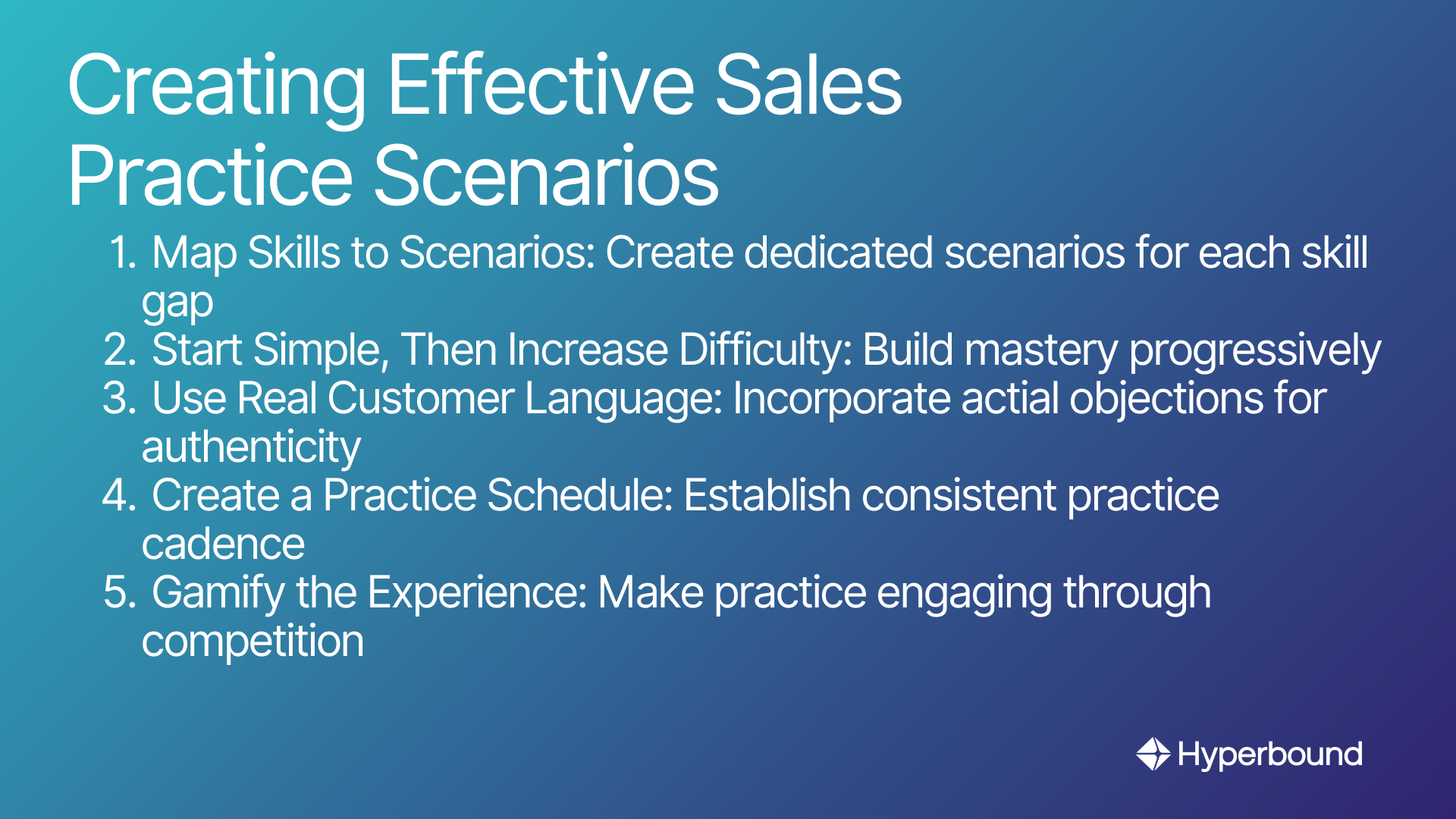
- Map Skills to Scenarios: For each key skill gap, create a dedicated scenario. If a rep struggles with asking probing questions during discovery, create a scenario focused specifically on that skill.
- Start Simple, Then Increase Difficulty: Begin with straightforward scenarios and gradually increase complexity as reps master basic skills.
- Use Real Customer Language: Incorporate actual objections and language from your prospects to make scenarios authentic.
- Create a Practice Schedule: Establish a consistent cadence for practice—perhaps 15 minutes three times per week—rather than occasional marathon sessions.
- Gamify the Experience: Address the "homework" concern by making practice engaging through gamified learning and leaderboards, which motivate reps through healthy competition.
One sales manager using this approach reported: "After implementing regular AI roleplay sessions focused specifically on objection handling, we saw a 22% increase in our team's ability to overcome pricing objections in real calls within just three weeks."
With regular, targeted practice in place, the final step is to ensure continuous feedback that reinforces learning and drives measurable improvement.
Step 3: Implement Continuous Feedback Loops with Measurable Outcomes
Coaching isn't a one-time event; it's a continuous process. Learning sticks when feedback is immediate, consistent, and reinforced. Without this ongoing feedback loop, reps develop bad habits and your training investments are wasted.
The Problem with Delayed Feedback
Traditional coaching typically follows this pattern: rep has a call on Monday, manager reviews it on Wednesday, and feedback is delivered in a 1:1 the following week. By then:
- The context is lost
- The rep has had multiple similar calls since then
- The opportunity for immediate correction is gone
- Bad habits may have already formed
Research shows that feedback is most effective when delivered within minutes of the behavior, not days or weeks later.
Automating the Feedback Loop
Technology can provide the instant reinforcement needed to make new behaviors stick. Hyperbound's AI Coaching delivers immediate, personalized feedback after both practice roleplays and real customer calls.
The system works by providing:
- Instant, Objective Feedback: After each interaction, AI-powered scorecards objectively measure performance against your methodology, tracking metrics like talk ratios, questions asked, and objections handled
- Personalized Coaching: The system identifies missed opportunities, weak responses, or moments where the rep went off-track, allowing reps to self-correct in real-time without waiting for a manager
- Manager Empowerment: This approach automates low-level call review, freeing managers to focus on high-impact strategic coaching
Measuring Improvement Over Time
The final piece of an effective coaching framework is tracking progress to demonstrate ROI and refine your approach. Effective measurement includes:
- Track Skill-Specific Metrics: Monitor improvement in specific skills (e.g., discovery question count, objection handling success rate, talk-to-listen ratio)
- Correlate with Business Outcomes: Connect skill improvements to business metrics like:
- Close rates
- Deal sizes
- Sales cycle length
- Win rates against specific competitors
- Celebrate Progress: Publicly recognize improvement to reinforce positive behavior change
Industry research shows that organizations using AI coaching see up to 36% higher win rates, demonstrating the power of continuous, automated feedback.
Putting It All Together: From Coaching As an Art to Coaching As a Science
This three-step framework transforms coaching from a subjective, time-intensive art into a scalable, data-driven science:
- Identify Winning Behaviors: Use AI to analyze calls and identify exactly what your top performers do differently
- Create Personalized Practice: Build targeted practice scenarios that address each rep's specific skill gaps
- Implement Continuous Feedback: Reinforce learning with immediate feedback and track measurable improvement over time
By implementing this framework, you'll empower your sales managers to stop being reactive problem-solvers and become proactive performance architects who can:
.png)
- Reduce new rep ramp time by 30-50%
- Drive consistent execution of your sales methodology
- Improve close rates across the entire team
- Scale coaching effectively, even across large, remote teams
Most importantly, you'll create a culture of continuous improvement where reps are constantly developing their skills and closing more deals.
Ready to implement a coaching framework that drives real results? See how Hyperbound can help you identify what your best reps do, scale it across your entire team, and close more deals through AI-powered practice and feedback.
Frequently Asked Questions
What is the three-step sales coaching framework?
The three-step sales coaching framework is a data-driven system designed to improve sales team performance by identifying what top reps do, creating personalized practice, and providing continuous feedback. It moves beyond subjective coaching by first using AI to analyze real sales calls and pinpoint specific "winning behaviors." Second, it uses those insights to create targeted, risk-free AI roleplay scenarios for reps to practice those skills. Finally, it implements an automated, continuous feedback loop to reinforce learning and track measurable improvements in performance.
Why is traditional sales coaching often ineffective?
Traditional sales coaching is often ineffective because it is time-consuming, subjective, difficult to scale, and provides feedback too late to be useful. Managers struggle to review enough calls to get a clear picture, leading to generic advice. Feedback is often delivered days after a call, by which time the context is lost and bad habits may have already formed. Furthermore, reps can perceive it as extra "homework," leading to low engagement.
How can AI help identify winning sales behaviors?
AI can automatically analyze thousands of sales conversations to identify the specific patterns, talk tracks, and techniques that consistently lead to successful outcomes. Instead of manually listening to calls, AI tools can systematically track metrics like talk-to-listen ratios, the types of questions asked, and the exact language used to handle objections. This allows sales leaders to create a data-backed blueprint of what their best reps do, transforming vague goals into actionable and specific coaching points.
How do AI sales roleplays improve rep performance?
AI sales roleplays improve performance by providing reps with a safe, scalable, and personalized environment to practice high-stakes scenarios without risking live deals. Unlike traditional roleplay, AI simulations can be tailored to specific products, customer profiles, and common objections. They offer unlimited practice opportunities and provide immediate, objective feedback, helping reps build muscle memory and confidence before they engage with actual prospects.
Will AI coaching replace sales managers?
No, AI coaching is designed to empower sales managers, not replace them. AI automates the time-consuming tasks of call review and low-level feedback, freeing up managers to focus on higher-impact strategic coaching, deal strategy, and personal mentorship. It provides managers with the data and insights they need to have more effective, targeted coaching conversations.
How do I get sales reps to adopt a new coaching program?
To get buy-in from reps, frame the coaching program as a tool for their personal success and make the process engaging, relevant, and easy to use. Emphasize that the goal is to help them close more deals and earn more commission. Use gamification elements like leaderboards to foster healthy competition and ensure the practice scenarios are realistic and directly address the challenges they face daily. When reps see that the coaching is personalized and helps them improve, adoption rates increase significantly.
Looking for more insights on sales coaching? Check out these resources:
Book a demo with Hyperbound


