

.png)
Summary
- Top reps speak only 40-45% of the time, proving that call analysis can uncover measurable winning behaviors like active listening.
- AI-powered transcript analysis reveals customer pain points, competitor mentions, and effective talk tracks to inform sales coaching, marketing, and product strategy.
- Start by tracking one or two metrics—like talk-to-listen ratio or common objections—to turn call recordings into actionable business intelligence.
- Once winning behaviors are identified, Hyperbound's AI Sales Roleplays help reps practice and master these techniques in a safe, repeatable environment.
You have hundreds of hours of sales calls—a goldmine of qualitative data sitting in your system. Yet like many sales leaders, you're struggling to "quantify some of the qualitative data we have" and transform these conversations into actionable insights. You want to understand "what words were used in successful sales pitches that were not used in unsuccessful ones" and systematically "identify pain points, problems, objections, etc. to better inform our marketing material."
The truth is, most companies are sitting on a treasure trove of customer intelligence that remains largely untapped. This guide will show you how to transform raw sales call transcripts from passive records into active assets that drive coaching, strategy, and revenue.
Beyond the Basics: Why AI-Powered Transcription Is a Game-Changer
Manually reviewing every sales call is impossible for most teams. Even if you could listen to every conversation, human memory is fallible, and insights often get lost without systematic capture.
Modern sales analysis has evolved beyond tracking simple metrics like call volume or talk time. Today's leaders are analyzing the quality and context of conversations to drive meaningful improvements. This shift from volume to value is essential for modern sales teams.
AI-powered transcription and analysis tools offer three core benefits:
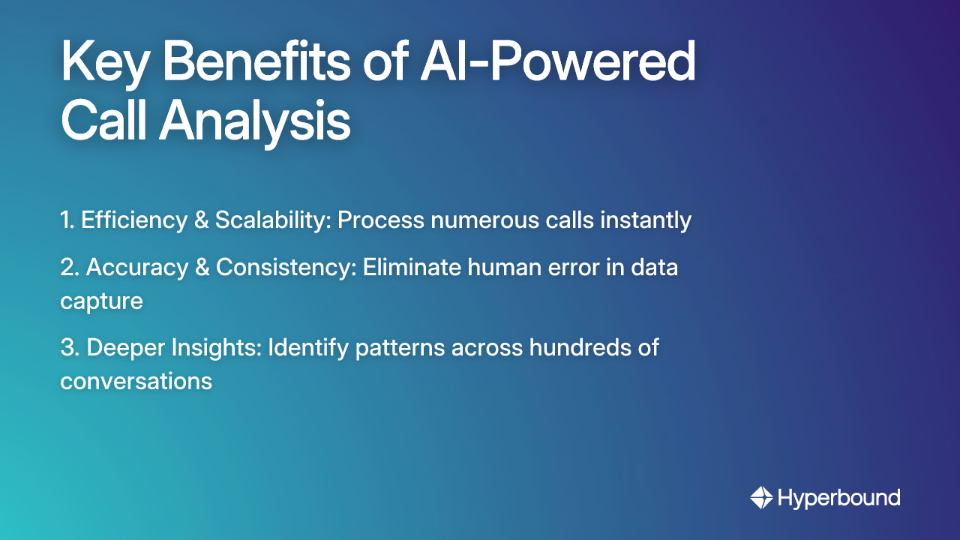
- Efficiency & Scalability: AI provides instant transcripts, flags action items, and handles numerous calls withoutsacrificing quality. This is particularly crucial for managing larger teams where manual review becomes impractical.
- Accuracy & Consistency: AI eliminates human error and captures every detail consistently, ensuring no critical insights slip through the cracks. This creates a permanent, searchable record of every customer interaction.
- Deeper Insights: Today's AI can perform sentiment analysis, track keywords, and generate summaries automatically. This enables sales leaders to spot patterns across hundreds of calls that would be impossible to identify manually.
Foundational Analysis: Turning Conversations into Quantifiable Insights
For sales managers asking "how do we code for themes" from qualitative data, here's your systematic approach:
Step 1: Track Keywords, Topics, and Competitor Mentions
AI analysis tools can systematically monitor specific keywords that signal buyer intent, pain points, or opportunities. This allows you to:
- Track how often prospects mention specific features or benefits
- Monitor competitor mentions to understand market positioning
- Identify common objections that arise during the sales process
These insights help teams adjust their messaging to address the most prevalent customer concerns and competitive threats.
Step 2: Analyze Buyer Sentiment and Signals
Modern AI tools can gauge client interest and hesitation by analyzing tone and verbal cues, marking them as positive or negative. For example:
- When a prospect's tone becomes negative during pricing discussions, reps can be prompted to adjust their proposals or follow-up strategy
- Enthusiasm when discussing specific features can indicate which aspects of your product resonate most strongly
- Hesitation or confusion might signal areas where your messaging needs clarification
Additionally, AI can spot subtle buying signals that humans might miss. For instance, when a prospect discusses switching vendors, this indicates a potential churn risk for their current provider—and an opportunity for your team to follow up strategically.
Step 3: Identify Upsell & Cross-Sell Opportunities
AI analysis can detect mentions of additional needs or desired integrations that signal clear upsell or cross-sell opportunities. For example, if a customer mentions wanting CRM integration during an initial product discussion, this creates an immediate opportunity to introduce your integration capabilities or premium tier.
Step 4: Discover Temporal Patterns
Many sales leaders wonder: "Is there a difference in success rates by time, day, or week?" Call analytics can answer this question by correlating call timing with outcomes. You might discover that:
- Certain days yield higher conversion rates
- Specific call durations correlate with successful outcomes
- Morning calls consistently outperform afternoon conversations
These insights allow you to optimize scheduling for maximum impact. This data-driven approach eliminates guesswork and allows teams to focus their efforts when prospects are most receptive.
Precision Coaching: Using Data to Elevate Your Team's Performance
With foundational analysis in place, you can move to the next level: using transcript data for effective, personalized coaching.
Action 1: Isolate Winning Behaviors to Build a Playbook
Analyze calls from your top-performing reps to identify successful patterns:
- Effective opening lines that engage prospects immediately
- Strategies for handling common objections
- Call structures that consistently lead to more demos or closed deals
This "winning playbook" based on real conversations provides concrete examples for coaching, rather than theoretical best practices.
Action 2: Master Key Conversational Metrics
Several data-driven metrics have proven particularly valuable for coaching:
Talk-to-Listen Ratio: Industry benchmarks show that top reps speak only 40-45% of the time, emphasizing active listening over excessive talking. Track this ratio across your team to identify who needs coaching on customer-centric conversation.
Call Opening Optimization: The first 30 seconds are critical. Optimized openings can lead to a 30-40% increase in call engagement. Coach reps on key components: pattern interrupts, personal connection, clear agenda, and a concise value proposition.
Filler Word Tracking: AI can track filler words ("um," "like," "sort of") and analyze long monologues to help reps become more effective communicators. Even experienced reps are often surprised to see their actual patterns when presented with data.
Action 3: Systematize Objection Handling
Create an Objection Anticipation Framework by documenting common objections from transcripts. For each objection, develop and test responses, then measure their effectiveness.
Many sales teams find success with the "feel, felt, found" technique to address objections proactively:
- "I understand how you feel..."
- "Others have felt the same way..."
- "What they've found is..."
By tracking which approaches to specific objections yield the best results, you create a continuously improving playbook.
Action 4: Implement Objective Scoring
Use AI-powered scorecards based on specific methodologies (e.g., MEDDIC, Sandler) to objectively assess rep performance. Platforms like Hyperbound provide a standardized framework for feedback, removing subjectivity from the coaching process. Hyperbound’s AI Real Call Scoring can automate this process, ensuring consistent evaluation across your team.
Strategic Impact: Leveraging Call Insights Across the Business
Sales call data isn't just for the sales team—it can inform broader business strategy.
Strategy 1: Inform Marketing and Messaging
This directly addresses the core need to "better inform our marketing material." Extract common customer pain points, objections, and desired outcomes from transcripts to:
- Create highly resonant marketing copy using actual customer language
- Develop case studies addressing the most common challenges
- Refine value propositions based on what actually resonates
These authentic insights are far more powerful than assumptions made in marketing brainstorming sessions.
Strategy 2: Drive Product Development
Systematically categorize recurring issues, feature requests, and customer feedback from calls. Share these insights with the product team to:
- Prioritize features that address common pain points
- Fix problems that repeatedly impact the sales process
- Identify new market opportunities based on unmet needs
Strategy 3: Conduct Data-Driven Win/Loss Analysis
Go beyond anecdotal evidence. Use AI to analyze transcripts from won and lost deals to understand:
- Key factors that influence outcomes
- Common competitor mentions and how they're positioned
- Buyer concerns that frequently lead to lost opportunities
This data-driven approach provides more reliable insights than traditional win/loss analysis, which often relies on biased recall.
Choosing Your Toolkit and Addressing Privacy Concerns
When selecting an AI sales coaching platform, look for key capabilities that turn insights into action:
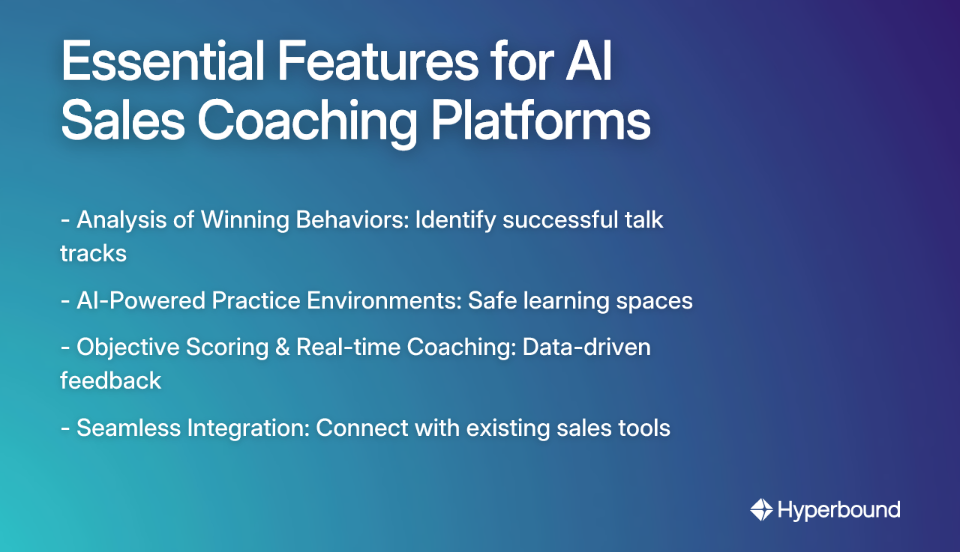
- Analysis of Winning Behaviors: The ability to automatically transcribe calls and identify the talk tracks and techniques of your top reps.
- AI-Powered Practice: Tools like AI Sales Roleplays that allow reps to practice what they've learned in a safe, repeatable environment.
- Objective Scoring & Coaching: Automated scorecards and instant, personalized feedback to accelerate skill development.
- Seamless Integration: The ability to connect with your CRM and other sales tools for a streamlined workflow.
As for privacy concerns, you're right that "privacy shouldn't be an issue" with proper safeguards. Ensure any tool used is compliant with standards like GDPR. For teams with extreme sensitivity, some companies have "ended up building a tool that analyzes transcripts" internally to ensure data never leaves their secure environment.
The Path Forward
Sales call transcripts are no longer just for record-keeping. They are dynamic, strategic assets. With the right approach and tools, you can unlock a continuous feedback loop that drives performance and growth.
Start small: Pick one metric to track this week—like the Talk-to-Listen Ratio—to begin your journey toward data-driven sales management. The insights you gain will shape not just your sales strategy, but your entire business approach.
Frequently Asked Questions
What is AI-powered sales call analysis?
AI-powered sales call analysis is the process of using artificial intelligence to automatically transcribe, summarize, and extract key insights from sales conversations at scale. It goes beyond simple transcription by identifying keywords, tracking topics, analyzing speaker sentiment, and flagging key moments like objections or competitor mentions. This technology transforms qualitative call recordings into structured, quantifiable data that can be used to improve sales performance and business strategy.
How can analyzing sales calls improve my team's performance?
Analyzing sales calls provides data-driven insights that enable highly effective and personalized coaching for your sales team. By identifying the specific behaviors, talk tracks, and objection-handling techniques of your top performers, you can create a "winning playbook" for the entire team. It also allows you to track key metrics like the talk-to-listen ratio and filler word usage, providing objective feedback to help reps become more effective communicators.
What are the most important metrics to track from sales calls?
Some of the most critical metrics to track are the talk-to-listen ratio, competitor mentions, common objections, and buyer sentiment during key moments of the conversation. The ideal talk-to-listen ratio for top reps is around 40-45% speaking time, emphasizing active listening. Tracking objections helps you build a systematic framework for handling them, while monitoring sentiment and competitor mentions provides real-time intelligence on market positioning and deal health.
How can sales call insights be used by other departments?
Sales call insights are a goldmine of customer intelligence that can directly inform marketing, product development, and overall business strategy. The marketing team can use the exact language customers use to describe their pain points to create more resonant ad copy and content. The product team can use recurring feature requests and feedback to prioritize their development roadmap. This cross-functional use of data ensures the entire company is aligned with the voice of the customer.
How do I get started with sales call analysis?
The easiest way to get started is by choosing an AI-powered transcription and analysis tool and focusing on one or two key metrics initially. Instead of trying to analyze everything at once, begin by tracking a simple yet powerful metric like the talk-to-listen ratio or the frequency of a top competitor's name being mentioned. This allows you to see immediate value and build a business case for expanding your analysis to include more advanced features like automated scoring and sentiment analysis.
Is AI analysis accurate enough to understand complex sales conversations?
Yes, modern AI tools have become highly sophisticated and can accurately capture the nuances of complex sales conversations, including sentiment, tone, and context. While no system is perfect, AI eliminates the human error and inconsistency inherent in manual reviews. It can reliably transcribe conversations, identify keywords, and even gauge speaker emotion.
Book a demo with Hyperbound


