

.png)
Summary
- Standalone call scoring often fails because it acts as "expensive reporting," identifying issues without providing a system for reps to practice and improve.
- Teams that connect call scoring to practice see significant improvements, with data showing a 50% faster ramp time and 2x faster time to a first won deal.
- The solution is to create a "practice loop" that routes reps from a scored call directly into targeted practice, allowing them to fix mistakes before the next live customer conversation.
- Hyperbound's platform closes this loop by linking AI Real Call Scoring to targeted AI Sales Roleplays, turning insights into verifiable skills.
Your sales team is running call scoring. Scorecards are being filled out. Summary emails are landing in inboxes. On paper, it looks like a functioning coaching operation.
So why haven't your win rates moved?
Here's the uncomfortable truth: most sales teams have adopted sales call scoring software, but the data stays data. It informs. It diagnoses. It generates slides for the QBR. But it doesn't change what a rep says on their next call — because there's no connected loop between the insight and the behavior.
Scoring without a practice loop is just expensive reporting.
The teams actually pulling ahead aren't just scoring calls — they're routing reps directly from scored calls into targeted practice. According to Hyperbound's internal data, teams that connect call scoring to AI roleplays see 50% faster ramp and 2x faster time to first won deal compared to teams that score calls and send reps a summary email. That gap is the practice loop.
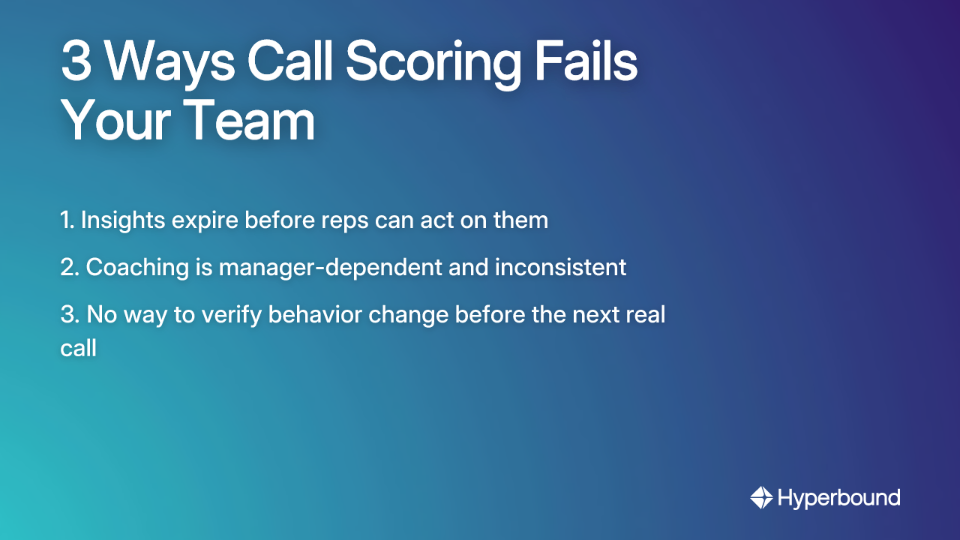
Before we get to the fix, let's name the three failure modes that make standalone call scoring an incomplete system — and why each one is quietly costing you revenue.
The Illusion of Progress: 3 Ways Standalone Call Scoring Fails Your Team
Call scoring is a good first step. The problem is most teams treat it like a final step.
Failure Mode #1: Insights Expire Before Reps Act on Them
Picture this: a rep handles a pricing objection poorly on a Monday call. The scorecard flags it. A manager reviews it Thursday. The 1:1 happens Friday. By the time any coaching lands, the rep has already been on six more calls — likely making the same mistake.
The coachable moment is gone.
Feedback has a half-life. The further it sits from the actual behavior, the less it changes anything. This is the core flaw of batch-review coaching: it's almost always too late to matter. Context fades, motivation fades, and the specific nuance of how the rep stumbled gets lost in translation between a scorecard and a conversation four days later.
The fix isn't better scorecards. It's collapsing the time gap between insight and action to near-zero.
Failure Mode #2: Coaching Is Manager-Dependent and Inconsistent
Even teams with strong call scoring programs often hit the same wall: coaching quality varies wildly depending on who the manager is.
As one sales rep put it on Reddit: "the biggest thing I've noticed is a complete lack of sales experience in management at a lot of companies." And when managers do review calls, reps frequently describe the feedback as “too subjective and not actionable for improvement.”
This isn't a manager problem — it's a systems problem. When coaching is entirely manager-dependent, you don't have a coaching program. You have a lottery. Two reps with identical skill gaps can receive completely different development experiences based on nothing more than which team they sit on.
Call scoring surfaces the gaps consistently. But without a standardized mechanism to act on them, you still get inconsistent outcomes.
Failure Mode #3: There's No Way to Verify Behavior Change Before the Next Real Call
This is the one nobody talks about.
After the coaching session, how do you actually know the rep internalized the feedback? You don't — until they're back on a live call, and by then you're risking a real deal to find out.
Sales reps themselves feel this too. One community member described the need for “a low-stakes space to practice high-stakes moments… without the cost of lost deals or trust.” That space doesn't exist in a call review cycle. It has to be purpose-built.
Scoring tells you what went wrong. But there's no verification step in a standalone scoring system — no moment where you can confirm the rep can now execute the fix under pressure before it counts.
The Solution: Closing the Loop with Perform → Practice → Activate
The teams escaping these failure modes aren't doing anything radically different with their call data. They're just doing one critical thing: treating the scored call as the beginning of the learning cycle, not the end of it.
That's the foundation of what Hyperbound calls Revenue Activation — a category built around a simple premise: data alone doesn't change outcomes. Analyzing real sales conversations, identifying the behaviors that drive wins, and connecting those insights to targeted practice does.
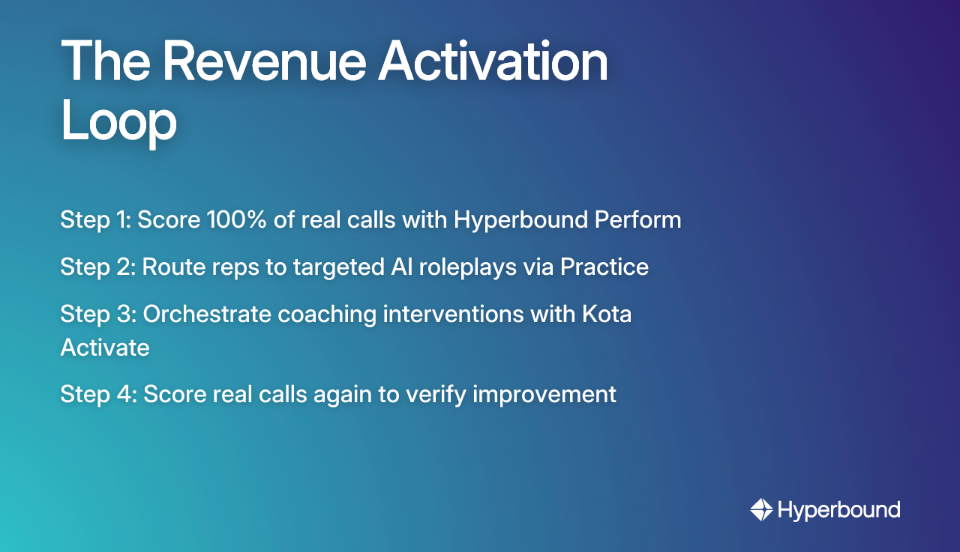
The operational loop looks like this:
Score Real Calls → Identify Skill Gaps → Practice Roleplays → Score Real Calls Again
Here's how each piece works:
Step 1: Perform — Turn Conversation Data into Actionable Insight
Hyperbound Perform automatically scores 100% of real customer conversations against your custom methodology scorecards. It integrates with popular conversation intelligence platforms and other recording systems — so you're not starting from scratch. But crucially, it doesn't just score calls in isolation. It rolls up deal-level intelligence across every touchpoint, surfacing what's helping or hurting an opportunity and flagging deal risk while it's still winnable. This addresses Failure Mode #1 — the insight is immediate, specific, and tied to a deal, not a general observation.
Step 2: Practice — Turn Insight into Muscle Memory
Once a skill gap is identified, the rep doesn't get an email — they get a targeted practice session. Hyperbound Practice routes reps directly into AI roleplays designed around the exact scenario they struggled with — whether that's handling a pricing objection, re-engaging a cold discovery call, or navigating a multi-stakeholder close.
These aren't generic scripts. The AI buyer personas are trained on 2M+ hours of real B2B sales conversations, which means the practice feels like the real thing. One rep described it as "the first thing they actually stick with because it feels like practicing with a tough prospect." After every simulation, reps receive instant, objective AI scorecards tracking talk ratios, methodology adherence, and specific coaching areas — the same objective standard for every rep, every session. This closes Failure Mode #2 by decoupling coaching quality from manager availability or experience.
And it closes Failure Mode #3 because the scorecard from the roleplay is the verification. Before a rep goes back on a live call, you can see whether they've actually internalized the fix — not just nodded along in a 1:1.
Step 3: Kota Activate — Orchestrate the Right Coaching at the Right Time
Kota is the AI Revenue Analyst that sits above Practice and Perform, acting as the intelligence layer that connects the dots. Kota doesn't just surface data — it recommends specific coaching interventions at the right moment based on combined signals from both real call performance and roleplay results.
Instead of a manager guessing where to focus coaching energy, Kota recommends what action to take next to move a deal forward or accelerate a rep's development. It's the difference between a stack of data and an actual system.
The loop runs continuously: Perform scores real calls → gaps are flagged → Practice routes reps to targeted roleplays → AI scorecards verify improvement → Perform scores the next real call. Every rep is improving in real-time, and managers have visibility into whether the training is actually translating on live calls.
Proof in Performance: How Vanta Cut Rep Ramp Time by 60%
The benchmark for what this loop can produce isn't theoretical.
Vanta — the security compliance platform — implemented the Perform → Practice → Activate loop and achieved results that reset expectations for what's possible in sales ramp. Their new BDR ramp time dropped from 210 days to 72 days — a 60% reduction. At the same time, they grew their BDR team 4x and generated 5x more pipeline.
As Stevie Case, CRO at Vanta, put it: the results weren't incremental. They were structural — a fundamentally different approach to how rep development connects to revenue outcomes.
Vanta isn't alone:
- Nivoda saw a 50% ramp reduction, doubled revenue year-over-year, and increased their demo rate by 150% — validating that when the practice loop is embedded in the workflow, it compounds across the entire funnel.
- LinkedIn deployed the system across 3,000+ sellers across three business units in NAMER and EMEA, signaling that the model scales beyond startups and high-growth teams — it works at enterprise velocity too.
These results share a common thread: none of them came from better scoring alone. They came from closing the loop.
Stop Reporting, Start Activating
A sales call scorecard is a diagnosis. And a diagnosis without a treatment plan is just bad news delivered on a dashboard.
The revenue left on the table isn't in your call data — it's in the gap between what your scoring tells you and what your reps do differently because of it. That gap is the practice loop. And right now, most teams don't have one.
The three failure modes of standalone call scoring — insights expiring before reps act, coaching staying manager-dependent, and no mechanism to verify behavior change — aren't fixable by better scorecards or more detailed summary emails. They're structural. They require a loop that connects scoring to practice to verified improvement and back again.
The question for every revenue leader is: are you running a reporting function, or a revenue activation engine?
If your call scoring isn't connected to a practice loop today, see how Hyperbound closes the gap — and what your ramp time and win rates look like when it is.
Frequently Asked Questions
What is the primary failure of standalone sales call scoring?
The primary failure of standalone sales call scoring is that it identifies problems without providing a system to fix them, effectively becoming "expensive reporting" that doesn't change sales rep behavior or improve win rates. The data and insights from scorecards often expire before a rep can act on them, coaching becomes inconsistent and dependent on individual managers, and there is no way to verify if a rep has internalized feedback before their next live customer call.
Why is a sales practice loop essential for coaching?
A sales practice loop is essential because it connects the insights from call scoring directly to targeted practice, allowing reps to immediately apply feedback and build muscle memory in a safe environment. This loop closes the gap between diagnosing a skill gap and developing that skill. By moving directly from a scored call into a targeted AI roleplay, reps can work on specific weaknesses when the feedback is most relevant, leading to faster skill acquisition and verified behavior change.
How does AI roleplay improve on manager-led coaching?
AI roleplay improves on manager-led coaching by providing immediate, consistent, and scalable practice opportunities that are not dependent on a manager's availability or coaching style. AI simulations offer a low-stakes environment for reps to practice high-stakes conversations 24/7. The feedback is objective and standardized, ensuring every rep receives the same quality of coaching for a given scenario. This solves the problem of inconsistent, subjective feedback and allows managers to focus their time on higher-level strategic coaching.
What is Revenue Activation?
Revenue Activation is a system that directly connects insights from real sales conversations to targeted practice and coaching interventions, ensuring that data leads to behavior change and measurable revenue outcomes. It moves beyond passive data analysis with a three-stage loop: Perform (scoring real calls to find skill gaps), Practice (using AI roleplays to fix those gaps), and Activate (using AI to orchestrate the right coaching interventions).
How can a sales team measure the impact of a practice loop?
The impact of a practice loop is measured through key performance indicators like reduced rep ramp time, increased pipeline generation, higher demo and win rates, and faster time to a rep's first won deal. For example, companies using this system have cut BDR ramp time by 60% and generated 5x more pipeline. The loop provides continuous verification by allowing you to compare a rep's performance score on a real call before and after they complete targeted practice simulations.
Is this coaching model suitable for large, enterprise sales teams?
Yes, this coaching model is highly scalable and has been successfully deployed by large enterprise teams to standardize development and improve performance across thousands of sellers. The use of AI for scoring and practice removes the bottlenecks of manual, manager-dependent coaching. As a result, every seller, regardless of their team or location, has access to consistent, high-quality coaching on-demand.
Book a demo with Hyperbound


