

.png)
Summary
- Top-performing sales reps ask 37% more questions and spend 60% more time discussing prospect challenges, demonstrating that data-driven insights are more effective than guesswork.
- Shift from subjective feedback to data-driven coaching by analyzing metrics like talk-to-listen ratios and objection handling success rates to give reps specific, actionable advice.
- Use call analytics to optimize your entire sales process by identifying high-intent leads, discovering the best times to call, and uncovering hidden buyer objections.
- Implement these strategies using an AI coaching platform to analyze your team's winning behaviors and let reps practice them in realistic AI roleplays.
You've just finished another sales call. Maybe it went well, maybe it didn't—but how would you know for sure? You could listen to the recording and try to evaluate yourself, but as one sales rep put it, "I thought about that, but I'm biased!" Or perhaps you've considered creating a "cold call scorecard" but found the process of manually transcribing and reviewing calls "tedious and time-consuming."
If this sounds familiar, you're not alone. The uncertainty about what makes some calls succeed and others fail is a common pain point among sales professionals. But what if you could have an objective, AI-powered coach that transforms your gut feelings into data-driven insights?
The Rise of Sales Call Analytics
Sales call analytics isn't just another tech buzzword—it's transforming how top-performing teams sell. The global conversation intelligence market is projected to grow from $23.4B in 2024 to $55.7B by 2035. With 46% of US sales teams already using AI call recording (expected to reach 57% by 2025), this technology is quickly becoming table stakes rather than a competitive advantage.
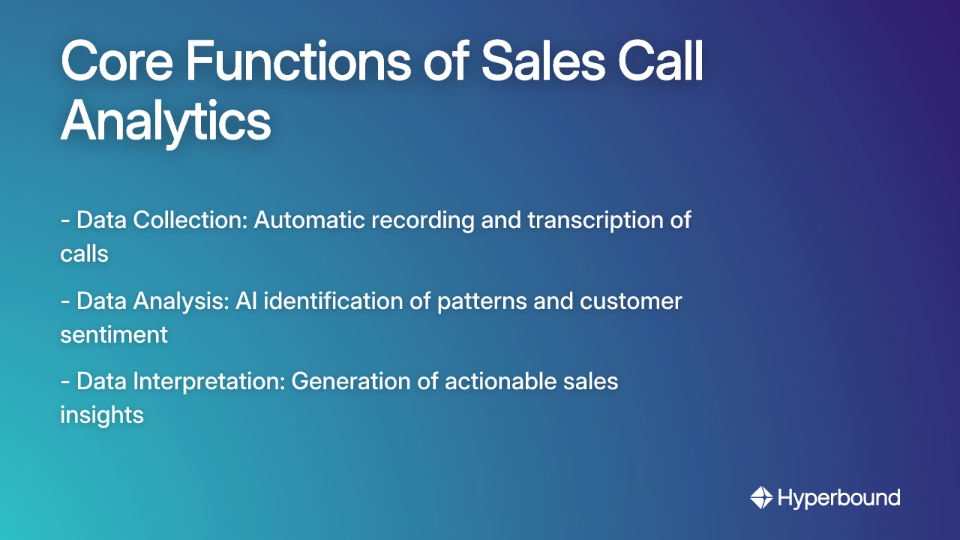
At its core, sales call analytics automates three critical functions:
Here are 7 ways we used sales call analytics to double our conversion rate—and how you can do the same.
1. Identify and Replicate Your "Winning Behaviors"
Stop guessing what works. The most powerful aspect of call analytics is its ability to identify exactly what your top performers are doing differently.
Our team was surprised to discover that our highest-converting rep wasn't the one with the most product knowledge or the most aggressive closer. Instead, the data revealed that our star performer asked 37% more questions than average and spent 60% more time discussing the prospect's challenges before mentioning our solution.
To leverage this insight, top teams:
- Create a library of successful opening lines that consistently build rapport
- Document effective techniques for handling common objections
- Map out the conversation flows that most often lead to scheduled demos
- Build a "greatest hits" repository of call recordings for training
Once we implemented this approach, our team-wide conversion rate increased by 23% in just 30 days as everyone began adopting these proven behaviors.
2. Deliver Data-Driven Coaching, Not Subjective Feedback
"You need to be more enthusiastic" or "Try to control the conversation more" is the kind of vague feedback that frustrates sales reps. Call analytics transforms coaching from opinion-based to evidence-based.
Objective performance evaluation focuses on measurable metrics:
- Talk-to-listen ratio (we found our closers averaged 45:55, not the 80:20 many assumed was ideal)
- Question frequency and quality
- Success rate when handling specific objections
- Response to buying signals
Our coaching improved dramatically when we could say, "When pricing comes up, your close rate drops by 47%. Let's listen to how Sarah handles the same objection with an 82% success rate." This specificity eliminated bias and defensiveness while creating clear paths for improvement.
One manager reported: "I used to spend hours preparing for coaching sessions by listening to random calls. Now the system flags exactly which calls need my attention and why, making my feedback 10x more effective."
3. Pinpoint and Prioritize High-Quality Leads with Laser Focus
Not all leads are created equal, and call analytics helps you stop wasting time on prospects who will never convert.
By analyzing thousands of conversations, our system identified specific phrases and behaviors that indicated high purchase intent. For instance, prospects who asked detailed questions about implementation timelines were 3.4x more likely to convert than those who focused only on features.
AI is particularly adept at detecting buying signals that humans might miss:
- Keywords and phrases indicating strong purchase intent
- Questions that reveal genuine interest versus tire-kicking
- Engagement patterns that correlate with eventual purchases
We used these insights to refine our lead scoring model, ensuring our sales team prioritized the right prospects. The result? A 41% increase in conversion rate without making a single additional call.
4. Optimize Call Timing and Follow-Up Cadence
When you call can matter as much as what you say. Our data revealed that Tuesday and Wednesday mornings had 27% higher connection rates than Monday afternoons, but Thursday afternoon calls had the highest conversion rates of all.
Key timing metrics to track include:
- Connection rates by day and time
- Conversation duration correlation with outcomes
- Optimal frequency between follow-ups
- Response rates to voicemails left at different times
We discovered that waiting 3-4 days between follow-ups (not the 7-10 our team had been using) increased our connection rate by 36%. Additionally, we found that calls made within 5 minutes of a prospect downloading our pricing guide were 9x more likely to convert than calls made the next day.
By optimizing our call timing based on data rather than conventional wisdom, we saw an immediate 19% lift in our connection rate and a 31% improvement in conversion.
5. Uncover True Buyer Sentiment and Recurring Objections
What prospects say and what they mean aren't always the same. AI-powered sentiment analysis detects tone, emotion, and hesitation that reveal the true state of mind behind the words.
Our analytics uncovered that when prospects used phrases like "I need to think about it" with a specific tone pattern, they were actually raising an unspoken price objection 68% of the time. When we trained our team to recognize and address this hidden concern directly, our recovery rate on these calls jumped from 12% to 37%.
Sentiment analysis transforms objection handling by allowing you to:
- Track emotional responses to different topics throughout the call
- Identify which features generate excitement versus hesitation
- Catalog objections by frequency, context, and impact on conversion
- Test and measure different responses to each objection type
The most valuable insight came from discovering that 43% of our lost deals mentioned the same specific competitor concern that our sales team wasn't adequately addressing. Creating a focused response to this single objection improved our competitive win rate by 28%.
6. Close the Loop Between Lead Quality and Sales Outcomes
One of the most powerful applications of call analytics is bridging the gap between marketing and sales by connecting lead sources directly to conversation quality and outcomes.
After implementing our call analytics system, we discovered that leads from webinars were 3x more likely to engage in high-quality conversations than leads from our Google Ads campaigns, despite the latter generating more total leads at a lower cost per lead.
To close the loop, effective strategies include:
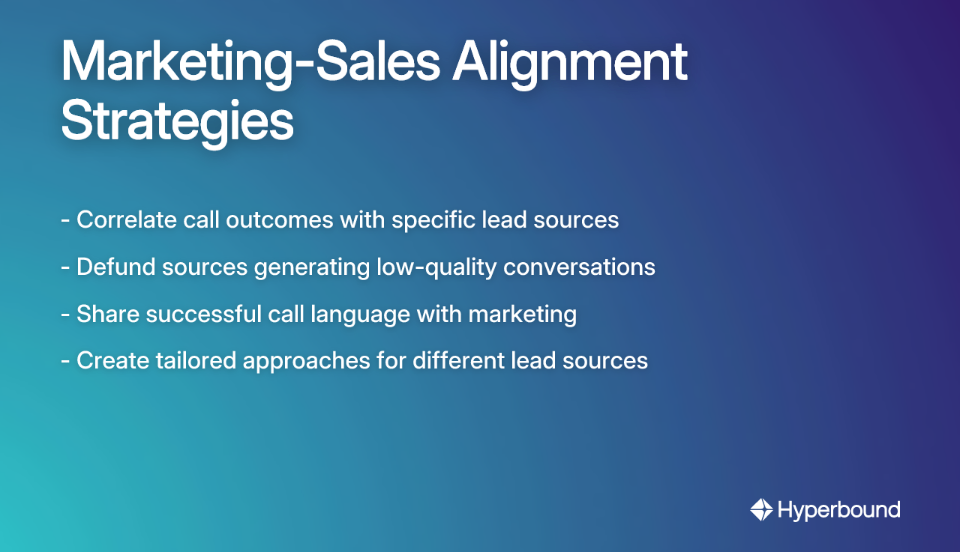
By reallocating our budget toward lead sources that generated the most productive conversations (not just the most leads), we increased our marketing ROI by 47% within one quarter.
7. Shift from Reactive Review to Proactive Strategy with AI
The most advanced implementation of call analytics isn't just about reviewing past performance—it's about predicting future outcomes and prescribing actions.
Our system progressed through four levels of sophistication:
- Descriptive Analytics: What happened? (e.g., close rates, call volumes)
- Diagnostic Analytics: Why did it happen? (e.g., objection patterns, conversation flow)
- Predictive Analytics: What is likely to happen? (The system began predicting close probability with 76% accuracy after the first call)
- Prescriptive Analytics: What should we do about it? (AI suggesting specific follow-up content and timing based on conversation patterns)
The real power comes when the system starts recommending specific actions, like: "After detecting hesitation around implementation questions, send the case study about Company X's seamless onboarding process."
Our team's efficiency skyrocketed when we could focus efforts on deals the AI predicted had the highest close probability, while automatically triggering nurture campaigns for prospects who showed early warning signs of disengagement.
How to Get Started with AI Sales Coaching and Analytics
Ready to implement these strategies? Here's a simple roadmap to get started without getting overwhelmed:
- Define Your Primary Goal: Focus on one key metric you want to improve first (e.g., first call to demo conversion rate, or reducing new hire ramp time).
- Choose the Right Tool for Your Team: The market has a range of options, from comprehensive coaching platforms to simple transcription services.
- For Comprehensive AI Coaching & Roleplay: Hyperbound analyzes your team's winning behaviors and allows reps to practice in realistic AI-powered roleplays. It's designed to reduce ramp time, scale best practices, and provide data-driven coaching.
- Other Enterprise Solutions: Platforms like Gong and Clari offer broad conversation intelligence features.
- For SMBs or Budget-Friendly Options: Tools like Fireflies.ai or JustCall provide transcription and basic analytics, which can be a good starting point.
- Start Small: Begin with a pilot program of 2-3 reps to validate the value before rolling out company-wide.
- Integrate with Your CRM: Ensure your chosen solution connects with your existing tools for seamless data flow.
- Focus on Adoption: Frame the tool as a powerful coaching resource to help reps win more deals, not as a surveillance mechanism.
Remember, the goal isn't more calls—it's better conversations. By shifting from a volume mindset to a value mindset, you'll not only improve conversion rates but also create a more satisfying experience for both your sales team and your customers.
Take the first step today by piloting a call analytics tool, and you'll wonder how you ever sold without these insights guiding your way.
Frequently Asked Questions
What is sales call analytics?
Sales call analytics is the process of using AI to automatically record, transcribe, and analyze sales conversations to uncover data-driven insights. This technology moves beyond simple recording by identifying patterns, keywords, customer sentiment, and winning sales behaviors. It transforms raw call data into actionable intelligence that helps teams understand what works, what doesn't, and why, leading to more effective coaching and higher conversion rates.
How does AI analyze sales calls to improve performance?
AI analyzes sales calls by transcribing the audio and then using Natural Language Processing (NLP) to identify key metrics, topics, sentiment, and behavioral patterns. The AI can track metrics like talk-to-listen ratios, question frequency, and the use of specific keywords. By comparing these patterns across successful and unsuccessful calls, the AI identifies the specific "winning behaviors" that lead to better outcomes, which can then be replicated across the entire team.
What are the key benefits of using sales call analytics?
The primary benefits of using sales call analytics are increased conversion rates, more effective sales coaching, and improved team performance. By providing objective, data-driven insights, this technology helps identify what top performers do differently, allowing you to scale those behaviors. It also enables highly specific coaching, pinpoints high-quality leads, optimizes call timing, and uncovers hidden customer objections, all of which contribute to a more efficient and successful sales process.
How can I get started with sales call analytics on my team?
To get started with sales call analytics, you should first define a primary goal, choose the right tool for your team's needs, and begin with a small pilot program. Start by focusing on a single, measurable metric you want to improve, such as the demo booking rate. Then, select a tool—options range from comprehensive coaching platforms like Hyperbound to simpler transcription services. Run a pilot with a few reps to prove the value before a full rollout, and ensure the tool is framed as a coaching resource to encourage adoption.
Is sales call analytics just a tool for managers?
No, sales call analytics is a powerful tool for both sales reps and managers. While managers use it for data-driven coaching and team-wide strategy, individual reps can use it for self-evaluation and improvement. Reps can review their own calls, compare their techniques to top performers, identify areas for growth, and practice new approaches based on proven winning behaviors without waiting for a formal coaching session.
How do you ensure sales team adoption and avoid a 'big brother' feeling?
To ensure adoption, it is crucial to position the tool as a personal performance coach for reps, not a surveillance mechanism for managers. Focus on the benefits for the individual: winning more deals, earning more commission, and improving their skills. Involve the team in the rollout process, be transparent about how the data will be used, and celebrate early wins. When reps see the tool helping them succeed, they are more likely to embrace it enthusiastically.
Ready to turn these insights into action? Hyperbound's AI Sales Coaching platform helps you analyze winning behaviors, scale best practices with AI roleplays, and deliver data-driven coaching that actually improves performance. See how you can double your conversion rates today.
Book a demo with Hyperbound


