

.png)
Summary
- The average SaaS sales ramp time is 3-9 months, largely because traditional, passive training methods are ineffective and reps forget what they learn.
- Effective sales training shortens ramp time by prioritizing active practice, like role-plays and simulations, over passive content consumption.
- To accelerate productivity, sales leaders should evaluate training programs on their ability to provide realistic, repeatable practice that builds skills for real-world scenarios.
- AI-powered practice platforms like Hyperbound allow reps to master your sales playbook in a risk-free environment, cutting ramp time by up to 60%.
You hired a great rep. They're motivated, coachable, and ready to crush quota. But three months in, they're still fumbling through discovery calls, demoing features instead of business outcomes, and caving on price the moment a prospect pushes back.
Sound familiar? You're not alone — and the problem isn't your reps.
The average SaaS sales ramp takes 3 to 9 months, and 72% of sales opportunities stall longer than projected due to ineffective onboarding. When you're running a 4–6 month enterprise sales cycle and ramp is 90 days on paper, your new hire is statistically set up to fail before they ever run a real deal.
The bigger problem? Most training programs are passive content dumps. As one sales manager put it on Reddit: "You're dealing with the Ebbinghouse Forgetting Curve. Essentially, 30 days later we forget what we learned." Handing a new hire a 40-page onboarding doc or a library of video modules doesn't change behavior under pressure. It just gives you something to point to when they underperform.
This list is different. We're not evaluating programs on curriculum breadth, brand reputation, or how many Fortune 500 logos they have. We're evaluating them on one thing: how fast they get a new rep to quota. Each program below is scored on a mini-scorecard covering:
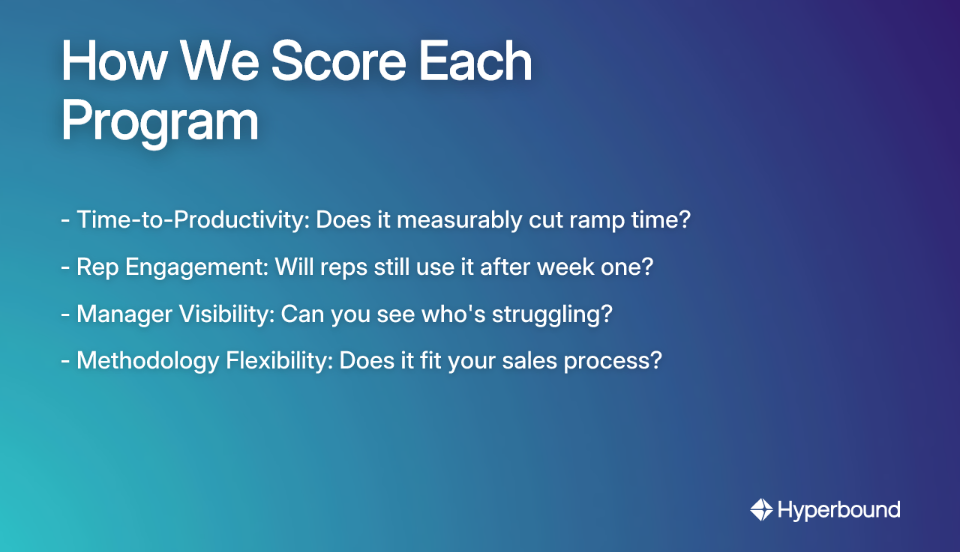
- Time-to-Productivity Impact — Does it measurably reduce ramp time?
- Rep Engagement — Will reps actually use it, or ignore it after week one?
- Manager Visibility — Can you see what's working and who's struggling?
- Methodology Flexibility — Does it adapt to your ICP, sales cycle, and process?
Let's get into it.
1. Hyperbound Practice
If the core problem with most SaaS sales training is that it's passive, Hyperbound Practice is the direct antidote. It's not a content library or a certification course — it's an AI-powered practice environment where reps run live sales simulations before they ever touch a real prospect.
Hyperbound's AI buyer personas are trained on over 2 million hours of real B2B sales conversations. That means when a rep practices a cold call or an objection-handling scenario, the AI doesn't give canned, predictable responses. It handles curveballs — the "we're happy with our current solution," the sudden pivot to pricing, the multi-stakeholder power play — the same way real buyers do. This directly addresses the frustration that generic AI role-play tools are "a bit unrealistic for B2B sales" because they can't handle unexpected directions.
How it accelerates ramp:
Reps can practice the full sales cycle — cold calls, discovery, demos, objection handling, renewals, and upsells — on demand, as many times as they need. After each session, AI Scorecards deliver instant feedback on talk ratio, methodology adherence (MEDDIC, Sandler, SPIN — your choice), and specific weak spots. Managers get analytics dashboards showing skill development and training completion across the team, so coaching conversations are backed by data, not gut feel.
The Bitesized Roleplays feature is particularly powerful for ramp: reps get short, focused practice sessions on a single scenario — like handling a price objection — right before a real call. This is the "short daily lessons that pop up right in their workflow" that sales managers consistently say outperform traditional training.
Proof points:
The results speak for themselves. Vanta's CRO Stevie Case reported a 60% reduction in ramp time — from 210 days down to 72 days — while scaling their BDR team 4x and generating 5x pipeline. Nivoda's Director of Sales Performance Rob Rangel saw a 50% reduction in ramp time, 2x revenue year-over-year, and a 150% increase in demo rates.
These aren't incremental improvements. They're the kind of numbers that change how a sales org operates.
Mini-Scorecard:
.png)
2. Mindtickle
Mindtickle is a sales readiness platform that combines training content, simulations, and coaching workflows in one place. Its strength is reinforcement — the platform is built on the idea that readiness isn't a one-time event but a continuous state, which maps well to the Ebbinghouse problem that plagues most onboarding programs.
How it accelerates ramp:
Mindtickle's Readiness Index gives managers a live, scored view of how prepared each rep is for the field — not just whether they completed a module. Interactive missions, video challenges, and quizzes keep engagement higher than passive LMS platforms. The integration of training impact measurement into the platform means you can tie training activities to actual performance outcomes over time.
Mini-Scorecard:
.png)
3. Winning by Design
Winning by Design brings a scientific, data-backed approach to SaaS sales onboarding. Where other programs teach "the art of selling," WbD focuses on architecting a repeatable, measurable sales process — and then training reps to execute it with precision.
How it accelerates ramp:
Their 9-step onboarding framework gives new hires a structured path: understand your customers, learn the playbook, develop skills, roleplay, and model top-performer behavior. The emphasis on sales math — helping reps build their own activity-based business plan — means new hires understand what they need to do daily to hit quota, not just conceptually what good looks like. Role-specific tracks for SDRs, AEs, and CSMs prevent the one-size-fits-all problem that makes generic training fail.
Mini-Scorecard:
.png)
4. JB Sales
JB Sales, led by John Barrows, is the antithesis of high-level theory training. It's tactical, direct, and focused on the specific skills that generate pipeline fast — prospecting, cold outreach, objection handling, and closing. For sales managers who need reps booking meetings in their first 30 days, this is a strong option.
How it accelerates ramp:
Programs like "Filling the Funnel" are built for early-stage productivity. Reps leave with frameworks they can use on their next call, not after a month-long certification. The live session format keeps engagement high, and John Barrows' blunt, rep-empathetic style tends to resonate with the salespeople who've tuned out corporate training. An on-demand library supports the reinforcement reps need to actually retain what they've learned.
Mini-Scorecard:
.png)
5. Salesloft Coaching
If your team is already running on Salesloft, its integrated coaching functionality is one of the most underutilized ramp tools available. Rather than training reps on hypothetical scenarios, Salesloft coaches them on what's actually happening in their deals — which makes the feedback immediately actionable.
How it accelerates ramp:
Conversation intelligence automatically surfaces coaching moments from real call recordings. Managers can flag specific moments, add written feedback, and turn those clips into coaching agendas — all without pulling reps out of their workflow for a separate training session. For new hires, this creates a tight loop between "what I did on that call" and "what I should do differently next time" that textbook training simply can't replicate. The real-world context makes the learning stick.
Mini-Scorecard:
.png)
6. The Harris Consulting Group
The Harris Consulting Group, led by Richard Harris, sits at an interesting intersection: rigorous sales methodology training with an emphasis on role-play and scenario-based learning. For teams that need reps to master qualification and discovery quickly, this is one of the better options on the market.
How it accelerates ramp:
Role-play is a core philosophy, not an afterthought. Harris believes — and the user research backs this up — that reps only truly learn by doing, and that practicing on real deals before they're ready is expensive. The introduction of AI-powered mentorship through "CoachRichardGPT" has added a scalable practice layer that lets reps run scenarios on demand. The focus on foundational discovery skills gives new hires a strong base to build on across any sales cycle length or deal complexity.
Mini-Scorecard:
.png)
7. Sandler Training
Sandler Training is one of the most recognized names in sales methodology, and for good reason. Its counter-intuitive framework — centered on psychology, qualification, and shifting the buyer-seller power dynamic — gives new reps a mental model that prevents the most common early mistakes: chasing unqualified deals, over-presenting, and folding on price.
How it accelerates ramp:
The Sandler Selling System's emphasis on Up-Front Contracts and rigorous qualification helps new reps learn to disqualify bad deals early, which is arguably as valuable as learning to close. Reps stop wasting time on low-probability opportunities and focus their energy where it counts. Sandler's reinforcement training model acknowledges the forgetting curve problem directly — the methodology is designed to be practiced repeatedly, not learned once and forgotten.
The caveat: Sandler is its own comprehensive system. If your team already runs a different methodology, adding Sandler can create more confusion than clarity.
Mini-Scorecard:
.png)
Comparison Table: How These Programs Stack Up on Ramp Speed
.png)
Stop Training. Start Practicing.
The programs that consistently collapse ramp time share one trait: they prioritize active practice over passive learning. The Ebbinghouse Forgetting Curve isn't a nuisance — it's a business problem. When reps forget 70% of what they learned in training within a month, every dollar you spent on that program is mostly waste.
The fix isn't better content. It's more reps, more often, in realistic situations that force them to perform under pressure before real money is on the line.
As the research consistently shows, reps who shadow top performers or run roleplay on real deals in the pipeline ramp faster than those who sit through certification courses. The best programs on this list understand that — and the ones with the most dramatic ramp reductions are the ones that make practice scalable, repeatable, and tied to your actual selling environment.
A 6-month ramp isn't inevitable. Vanta proved that with a 60% reduction. Nivoda proved it with 50%. The cost of maintaining the status quo — in lost pipeline, wasted salaries, and missed quarters — is higher than most sales leaders calculate.
Want to know exactly what slow ramp is costing your team? Calculate the hidden cost of your current ramp time →
Frequently Asked Questions
What is sales ramp-up time and why is it so important?
Sales ramp-up time is the period it takes for a new sales representative to become fully productive and consistently hit their quota. It's a critical metric because a long ramp time directly impacts revenue, increases the cost of new hires, and can lead to higher turnover. With an average SaaS ramp time of 3-9 months, a new hire may not contribute to revenue for several quarters, representing a significant business cost.
Why do most traditional sales onboarding programs fail?
Most traditional sales onboarding programs fail because they rely on passive learning methods, which leads to rapid knowledge decay as described by the Ebbinghaus Forgetting Curve. Handing reps a library of videos or documents doesn't prepare them for the pressure of a live sales call. Effective programs prioritize active, hands-on practice over passive content consumption to ensure reps can apply their knowledge in real-world scenarios.
How does AI-powered role-play help new sales reps ramp faster?
AI-powered role-play helps reps ramp faster by providing a safe, on-demand environment to practice real-world sales scenarios and receive instant, data-backed feedback. Instead of practicing on live prospects, new reps can run countless simulations—from cold calls to objection handling—against AI buyers. This builds muscle memory and confidence, allowing them to master your playbook before they engage with actual customers, measurably reducing ramp time.
What are the key features to look for in a sales training program to reduce ramp time?
The most important features are those that accelerate time-to-productivity, ensure high rep engagement, provide manager visibility into progress, and offer flexibility to fit your sales methodology. Look for programs that emphasize active practice (like simulations) over passive content. Ensure the tool is engaging enough for reps to use consistently and provides analytics to track progress. Finally, the program must adapt to your specific sales process.
How can I measure the impact of a new sales training program on ramp time?
You can measure the impact by tracking the time it takes for a new cohort of reps to consistently achieve 80-100% of their quota compared to a historical baseline. Key metrics to monitor include time to first deal, average deal size, win rate, and sales cycle length for new hires. Comparing these performance indicators before and after implementing a new program will give you a clear, quantitative measure of its effectiveness.
Should I choose a specific methodology like Sandler or a practice platform like Hyperbound?
The choice depends on whether your primary need is a new selling framework or a way to practice and reinforce your existing one. A methodology like Sandler provides a comprehensive system for how to sell, which can be powerful but also rigid. A practice platform like Hyperbound is methodology-agnostic; it allows your reps to master your specific sales process through active role-play. For teams looking to accelerate ramp time within their current framework, a flexible practice platform is often more effective.
Book a demo with Hyperbound


