

Published by Hyperbound | 2026
Summary
- Despite massive AI investment, 84% of sales reps missed quota last year, and the average new hire takes over a year (381 days) to become fully productive, costing over $130,000 per mis-hire.
- The key challenge is the 'insight-practice gap'—while conversational intelligence tools diagnose performance issues, they don't provide the scalable practice needed to change rep behavior.
- Revenue Activation closes this gap by turning call insights into targeted AI-powered practice, with case studies showing up to a 25% reduction in ramp time and saving over 1,200 manager hours per quarter.
- Platforms like Hyperbound's AI Sales Roleplays provide the closed-loop system needed to turn call data into measurable performance improvements through AI-powered practice and coaching.
Introduction: The Tipping Point Has Arrived
The numbers are impossible to ignore. The AI for sales and marketing market is projected to surge from $58.0 billion in 2025 to $240.59 billion by 2030 — a staggering 32.9% compound annual growth rate. The sales training software market alone is on track to nearly double, growing from $2.68 billion in 2024 to $6.11 billion by 2030 at a 15.1% CAGR. Meanwhile, the conversational AI market is tracking from $11.58 billion in 2024 to $41.39 billion by 2030 at a 23.7% CAGR.
The investment is real. The urgency is real. And yet, the performance gap persists.
Despite the explosion of sales technology, 84% of sales reps missed quota last year, and reps still spend 70% of their time on non-selling tasks, according to Salesforce's State of Sales research. The tools are getting smarter — but outcomes haven't kept pace. Something is broken in the loop between data and behavior change.
This report introduces a new framework for understanding why: the gap between insight and activation.
For the past decade, revenue teams have invested heavily in tools that tell them what is happening on their calls — which reps are struggling, which deals are at risk, which objections aren't being handled. Conversational intelligence platforms have been enormously valuable in creating this visibility. But visibility alone doesn't change behavior. Knowing a rep struggles with pricing objections doesn't automatically give them the dozens of deliberate practice reps they need to master the response under pressure.
Revenue Activation is the category that closes this loop. It describes what happens when teams stop merely analyzing call data and start using it to change outcomes — by turning real conversation insights into targeted practice, consistent scoring, and automated coaching interventions at the deal level.
This report is designed to give CROs, VPs of Sales, Sales Enablement Leaders, and Revenue Operations executives the data they need to make the case for investing in this next evolution of the revenue stack. Inside, you'll find:
- The true cost of slow ramp and mis-hires — why this is already a six-figure problem per rep
- The critical gap in today's conversational intelligence platforms — and why insight without practice is only half the solution
- A maturity model for the modern sales tech stack — from content repositories to Revenue Activation
- The new economics of AI-driven practice — real case studies on time saved and performance gained
- The compliance crucible — why regulated industries like medical devices and financial services need more than generic AI coaching
- Key tailwinds and headwinds for 2026 — what's accelerating adoption and what's slowing it down
The era of passive analysis is over. The era of Revenue Activation has begun.
Section 1: The State of Sales in 2026 — An AI-Powered Mandate
AI in sales is no longer an experiment. It's becoming core infrastructure — and the revenue gap between teams that use it well and those that don't is widening.
According to Salesforce, 81% of sales teams are currently experimenting with or have fully implemented AI tools. More tellingly, 83% of teams using AI reported revenue growth, compared to just 66% of teams without it. That 17-point gap is already shaping where the next wave of CRO budgets will go.
Enablement spending is also not retrenching. Seismic's 2024 Value of Enablement Report found that 82% of respondents use enablement technology at work, 89% plan to retain or increase their enablement investment, and 92% say their company specifically plans to increase spending because of AI's promise. Highspot's 2024 State of Sales Enablement Report reinforced the ROI case: companies using AI are 3x more effective at achieving their sales goals, and teams that use analytics to measure training effectiveness are 36% more likely to decrease ramp time.
The mandate from the C-suite is clear: do more with less, but do it smarter.
Yet the same Salesforce data that celebrates AI adoption also reveals the scale of the underlying challenge. 67% of reps don't expect to meet quota this year. The tools are proliferating, but execution at the rep level is still lagging. This creates the central tension of 2026: enormous investment in AI at the platform level, but insufficient translation of that investment into measurable behavior change at the rep level.
The implication for revenue leaders is direct. The next dollar of AI investment should not go toward more dashboards and more insights. It should go toward closing the loop between what the data tells you and what reps actually do differently on their next call.
"The market is graduating from call analysis to behavior change. The next budget wave goes to platforms that turn insights into rep actions."
This is the defining shift for 2026 — and this report is built around understanding it.
Section 2: The Six-Figure Problem — Quantifying the Cost of Slow Ramp and Bad Hires
Before a single deal is lost to a competitor, before a forecast misses by millions — the revenue damage from slow ramp times and mis-hires is already accumulating quietly on your balance sheet. For most revenue leaders, the true cost is dramatically underestimated.
What a Failed Sales Hire Actually Costs
The most cited academic model for sales hire costs comes from DePaul University's research, which breaks down the true cost of a failed salesperson across three phases: $29,159 to hire, $36,290 to train, and $49,508 to replace — totaling $114,957 per failed hire. More recent field surveys push that number even higher, with the average cost to replace a salesperson now estimated at more than $130,000.
And that's before accounting for the pipeline that didn't get worked, the deals that went cold, or the team's morale impact.
"Even before missed revenue, a failed or delayed sales hire is already a six-figure problem."
The Hidden Drag of Slow Ramp
The average new salesperson takes 381 days to reach the performance level of a tenured rep. That's over a year of degraded productivity, missed quota contribution, and manager bandwidth consumed — nearly invisibly.
For a direct productivity loss model: a rep earning a $100,000 base salary who ramps 3 months slower than average represents $25,000 in direct productivity cost — before any missed pipeline or quota calculations. Scale that across a team of 10 new reps, and the same delay exceeds $150,000 in direct costs alone.
Ramp Time Benchmarks by Industry
Ramp time varies significantly by selling complexity, deal cycle, and regulatory environment. Based on the best available public operator benchmarks:
.png)
Sources: Bridge Group SaaS benchmark data; directional field benchmarks from operator sources.
The medical device number deserves particular attention. Unlike SaaS, where a rep primarily needs to master a demo and a few competitive objections, medical device selling requires product fluency across clinical applications, familiarity with regulatory requirements, the ability to credibly engage surgeons in clinical environments, and the relationship capital to navigate complex, multi-stakeholder procurement processes. Ramp in this environment is not a software onboarding problem — it's a clinical knowledge and trust-building problem that takes 9–12+ months by any credible operator benchmark.
Financial services shares some of this complexity. Products are often regulated, compliance training is mandatory, and reps must earn trust with sophisticated buyers who've seen every pitch variation. A 6–9 month ramp is directionally consistent with the industry's combination of product complexity and buyer skepticism.
.png)
The Acceleration Opportunity
Recent 2024 data points to a specific lever: teams that use analytics to measure training effectiveness are 36% more likely to decrease ramp time. That's not a coincidence — it's a signal that measurement and targeted intervention, not just more content, is what moves the needle on ramp time.
The math here is compelling. If a standard medical device rep ramp is 10 months, and an AI-powered training platform compresses that to 7 months, the three-month acceleration for a rep earning $150,000 is a $37,500 direct productivity recovery — before calculating the deal revenue that rep brings in during those recovered months.
Multiply that across a team of 20 new hires per year, and the ROI conversation becomes straightforward.
Section 3: The Insight-Practice Gap — Why Conversational Intelligence Is Only Half the Solution
The rise of conversational intelligence (CI) platforms represents one of the most significant advances in sales management in the past decade. For the first time, leaders could see exactly what was happening across every sales conversation — not just the handful of calls they could shadow in any given week. Platforms like Gong and ZoomInfo Chorus created a true system of record for sales execution, surfacing objections, identifying deal risks, flagging coaching opportunities, and benchmarking rep behavior at scale.
This was genuinely transformative. And it is genuinely insufficient on its own.
What CI Platforms Do Well
Leading CI platforms are described as the "data backbone" for onboarding, coaching, forecasting, and deal-risk assessment. They are positioned as tools that automatically capture, transcribe, and analyze calls to identify why you win and lose deals. These descriptions are accurate. CI platforms excel at diagnosis — at telling you what happened and what needs attention.
But diagnosis is not treatment.
The Forgetting Curve and the Practice Deficit
Here's the core problem: insights are perishable, and information alone does not change behavior.
Research on learning retention shows that 70% of learning is forgotten within just 24 hours without reinforcement and practice. A manager might surface a coaching insight from a call — "you're not handling the pricing objection effectively" — within 24 hours of the call. But unless the rep has a structured, low-stakes environment to practice that specific objection repeatedly until the response becomes reflexive, the insight evaporates before the next discovery call.
And the traditional alternative — live role-play with a manager — has its own well-documented failure mode. As industry analysis describes it plainly, traditional role-play is "time-consuming, inconsistent, and often awkward" — which is exactly why it doesn't scale and reps actively avoid it. Managers with six direct reports can't run quality, scenario-specific practice sessions across 20 different objection types before every rep's next call cycle.
The Gap in Plain Language
"Conversation intelligence can diagnose. It cannot, on its own, remediate."
This is the fundamental gap in today's sales tech landscape. A CI platform can tell you that 64% of your SDRs are failing to effectively handle the "we're already using a competitor" objection. It cannot, on its own, give each of those SDRs ten targeted practice reps against an AI buyer persona trained on how your actual customers raise that objection — scored against your methodology, with instant feedback, available at 10pm before a big meeting.
That gap is where revenue is being left on the table. And it's the gap that Revenue Activation platforms are purpose-built to close.
The Closed-Loop Difference
The insight-to-activation loop looks like this:
- Score real calls → Identify specific skill gaps and deal risks at the rep and team level
- Generate targeted AI practice → Build buyer personas from your own call data, trained on how real prospects behave
- Run scenario-specific simulations → Give reps deliberate, scored practice reps on exact gaps
- Score practice performance → Measure improvement against the same methodology benchmarks used for real calls
- Orchestrate coaching interventions → Automatically trigger manager follow-up or additional practice when gaps persist
Each step reinforces the next. The real call data makes the practice more realistic. The practice improves the real call. The improved real call generates better data. This is the closed loop that transforms insight into permanent behavior change — and it's the defining architecture of Revenue Activation platforms.
Without step 2 through 5, CI platforms remain powerful diagnostic tools — but the diagnosis never gets filled.

Section 4: A Maturity Model for the Modern Sales Tech Stack
Not all sales technology is created equal — and the difference matters far more now that "AI" is a checkbox feature on nearly every vendor's marketing page. The right framework for evaluating your tech stack is not which features a platform lists, but what its native operating loop actually is. What is the system built to do, at its core?
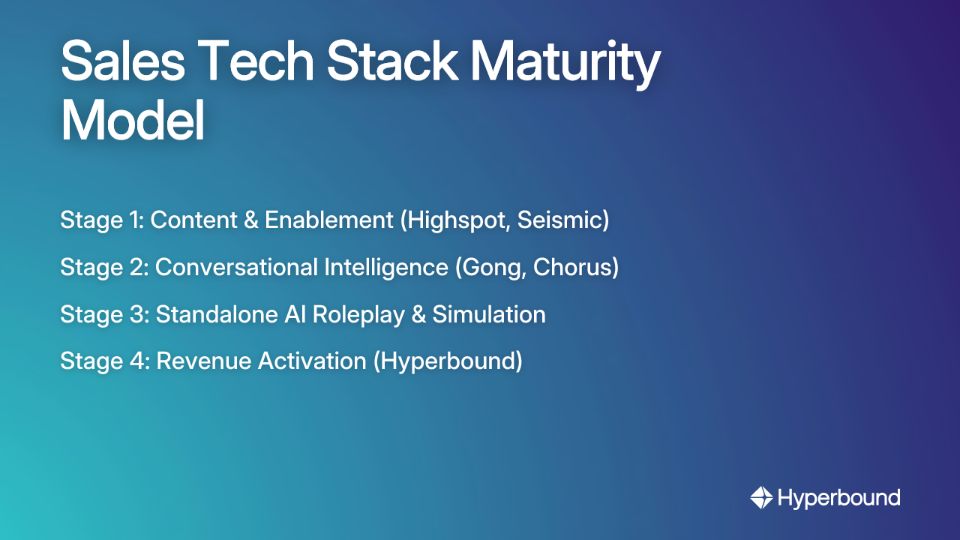
Below is a Gartner-style maturity model organized by native operating loop and center of gravity, representing the four current stages of the market.
Stage 1 — Content & Enablement Systems of Record
What it does: Manages and distributes sales content, learning paths, certifications, playbooks, and governance. Analytics typically measure content consumption and completion, not behavior change.
Examples: Highspot, Seismic
2026 Context: Both Highspot and Seismic now publicly market AI role-play features and expanded practice capabilities, and Highspot also markets conversation intelligence. These are not static-only tools anymore. But their center of gravity remains content-first — their platforms are designed around organizing, delivering, and governing sales knowledge, and their AI features are expansions on that core rather than a native closed-loop architecture. Highspot's 2024 report notes that companies using their analytics are 36% more likely to decrease ramp time — evidence that the platform is moving toward outcomes, but primarily through content measurement.
The gap: These platforms tell reps what to say. They don't systematically build the muscle memory to say it well under pressure.
Stage 2 — Conversational Intelligence / Revenue Intelligence
What it does: Captures, transcribes, and analyzes real sales conversations to surface deal risks, objection patterns, coaching opportunities, and competitive intelligence. Creates a system of record for what actually happens on calls.
Examples: Gong, ZoomInfo Chorus
The native action: These platforms are designed to inspect past performance and surface insights. They are the diagnostic layer of the revenue stack — extraordinarily powerful for understanding what's happening, but not architecturally designed to prescribe and deliver the practice needed to change it.
The gap: As described in Section 3 — insight without practice doesn't change behavior. The system of record for calls does not automatically become a system of improvement for reps.
Stage 3 — Standalone AI Role-Play & Simulation
What it does: Provides AI-powered practice simulations where reps can rehearse sales scenarios, receive automated scoring, and repeat practice at scale without requiring manager time.
Examples: Second Nature, PitchMonster, Yoodli
The advance: These platforms genuinely solve the scale problem for practice. One AI simulation platform's work with Snowflake — eliminating approximately 1,215 hours of manager grading time per quarter and saving nearly $700,000 annually — demonstrates what's possible when practice becomes automated and measurable. Another's work with SAP produced 7x more practice time and 32% more sales opportunities.
The gap: Many standalone simulation tools are still practice-first rather than natively grounded in the company's own real call data and deal flow. The buyer personas and scenarios exist in isolation from the signals coming in from the actual sales floor. Practice is improved, but it often isn't connected — to real call analysis, real deal risk, or methodology-aligned scoring.
Stage 4 — Revenue Activation Platforms
What it does: Creates a closed loop between real call performance, targeted AI practice, consistent scoring, and automated coaching interventions at the deal level.
Native operating loop: Score real calls → Identify skill gaps and deal risks → Generate targeted AI buyer practice from your actual call data → Score practice using the same methodology benchmarks → Orchestrate coaching interventions when gaps persist → Score real calls again.
Example: Hyperbound
Hyperbound's three core products embody this loop: Practice (AI roleplays trained on 2M+ hours of real B2B sales conversations), Perform (AI real call scoring and deal coaching), and Kota Activate (AI revenue analyst that orchestrates coaching interventions automatically). The products are not independent features — they are sequenced steps in a single closed-loop architecture that turns every real call into a training data point and every practice session into a signal for real-world performance.
The platform has delivered 250,000+ AI simulations across 7,000+ companies and 25,000+ reps, including enterprise customers like Autodesk, Monday.com, Bloomberg, LinkedIn, Vanta, and IBM. Enterprise clients report 50% faster ramp time, 150% increase in discovery-to-demo conversion rates, and 2x faster time to first won deal.
The Market Trajectory
"The market is moving from systems of record, to systems of insight, to systems of practice, to systems of activation."
This is not a prediction — it's already underway. Enablement teams that built around Stage 1 content platforms are now layering in Stage 2 call intelligence. Teams that have both are increasingly asking the next question: now that we know what's broken, how do we fix it at scale? That question is the entry point for Stage 4.
The leaders who answer it first will have a durable structural advantage in rep productivity and ramp time — compounding with every cohort of new hires they onboard.
Section 5: The New Economics of Sales Readiness
The question of whether AI-powered sales practice is worth the investment has a clear answer when you look at the unit economics. The real comparison is not "AI platform cost vs. zero" — it's "AI platform cost vs. the cost of what it replaces."
The Traditional Cost Baseline
According to the Association for Talent Development (ATD), the average direct learning expenditure per employee was $1,054 in 2024, with an average cost per learning hour of $165. These numbers capture direct spend — they don't include the opportunity cost of manager time spent designing, running, and grading role-plays, which is often the most expensive variable in the traditional coaching model.
For a sales manager with six direct reports, spending even two hours per week on coaching, review, and feedback represents over 100 hours per quarter — time that could otherwise be spent in pipeline reviews, strategic account support, or actual selling.
What AI Practice Changes: Real Case Studies
The best evidence for the new economics is not a projection model — it's what companies with mature AI practice programs are actually reporting.
Snowflake (via an AI Practice Vendor): Eliminated approximately 1,215 hours of manager grading time per quarter and saved nearly $700,000 annually — while enabling nearly 3,000 sellers to become pitch-ready within minutes of a new product launch. Previously, this would have required hundreds of manager hours across dozens of sessions with no consistency guarantee.
Harness (via an AI Practice Vendor): Cut sales-training review time by 75%, saving an estimated $94,500 per year per enablement team member in time spent reviewing and grading practice sessions.
SAP (via an AI Practice Vendor): Achieved 7x more practice time per rep and generated 32% more sales opportunities using AI role-plays — demonstrating that more practice directly translates to more pipeline, not just more readiness scores.
Oracle NetSuite (via an AI Practice Vendor): Boosted overall sales performance by 21% while simultaneously reducing manager workload — one of the clearest documented examples of AI practice delivering both productivity and coaching efficiency gains.
Engaged Prospect (via an AI Practice Vendor): Cut new rep ramp time by approximately 25% — a number that, applied against the DePaul cost model for ramp delays, represents tens of thousands of dollars in recovered productivity per cohort.
The Honest Cost Comparison
The right way to frame AI practice economics is not a precise per-seat cost comparison — pricing varies by vendor, deal size, and feature scope. The defensible, source-backed claim is:
"AI role-play replaces manager review time, increases practice repetitions, and accelerates rep readiness with materially better scale economics than live-only practice models."
The math that matters:
.png)
This is why leading enablement teams are no longer asking "can we afford AI practice?" They're asking "how much is slow ramp and inconsistent coaching costing us per quarter — and what's the fastest path to fixing it at scale?"
Section 6: The Compliance Crucible — Winning in Regulated Industries
For medical device, financial services, and healthcare companies, sales training is not optional, and it is not just about performance. It is a regulatory obligation — one with audit trails, documentation requirements, and real enforcement consequences.
The FDA's 2026 Mandate
The FDA's Quality Management System Regulation (QMSR) became effective on February 2, 2026, harmonizing U.S. device Current Good Manufacturing Practice (CGMP) requirements with ISO 13485:2016, the international standard for medical device quality management systems. This isn't a future concern — it's live, and it's shaping procurement decisions right now.
Under 21 CFR 820.25, manufacturers are required to:
- Establish and maintain documented procedures for identifying training needs
- Ensure personnel are trained to adequately perform their assigned responsibilities
- Maintain documented records of all training activities
This means that for medical device sales organizations, training is not a soft HR function — it's an auditable, documented process that regulators can inspect. A platform that delivers AI coaching simulations but doesn't produce training records, completion logs, or methodology-aligned scoring documentation is not a viable option in this environment.
The Complexity of the Medical Device Sale
Regulatory compliance aside, the actual selling environment in medical devices is among the most complex in B2B. According to McKinsey, clinical engagement in procurement is critical for value-based care decisions, while HealthTrust research notes that surgeons are integral to supply chain decisions — they are end users who weigh cost, quality, and clinical outcomes simultaneously.
A rep selling to a major health system must be credible across at least three stakeholder types simultaneously:
- Clinical stakeholders (surgeons, nurses, clinical department heads) who care about procedure outcomes, product usability, and clinical evidence
- Hospital procurement (supply chain, contracting, value analysis committees) who care about cost, contract terms, and GPO compliance
- C-suite executives (CFOs, CMOs, COOs) who care about system-level economics, risk, and strategic vendor relationships
Per industry guidance for medical device sales, reps need full fluency in clinical trial data, cost-benefit analysis, and the regulatory landscape. Clinical reps who support surgeons in the Operating Room require highly specific, scenario-based training — not generic objection-handling practice.
Typical hospital and med-tech sales cycles run 6–18 months — long enough that a rep who ramps 3 months slower than peers doesn't just lose one deal; they remain in the bottom quartile of productivity for the entire first year.
The Security Requirement Is a Moat, Not a Barrier
This is the counterintuitive insight for revenue leaders evaluating AI coaching in regulated industries: the strict compliance environment is an advantage for vendors who meet it, not an obstacle for all vendors equally.
A medical device company or health system that needs SOC 2 Type II, ISO 27001, GDPR, and HIPAA compliance from any tool touching sales conversations will immediately disqualify most AI coaching vendors. The ones that survive that procurement filter are precisely the ones most worth evaluating — because they've invested in the governance architecture that regulated buyers require.
For Hyperbound, which holds all four of these certifications, this creates a durable wedge in the verticals where training requirements are highest, sales cycles are longest, and the cost of getting it wrong is greatest.
"The stricter the environment, the more valuable auditable, secure, and methodology-aligned coaching becomes."
Section 7: Market Forces — Tailwinds and Headwinds for 2026
Tailwinds Accelerating Adoption
1. The "Do More With Less" CRO Mandate With 67% of reps not expecting to meet quota and 84% having missed it last year, the pressure on revenue leaders to improve execution per rep — not just add headcount — is intense. AI tools that demonstrably compress ramp time and improve deal conversion have a clear ROI case that doesn't require a bull market to justify.
2. AI Is Already Normalized at the Platform Level With 81% of teams using or experimenting with AI, the conversation has moved from "should we use AI?" to "which AI tools are actually changing outcomes?" That maturation creates an opening for capability-differentiated platforms to displace earlier-generation tools.
3. Enablement Is Becoming Infrastructure Enablement research found 89% of organizations plan to retain or increase enablement investment, and 92% cite AI's promise as the primary reason. When nearly every company in your market is increasing spend in a category, the question becomes not whether to invest but where to allocate to generate the highest return.
4. LLM Cost Deflation Making Simulation Economically Viable at Scale OpenAI's Batch API reduces inference costs by 50% on inputs and outputs at scale — one of several pricing signals that large-volume AI simulation is becoming economically viable for every segment, not just large enterprises. This makes per-rep unit economics for AI roleplay dramatically more favorable than they were even 18 months ago.
5. Multilingual and Multiparty Deal Complexity The Asia-Pacific market is driving demand for mobile-compatible and multilingual training platforms, while European growth is shaped by GDPR-compliant solutions. As deals increasingly span borders, business units, and stakeholder types, the need for scalable, scenario-specific practice across languages and personas is growing.
6. Medical Device and Manufacturing Companies Entering AI-Era Training for the First Time Many companies in regulated verticals are evaluating AI-powered training for the first time as the 2026 QMSR mandate drives documentation and compliance urgency. This is a first-generation adoption wave — with significant greenfield opportunity for vendors that meet the trust and compliance bar.
Headwinds Slowing Adoption
1. Data Trust Remains a Significant Barrier Only 35% of sales professionals completely trust the accuracy of their organization's data, per Salesforce. In regulated industries, concerns about data residency, call recording consent, and HIPAA-compliant AI touching sensitive conversations are not irrational — they reflect genuine legal and operational risk. 51% of teams with full AI implementation have added extra data-security measures, indicating that security investment is table stakes for credibility.
2. Manager Resistance to AI Scoring Some sales managers resist AI-generated call scores or coaching recommendations, viewing them as a challenge to their subjective judgment on deals. This is a change management challenge as much as a technical one — and it requires vendors to position AI scoring as a support for manager insight, not a replacement for it.
3. Integration Complexity with Existing Stacks Layering a Revenue Activation platform on top of an existing CRM, LMS, call recording system, and BI stack requires technical integration work and organizational alignment. For large enterprises, this can extend evaluation cycles and delay deployment.
4. Hallucination Risk in High-Stakes Conversations In medical device and financial services, where a coaching suggestion could touch on clinical claims or regulatory guidance, the risk of AI hallucination is not theoretical. Organizations evaluating AI coaching in these verticals are right to probe how platforms prevent, detect, and handle inaccurate outputs — especially when those outputs are used in documented training records.
5. The "Content vs. Practice" Culture Gap in Enablement Teams Many sales enablement teams are still organized around content production — decks, playbooks, battle cards, onboarding modules. Transitioning to a practice-and-activation model requires investment in new skills, new workflows, and a fundamentally different philosophy about what enablement is for. This culture gap is a real adoption headwind, even in organizations that intellectually accept the value of AI roleplay.
Conclusion: Activating Your Revenue Engine
The data in this report points to a single, clear conclusion: the era of passive insight in sales is over.
The most important questions for revenue leaders in 2026 are not "how do we get more call data?" or "how do we build more enablement content?" The most important questions are:
- Does our tech stack close the loop between what we learn from real calls and how we change rep behavior?
- Are we measuring time-to-competency and practicing intervention as rigorously as we measure pipeline coverage?
- Is our ramp process treating new reps as systems to be optimized — or as people who need dozens of deliberate practice reps before they're ready for their next deal?
The Five Theses of Revenue Activation
1. The market is graduating from call analysis to behavior change.CI vendors proved the value of call data. The next budget wave will go to platforms that turn those insights into rep-level action — at scale, with consistency, and with measurable outcomes.
2. Ramp time is still too long — and too expensive — to leave unaddressed. At 381 days to full productivity, with failed hires costing over $130,000 and ramp delays costing $25,000+ per rep in direct productivity, the business case for investing in faster, more consistent ramp programs is already built. The question is execution.
3. The cost of inaction is already six figures per rep. Between delayed productivity, failed hires, and the compounding revenue impact of inconsistent execution, standing still is not a neutral decision. Every quarter without a structured practice and activation program is a quarter of avoidable loss.
4. AI roleplay is winning because it changes the unit economics of coaching. Public case studies show 7x more practice time (SAP), 75% reduction in review time (Harness), $700K annually in manager time saved (Snowflake), and 25% faster ramp time (Engaged Prospect). The scale economics are demonstrably superior to live-only practice models.
5. For regulated verticals, compliance is a moat — not a blocker. In medical devices and financial services, the stricter the compliance environment, the more valuable a SOC 2 Type II, ISO 27001, HIPAA, and GDPR-certified platform becomes. The organizations that need training the most — and are furthest from having scalable practice infrastructure — are also the organizations most willing to pay a premium for a vendor they can trust with their call data and their audit trail.
The Call to Action for Revenue Leaders
Evaluate your current stack honestly:
- Does it create reports or does it create readiness?
- Does it surface insights or does it drive impact?
- Does it tell you what's broken or does it fix it at the rep level, at scale, consistently?
The revenue leaders of 2026 will be those who invest in closing the loop — from data to behavior, from insight to activation, from analysis to outcomes.
The infrastructure is ready. The economics are proven. The question is whether you're building a system that generates reports about your performance problems, or a system that solves them.
Frequently Asked Questions
What is Revenue Activation?
Revenue Activation is the process of using AI to turn insights from real sales conversations into improved rep performance and measurable business outcomes. It creates a closed loop where call data is used to identify skill gaps, generate targeted AI practice simulations for reps, and provide automated coaching, moving teams beyond simply analyzing past calls to actively changing the outcomes of future ones.
Why is conversational intelligence not enough to improve sales performance?
Conversational intelligence (CI) platforms are excellent at diagnosing problems but do not provide the tools to fix them at scale. CI tools can tell you which reps struggle with pricing objections, but they don't provide the structured practice needed to master that response. Revenue Activation closes this "insight-practice gap" by giving reps a safe, on-demand environment to rehearse specific scenarios until the correct behaviors become second nature.
How does AI-powered practice reduce sales ramp time?
AI-powered practice significantly reduces sales ramp time by providing new hires with unlimited, consistent, and targeted training from day one. Instead of waiting for limited manager time for role-plays, reps can practice key messages and objection handling 24/7. This accelerates their time-to-competency and first deal, with some companies reporting up to a 50% reduction in ramp time.
What is the difference between Revenue Activation and sales enablement platforms?
Sales enablement platforms are primarily systems of record for content, while Revenue Activation platforms are systems of action for behavior change. Enablement platforms like Highspot or Seismic excel at organizing and distributing sales materials like playbooks and battle cards. Revenue Activation platforms take the next step by using that content and real call data to create AI simulations that build the muscle memory reps need to deliver the right message effectively under pressure.
How do Revenue Activation platforms ensure compliance in regulated industries?
Leading Revenue Activation platforms ensure compliance by providing auditable training records and adhering to strict data security standards like SOC 2 Type II, ISO 27001, and HIPAA. For industries like medical devices or financial services, this is critical. The platform creates documented proof of training on regulated topics, helping organizations meet requirements like the FDA's Quality Management System Regulation (QMSR) while securely handling sensitive conversation data.
What is the true cost of a slow sales ramp?
The true cost of a slow sales ramp is a six-figure problem per rep when accounting for direct costs, lost productivity, and replacement expenses. Research shows a failed hire can cost over $130,000 to replace. Even a three-month delay in ramp time for a rep with a $100,000 base salary represents $25,000 in direct productivity cost, not including the missed pipeline and revenue opportunities.
This report was published by Hyperbound, the Revenue Activation Platform. Hyperbound's AI buyer personas are trained on 2M+ real B2B sales conversations. The platform has delivered 250,000+ simulations across 7,000+ companies and 25,000+ reps. Hyperbound is SOC 2 Type II, ISO 27001, GDPR, and HIPAA compliant, supports 25+ languages, and is rated 4.9/5 on G2.
Book a demo with Hyperbound


