.png)


.png)
Summary
- Traditional sales coaching is broken; only 1% of sales calls are ever reviewed, leaving massive performance gaps and coaching opportunities on the table.
- The most effective coaching model shifts from reactive post-call reviews to a proactive approach combining AI-powered practice and real-time, in-call guidance.
- Using AI as a "flight simulator" for practice builds rep confidence and muscle memory for handling tough objections before they risk live deals.
- Sales coaching platforms like Hyperbound provide AI Sales Roleplays and AI Coaching to ensure every rep is prepared for any conversation, driving consistent performance across the team.
You're in the middle of what feels like the perfect sales call. You've built rapport, uncovered pain points, and the prospect seems engaged. Then suddenly, they hit you with a technical question you weren't prepared for. Your mind goes blank. That confident rhythm you had going? Gone in an instant.
"I completely freeze when prospects hit me with unexpected objections or ask technical questions I wasn't ready for," confessed one sales rep on Reddit. It's a common pain point that countless sales professionals experience daily—and one that traditional coaching methods fail to address effectively.
Here's the sobering reality: 99% of sales calls are never reviewed by sales leaders due to time constraints and resource limitations. This means the vast majority of coaching opportunities are simply lost, leaving reps to figure things out on their own and potentially repeating the same mistakes for months.
While post-call reviews have their place in the sales coaching ecosystem, relying on them as your primary coaching mechanism creates a fundamentally reactive and inefficient approach to skill development. To truly elevate performance in today's competitive landscape, sales organizations need to shift to a more proactive model powered by real-time coaching and scalable practice.
The Glaring Limitations of Post-Call Reviews
Before we explore solutions, let's examine why the traditional "listen and review later" coaching model is failing modern sales teams:
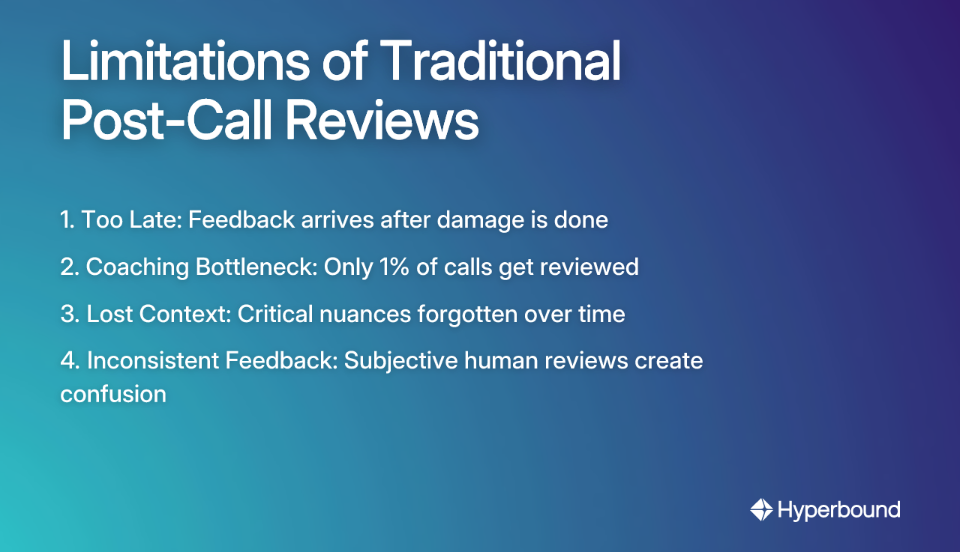
1. Too Little, Too Late
By the time feedback arrives from a post-call review, the damage is already done. The deal may be lost, the prospect's impression formed, and the opportunity to course-correct in real-time has vanished. Post-call feedback analyzes history instead of influencing the present—it's like getting driving directions after you've already missed your exit.
2. The Coaching Bottleneck
With research showing that only 1% of calls ever get assessed, sales managers have become a severe bottleneck in the coaching process. Even the most dedicated managers can only review a handful of calls per rep per month. This creates a massive gap between top performers and the rest of the team, as the majority of reps receive minimal guidance on how to improve.
3. Context is Lost
The "forgetting curve" is steep in sales. By the time a manager and rep sit down to review a call from last week, critical nuances, tone, and emotional context are gone. The rep may not even remember what they were thinking in the moment, making the feedback less impactful and harder to internalize.
4. Inconsistent and Biased Feedback
Human reviews are inherently subjective. Different managers may have conflicting opinions about the same call, leading to inconsistent training and skill development across the organization. What one manager praises, another might criticize, leaving reps confused about what "good" really looks like.
The Proactive Shift: Real-Time Coaching & AI-Powered Practice
The solution to these challenges lies in a two-pronged approach that combines real-time coaching with systematic practice—creating a continuous improvement loop that elevates performance before, during, and after customer interactions.
Part 1: The Power of Practice – The Sales "Flight Simulator"
Some might argue that "it's better to practice and get better than try to use an AI crutch." This perspective misses a crucial point: modern AI isn't a crutch—it's the most effective practice tool ever created for sales professionals.
Think of AI-powered sales roleplays as a flight simulator for pilots. Pilots don't learn to fly by crashing real planes, and sales reps shouldn't have to learn by failing with real prospects. A safe, controlled environment for practice is essential for mastering complex skills.
Hyperbound's AI Sales Roleplays exemplify this approach, allowing reps to simulate entire sales cycles with diverse scenarios:
- Diverse Practice Scenarios: Reps can practice everything from cold calls and discovery to demos, objection handling, renewals, and upsells with AI-powered buyer personas that respond realistically.
- Instant, Objective Feedback: After each roleplay, AI-powered scorecards track key metrics like talk ratio, questions asked, and how effectively objections were handled, allowing for immediate self-correction.
- Gamified Learning: Leaderboards and scoring create healthy competition, making skill development engaging rather than a chore.
This systematic approach to practice ensures reps build muscle memory for handling tough situations before they encounter them in real customer conversations.
Part 2: The Power of Live Guidance – The Co-Pilot in the Cockpit
Real-time sales coaching delivers live, contextual feedback during a call to help reps correct mistakes, reinforce playbooks, and save deals in critical moments. Just as modern pilots have sophisticated co-pilot systems, sales reps can now benefit from AI assistance that helps them navigate complex conversations.
According to Gartner research, implementing real-time coaching can improve close rates by over 12%—a significant advantage in competitive markets.
Hyperbound's AI Coaching exemplifies this approach by providing:
- Methodology-Aligned Coaching: Feedback tailored to your specific sales playbook and frameworks
- Instant Real-Time Feedback: Identifying missed opportunities and weak responses during or immediately after calls
- Targeted Improvement Areas: Delivering actionable insights on specific skills like objection handling, discovery, and closing
The most effective real-time coaching systems don't overwhelm reps with constant feedback. Instead, they provide minimal, high-impact prompts focused on critical moments, allowing reps to stay present and engaged with customers.
The Tangible Business Impact of a Modern Coaching Strategy
The shift to a proactive coaching model delivers measurable ROI across multiple dimensions:
.png)
Better Call Outcomes
Real-time guidance directly impacts the bottom line. When reps have support during critical moments, they're more likely to navigate objections effectively and advance deals. This leads to higher conversion rates and increased revenue.
Faster Onboarding & Reduced Ramp Time
New hires can practice complex scenarios and get up to speed in weeks, not months. When combined with real-time guidance during their initial customer conversations, AI provides the structured, self-paced coaching they need to become productive faster.
Salesforce research shows that AI-powered coaching significantly accelerates the ramp time for new sales hires, getting them to quota achievement faster than traditional methods.
Manager Efficiency & Scalability
AI automates the tedious work of call reviews, freeing up managers from tactical feedback to focus on strategic coaching. Research shows that AI can reduce administrative tasks by 40% and save sales professionals an average of 12 hours per week.
Tools like Hyperbound's AI Real Call Scoring can automatically score 100% of your team's calls against your custom methodology and provide AI Deal Summaries, giving managers unprecedented visibility while saving countless hours.
Addressing the Skepticism: Is AI a Crutch or a Coach?
Despite the clear benefits, some valid concerns about AI-powered coaching deserve addressing:
"AI will make me a worse salesperson / I don't want to be overly reliant."
This concern fundamentally misunderstands the role of AI in sales coaching. AI practice tools like Hyperbound's AI Roleplays aren't a crutch; they're a gym. You don't take the treadmill with you into a marathon. You use it to train so you're prepared.
The goal is to internalize skills through repetition so you don't need assistance on a live call. Just as professional athletes use video analysis and practice technology to perfect their craft, sales professionals can use AI to develop muscle memory for effective selling behaviors.
"Real-time prompts are distracting and awkward."
Poorly implemented AI can be distracting. As one rep noted on Reddit, "It's awkward when the AI cuts in with pop-ups like 'You're speaking too fast' or 'Ask this question now.'"
The solution lies in thoughtful implementation:
- Minimal, High-Impact Prompts: Don't overload the rep. Prompts should be trigger-based and focused on critical moments.
- Customization: Allow reps to customize the visibility and tone of prompts to fit their workflow.
"If AI is so good, why not just have it take the calls?"
AI is brilliant at pattern recognition and methodology reinforcement. It is not a substitute for human empathy, strategic thinking, and genuine relationship-building. The AI is the coach, not the player. It helps perfect the craft; it doesn't replace the artisan.
The most successful salespeople will be those who learn to leverage AI as a performance enhancement tool while maintaining their uniquely human abilities to connect, understand, and build trust.
Conclusion: Build a Culture of Continuous Improvement
Relying on the 1% of calls that get reviewed is no longer a viable strategy for growth. The future of sales performance lies in a proactive, blended approach.
By combining data-driven insights from 100% of calls with scalable, AI-powered practice and targeted, real-time guidance, sales organizations can empower every rep to learn from every conversation and perform like a top rep.
Stop leaving 99% of your coaching opportunities on the table. It's time to build a culture of continuous improvement where every rep is constantly learning and perfecting their craft—before, during, and after every customer interaction.
The question isn't whether you can afford to implement real-time coaching. In today's competitive sales landscape, the real question is: Can you afford not to?
Frequently Asked Questions
What is real-time sales coaching?
Real-time sales coaching is a technology that provides sales representatives with live, in-the-moment feedback and guidance during a customer call. Unlike traditional post-call reviews, which happen days later, real-time coaching acts like a co-pilot, using AI to identify critical moments, reinforce your sales methodology, and help reps navigate objections as they happen.
Why is traditional post-call coaching ineffective?
Traditional post-call coaching is ineffective because it's fundamentally reactive, slow, and doesn't scale. With sales leaders only having time to review about 1% of all calls, feedback arrives too late to save a deal, critical context is often forgotten, and reviews can be subjective. This creates a coaching bottleneck that hinders widespread skill development.
How does AI help sales reps practice?
AI helps sales reps practice by providing a safe, scalable "flight simulator" environment where they can master skills before talking to real prospects. AI sales roleplay platforms allow reps to run through entire sales cycles with realistic AI buyer personas and receive instant, objective scorecards on their performance, allowing them to improve continuously without risking live deals.
Will AI coaching prompts distract my reps during live calls?
No, a well-designed AI coaching system will not distract reps. Its goal is to provide minimal, high-impact prompts during critical moments, not to overwhelm the user. The most effective real-time coaching tools are designed to be a subtle guide and are often customizable to fit a rep's personal workflow, keeping them focused on the customer.
How does AI sales coaching improve business outcomes?
AI sales coaching directly improves business outcomes by increasing conversion rates, accelerating new hire onboarding, and boosting manager efficiency. By providing reps with live guidance, AI helps them win more deals. It allows new hires to ramp up faster through structured practice, and it automates call reviews, saving managers hours each week so they can focus on high-level strategy.
Is AI a replacement for human sales managers?
No, AI is not a replacement for human sales managers. AI acts as a performance enhancement tool that handles repetitive, data-driven tasks, freeing up managers to focus on higher-value activities like strategic deal coaching, career development, and building team morale. The AI is the coach; the manager is the head coach who sets the strategy.

Book a demo with Hyperbound


