

Summary
- Traditional metrics like NPS are often lagging indicators that fail to capture the full story of customer interactions.
- Real-time call analytics provides immediate visibility into 100% of conversations, allowing teams to proactively de-escalate issues and solve problems on the first call.
- Empowering agents with AI-driven assistance during calls improves key metrics like First Call Resolution (FCR) and reduces customer effort, directly boosting CSAT scores.
- Hyperbound’s AI Real Call Scoring helps teams analyze customer conversations at scale, uncovering key insights to enhance agent performance and improve the overall customer experience.
You've set up sophisticated customer satisfaction surveys. You diligently track your Net Promoter Score. You've implemented a robust CRM system. Yet somehow, you're still left wondering: What are our customers really talking about when they call us?
If you're an executive or customer service leader, this frustration likely sounds familiar. The lack of visibility into call content creates a blind spot in your customer experience strategy, leaving you unable to address issues proactively.
"There is no way out of the box to understand the calls that come in at scale," laments one service manager on Reddit. Another points out that "executives desire analytics about what customers are talking about on calls" but struggle to get meaningful insights.
Traditional metrics like NPS are valuable but insufficient. As one CX professional notes, NPS is a "lagging indicator" with "very low response rates", mostly from angry customers, making it an unreliable gauge for overall customer experience.
The solution? Real-time call analytics - a technology that's transforming how customer service teams operate, react to issues, and ultimately improve customer satisfaction scores.
What Is Real-Time Call Analytics? The Mechanics of Instant Insight
Real-time call analytics involves gathering, interpreting, and reacting to data from customer interactions as they happen - not days or weeks later. This technology provides immediate visibility into conversation content, sentiment, and outcomes, allowing teams to take action when it matters most: during the actual customer interaction.
At its core, real-time call analytics combines several powerful technologies:
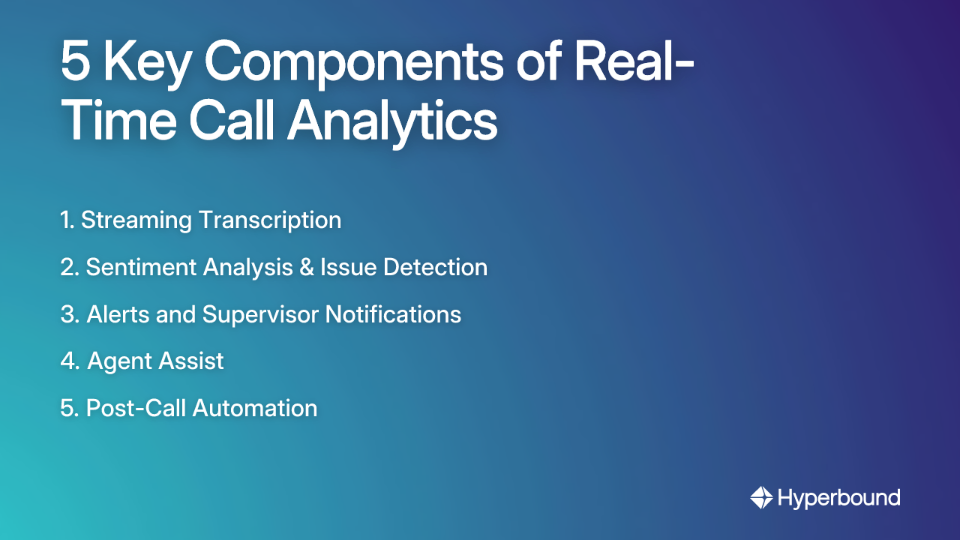
1. Streaming Transcription
The foundation of real-time analytics is accurate speech-to-text conversion that happens as the conversation unfolds. Modern systems like Amazon Transcribe can automatically redact personally identifiable information (PII) for compliance purposes and recognize industry-specific terminology or product names.
2. Sentiment Analysis & Issue Detection
Using Natural Language Processing (NLP), the system monitors emotional tone throughout the call. It can detect shifts from neutral to negative sentiment and identify specific keywords or phrases that indicate potential problems. When a customer says, "This is frustrating" or "I want to cancel," the system flags these as critical moments.
3. Alerts and Supervisor Notifications
When negative sentiment or specific issues are detected, supervisors can be automatically alerted to intervene before a situation escalates. This transforms customer service from reactive to proactive management.
4. Agent Assist
Perhaps most powerful is the ability to provide real-time guidance to agents during calls. The system can automatically suggest answers to questions, pull up relevant documentation, or offer best practice responses based on what's being discussed.
5. Post-Call Automation
After the call ends, the system can generate summaries and extract key data points, reducing the manual work for agents and ensuring accurate call categorization.
5 Ways Real-Time Analytics Directly Boosts CSAT
The impact of real-time analytics on customer satisfaction isn't theoretical - it's direct and measurable. Here are five concrete ways this technology improves CSAT scores:
1. Proactive Problem-Solving & De-escalation
Traditional customer service is reactive: a problem occurs, a customer complains, and then service teams try to resolve it. Real-time analytics flips this model.
When sentiment analysis detects a customer becoming frustrated - perhaps their tone changes or they use phrases indicating irritation - supervisors can be notified immediately. This enables teams to "intervene before negative experiences impact CSAT scores."
For example, when a customer begins showing signs of frustration during a billing dispute, a supervisor can join the call or provide the agent with immediate guidance, often turning a potential negative experience into a positive one.
This approach significantly reduces Customer Effort Score (CES), a metric that measures how much work customers must do to get their issues resolved. Research shows that lower effort correlates directly with higher satisfaction and loyalty.
2. Empowering Agents with AI-Assisted Performance
Agent performance is perhaps the single biggest factor affecting customer satisfaction. Real-time analytics transforms how agents operate during calls in several ways:
Real-time coaching: Managers can provide "instant answers to agents based on specific keywords during calls," making every interaction a micro-training opportunity. When an agent struggles with a technical question, the system can immediately suggest the correct information.
Reduced cognitive load: By automating note-taking and data extraction, agents can focus entirely on solving the customer's problem rather than documentation. As highlighted in the Quantiphi case study, this allows agents to "address more complex issues" by freeing up mental bandwidth.
Boosted morale and reduced turnover: When agents have the tools to succeed, job satisfaction increases. This reduces the high turnover that plagues many contact centers, ensuring customers interact with experienced agents who know how to deliver satisfaction.
3. Optimizing Critical Contact Center KPIs
Many customer service leaders express confusion about which KPIs they should track. Real-time analytics addresses this by making key metrics both visible and actionable:
Average Handle Time (AHT): While reducing call length is important for efficiency, cutting calls short can harm customer satisfaction. Real-time analytics helps agents find the optimal balance by providing information faster without sacrificing quality. AI Agent Assist provides immediate access to information during calls, reducing handling times while maintaining quality.
First Call Resolution (FCR): When customers need to call back about the same issue, satisfaction plummets. By providing all necessary information during the initial conversation, analytics helps agents solve problems on the first try. Studies consistently show that improving FCR has a direct positive impact on CSAT scores.
Customer Effort Score (CES): The easier you make it for customers to get help, the more satisfied they'll be. Real-time analytics reduces effort by streamlining interactions and anticipating needs.
4. Uncovering Actionable Customer Insights & Trends
This benefit directly addresses the executive need for "analytics about what customers are talking about on calls" - a common pain point mentioned in user research.
Real-time analytics categorizes calls by topic and identifies patterns that might otherwise go unnoticed. For example, if multiple customers report the same website issue within a short timeframe, IT can address it proactively before it affects more customers.
As one Reddit user points out, "Factors that matter to customers are not always tracked by other teams." Real-time analytics bridges this gap by highlighting customer concerns that might not appear in traditional metrics but significantly impact satisfaction.
5. Delivering Hyper-Personalized Customer Interactions
When integrated with CRM systems, real-time analytics enables a level of personalization that dramatically improves customer satisfaction:
In-the-moment context: Agents can see a customer's previous issues and preferences during calls. Imagine the difference between a generic greeting and "I see you called last week about your router configuration. Has that been working better for you?"
Intelligent routing: The system can match customers with agents best equipped to handle their specific issues or even route them to agents they've spoken with before, reducing transfers and wait times.
Case Study: Transforming Healthcare Call Centers
A North American healthcare company handling over 200,000 calls monthly faced a common challenge: agents were manually taking notes during calls, leading to errors, omissions, and delays in query resolution.
They implemented a real-time analytics solution using Amazon Transcribe for speech-to-text and Amazon Comprehend for NLP and entity extraction. The results were impressive:
- Improved Average Handling Time through automated note-taking
- Enhanced agent performance with real-time keyword analysis and assistance
- Better customer experience as agents could focus entirely on complex issues rather than documentation
According to Quantiphi's case study, the solution "reduced the cognitive load on agents," allowing them to deliver significantly better customer experiences.
Best Practices for Implementing Real-Time Call Analytics
If you're considering implementing this technology, follow these best practices:
.png)
- Identify Customer Pain Points & Define Goals: Before investing, analyze call data to uncover recurring issues and define what you're trying to improve (FCR? CSAT? AHT?).
- Invest in AI-Powered Software: Choose a tool that delivers actionable insights, not just raw data. Platforms like Hyperbound offer AI Real Call Scoring to analyze conversations and provide coaching, while other options include Gong.io, CallRail, Talkdesk, RingCentral, and Freshdesk.
- Integrate with Your CRM: This integration is essential for personalization and a holistic view of the customer journey.
- Train Agents Continuously: The technology is a tool; the agents are the experts. Use analytics insights for ongoing coaching and refinement of support strategies.
- Act on the Data: Continuously track metrics such as call duration and customer sentiment, and use these insights to refine broader customer service strategies.
The Future of Customer Service Is Live
Real-time call analytics solves the critical business need for visibility into customer conversations. It empowers agents with in-the-moment assistance, provides actionable data to leadership, and moves beyond flawed, lagging indicators like low-response surveys.
By understanding and addressing customer needs in real-time, companies can significantly improve CSAT, build lasting loyalty, and create a truly customer-centric organization. In today's competitive landscape, this capability isn't just a nice-to-have—it's becoming essential for service teams committed to excellence.

Frequently Asked Questions
What is real-time call analytics?
Real-time call analytics is the process of gathering, interpreting, and acting on data from customer phone calls as they are happening. It uses technologies like streaming transcription and Natural Language Processing (NLP) to provide immediate visibility into conversation content, customer emotion, and potential issues, allowing teams to react during the call rather than analyzing it days or weeks later.
How does real-time call analytics improve customer satisfaction (CSAT)?
Real-time call analytics improves CSAT by enabling proactive problem-solving, empowering agents with AI-powered assistance, and providing insights to resolve issues on the first call. By detecting customer frustration as it happens, supervisors can intervene to de-escalate issues. Agents receive in-the-moment coaching and access to information, which reduces customer effort and leads directly to higher satisfaction scores.
Why is real-time call analytics more effective than NPS surveys?
Real-time call analytics is more effective because it provides immediate, actionable insights from 100% of customer calls, whereas NPS surveys are lagging indicators with very low response rates that often only capture extreme opinions. Analytics gives you a complete, unbiased view of what customers are talking about, allowing you to address dissatisfaction during the actual conversation instead of waiting for a small fraction of customers to fill out a survey.
What are the key features of a real-time call analytics system?
The key features include streaming speech-to-text transcription, sentiment analysis, issue detection, automated supervisor alerts, and AI-powered Agent Assist. These components work together to convert speech to text, monitor the conversation for keywords and emotional tone, notify supervisors of problems, and provide live guidance to the agent to help them resolve issues faster and more effectively.
What are the most important KPIs that real-time analytics can improve?
Real-time analytics directly improves critical contact center KPIs such as First Call Resolution (FCR), Average Handle Time (AHT), and Customer Effort Score (CES). By providing agents with instant access to information, it helps resolve issues on the first try (improving FCR) and optimizes call duration (AHT) without sacrificing quality. This streamlined process makes it easier for customers to get help, which lowers their effort (CES) and boosts loyalty.
How does real-time analytics help with agent training and performance?
Real-time analytics acts as a live coaching tool, providing agents with in-the-moment guidance, suggested answers, and relevant documentation during calls. This turns every customer interaction into a training opportunity. AI-powered Agent Assist tools also reduce the agent's cognitive load by handling note-taking and information retrieval, which leads to higher agent confidence, better performance, and reduced employee turnover.
Book a demo with Hyperbound


