.png)


.png)
You've prepared for the call, researched the prospect, and crafted the perfect pitch. You log into Zoom at the scheduled time, ready to wow them with your solution. Five minutes pass. Then ten. Your screen remains empty, and that sinking feeling sets in—you've been ghosted.
If you've ever stared at an empty video call screen wondering whether to hang up or keep waiting, you're not alone. According to a recent Reddit discussion, salespeople across industries share this frustrating experience of prospects who simply don't show up for scheduled meetings.
The impact goes beyond the immediate inconvenience. No-shows disrupt your schedule, waste valuable time, and can even shake your confidence in the deal's potential. As one sales professional put it, "It's not just about the missed appointment—it's about feeling like your time isn't valued."
This comprehensive guide will walk you through exactly what to do when prospects ghost you, from your immediate response in those first crucial minutes to long-term relationship management strategies. We'll cover everything from professional follow-up email templates to knowing when it's time to move on.
Why Prospects Ghost: Decoding the Silence
Before jumping into action, it helps to understand why prospects disappear in the first place. Rarely is ghosting a personal rejection—it's usually about circumstances beyond your control.
Research shows the most common reasons prospects ghost include:

- Overwhelmed with priorities: Their schedule is packed, and your meeting simply got lost in the noise
- Internal changes: Priorities, budgets, or personnel have shifted, making your proposal suddenly less relevant
- Decision paralysis: They're facing too many choices and disengage rather than make a decision
- Lack of perceived value: They don't see an immediate need for your solution
- Information overload: The discovery process was rushed, leaving them unclear on how your solution fits their needs
As Spin Sucks points out, "Ghosting often has more to do with what's happening internally at the prospect's organization than with you or your offering."
Understanding these factors helps you respond with professionalism and empathy rather than frustration.
Your Immediate No-Show Protocol: The First 15 Minutes
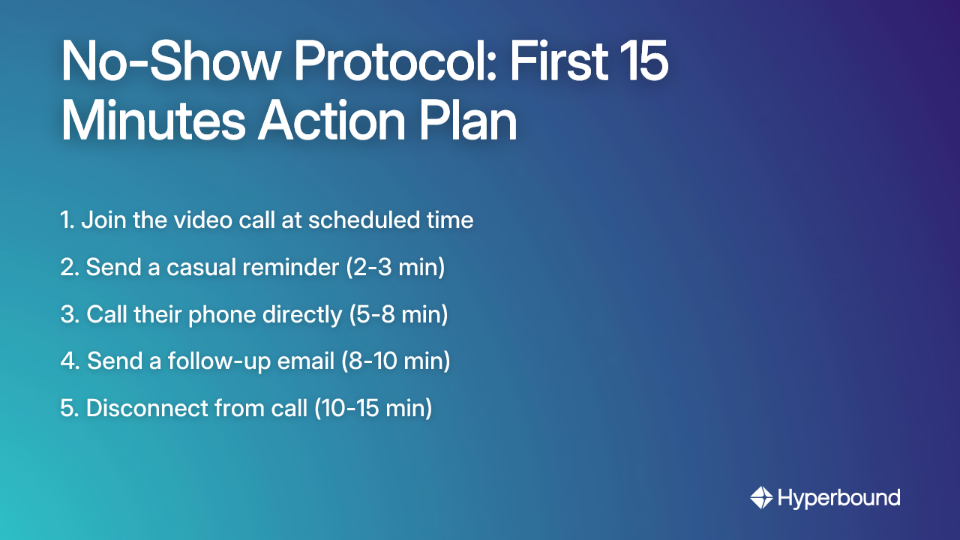
When a prospect doesn't show up, having a clear, consistent protocol reduces frustration and ensures professional handling. Here's your minute-by-minute action plan:
Minute 0: Join the video call at the scheduled time, ready to begin.
Minutes 2-3: Send a casual reminder via email or text:
Hi [Name],
Just hopped on our Zoom call. Here's the link again in case you need it: [Link].
Looking forward to speaking with you!
Minutes 5-8: Call their phone number directly. If there's no answer, prepare a follow-up email.
Minutes 8-10: Send your follow-up email that transitions from waiting to rescheduling:
Subject: Missed our call today

Hi [Name],

I called at [scheduled time] today for our meeting but wasn't able to connect. I hope everything is alright on your end.

Would you like to reschedule? I have availability [provide 2-3 options].

Best regards,
[Your name]
Minutes 10-15: Disconnect from the call. As one Reddit user advised, "I start casually writing an email at 8 minutes and send it right at 10 then disconnect." The consensus among sales professionals is that waiting longer than 15 minutes does not respect your own time management needs.
What to avoid during this phase:
- Don't send passive-aggressive messages ("I've been waiting for 20 minutes...")
- Don't bombard them with multiple messages across different platforms
- Don't immediately assume malicious intent
The Art of the Follow-Up: How to Re-engage, Not Annoy
Your follow-up after a no-show shouldn't just ask for a reschedule—it should add value and reignite interest. Here are three effective strategies:
Strategy 1: The Value-Add Reschedule
Instead of simply requesting another meeting, deliver some of the valuable content you planned to discuss in your follow-up email. This positions your outreach as helpful rather than needy.
Email Template:
Subject: Following Up on Our Missed Call

Hi [Name],

I called at [time] today for our scheduled meeting but wasn't able to connect. Hope everything is alright on your end.

I was looking forward to discussing [specific topics]. To give you a head start, here are a couple of resources I thought you'd find valuable based on our previous conversation:
- [Link to relevant case study]
- [Link to helpful tool or whitepaper]

If you're still interested in connecting, here's my calendar link to reschedule: [scheduling link]

Best regards,
[Your name]
Strategy 2: The Humorous Approach (Use Judiciously)
A touch of light humor can sometimes break tension and restart the conversation on a positive note. Enterprise League notes that appropriate humor can be effective when used carefully.
Email Template:
Subject: Missed you today!

Hi [Name],

I couldn't reach you for our meeting today and spent some time reorganizing my desktop folders instead!

Joking aside, I was planning to cover [key points] on our call. Here's a quick resource that might interest you: [link to relevant content]

When you have a moment, feel free to grab a new time on my calendar: [scheduling link]

Looking forward to connecting,
[Your name]
Strategy 3: The Direct Phone Call
If email follow-ups go unanswered, consider a phone call. As Spin Sucks suggests, hearing your voice can sometimes prompt a more immediate response than another email in an overflowing inbox.
When calling back, keep it brief and positive:
- "I noticed we missed our scheduled call yesterday."
- "I wanted to check if you're still interested in discussing [specific value proposition]."
- "Would you prefer to reschedule, or has your situation changed?"
Long-Term Strategy: Knowing When to Nurture and When to Cut Ties
According to Robert Hartline on LinkedIn, only 2% of sales happen at the first meeting. This means follow-up is crucial—but so is knowing when to persist and when to move on.

When to Keep Nurturing:
- They've engaged previously: If they've shown genuine interest before the no-show, it's worth several follow-up attempts
- You see trigger events: Their company announces expansion, new leadership, or other changes that might make your solution newly relevant
- They're in your ideal customer profile: High-value prospects merit more persistence
When to Cut Ties:
- The Rule of Three: If three follow-up attempts over several weeks yield no response, it's likely time to move on
- Clear disqualification signals: They've mentioned budget constraints, timeline issues, or other factors that make them poor fits
- Consistent ghosting behavior: If they've rescheduled multiple times without showing up, this pattern likely won't improve
The "Break-Up" Email Template:
When it's time to move on, send a final, professional message that leaves the door open but ends active pursuit:
Subject: Closing your file for now

Hi [Name],

I've tried to connect a few times to follow up on our discussion about [specific solution] but haven't heard back. I'll assume your priorities have shifted or it's not the right time.

With that in mind, I'm going to close your file for now to respect your inbox.

If addressing [specific pain point] becomes a priority in the future, please don't hesitate to reach out. I'd be happy to pick up where we left off.

All the best,
[Your name]
This respectful approach maintains professional meeting etiquette while allowing you to focus on more engaged prospects.
Proactive Prevention: How to Reduce Ghosting Before It Happens
The best way to handle no-shows is to prevent them from occurring in the first place. These strategies can significantly reduce your ghosting rate:
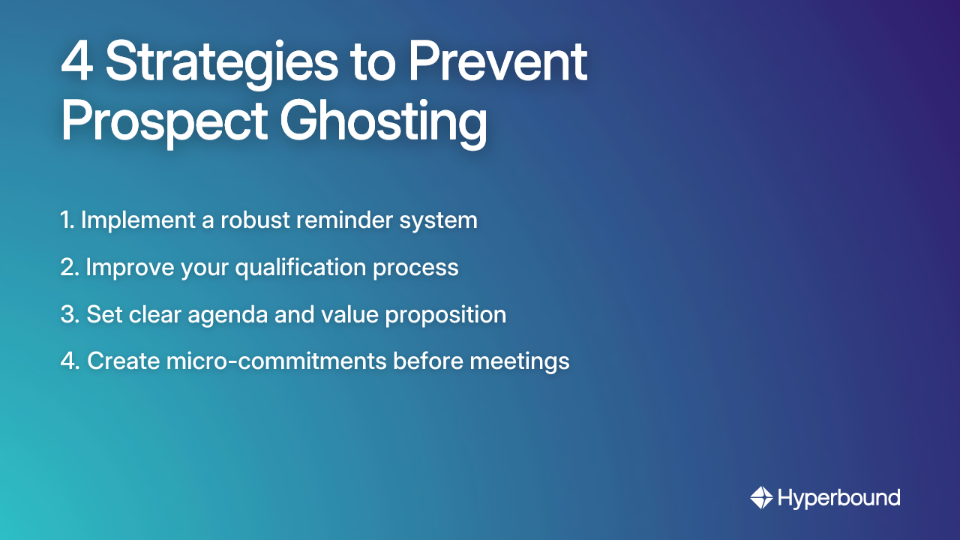
Implement a Robust Reminder System
Based on Reddit community feedback, a multi-touch reminder system works best:
- Send a calendar invitation immediately after scheduling
- Follow up with an email confirmation including agenda and value points
- Send an automated email reminder 24 hours before the meeting
- Send a final text or email reminder 10-15 minutes before the scheduled time
Many scheduling tools offer automated reminder functionality that can handle this for you.
Improve Your Qualification Process
Research suggests that a rushed discovery process often leads to meetings with prospects who aren't truly qualified or interested. Before booking a meeting:
- Thoroughly explore their needs and pain points
- Confirm they have the authority to make decisions
- Establish clear next steps that would follow a successful meeting
- Get verbal confirmation of their interest level and commitment to the meeting
One sales leader noted: "When I started spending more time qualifying before sending a calendar invite, my no-show rate dropped by over 60%."
Set a Clear Agenda and Value Proposition
In your calendar invitation and reminder emails, clearly outline:
- The specific topics to be discussed on the call
- The exact value the prospect will gain from the meeting
- Any preparation they should do before joining
- The expected duration of the video call
By setting clear expectations about the meeting's value, you increase the prospect's commitment to showing up.
Create Micro-Commitments Before the Meeting
Ask prospects to complete a small task before the scheduled time, such as:
- Reviewing a short document you've sent
- Answering a few quick questions via email
- Confirming receipt of pre-meeting materials
These micro-commitments increase psychological investment in the upcoming meeting and reduce the likelihood they'll disconnect without notice.
Conclusion: Maintain Professionalism and Value Your Time
Ghosting is an unfortunate reality of sales, but how you respond to it can differentiate you from competitors and preserve your productivity. Remember these key principles:
- Default to understanding, not judgment. Most ghosting isn't personal—it's circumstantial.
- Follow a consistent protocol for no-shows that respects both the prospect's time and your own.
- Add value in every follow-up rather than just requesting another meeting.
- Know when to persist and when to move on so you can focus your energy on engaged prospects.
- Implement preventive measures to reduce ghosting before it happens.
As one Reddit user wisely pointed out: "Call them the minute they are late. Know your worth and value your time." By maintaining professionalism while protecting your most valuable resource—your time—you can navigate the frustration of no-shows while keeping your sales pipeline healthy.
Remember that your goal isn't to eliminate ghosting entirely (an impossible task) but to respond to it effectively when it happens and gradually reduce its frequency through better qualification, communication, and preparation.
With these strategies in place, you'll be well-equipped to handle even the most elusive prospects—and focus your energy where it truly matters.
Frequently Asked Questions
How long should you wait for a prospect who is a no-show for a meeting?
The general consensus among sales professionals is to wait no longer than 10-15 minutes. This respects your own time while allowing for minor delays on the prospect's end. A good protocol is to send a reminder email after 2-3 minutes, call their phone around the 5-8 minute mark, and send a rescheduling email at 10 minutes before disconnecting.
What is the best way to follow up after a prospect ghosts you?
The best way to follow up is to add value rather than simply asking to reschedule. Instead of just requesting a new time, your follow-up email should include helpful resources you planned to discuss, such as a relevant case study, a helpful tool, or a whitepaper. This positions you as a helpful advisor and can reignite their interest.
Why do sales prospects ghost scheduled meetings?
Prospects usually ghost meetings for reasons related to their own circumstances, not as a personal rejection. The most common reasons include being overwhelmed with competing priorities, sudden internal changes at their company (like budget or personnel shifts), decision paralysis, or a lack of perceived immediate value in your solution.
How can I reduce the number of no-shows for my sales meetings?
You can significantly reduce no-shows by implementing a proactive prevention strategy. This includes using a robust, multi-touch reminder system (e.g., email 24 hours before, text 15 minutes before), improving your qualification process to ensure genuine interest, setting a clear agenda and value proposition in the meeting invite, and creating micro-commitments (like asking them to review a document beforehand).
When is it time to give up on a prospect who keeps ghosting?
It's time to give up on a prospect after about three follow-up attempts over several weeks yield no response. If they show a consistent pattern of ghosting or provide clear signals they are not a good fit (like budget or timeline issues), it's best to send a professional "break-up" email to close the file and focus your energy on more engaged leads.
What should my immediate action plan be when a prospect doesn't join a call?
Your immediate action plan should be a timed, professional protocol. In the first 15 minutes, you should:
- Join the call on time.
- Send a casual reminder link via email or text at 2-3 minutes.
- Call their phone at 5-8 minutes.
- Send a follow-up email to reschedule at 8-10 minutes.
- Disconnect from the call by the 15-minute mark.

Have you developed effective strategies for handling prospects who ghost scheduled meetings? Share your experiences in the comments below.
Book a demo with Hyperbound


