

.png)
Summary
- Predictive Sales AI's greatest value for enterprises goes beyond forecasting; it lies in identifying the winning behaviors of top reps and scaling them through AI-driven coaching.
- A successful rollout hinges on a phased approach: ensure data hygiene, establish baseline KPIs to measure ROI, and pilot the technology with a small team before scaling.
- With only 45% of sales leaders confident in their forecasting, modern AI addresses key business metrics by improving win rates, reducing new hire ramp time, and boosting overall rep productivity.
- AI coaching platforms like Hyperbound analyze your team's best calls and create hyper-realistic AI roleplays, allowing every rep to practice and master winning behaviors risk-free.
You've invested in a CRM, a call recorder, a sales engagement platform, and maybe even a forecasting tool. Yet your sales leaders are still asking the same questions: Why can't I see skill gaps across my entire team, not just on a single call? Why aren't my tools talking to each other? And how do I actually know if any of this is working?
You're not alone. As one sales leader put it on Reddit, "I am looking for how to improve rep skill gaps not just on a deal or call. Then help me recommend what to change across all rep calls." That's the gap that modern predictive sales AI is designed to fill — and it goes far deeper than just forecasting next quarter's numbers.
This guide will walk you through exactly what predictive sales AI is (hint: it's much more than a crystal ball), how to implement it across a large enterprise team, and a practical ROI framework that accounts for win rates, ramp time, and rep productivity. We'll also cover the critical enterprise-specific considerations around compliance and security that often get overlooked until it's too late.
Beyond the Crystal Ball: What Is Predictive Sales AI, Really?
Most people hear "predictive sales AI" and think of pipeline forecasting. That's a reasonable first association — but it's only a fraction of the story.
Predictive Sales AI encompasses technologies that analyze historical data, customer behavior, and market trends to help sales teams make better decisions. It uses machine learning (ML) and statistical modeling to surface patterns humans simply can't detect at scale.
The problem with traditional forecasting methods — moving averages, linear regression, judgmental forecasting — is that they're either too rigid or too biased. According to Gartner, only 45% of sales leaders have high confidence in their organization's forecasting accuracy. That means more than half of enterprise sales leaders are making multi-million dollar resource allocation decisions on shaky ground.
Modern predictive analytics platforms address this by going well beyond the forecast. Today's leading tools are used for:
- AI-powered lead scoring: Prioritizing the leads most likely to convert based on behavioral signals and ICP fit.
- Churn prediction: Identifying at-risk customers before they reach the cancellation window, enabling proactive intervention.
- Sales readiness and coaching: The newest and fastest-growing frontier — using AI to analyze conversations, identify rep skill gaps, and scale winning behaviors across the entire team.
That last category is where the biggest untapped ROI lives for most enterprise teams.
.png)
The New Wave of Predictive AI: From Forecasting Deals to Coaching Reps
Traditional conversation intelligence tools tell you what happened on a call. The new wave of predictive sales AI tells you why your top reps win — and gives every rep on your team a way to practice those winning behaviors before they ever get on a live call.
This is the shift from passive analytics to active skill development. Instead of just flagging a weak discovery call after the deal is lost, these platforms identify the common threads across hundreds of calls and give managers the insight to coach more strategically — not just reactively.
Top Predictive Sales AI Platforms for Enterprise Teams
1. Hyperbound — AI-Powered Sales Readiness & Coaching
Hyperbound is built for the coaching problem at scale. It analyzes thousands of your actual sales calls to uncover the specific techniques and talk tracks that make your top reps successful, then turns those insights into practice tools the entire team can use.
Key capabilities include:
- AI Sales Roleplays: Reps practice cold calls, discovery, objection handling, renewals, and upsells against hyper-realistic AI buyer personas — customized to your ICP, product, and sales methodology. This creates unlimited, risk-free repetition that scales far beyond manager availability.
- AI Real Call Scoring: Automatically scores real customer conversations against your custom scorecards and playbook, eliminating hours of manual QA review for managers.
- AI Coaching: Delivers instant, personalized feedback after every call or roleplay, so reps can self-correct in real time rather than waiting for a 1:1.
Hyperbound is SOC 2 Type II compliant and supports over 25 languages — enterprise-ready out of the box.
2. Gong.io — Conversation Intelligence & Deal Insights
Gong excels at analyzing recorded calls to surface deal risk signals and team performance trends. It's a strong fit for teams whose primary need is pipeline management visibility and deal-level coaching.
3. Clari — Revenue Operations & Forecasting
Clari aggregates data from across your tech stack to improve AI-powered sales forecasting accuracy and give revenue leaders a single source of truth for pipeline health and commit calls.
A 4-Step Implementation Guide for Enterprise Rollouts
Buying an AI platform is the easy part. Successfully rolling it out across a 50-, 200-, or 1,000-person sales org is where most implementations stall. Here's a framework that works.
Step 1: Lay the Groundwork — Data Hygiene and Tech Stack Integration
The cardinal rule of predictive AI: Garbage In, Garbage Out.
Effective AI models typically require 12–24 months of detailed historical data from sources like your CRM, call recordings, and email engagement logs. Before you flip the switch on any new platform, audit your CRM data integration health. Are deals being logged consistently? Are stage progressions accurate? Are call recordings attached to the right opportunities?
Beyond data quality, integration is the make-or-break factor for enterprise rollouts. As one sales enablement leader noted in a Reddit thread, "the big thing with enablement stacks is making sure tools actually talk to each other." Look for platforms with robust APIs and native connectors to your CRM (Salesforce, HubSpot) and existing call recording tools. If your reps have to manually sync data between systems, adoption will collapse.
Checklist before you launch:
- Audit CRM field completion rates (aim for >85% on key fields)
- Confirm call recordings are being captured and stored consistently
- Map out all integration touchpoints and test them before your pilot
Step 2: Establish Your Baseline and Define Success Metrics
You cannot prove ROI without a baseline. Before implementing any predictive sales AI tool, capture your current state across the metrics that matter. CIO.com's research on AI ROI emphasizes focusing on business change rather than just model accuracy — a critical mindset shift for enterprise teams.
KPIs to establish before go-live:
.png)
Track these consistently. Set a cadence — every 4–6 weeks for early-stage rollouts — to review progress against baseline. This is also what builds internal buy-in for broader adoption.
Step 3: Execute a Phased Rollout Strategy
Don't try to boil the ocean. A phased approach dramatically improves adoption and allows you to course-correct before scaling.
Phase 1 — Pilot (Weeks 1–6): Select one team or pod of 8–12 reps. Ideally choose a group with a mix of tenures and performance levels. Run full implementation with this group, including all integrations and training.
Phase 2 — Evaluate & Iterate (Weeks 7–10): Analyze pilot data against your baseline metrics. Gather qualitative feedback from reps and managers. What's clicking? What feels like friction? Build 2–3 internal case studies from early wins to use as social proof for the broader rollout.
Phase 3 — Full Rollout (Weeks 11+): Scale with the confidence of a proven playbook. Use your pilot champions as internal advocates, and leverage the gamified leaderboards and competition features (like those in Hyperbound's AI Sales Roleplays) to drive engagement across the wider team.
Step 4: Champion Human-AI Collaboration for Strategic Coaching
The goal isn't to replace your managers — it's to make them dramatically more effective. The best implementations combine algorithmic pattern recognition with human judgment.
When AI handles the repetitive work — call review, scorecard grading, data entry, CRM sync — managers get their time back. That time should be reinvested in high-value coaching: career development conversations, complex deal strategy, and working through the systemic skill gaps the AI surfaces across the team. As one practitioner noted, the best AI tools "give you the common threads so you can coach more strategically," not just flag individual call moments.
The Enterprise-Ready ROI Framework: Calculating the True Value of Predictive AI
Here's how to build a business case that will survive CFO scrutiny.
Part 1: The Core ROI Calculator
Metric 1: Improved Win Rates & Deal Velocity
Better predictive analytics means your reps spend more time on high-probability deals. AI has been shown to reduce forecasting errors by 20–50%, and even a modest improvement in win rate compounds significantly at enterprise scale.
Formula: (Average Deal Size × Additional Wins per Rep per Quarter) × Number of Reps
Example: $25,000 ACV × 0.5 additional wins/rep/quarter × 50 reps = $625,000/quarter in incremental revenue
Metric 2: Reduced New Hire Ramp Time
This is where AI coaching platforms like Hyperbound deliver some of their most measurable ROI. By giving new hires unlimited, realistic roleplay practice on cold calls, discovery, and objection handling — without consuming manager time or risking live deals — you compress the learning curve meaningfully.
Formula: (Monthly Quota ÷ Months to Full Ramp) × Ramp Time Reduction in Months × Number of New Hires/Year
Example: $50,000/month quota ÷ 6-month ramp × 1-month reduction × 20 new hires = $166,667 in accelerated quota attainment
Metric 3: Increased Rep Productivity & Capacity
When AI handles note-taking, CRM updates, and call scoring automatically, every rep gets back meaningful selling time each week.
Formula: (Hours Saved per Rep per Week) × (Average Rep Hourly Cost) × 52 Weeks × Number of Reps
Example: 3 hours saved/week × $60/hour × 52 weeks × 50 reps = $468,000/year in recaptured capacity
Add these three figures together, subtract platform cost, and you have a conservative, defensible ROI number you can take into any budget conversation.
Part 2: Enterprise-Specific Considerations — Compliance & Security
This section is non-negotiable for enterprise procurement teams, and yet it's where many AI rollouts get derailed late in the process.
The Shadow AI Problem
65% of AI tools in enterprises operate without IT approval, according to MindStudio's research on enterprise AI compliance. This "shadow AI" reality creates massive data privacy and regulatory risk, especially when sales call recordings — which often contain sensitive customer information — are being processed by third-party AI platforms.
The Financial Stakes
Inversely, organizations that use AI and automation extensively in their security programs save an average of $1.76 million in breach costs compared to those that don't. For enterprise teams operating under GDPR, CCPA, HIPAA, or financial services regulations, this isn't just a theoretical risk.
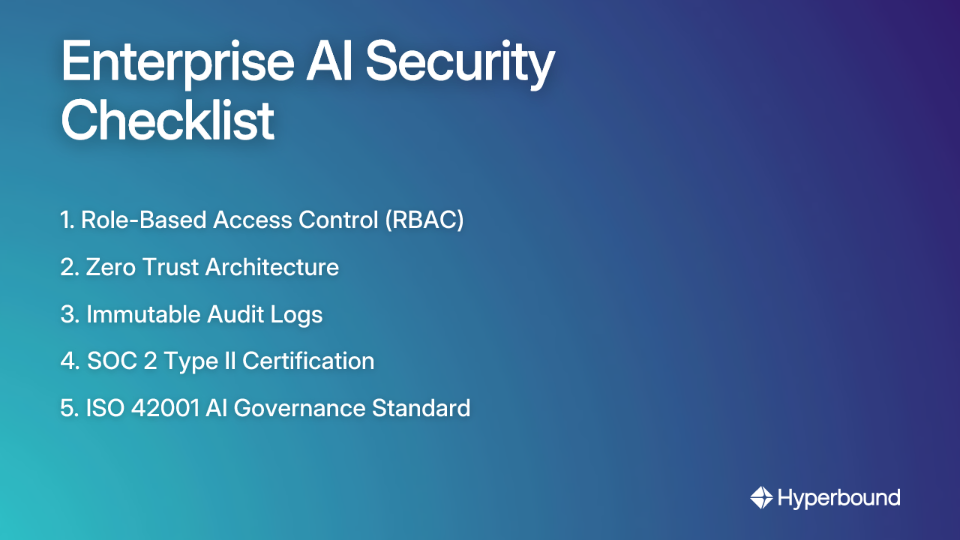
Key Security Pillars to Evaluate in Any AI Vendor
- Role-Based Access Control (RBAC): Ensures that AI systems only access the data relevant to each user's role. Critical for preventing over-permissioned access to sensitive deal or customer data.
- Zero Trust Architecture: Never assume a user or system is safe by default. Every access request should be continuously verified — don't rely on perimeter security alone in a distributed, multi-SaaS environment.
- Immutable Audit Logs: A complete, tamper-proof record of all system activity is essential for regulatory compliance and incident investigation.
Certifications to Look For
- SOC 2 Type II: Confirms a vendor has undergone a rigorous independent audit of their security controls over time, not just at a point in time. Hyperbound holds SOC 2 Type II certification.
- ISO 42001: The first international standard for AI management systems, focused on systematic governance and responsible AI practices. As MindStudio notes, this is becoming a key differentiator in enterprise vendor evaluations.
Before any enterprise AI procurement, run prospective vendors through a security review that covers these pillars. A platform that can't demonstrate these standards isn't enterprise-ready — no matter how impressive the demo.
Build a More Predictable and Productive Sales Future
Implementing predictive sales AI is one of the highest-leverage investments an enterprise sales organization can make — but only if it's done with intention. The teams that win aren't the ones who buy the most tools; they're the ones who implement deliberately: clean data first, a phased rollout second, and a relentless focus on augmenting human coaching rather than replacing it.
The forecasting problem is largely solved. The coaching problem — scaling what your best reps do across your entire team, consistently, at enterprise speed — is where the next generation of revenue wins will be found.
Frequently Asked Questions About Predictive Sales AI
What is predictive sales AI really used for?
Predictive sales AI is used to analyze data and help sales teams make better decisions, extending far beyond simple forecasting. Its key applications include AI-powered lead scoring to prioritize prospects, churn prediction to identify at-risk accounts, and most impactfully, sales readiness and coaching to analyze rep conversations, identify skill gaps, and scale winning behaviors across an entire team.
How is predictive sales AI different from conversation intelligence tools?
Predictive sales AI for coaching moves beyond the passive analysis of conversation intelligence tools. While conversation intelligence tells you what happened on a call, predictive AI platforms tell you why your top reps win and then provide AI-powered roleplays for the rest of the team to practice and adopt those specific winning behaviors, actively developing skills rather than just reviewing past performance.
How much historical data is needed to implement predictive sales AI effectively?
Effective AI models typically require 12 to 24 months of clean, detailed historical data. This includes information from your CRM (like deal stages and outcomes), call recordings, and email engagement logs. The quality and consistency of this data are crucial, as the principle of "garbage in, garbage out" heavily applies.
What is the most common mistake companies make when rolling out sales AI?
The most common mistake is attempting a "big bang" rollout across the entire organization at once. A successful implementation strategy involves a phased approach, starting with a small pilot group to establish baselines, prove ROI, and gather feedback before scaling. This minimizes disruption and builds internal champions for the wider launch.
Will predictive AI replace my sales managers or coaches?
No, the goal of predictive sales AI is not to replace managers but to augment them and make them more effective. By automating repetitive tasks like call review and scorecard grading, AI frees up managers' time to focus on high-value strategic coaching, career development, and addressing the systemic skill gaps that the AI platform identifies across the team.
How can I calculate the ROI of a predictive sales AI platform?
You can calculate the ROI by focusing on three key areas: improved win rates, reduced new hire ramp time, and increased rep productivity. Measure the baseline for these metrics before implementation and then track the improvements. Quantifiable gains can be found in the incremental revenue from more wins, accelerated quota attainment from faster ramping, and recaptured capacity from time saved on administrative tasks.
Why is SOC 2 Type II compliance important for a sales AI vendor?
SOC 2 Type II compliance is crucial because it confirms that a vendor has undergone a rigorous, independent audit of its security controls over an extended period. For sales AI, which processes sensitive customer conversations and deal data, this certification provides essential assurance that the vendor has proven, robust systems in place to protect your data, which is a non-negotiable requirement for most enterprise security and procurement teams.
Ready to see how AI can surface your team's winning behaviors and turn them into a scalable playbook? Explore Hyperbound's AI Sales Coaching platform and see how leading enterprise teams are cutting ramp time, improving win rates, and building the kind of data-driven sales coaching culture that compounds over time.
Book a demo with Hyperbound


