.png)


.png)
Summary
- Prospect ghosting often stems from a “confidence chasm” where a rep’s pitch fails to establish them as a trusted advisor, undermining the prospect's trust from the start.
- Top-performing sales reps overcome this by making practice a daily discipline, internalizing their pitch so they can focus on the buyer, not their script.
- Implement a structured, 15-minute daily practice routine focusing on key pitch components like the hook, value proposition, and objection handling.
- Modern tools like AI Sales Roleplays can accelerate this process, offering scalable, risk-free practice with instant feedback to master every conversation.
You've crafted the perfect email and somehow landed a meeting with a promising prospect. You've researched their company, prepared your slides, and know your product inside out. Yet as the meeting wraps up and you eagerly await their response... silence. Another ghost to add to your growing collection of disappeared prospects.
"I'm constantly ghosted and feel like the only thing I could do more of is bugging people and making them strongly annoyed by me," shared one frustrated sales rep in a recent Reddit thread.
If this sounds familiar, you're not alone. But have you considered that the issue might not be your follow-up strategy but something more fundamental—your pitch delivery itself?
The Confidence Chasm: Why Daily Practice is the Bridge to "Trusted Advisor" Status
There's a revealing gap in today's sales landscape: 84% of business buyers expect sales reps to act as trusted advisors, but only 59% feel their needs are actually being considered during sales interactions.
This "confidence chasm" explains why many reps struggle with ghosting and stalled deals. When you lack confidence in your pitch, it manifests in ways that undermine trust:
- Hesitant language that undermines your expertise
- Inconsistent delivery that confuses your message
- Awkward handling of objections that erodes credibility
As one sales veteran pointedly observed, "If you feel like follow up is 'bugging people and making them strongly annoyed,' that gives me the impression that you don't really believe in what you sell."
The correlation between confidence and performance isn't just anecdotal. Research from RAIN Group shows that salespeople who receive comprehensive training, coaching, and practice are 63% more likely to become Top Performers.
But here's what separates the elite from the average: top performers don't just practice occasionally—they make it a daily discipline.
"I practice till I feel comfortable and more confident," shared a successful rep. "Do whatever you need to do to make yourself comfortable." This comfort isn't a luxury; it's the foundation that allows you to focus on the prospect rather than fumbling through your own thoughts.
The truth is, most sales professionals dramatically underestimate how much practice is required to achieve the seemingly effortless delivery they admire in others. The top 1% understand that mastery isn't about knowing what to say—it's about internalizing it so deeply that your delivery becomes second nature.
Deconstructing the Masterpiece: What Exactly Should You Be Practicing?
Daily practice without structure is just motion without progress. Top performers don't simply rehearse the same generic pitch—they methodically refine each component of a winning framework.
A compelling sales pitch generally follows a proven structure:
.png)
- Hook: Start with an engaging question or compelling fact that immediately captures attention
- Problem: Articulate the specific challenges your prospect faces (in their own words, ideally)
- Value Proposition: Clearly define how your solution addresses their unique needs
- Solutions: Briefly detail how your product solves these problems
- Social Proof: Include relevant testimonials or case studies
- Call-to-Action: End with a clear, confident next step
Beyond this structure, top performers practice these critical principles:
Personalization is Paramount
Generic pitches produce generic results. 96% of B2B buyers research products before engaging with sales reps. They expect you to have done your homework too.
Practice researching target accounts and tailoring your pitch to their specific industry, company size, and known challenges. This preparation should become as routine as checking your email.
Communicate Value, Not Just Features
One hallmark of elite salespeople is their ability to articulate value in the prospect's terms. Top performers "artfully quantify the value proposition tailored to a customer's unique challenges."
Rather than practicing a laundry list of features, rehearse translating those features into tangible business outcomes for different buyer personas.
Master Storytelling
Stories stick when facts are forgotten. Practice weaving customer success stories with concrete ROI data into your pitch. These narratives should feel natural and conversational, not like you're reading from a case study.
"The biggest thing is doing the presentation out loud," advised one successful rep. "You can't get your timing and language right otherwise."
The Modern Sales Gym: How Top Performers Rehearse for Reality
The methods top performers use to practice have evolved dramatically. While traditional approaches still have value, innovative technologies are creating new possibilities for more effective, scalable practice.
Traditional Practice Methods
Role-Playing with Colleagues This classic approach remains effective when done right. The key is ensuring your role-play partner provides realistic objections and genuine feedback. This helps prepare for unexpected questions and improves your improvisation skills.
Self-Recording and Review "I recorded my whole pitch and watch it back. It's painful but it helps," shared one sales professional. This brutally honest self-assessment reveals unconscious habits, filler words, and body language issues that might otherwise go unnoticed.
The AI-Powered Practice Revolution
Modern sales professionals have access to tools their predecessors could only dream of. Advanced AI Sales Coaching platforms like Hyperbound are transforming how top performers prepare with hyper-realistic AI roleplays.
Instead of generic practice, these platforms allow you to:
- Practice Against AI Buyer Personas: Engage in realistic conversations with AI avatars that are programmed to mirror your ideal customer profiles. They respond dynamically, raise relevant objections, and push back just like a real prospect would.
- Get Instant, Unbiased Feedback: After each roleplay, receive objective, data-driven feedback. Hyperbound's AI scores your performance against your company's sales methodology, highlighting areas of strength and opportunities for improvement—from talk track adherence to handling specific objections.
- Scale Your Playbooks: Practice custom scenarios for new product launches, competitive positioning, or revised messaging. This ensures your entire team can master new talk tracks consistently and effectively.
With specialized practice for everything from cold calls and discovery to objection handling and renewals, reps can build confidence and master their craft. The advantage is significant: you can fail privately, practice at scale, and receive personalized coaching without the social pressure of practicing with peers or managers.

The Compounding Gains: Tangible Business Outcomes of a Daily Practice Habit
Daily pitch practice isn't just about personal improvement—it directly addresses the most common pain points sales professionals face:
Building a Qualified Pipeline
"It's not a qualified pipeline if nothing is closing. Don't waste your time with people who aren't going to buy," warned one experienced sales professional. A well-practiced pitch forces you to refine your qualification process. As you practice articulating value, you simultaneously sharpen your ability to identify which prospects will truly benefit from your solution.
Top performers excel at asking precise questions and actively listening—skills that improve dramatically through deliberate practice.
Eliminating Ghosting with Proactive Follow-ups
When you believe in your pitch and your product's value, follow-ups feel like a service rather than an imposition. Daily practice builds this conviction.
One practical tip from a Reddit user: "One good trick is to make sure you lock down the follow-up appointment while on site." Practicing this specific moment—confidently scheduling the next meeting—can dramatically reduce ghosting.
Mastering Objection Handling
Every sales conversation includes objections. Regular practice, especially using AI scenarios designed for objection handling, prepares you to address concerns with empathy and evidence rather than defensiveness or hesitation.
Building the Habit: Your 15-Minute Daily Pitch Workout
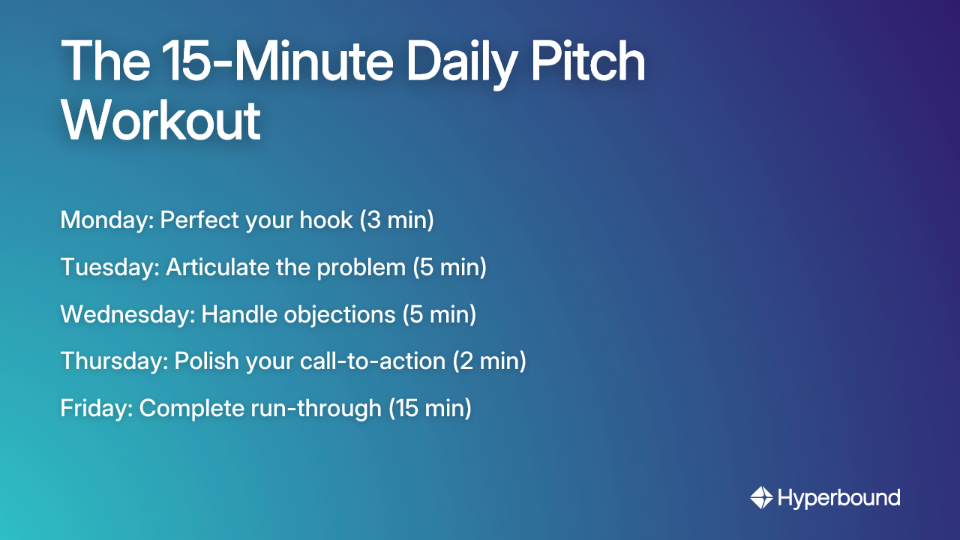
The key to making daily practice sustainable is keeping it simple, focused, and consistent. Here's a 15-minute daily workout routine used by top performers:
Monday: The Hook (3 Minutes)Practice three different opening lines for a specific target account. Record yourself and choose the most engaging one.
Tuesday: The Problem (5 Minutes)Articulate a client's pain point and tell a compelling story about how it impacts their business. Focus on using their industry jargon correctly.
Wednesday: Handling Objections (5 Minutes)Use an AI coaching platform like Hyperbound to run through a tough objection scenario. Review the instant AI feedback and try again with improvements.
Thursday: The Call-to-Action (2 Minutes)Rehearse three variations of your closing statement, focusing on clarity and confidence in scheduling the next steps.
Friday: Full Run-Through & Feedback (15 Minutes)Record a complete pitch, review it critically, and identify one specific improvement for next week.
Make this practice non-negotiable by blocking time in your calendar, just as top performers do for prospecting activities. Elite salespeople protect their practice time as fiercely as their selling time.
The Real Secret of Top Performers
The defining characteristic of sales elites isn't just what they know—it's their commitment to continuous refinement of how they deliver that knowledge.
As the research from RAIN Group shows, top performers maintain a lifelong learning mindset. They leverage books, podcasts, mentorships, and new technologies to continuously sharpen their skills.
The daily practice habit separates those who merely understand sales techniques from those who embody them with such confidence and conviction that prospects naturally trust their guidance.
Next time you feel like you're "bugging people" with follow-ups, ask yourself: Have I practiced my pitch until it feels as natural as breathing? Have I refined my delivery until I genuinely believe in the value I'm offering?
The answer to ghosting isn't more follow-ups—it's a more compelling initial conversation that makes follow-ups feel like a natural continuation of value.
Start your 15-minute daily practice routine tomorrow. Within a week, you'll notice increased confidence. Within a month, you'll see improved results. And within a year, you might just find yourself among the top performers who make it all look effortless.
Frequently Asked Questions
Why do my sales prospects keep ghosting me?
Prospects often ghost sales reps due to a "confidence chasm," where the rep's pitch delivery fails to establish them as a trusted advisor. This lack of confidence can manifest as hesitant language, inconsistent messaging, and poor objection handling, which undermines the prospect's trust. The issue often lies not in your follow-up strategy but in the initial conversation's inability to create compelling value and a clear reason for the next step.
How can daily practice improve my sales performance?
Daily practice directly improves sales performance by building the confidence and muscle memory needed to deliver a smooth, convincing pitch. Consistent rehearsal internalizes your messaging, allowing you to focus on the prospect's needs instead of your own thoughts. This leads to better qualification, stronger value articulation, more effective objection handling, and ultimately, a reduction in stalled deals.
What are the most effective ways to practice a sales pitch?
The most effective ways to practice include traditional methods like role-playing with colleagues and self-recording, as well as modern AI-powered sales coaching platforms. While role-playing helps with improvisation and self-recording reveals personal habits, AI platforms like Hyperbound offer scalable, unbiased practice against realistic AI buyer personas, allowing you to receive instant, data-driven feedback without social pressure.
How much time should I spend practicing my pitch every day?
You can see significant improvement by dedicating just 15 minutes a day to a focused pitch workout. The key is consistency, not duration. A structured 15-minute routine allows you to break down your pitch and refine different components each day—from your opening hook on Monday to a full run-through on Friday.
What are the key components of a winning sales pitch?
A winning sales pitch follows a clear structure: Hook, Problem, Value Proposition, Solutions, Social Proof, and a Call-to-Action. It begins by capturing attention (Hook), articulates the prospect's challenges (Problem), defines your unique solution (Value Proposition), details how it works (Solutions), provides evidence with success stories (Social Proof), and ends with a clear next step (Call-to-Action).
How do I get better at handling sales objections?
You get better at handling sales objections through deliberate and repeated practice in realistic scenarios. Instead of being caught off guard, proactively rehearse responses to common objections. Using AI role-play tools is particularly effective, as they can simulate tough questions and provide a safe space to practice addressing concerns with empathy and evidence, rather than defensiveness.

Book a demo with Hyperbound


