

.png)
Summary
- Cold calling remains highly effective, with 82% of buyers accepting meetings from prepared callers. Success in 2026 relies on an omnichannel approach, which can boost response rates by 287%.
- Master your pre-call ritual by researching prospects to turn cold calls warm and adopting a "just press dial" mindset to overcome call reluctance.
- Ditch the rigid script for a flexible blueprint; use "pattern interrupts" like "Is now a bad time?" and ask open-ended questions to create a natural, human conversation.
- The most effective way to improve is through practice. Use AI Sales Roleplays to master objection handling and new messaging in a risk-free environment, receiving instant feedback to accelerate your skills.
Do you find yourself staring at the phone, overthinking how the call might go? You're not alone. Many sales reps struggle with the fear of rejection and the challenge of sounding natural instead of scripted.
Despite claims that "cold calling is dead," the data tells a different story. In fact, 57% of C-level buyers prefer to be contacted by phone, making it a powerful initial contact method. Even more impressive, 82% of buyers accept meetings from cold callers who demonstrate persistence and preparation.
As we look toward 2026, cold calling is evolving - not disappearing. With AI-powered personalization, real-time intent data, and omnichannel outreach, the modern cold caller has more tools than ever. Studies show an omnichannel approach (email, LinkedIn, then call) can lead to a 287% increase in response rates compared to single-channel outreach.
This guide delivers 25 actionable tips and modern script templates designed to build confidence, handle objections, and secure more meetings in 2026. Let's dive in!
Part 1: The Pre-Call Ritual: Mindset, Environment & Strategy for 2026
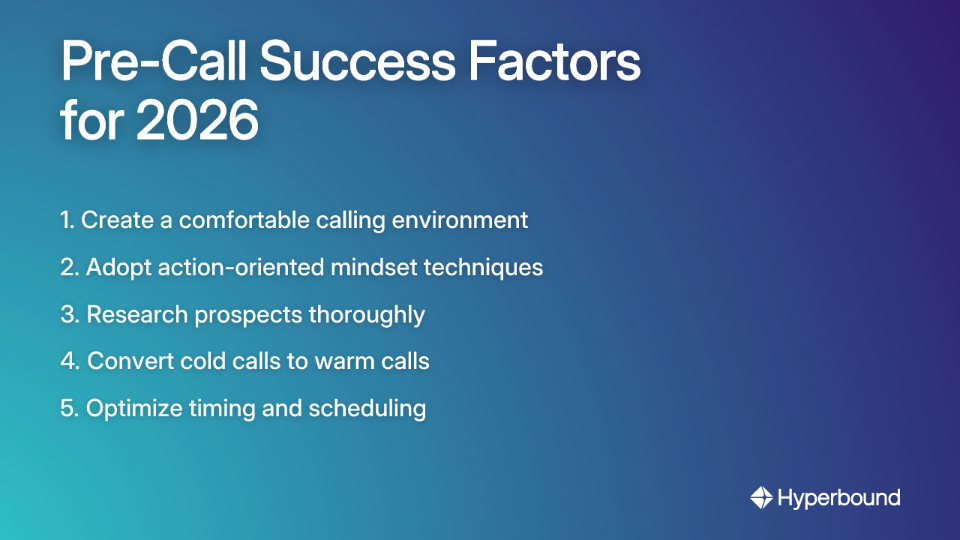
Tip 1: Build Your "Comfort Studio Environment"
Creating the right physical space can dramatically reduce anxiety and boost focus. As one sales professional on Reddit recommends: "Use calming lights, soft humming white noise, music on your earphones, and an essential oils vaporizer to make your environment as comfortable as possible." This combination creates a personal sanctuary that helps manage call anxiety.
Tip 2: Master the "Just Press Dial" Mindset
The most powerful advice is often the simplest. When you start overthinking, "JUST PRESS DIAL." As one seasoned sales rep puts it: "Spend no time worrying about how the call might go. Just press dial." This mindset combats analysis paralysis and builds a habit of action over contemplation.
Tip 3: Adopt a "Smile and Dial" Attitude
It sounds cliché, but it works. Physically smiling while on calls audibly changes your tone, making you sound more approachable and confident. One Reddit user notes: "Smile and dial. It's cliche but true. Pay attention to how you feel when you force a smile." This simple physical adjustment can transform your vocal delivery.
Tip 4: Set a "No Quota" to Gamify Rejection
Instead of fearing rejection, aim for it. Set a daily target for the number of "nos" you'll collect. This counterintuitive approach transforms rejection from a personal failure into just another metric, helping you remember that "They're not rejecting you, they're just rejecting what you're proposing."
Tip 5: Do Your Homework: Research is Your Superpower
Going into a call unprepared is a recipe for disaster. Use tools like BuiltWith to understand a prospect's tech stack, SimilarWeb for traffic analysis, and LinkedIn Sales Navigator to research the decision maker (DM). Even five minutes of research can provide conversation hooks that demonstrate you've done your homework.
Tip 6: Turn Cold Calls into Warm Calls
The difference is striking: cold calls have a 1-3% conversion rate, while warm calls convert at 15-30%. Warm up leads by:
- Engaging with their content on LinkedIn
- Sending a personalized email first
- Referencing a mutual connection
- Following up after they've downloaded content from your site
Tip 7: Time Your Calls for Maximum Impact
Not all calling hours are created equal. According to Zendesk research:
- Best Days: Wednesdays and Thursdays
- Best Times: 10 am–11 am and 4 pm–5 pm
These windows typically catch prospects when they're most receptive and least distracted.
Tip 8: Structure Your Day with Time Blocking
Dedicate specific, distraction-free blocks in your calendar solely for making calls. This practice, called time blocking, creates momentum and prevents procrastination. Aim for 60-90 minute blocks with short breaks in between to maintain focus and energy.
Part 2: The 2026 Cold Calling Scripts: Your Flexible Blueprint for Conversation
Remember: these scripts are guides, not cages. As one Reddit user puts it, "Do not sound scripted. Sound like a normal human." The goal is to create a natural, flowing conversation that builds trust.
Template 9: The General B2B Opener
Objective: Get past the gatekeeper and engage the prospect quickly.
"Hi, it's [Your Name] from [Your Company]. Is [Prospect Name] available?

[When connected with prospect]

Hi [Prospect Name], thanks for taking my call. I can see you do [specific business function]. Have you got 30 seconds for me to explain how we help companies like yours with [specific value prop]?

[After brief value proposition]

Does that sound like something worth exploring in a 15-minute conversation next week?"
Template 10: The SaaS Pitch
Objective: Address tech lead generation challenges directly with a pattern interrupt.
"Hey [Prospect Name], [Your Name] from [Your Company] here. Is now a bad time?

[Wait for response]

Great. The reason for my call is that we help SaaS companies like [Competitor They Know] generate direct dials for decision-makers in their target market, saving their sales team hours on prospecting.

Our customers typically see a 40% increase in connect rates. I'd like to show you how we could do the same for [Their Company]. Would you have 15 minutes this Thursday at 2 PM or would Friday at 10 AM work better?"
Template 11: The SaaS Demo Request
Objective: Quickly qualify and schedule a product demonstration.
"Hi [Prospect Name], do you have three minutes to talk about how you can [core benefit of your product]?

[After brief explanation]

Based on what you've shared about [challenge they mentioned], I think our [Product Name] could help by [specific solution]. We've recently helped [Similar Company] improve their [specific metric] by X%.

It sounds like this could be a fit. I'm free to show you a quick demo on [Day] at [Time] or [Day] at [Time]. Which works better for you?"
Template 12: The C-Level Approach
Objective: Engage senior executives with respect and brevity.
"Hi [First Name], I'm hoping you can help me out for a moment. Do you have two minutes?

[Wait for response]

Thank you. My understanding is you oversee [relevant department/initiative]. We've recently helped [Similar Company] improve their [specific metric] by X% through our [brief solution description].

I suspect this is a priority for you too. Could we schedule a brief 15-minute call to discuss how we might help [Their Company] achieve similar results? I have availability on [Day] at [Time] or [Day] at [Time]."
Template 13: The Enterprise Prospecting Script
Objective: Target high-value accounts by referencing industry challenges.
"Hi [First Name], this is [Your Name] from [Your Company]. Is this a bad time for a quick chat?

[Wait for response]

I'm calling because we work with several leaders in the [Prospect's Industry] space like [Recognizable Client], and a common challenge they face is [specific challenge].

We help solve this by [your solution brief]. Is that something you're currently experiencing at [Their Company]?

[If yes] I'd love to share some specific strategies we've implemented. Would you have 20 minutes on [Day] at [Time] for a more detailed conversation?"
Part 3: Mastering the Moment: In-Call Tactics for Connection and Control
Tip 14: Master the First 7 Seconds with a Pattern Interrupt
Prospects have a mental script for rejecting sales calls. Break it with unexpected openings like "Is now a bad time?" or "I'm hoping you can help me out." These pattern interrupts are more effective than the predictable "How are you today?" which immediately signals "sales call."
Tip 15: Use a Disarming Tone and Mirroring
As one Reddit user advises: "Talk to them like they're your favorite cousin that just showed up on Thanksgiving." This approach leverages emotional intelligence to build instant rapport. Additionally, try mirroring the prospect's pace and tone to create subconscious trust and connection.
Tip 16: Ask Open-Ended Questions and Embrace Silence
Transform your call from a pitch to a consultation by asking questions that start with "What," "How," and "Why." These encourage meaningful conversation and demonstrate genuine interest. After asking, don't be afraid of silence – give the prospect time to think and formulate thoughtful responses.
Tip 17: Sell the Vacation, Not the Plane Ride
This memorable Reddit advice encapsulates the essence of selling the outcome. Don't focus on features; focus on benefits and results. Instead of "Our software has a dashboard," say "Our software gives you a single view of your pipeline, so you can forecast revenue with 95% accuracy."
Tip 18: Prepare for Objection Handling
As one sales professional advises: "Write down the top five brush offs and objections you get, plan out how you'd like to respond going forward, and practice it over and over again until you have it memorized." This preparation builds confidence and ensures you're never caught off guard.
Tip 19: Navigate the Gatekeeper (GK) with Respect
Frame the gatekeeper as an ally, not an obstacle. Try this approach: "Hi, I was hoping you could help me. I'm trying to reach the person who handles [responsibility]. Who would be the best person to speak with?" This respectful language often earns their cooperation.
Tip 20: Nail Your Voicemail Game
With most cold calls going to voicemail, make those 30 seconds count. Structure your message with:
- Your name and company
- A specific reason for calling (value proposition)
- Your phone number (repeated twice)
- A clear next step
Tip 21: The Goal Is the Next Meeting, Not the Sale
Set realistic expectations for B2B calls. Your primary goal is rarely to close a deal, but to secure a qualified discovery call or demo. Close by offering two specific times: "Would Tuesday at 2 PM work, or is Wednesday at 10 AM better?" This increases the likelihood of commitment.
Part 4: After the Hang-Up: The Art of the Follow-Up and Continuous Improvement
Tip 22: The Fortune Is in the Follow-Up
According to Zendesk, 80% of sales occur after the fifth contact attempt, yet most reps give up after just two. On average, it takes eight attempts just to reach a prospect. Create a persistent, multi-channel follow-up cadence that combines calls, emails, and social touches.
Tip 23: Log Everything in Your CRM
This non-negotiable step ensures no leads fall through the cracks. After each call, log:
- Call outcome
- Key discussion points
- Objections raised
- Next scheduled action
- Personal details for future rapport building
Tip 24: Use Roleplaying and Shadowing for Rapid Improvement
Address the pain of inexperience head-on. As one Reddit user noted: "I found doing a bunch of roleplaying helped a ton." Practice common scenarios and objections with a manager or peer, and shadow top performers to learn their techniques firsthand.
While live practice is invaluable, scaling it is a major challenge. This is where AI-powered tools create a significant advantage. Platforms like Hyperbound's AI Sales Roleplays allow reps to practice critical conversations on-demand against realistic AI buyer personas. They can master everything from objection handling to new product messaging in a safe environment, receiving instant, objective feedback that accelerates skill development without burning out managers.
Tip 25: Leverage AI for Smarter Outreach in 2026
Looking forward, AI is already transforming cold calling from an art into a science. Platforms like Hyperbound are leading this charge by:
- Analyzing Winning Patterns: AI can analyze thousands of your team's actual sales calls to identify the talk tracks and behaviors that your top reps use to close deals. This data becomes the foundation for your sales playbook.
- Scaling Best Practices with AI Roleplays: Instead of just listening to call recordings, reps can practice what they've learned in hyper-realistic AI roleplays. This allows them to build muscle memory around winning techniques before they talk to a live prospect.
- Providing Objective, Real-Time Coaching: AI tools can score both practice and real calls against your sales methodology, providing instant, unbiased feedback. This helps reps understand exactly where they need to improve and accelerates their ramp time.
Conclusion
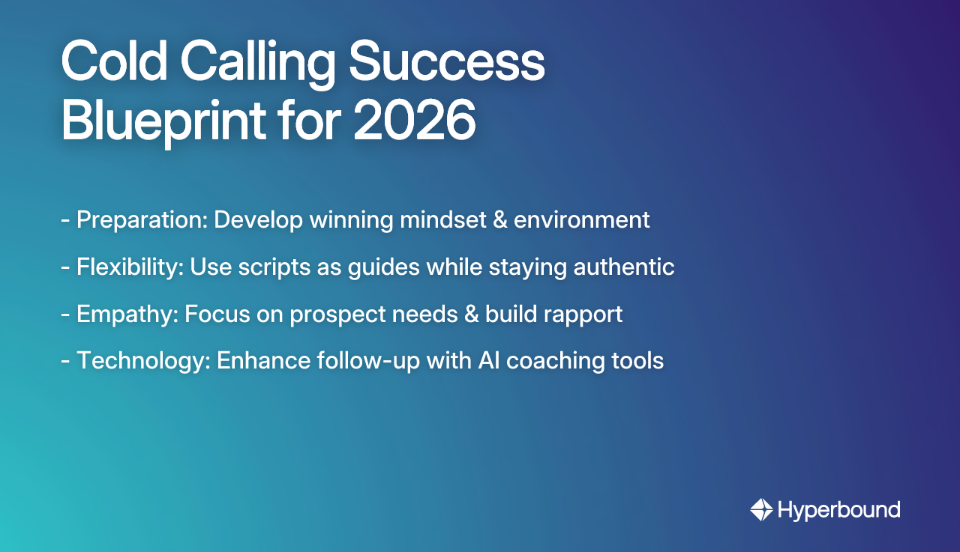
As we move toward 2026, successful cold calling rests on four key pillars:
- Preparation: A winning mindset and conducive environment
- Flexibility: Using scripts as guides while maintaining authenticity
- Empathy: Focusing on the prospect's needs and building genuine rapport
- Persistence & Technology: A disciplined follow-up process enhanced by AI
Remember the core principle that started our journey: just press dial. But now, you're dialing smarter, not just harder. Each call is an opportunity to refine your approach, learn from the interaction, and move closer to mastery.
Cold calling is a skill that improves with deliberate practice. With these 25 templates and tips, you have everything you need to transform from anxious dialer to confident closer. Your next great opportunity is just one call away.
Frequently Asked Questions
Is cold calling still effective in 2026?
Yes, cold calling remains highly effective, especially for B2B sales. Data shows that 57% of C-level buyers prefer phone contact, and a persistent, well-researched approach can lead to high meeting acceptance rates. The key to success in 2026 is integrating calls into a modern, omnichannel strategy that includes email and social media engagement.
How can I overcome the fear of cold calling?
Overcoming call reluctance starts with changing your mindset and environment. Adopt a "just press dial" attitude to combat overthinking, create a comfortable calling space, and gamify rejection by setting a daily "no" quota. These techniques shift your focus from fear to action, making it easier to pick up the phone.
What is the best way to start a cold call?
The best way to start a cold call is with a "pattern interrupt" that breaks the prospect's expectations. Instead of the predictable "How are you?", try disarming questions like, "Is now a bad time?" or "I'm hoping you can help me out for a moment." This approach captures attention and opens the door for a more genuine conversation.
How do I avoid sounding like I'm reading from a script?
To avoid sounding scripted, treat your script as a flexible blueprint, not a rigid text. Use a conversational, disarming tone—as if you're talking to a cousin—and focus on asking open-ended questions. Practicing your key talking points through roleplaying, especially with AI tools, helps you internalize the material so you can deliver it naturally.
What is the primary goal of a B2B cold call?
The primary goal of a B2B cold call is not to close a deal on the spot, but to secure the next step in the sales process. This usually means scheduling a qualified discovery call or a product demonstration. By focusing on this smaller commitment, you reduce pressure and increase your chances of getting a "yes."
How many times should I follow up with a prospect?
You should plan to follow up with a prospect at least five to eight times. Research shows that 80% of sales occur after the fifth contact, yet most reps give up after just two attempts. A persistent, multi-channel follow-up strategy that combines calls, emails, and social media touches is essential for breaking through the noise and getting a response.
How can AI improve my cold calling skills?
AI can significantly improve your cold calling skills by providing a safe and scalable way to practice. AI-powered roleplay platforms like Hyperbound allow you to practice objection handling and new messaging against realistic buyer personas on your own time. These tools also provide instant, objective feedback on your performance, helping you to identify areas for improvement and ramp up faster than traditional coaching methods.
Book a demo with Hyperbound


