.png)


.png)
Summary
- Objections are signs of engagement, not rejection. This guide provides a framework to handle the 12 most common sales objections by focusing on listening and exploring the root cause before responding.
- Handle price objections by reframing the conversation around value and ROI instead of immediately offering a discount, which devalues your product.
- For stalls like "I need to think about it," gently probe to uncover the real underlying objection, as this is often a mask for a more specific, unaddressed concern.
- Mastering objection handling requires consistent practice. Hyperbound's AI Sales Roleplays provide a risk-free environment for reps to build the confidence needed to turn objections into closed deals.
Every sales rep knows the feeling. You've built rapport, the conversation is flowing, and then you hear it: "It's too expensive," or "There's too much going on right now." It can feel like hitting a brick wall.
But here's the reality: objections aren't rejections—they're engagement signals. When a prospect raises an objection, they're telling you they're interested enough to voice a concern rather than simply ending the call.
Before we dive into specific objections, it's important to understand the difference between an objection and an obstruction:
- An objection is a genuine concern about your product/service (e.g., "I don't see the value in your product.")
- An obstruction is an excuse to end the conversation (e.g., "I don't have time for this.")
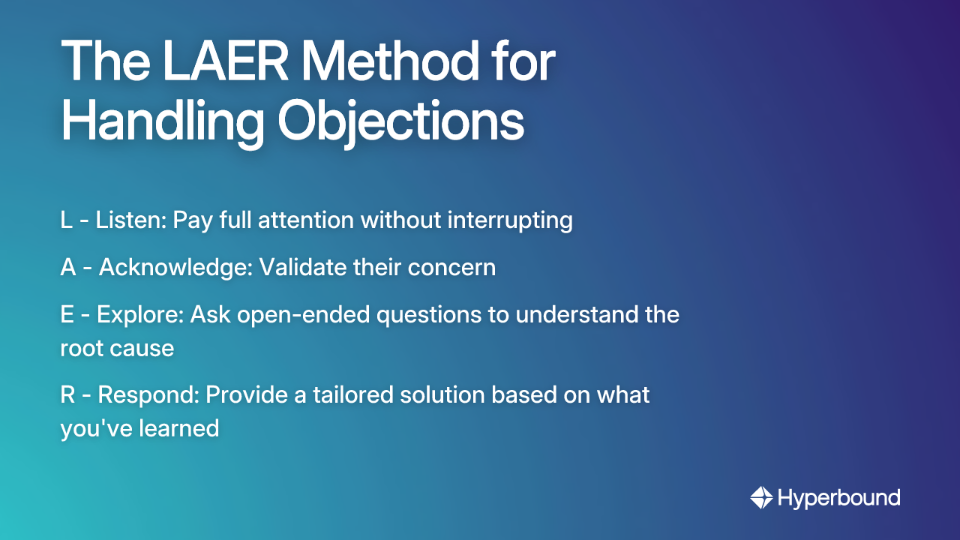
This article focuses on handling true objections with a simple, universal framework known as the LAER Method:
Now, let's examine the 12 most common sales objections and exactly how to overcome them.
1. The Price Objection: "It's too expensive." / "I don't have the money."
What They're Really Saying: They don't see enough perceived value to justify the cost, or they have genuine budget constraints.
The Wrong Way: "We can offer a 10% discount." (This immediately devalues your product).
The Right Way:
- Acknowledge & Reframe: "I understand price is an important consideration. To make sure I'm on the right track, could you help me understand how you're currently handling [problem] and what that's costing your team?"
- Focus on Value & ROI: "I hear you. Many of our customers initially felt the same way, but what they found was that by solving [specific challenge], they were able to achieve [X% increase in productivity, Y amount in cost savings], delivering a full ROI in under six months. For a company like yours, that could mean an extra [$$$] in revenue."
- Use Social Proof: "We have a case study with [Similar Company] that shows exactly how they justified the investment. Would that be helpful to review?"

Mastering the Response with Hyperbound: Price objections are high-stakes moments that require practice to handle effectively. With Hyperbound's AI Sales Roleplays, your reps can practice handling the "it's too expensive" objection against hyper-realistic AI personas that push back just like real prospects. The platform provides a safe space to test different value propositions and refine responses, with instant feedback identifying where reps successfully pivoted to value and where they could improve.
2. The Timing Objection: "Now's not a good time." / "Call me back next quarter."
What They're Really Saying: They're overwhelmed with other priorities, or they don't see your solution as urgent enough to act on now.
The Wrong Way: "Okay, I'll call you back in three months. Thanks." (Loses all momentum).
The Right Way:
- Acknowledge & Explore: "I understand, it sounds like you have a lot on your plate. Just so I can be prepared for our next conversation, what's expected to change next quarter regarding your ability to invest in a solution for [problem]?"
- Create Urgency (Gently): "I get that. Many businesses in your position are focused on [competing priority]. However, delaying a solution for [problem] often results in [specific negative consequence]. Is that something you've factored in?"
- Secure a Concrete Next Step: "Instead of me just calling you back, would it make sense to schedule a 15-minute placeholder on [Date] to reassess then?"
3. The Competitor Objection: "We're already working with [Competitor X]."
What They're Really Saying: They might be happy with their current provider, or they might be locked in a contract. This is your opportunity to uncover dissatisfaction.
The Wrong Way: "Oh, they're terrible. Our product is much better because of X, Y, and Z." (Bashing competitors is unprofessional).
The Right Way:
- Acknowledge & Inquire: "That's great, [Competitor X] is a well-known company. How are you finding the service so far? What do you like most about it, and is there anything you wish it did better?"
- Differentiate, Don't Denigrate: Based on their answer, highlight your unique differentiators. "That's interesting you mention [pain point]. One of the key reasons customers switch to us from [Competitor X] is our ability to [unique selling point that solves their pain]."
- Keep the Door Open: "If you're ever re-evaluating your options when your contract is up, I'd be happy to show you a side-by-side comparison."
4. The Authority Objection: "I need to run this by my boss." / "I'm not the decision-maker."
What They're Really Saying: They lack the authority to make the final decision, and you need to either empower them to be your champion or get in front of the actual decision-maker.
The Wrong Way: "Okay, let me know what they say." (You lose control of the sale).
The Right Way:
- Validate & Empower: "That makes perfect sense. Most of our customers involve multiple stakeholders. To make that conversation as productive as possible for you, what information would be most helpful for your boss to see?"
- Offer to Help: "I often find it's helpful to join that conversation to answer any technical questions directly. Would it make sense to schedule a brief call with you and [Boss's Name] together?"
- Identify the Decision Process: "Could you walk me through your company's typical evaluation process for a new tool like this?" This helps you understand who is involved.
5. The Need/Fit Objection: "I don't see how this can help me." / "We're happy the way things are."
What They're Really Saying: You haven't effectively connected your solution to their specific, pressing problems. They don't understand the value proposition for their business.
The Wrong Way: "But our product does A, B, and C! It's great!" (Feature-dumping).
The Right Way:
- Step Back to Discovery: "That's fair feedback. It seems I may have missed the mark in explaining the value for you specifically. Can we take a step back? What are your top 2-3 priorities for this quarter?"
- Ask Open-Ended Questions: Use their priorities to re-align your pitch. "You mentioned that [Priority 1] is a major focus. How are you currently addressing the challenges around that?"
- Use Case Studies: "Companies like yours often struggle with [common challenge]. For example, [Client Name] was in a similar spot, and by using our platform, they were able to [achieve specific outcome]. Does that sound relevant to you?"
6. The "Just Send Me an Email" Brush-Off
What They're Really Saying: This is often a polite way to end the conversation. They're not engaged or interested enough to continue talking live.
The Wrong Way: "Sure, what's your email?" (The conversation is over).
The Right Way:
- Acknowledge & Pivot: "Absolutely, I can send something over. To make sure I send the most relevant information and don't waste your time, what specifically caught your interest that you'd like to read more about?"
- Attempt a Quick Re-engagement: "Before I let you go, I can actually summarize the key benefit for a company like yours in 30 seconds. Would that be helpful?"
- Secure a Follow-up: "I'll send that email over. I'll also pop a 15-minute placeholder on your calendar for Thursday to follow up and answer any questions. Feel free to accept or decline."
7. The Trust Objection: "I've never heard of your company."
What They're Really Saying: Lack of brand recognition creates a trust deficit. They're asking, "Why should I trust you?"
The Wrong Way: "We're a startup, we're trying to get our name out there." (Focuses on your problem, not theirs).
The Right Way:
- Deliver a Concise Value Proposition: "That's understandable. We're a company that helps [Your ICP] solve [Problem] by [Your Solution]."
- Name Drop & Use Social Proof: "We work with well-known companies like [Client 1] and [Client 2], and they've seen [Specific Result]. I found your profile on [Source] and thought we could help you in a similar way."
8. The Complexity Objection: "This looks too complicated."
What They're Really Saying: They're worried about the effort required for implementation, training, and adoption. They fear disruption to their workflow.
The Wrong Way: "It's actually very easy to use." (Dismisses their valid concern).
The Right Way:
- Acknowledge & Clarify: "I can see why it might look that way at first glance. What part specifically seems complicated to you?"
- Reassure with a Process: "That's a great question. We pride ourselves on our white-glove onboarding. Our customers are typically fully up and running in [X days]. We handle the heavy lifting and provide comprehensive training, so your team can focus on what they do best. In fact, our customer service team will be with you every step of the way."
9. The Contract Objection: "I don't want to sign a long contract."
What They're Really Saying: They are concerned about cash flow or have had a negative experience being locked into a service that didn't deliver. They want flexibility and reduced risk.
The Wrong Way: "Our standard contract is 12 months, we can't change it." (Inflexible).
The Right Way:
- Explore the 'Why': "I understand the hesitation around long-term commitments. Can you tell me more about what's driving that concern? Is it related to budget planning or flexibility?"
- Offer Alternatives: "While most of our clients choose an annual agreement for the cost savings, we do offer flexible options like quarterly or even month-to-month terms to help you prove the value internally first. Would that be a better fit?"
10. The Missing Feature Objection: "You don't have [Feature X]."
What They're Really Saying: They believe a specific feature is critical to their process, or a competitor has highlighted it as a key differentiator.
The Wrong Way: "You don't need that feature." (Tells them their needs are wrong).
The Right Way:
- Understand the Job-to-be-Done: "That's an important point. Can you walk me through how you would use [Feature X] in your day-to-day workflow? What is the outcome you're trying to achieve with it?"
- Provide a Workaround or Alternative: "Thank you for explaining that. Many of our customers achieve the same outcome by using our [Alternative Feature Y]. It works a bit differently but gets you to the same result. Would you be open to seeing how?"
11. The Bad Review Objection: "I saw a bad review of your company."
What They're Really Saying: They have a specific concern about your company's reliability or quality, and it's created doubt.
The Wrong Way: "That review is fake." / "That was a difficult customer." (Defensive and dismissive).
The Right Way:
- Acknowledge and Own It: "Thank you for bringing that to my attention, we take all feedback seriously. We're aware of that issue from [Time Period], and it highlighted a gap in our [process/product]."
- Explain the Resolution: "As a direct result of that feedback, we implemented [Specific Change]. Since then, our customer satisfaction in that area has increased by [X%]."
- Provide Countervailing Proof: "I'd be happy to share a more recent case study or even connect you with a current customer who can speak to their positive experience with our support team."
12. The "Think About It" Objection: "I want to think about it."
What They're Really Saying: This is a classic stall. There is an unaddressed, underlying objection they aren't voicing. It could be price, trust, timing, or something else.
The Wrong Way: "Great, I'll follow up next week." (Lets them off the hook).
The Right Way:
- Gently Probe for the Real Reason: "Of course. Usually when I hear someone say they need to 'think about it,' it means there's a specific area of concern or something I haven't explained clearly enough. To help your thought process, is it the pricing, the implementation timeline, or something else that's giving you pause?"
- Recap the Value: "Based on our conversation, we agreed that solving [Problem] would save you [X hours/$$$] and help you achieve [Goal]. Is that still a priority for you?"
- Define Next Steps: "What information would help you feel confident in making a decision?"
From Objection to Opportunity
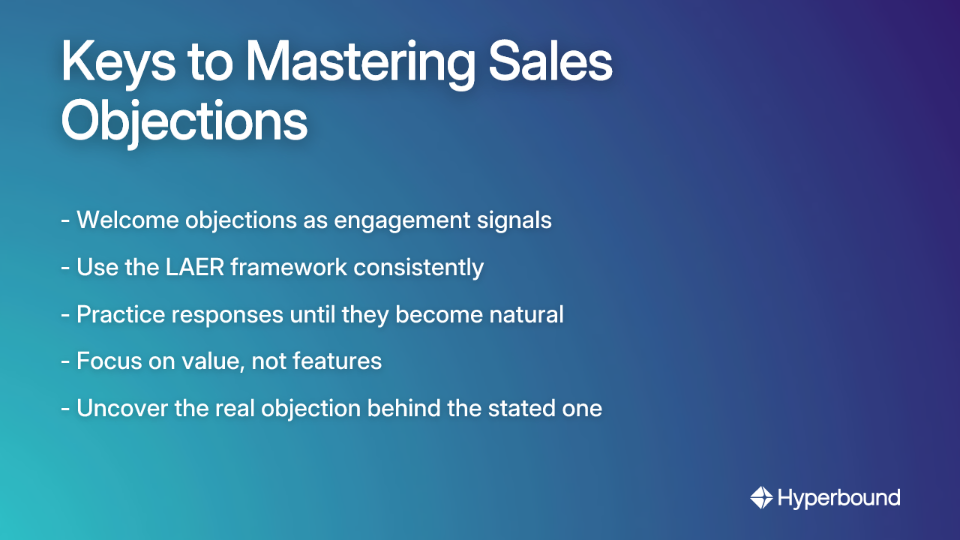
The best sales reps don't fear objections; they welcome them. By listening, understanding, and responding with value-focused solutions, you can turn a moment of friction into a path toward a closed deal.
Reading these responses is one thing; delivering them confidently in a live sales call is another. Consistent practice is the only way to internalize these frameworks and make them your own.
Platforms like Hyperbound are transforming how sales teams prepare for objection handling. By using AI Real Call Scoring to analyze what works in your real conversations and AI Sales Roleplays to practice in a risk-free environment, reps can build the muscle memory needed to handle any objection with confidence. This continuous loop of analysis, practice, and AI Coaching ensures your entire team is always ready to overcome objections and close more deals.
Frequently Asked Questions
What is the most common sales objection?
The most common sales objection is related to price or budget, often phrased as "It's too expensive." This objection usually indicates that the prospect doesn't see enough value in your product to justify the cost. The key is to shift the conversation from price to the return on investment (ROI) and the value your solution provides in solving their specific problems.
Why are sales objections important for a sales process?
Sales objections are important because they are signals of engagement from a prospect. Instead of being rejections, objections show that a prospect is interested enough to think critically about your offer and voice their concerns. This gives you a valuable opportunity to clarify your value proposition, address their specific needs, and build a stronger relationship.
How can I handle price objections without offering a discount?
You can handle price objections without offering a discount by reframing the conversation around value and return on investment (ROI). First, acknowledge their concern. Then, explore the costs associated with the problem they're trying to solve. Use case studies and social proof to demonstrate how other companies have justified the investment and achieved significant returns, effectively making the price a secondary consideration to the value gained.
What is the LAER method for handling objections?
The LAER method is a four-step framework for handling sales objections that stands for Listen, Acknowledge, Explore, and Respond. It provides a structured way to manage conversations: Listen fully to the prospect's concern without interrupting. Acknowledge that their concern is valid. Explore the root cause with open-ended questions. Finally, Respond with a tailored solution based on what you've learned.
What is the difference between a sales objection and a brush-off?
A sales objection is a genuine concern about your product or service, while a brush-off (or obstruction) is an excuse to end the conversation. An objection like "I don't see how this fits our workflow" invites a discussion. A brush-off like "Just send me an email" is typically a sign of disinterest. While you should try to re-engage with a brush-off, a true objection is a more valuable opportunity to move the sale forward.
How can sales reps practice objection handling?
Sales reps can practice objection handling effectively through consistent role-playing in a risk-free environment. Traditional role-playing with managers is helpful, but modern AI-powered platforms like Hyperbound offer a more scalable solution. These tools allow reps to practice against realistic AI personas, get instant feedback, and build the muscle memory needed to confidently handle any objection in a live call.
Book a demo with Hyperbound


