

.png)
Summary
- Sales objections differ significantly between SMB and enterprise clients; SMBs focus on immediate concerns like price and quick ROI, while enterprises prioritize long-term risks like security, integration, and stakeholder consensus.
- To handle SMB objections, pivot from price to value, showcase quick wins with case studies, and emphasize ease of use and strong support.
- For enterprise objections, be prepared with detailed implementation plans, security documentation, and a strategy to help your internal champion build consensus across departments.
- Mastering these distinct approaches requires practice, and teams can leverage AI Sales Roleplays to safely simulate and perfect their handling of both SMB and enterprise objections.
Sales conversations are often filled with frustration, emotion, and anxiety, especially when a prospect is already mentally blocking you out. That moment when you hear "It's too expensive" or "We need to discuss this with our team" can trigger an immediate sense of dread. Your heart rate increases, palms get sweaty, and suddenly, your carefully rehearsed pitch flies out the window.
But what if I told you that objections aren't roadblocks—they're actually signposts guiding you toward the sale?
The truth is, objections signal interest. They indicate that your prospect is engaged enough to voice concerns rather than politely ending the conversation. However, the nature of these objections—and how you should handle them—differs dramatically between selling to small and medium-sized businesses (SMBs) versus enterprise organizations.
In this guide, we'll explore the key differences in objection handling between these market segments and provide practical frameworks for navigating each conversation with confidence.
The Psychology of a Sales Objection: It's Not What You Think
Before diving into segment-specific approaches, it's essential to understand what's really happening when a prospect objects.
As one experienced sales professional noted on Reddit, "Any objection you receive comes down to ONE reason: they LACK CERTAINTY about you, your product/service, and/or your company."
This uncertainty manifests in two distinct ways:
Complaints: These are emotional, knee-jerk reactions like "I'm not interested" or "Just send me some information." They're often smokescreens that mask the true concern.
True Objections: These are logical reasons for disagreeing, such as "Your product is too expensive because our budget has been maxed out for this quarter." These provide valuable information you can work with.
The universal approach to handling both types includes:
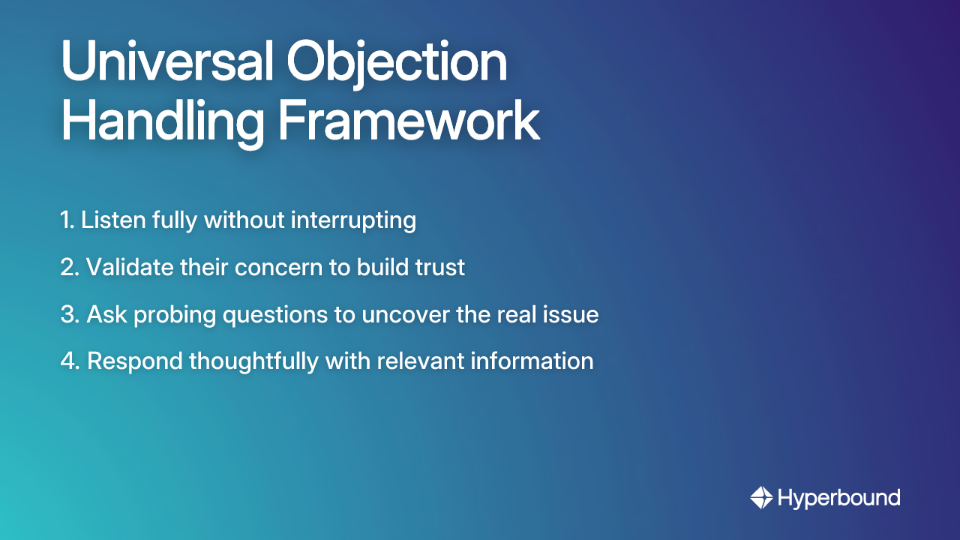
- Listen fully without interrupting
- Validate their concern to build trust
- Ask probing questions to uncover the real issue
- Respond thoughtfully with relevant information
But this is where the similarities between SMB and enterprise objection handling end. Let's explore the differences.
Decoding SMB Objections: The World of "Right Here, Right Now"
Small and medium-sized businesses operate in an immediate reality. Decision-makers are often owners or founders who are resource-constrained and focused on quick wins. Their objections reflect these priorities.
Top 3 SMB Objections and How to Handle Them
1. Price: "It's too expensive."
Why it happens: SMBs typically have tighter budgets with every dollar scrutinized. The decision-maker is often directly responsible for P&L and feels the pain of expenses personally.
How to overcome this objection:
- Isolate the objection first: "If price wasn't an issue, would our solution be a good fit for your needs?" This confirms if price is the real blocker or just a convenient excuse.
- Pivot to value & ROI: "Let's set the price aside for a moment and talk about the return. Based on what you've told me, our tool could save you X hours per week, which translates to $Y in productivity gains."
- Offer flexibility: Consider tiered pricing, payment terms, or limited-scope options that provide an entry point. According to Buzzboard, flexibility often wins over SMB clients who appreciate vendors who understand their constraints.
2. Immediate ROI: "I need to see results quickly."
Why it happens: SMBs can't afford to wait 12 months for a return. Cash flow matters, and they need to see a positive impact this quarter.
How to overcome this objection:
- Showcase quick wins: Share case studies and testimonials from similar-sized clients who saw rapid results. Use specific metrics and timelines.
- Offer a trial or pilot: De-risk the decision by offering a pilot program or trial period to let them experience the value firsthand.
- Create a phased implementation plan: Show how certain features can be implemented immediately for fast results, while more complex functionality can come later.
3. Simplicity & Time: "This looks too complicated/I don't have time for a complex setup."
Why it happens: Small teams lack dedicated IT resources and can't afford productivity loss from a steep learning curve.
How to overcome this objection:
- Emphasize simplicity: Use clear, jargon-free language. Offer a live demo focused on ease of use rather than technical capabilities.
- Highlight support: Stress that you offer extensive customer support and a smooth onboarding process to ensure a seamless transition.
- Focus on time savings: "The initial setup takes just 2 hours, but it will save your team 5 hours every week going forward."
Navigating Enterprise Objections: The Long Game of Consensus and Compliance
Enterprise sales involve multiple stakeholders, complex buying processes, and longer sales cycles. Their objections reflect concerns about risk, scalability, and organizational alignment rather than immediate costs.
Top 3 Enterprise Objections and How to Handle Them
1. Implementation & Integration: "How will this integrate with our existing systems?"
Why it happens: Enterprise organizations have complex, interconnected technology ecosystems. Any disruption could impact thousands of users and cost millions.
How to overcome this objection:
- Provide a clear plan: Offer a detailed implementation roadmap and highlight your robust onboarding process.
- Share social proof: Provide technical case studies of successful integrations at similar enterprise companies. Specificity matters here—"We successfully integrated with SAP at three Fortune 500 manufacturing companies last year."
- Connect the experts: Offer to set up a technical call between their IT team and your solutions engineers. This demonstrates confidence in your product's compatibility.
2. Security & Compliance: "How do you handle data security? Are you SOC 2 compliant?"
Why it happens: Data breaches and non-compliance represent massive financial and reputational risks. This is non-negotiable for enterprise buyers.
How to overcome this objection:
- Be proactive: Have your security documentation, policies, and compliance certifications ready to share. Don't wait for them to ask.
- Speak their language: Be prepared to discuss data encryption, privacy measures, and system security protocols in detail. This demonstrates your understanding of enterprise requirements.
- Offer to involve your security team: Suggest a dedicated meeting between your security experts and their compliance team to address any specific concerns.
3. Stakeholder Alignment & Authority: "I need to run this by my team/legal/IT."
Why it happens: Decisions are made by consensus in enterprises. The person you're speaking to is often a champion, not the final decision-maker.
How to overcome this objection:
- Embrace multi-threading: Ask, "That makes perfect sense. Who else on your team will be involved in this evaluation? I'd be happy to walk them through the aspects most relevant to their roles." This approach helps you engage all stakeholders directly.
- Enable your champion: Provide them with tailored materials (e.g., a one-pager on ROI for the CFO, a security brief for the CISO) to help them sell internally.
- Create stakeholder maps: Identify all potential decision-makers and influencers in the organization and develop strategies to address each one's specific concerns.
From Theory to Practice: How to Master Objection Handling for Any Market
Knowing these frameworks is one thing. Executing them confidently under pressure is another challenge entirely. Proper training in objection handling can dramatically decrease sales team turnover and speed up ramping for new talent.
Build Muscle Memory with AI-Powered Practice
Hyperbound's AI Sales Roleplays provides a safe, scalable environment for reps to practice handling any objection across both SMB and enterprise contexts. Unlike generic role-playing exercises, Hyperbound allows you to:
- Create hyper-realistic AI buyer personas that respond dynamically to your reps' handling techniques
- Tailor roleplays to specific ICPs, products, and sales methodologies
- Practice segment-specific objections repeatedly without risking real deals
For example, you can set up an "SMB Founder" persona programmed to repeatedly object on price, then create an "Enterprise IT Director" persona that relentlessly grills your reps on security protocols. Your team can practice both conversations in the same afternoon.
Refine Your Skills with AI-Powered Feedback
Practice isn't enough without feedback. Hyperbound's AI Real Call Scoring and AI Coaching provide instant, objective feedback on performance, tracking talk ratios and key selling moments.
This automated feedback loop helps sales teams:
- Identify patterns in how they handle different types of objections
- Spot missed opportunities to ask clarifying questions
- Receive personalized coaching on improving responses
- Build confidence through measurable improvement
The Two Languages of Sales: SMB vs. Enterprise
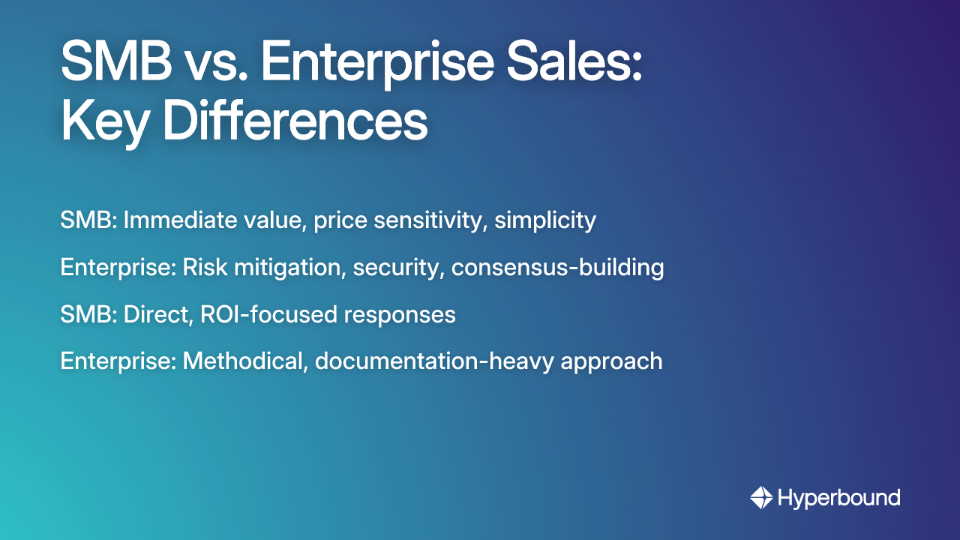
Mastering sales requires speaking two different languages:
For SMBs, it's the language of immediate value, price sensitivity, and simplicity. Your responses should be direct, ROI-focused, and emphasize quick implementation.
For Enterprise, it's the language of long-term risk mitigation, security, and consensus-building. Your approach should be methodical, documentation-heavy, and focused on alignment across stakeholders.
The confidence to handle any objection, in any market, isn't born—it's built through deliberate, realistic practice. By understanding the fundamental differences between SMB and enterprise objections, preparing segment-specific responses, and leveraging tools like Hyperbound to practice consistently, your team can transform objections from sources of anxiety into opportunities to demonstrate value and expertise.
Remember: an objection isn't a rejection—it's an invitation to provide more certainty. And with the right preparation, you'll be ready to provide that certainty, regardless of who's sitting across the table.
Frequently Asked Questions
What is the most common sales objection?
The most common sales objection is related to price, often phrased as "It's too expensive." This is particularly true for small and medium-sized businesses (SMBs) with tight budgets. However, price objections can sometimes mask other underlying concerns. The best approach is to first isolate the objection by asking if the solution would be a good fit if price weren't an issue, and then pivot the conversation to the value and return on investment (ROI) your product provides.
Why is it important to handle SMB and enterprise objections differently?
It's crucial to handle SMB and enterprise objections differently because they operate on different timelines, priorities, and scales of risk. SMBs focus on immediate needs, quick ROI, and simplicity, so their objections are often about price and ease of use. Enterprises, on the other hand, are concerned with long-term risk mitigation, security, integration with existing systems, and getting consensus from multiple stakeholders. A one-size-fits-all approach will fail because it doesn't address the core concerns of each segment.
How can I tell if a sales objection is real or just a smokescreen?
You can differentiate between a real objection and a smokescreen by identifying if it's a logical reason for disagreeing or an emotional, knee-jerk reaction. A smokescreen, or "complaint," is often a vague dismissal like "I'm not interested." A "true objection" is more specific and logical, such as "Our budget for this quarter is already maxed out." To get past a smokescreen, use probing questions to uncover the real issue behind the initial dismissal.
What is the best way to handle price objections from SMBs?
The best way to handle price objections from SMBs is to pivot the conversation from cost to value and return on investment (ROI). First, confirm that price is the only obstacle. Then, quantify the value your solution provides in terms of time saved or productivity gained. For example, you can frame it as, "Our tool could save you X hours per week, which translates to $Y in productivity gains." Offering flexible options like tiered pricing or payment plans can also show that you understand their financial constraints.
How should I respond when an enterprise prospect says they need to talk to their team?
When an enterprise prospect says they need to discuss it with their team, you should embrace it as an opportunity to engage more stakeholders directly. This objection is common in enterprise sales where decisions are made by committee. Respond by asking who else will be involved in the evaluation and offer to present the solution's benefits tailored to each person's role. You should also equip your primary contact (your "champion") with materials like ROI one-pagers or security briefs to help them make the case internally.
What is the universal framework for handling any sales objection?
The universal four-step framework for handling any sales objection is: Listen, Validate, Ask, and Respond. First, listen fully to the prospect's concern without interrupting. Second, validate their concern to show you understand and build trust. Third, ask probing questions to uncover the root cause of the objection. Finally, respond thoughtfully with relevant information that directly addresses their true concern.
How can AI help sales teams improve their objection handling skills?
AI can help sales teams improve objection handling by providing a safe, scalable environment for realistic practice and offering instant, objective feedback. Tools like AI-powered sales roleplays allow reps to practice responding to specific objections from different buyer personas (like an SMB founder or an enterprise IT director) without risking live deals. AI can also score real calls and provide coaching, helping reps identify weaknesses, track improvement, and build the confidence needed to handle any conversation.
.png)
Book a demo with Hyperbound


