

.png)
Summary
- The cyclical nature of the oil and gas industry makes rapid sales onboarding essential, yet traditional training methods often fail to prepare reps for highly technical buyers.
- An effective O&G training program stacks multiple solutions: market knowledge courses for credibility, relationship workshops for strategy, and an AI platform for practical execution.
- Close the "practice gap" between theory and real-world performance by giving reps a safe, on-demand environment to practice complex conversations and handle objections.
- With Hyperbound's AI Sales Roleplays, teams can ramp 50% faster by practicing with AI buyer personas that mirror the specific challenges of O&G sales.
You've just landed a sales role at an oilfield services company. The onboarding packet is thick, your territory is enormous, and your manager drops a line you'll hear a dozen times in your first month: "This industry runs on relationships." Meanwhile, somewhere in the back of your mind, you're already thinking about cyclical fluctuations — the booms and busts that make oil and gas sales feel like a career on a tightrope. New reps often feel like the most expendable on the team the moment prices dip. The pressure to ramp fast, hit quota, and prove your worth before the next downturn is relentless.
In this environment, oil and gas sales training isn't a nice-to-have. It's a survival tool. But not all training is created equal — and if you're a sales leader trying to build a resilient, high-performing team across upstream, midstream, and downstream segments, you're likely staring at three very different categories of training options:
- AI-native practice platforms — represented by Hyperbound, these platforms close the "practice gap" by enabling reps to run realistic, repeatable sales conversation simulations against AI buyer personas trained on millions of real B2B calls.
- Live workshop programs — exemplified by Game Face Inc. and OFS Portal, these are the traditional, in-person programs focused on relationship dynamics, client meetings, and trust-building across the O&G supply chain.
- Commodity and trading-focused courses — led by providers like Poten & Partners and PetroKnowledge, these are deep-dive industry knowledge programs that build market credibility, especially in LNG and natural gas sectors.
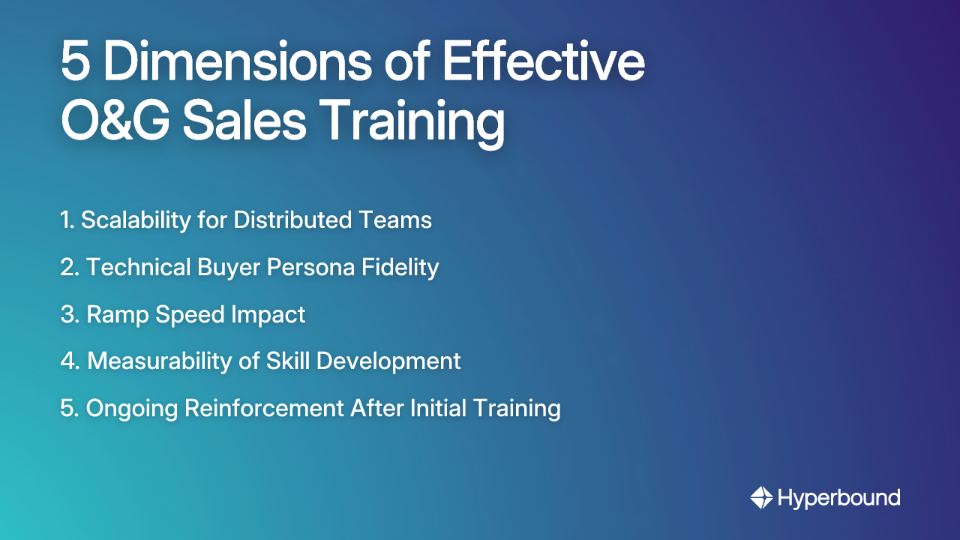
Each category has genuine merit. Each also has real structural limits. This article compares all three honestly across five dimensions critical to modern, distributed O&G sales teams: scalability, technical buyer persona fidelity, ramp speed impact, measurability of skill development, and ongoing reinforcement — so you can build a training stack that actually moves the needle.
A Closer Look at the Contenders
Hyperbound: The AI Practice & Performance Platform
Hyperbound is the Revenue Activation Platform — a category it coined to describe what happens when teams stop just analyzing call data and start using it to change outcomes. The core product for oil and gas sales training purposes is Hyperbound Practice: AI roleplays where reps practice cold calls, discovery conversations, objection handling, and demos against AI buyer personas built from 2M+ hours of real B2B sales conversations.
That last detail matters. These aren't generic scripts. The AI buyers push back like real buyers do — with the specific objections, skepticism, and jargon that technical buyers in industrial sectors actually use. Reps get instant, objective feedback after every session via AI Scorecards, flagging talk ratios, methodology adherence, and specific missed moments.
The result: a continuous improvement loop where practice sessions translate directly into performance on live calls.
Game Face Inc.: The Relationship Builders
Game Face has built its reputation around one central truth: oil and gas is a relationship business. Their training programs are designed to navigate the full complexity of the O&G supply chain — from upstream exploration and production, to midstream transport and storage, to downstream refining and distribution, and into product development and services.
Their methodology is rooted in mastering the face-to-face dynamics that define enterprise deals in this sector: listening deeply to clients, building trust over time, and negotiating outcomes where both sides walk away satisfied. They've worked with companies like ESCO Corporation, helping dealer networks articulate product superiority against larger, better-funded competitors. For teams that need to build or strengthen the human side of selling — the long lunches, the plant walk-throughs, the multi-stakeholder relationship maps — Game Face delivers real value.
The honest limitation: Game Face's model is fundamentally event-based and in-person. That has a ceiling.
Poten & Partners: The Market Experts
If Game Face teaches you how to sell, Poten & Partners teaches you what you're selling — and why it matters in a global energy market. Their flagship LNG and Natural Gas Business Training program draws on over 1,000 years of combined industry experience from their advisory team, offering a level of market depth that's hard to replicate anywhere else.
Their courses cover LNG fundamentals, trading dynamics, and market mechanics — often including live trading simulations developed in partnership with TwoTwoFive. For reps selling into the LNG value chain, walking into a client meeting with this depth of commercial knowledge is a genuine differentiator.
But again — Poten teaches the what. It doesn't train the how. Knowing the fundamentals of LNG cargo economics won't help a rep recover in real time when a procurement director challenges their pricing model mid-discovery call.
Head-to-Head: 5 Dimensions of Effective Oil and Gas Sales Training
1. Scalability for Distributed Teams
Hyperbound: Natively scalable. An AI roleplay runs for 10 reps or 10,000 with the same fidelity. Reps in any timezone can run a pre-call warm-up or practice a specific objection scenario from their laptop — no travel budget required. LMS/CMS integrations mean enablement teams can embed practice directly into existing onboarding tracks in platforms like Workday, eliminating the "training lives in a separate silo" problem that plagues distributed teams.
Game Face: High-impact for those in the room. But try delivering consistent, high-quality training to a team split between Houston, Aberdeen, and Perth. The logistics alone make frequent delivery cost-prohibitive. A workshop that works brilliantly for 20 people in a conference room doesn't scale to a field sales force of 200.
Poten & Partners: More scalable than in-person workshops — many courses can be delivered virtually. But it's still event-based learning, not an on-demand practice resource. It scales knowledge transfer, not skill application.
2. Technical Buyer Persona Fidelity
The buyers in oil and gas sales are not generic. A drilling engineer evaluating downhole tools thinks differently from a midstream procurement director negotiating a pipeline services contract. Getting the persona fidelity right in training is the difference between reps who can articulate value under pressure and reps who crumble the moment a technical buyer goes off-script.
Hyperbound: Built for this exact problem. Because the AI is trained on millions of real B2B sales calls, it can simulate specific buyer personas — their vocabulary, their priorities, their common deflections — with a level of fidelity that peers in a conference room simply can't match. Reps can run a discovery call against an AI Upstream Operations Manager who pushes back on implementation timelines, or use Multiparty Roleplays to practice navigating a simultaneous conversation with a technical champion and an economic buyer — the exact dynamic that closes (or kills) enterprise deals in this sector.
Game Face: Excellent for practicing general-purpose relationship dynamics with a human counterpart in the room. But as sales professionals consistently note, "role-playing sessions are often ineffective due to unqualified participants" and the scenarios "never feel real, even when they're customized for our industry." Peer role-plays routinely produce the same closed-off, unchallenging partner who gives vague feedback after the fact. You can't replicate a drilling engineer's objections with a colleague who's never met one.
Poten & Partners: Builds deep knowledge about the buyer's world. That context is valuable. It does not, however, simulate a conversation with that buyer. There's no mechanism for a rep to practice recovering when a counterpart challenges their commercial model in real time.
3. Ramp Speed Impact
New O&G sales reps are operating under a very specific kind of pressure. As one industry thread put it candidly, "you're the new guy and therefore the most expendable." With performance bonuses tied to quota attainment, a slow ramp doesn't just affect pipeline — it affects livelihoods. Every month of learning-by-doing on live calls is a month of lost revenue and damaged relationships with actual buyers.
Hyperbound: Gives reps a safe environment to fail and iterate before the stakes are real. The published results speak directly to this: Hyperbound delivers 50% faster ramp and 2x faster time to first won deal. For a new hire trying to prove themselves before the next market dip, those numbers aren't abstract — they're the difference between building confidence fast or grinding through months of expensive trial and error on live buyers.
Game Face & Poten: Both address foundational knowledge and skills — but neither closes the learning-doing gap fast. New hires absorb frameworks and market context, then go execute on live calls where real mistakes cost real money. The classic training paradox: you only truly learn by doing, but doing it wrong has consequences.
4. Measurability of Skill Development
Sales leaders in oil and gas are data-driven. They track rig counts, price forecasts, and win rates. Yet when it comes to training, most programs offer almost nothing quantifiable. You run a workshop, you get a post-event survey, and three weeks later you're left guessing whether anything actually stuck.
Hyperbound: Every practice session is scored and documented. AI Scorecards track talk-to-listen ratios, methodology adherence, key selling moments, and specific skill gaps — after every roleplay, automatically. A sales enablement leader can look at a team-wide dashboard, see that new hires are consistently struggling with pricing objection handling, and deploy a targeted Bitesized Roleplay focused on exactly that gap — without scheduling a single workshop or waiting for a quarterly training cycle.
Game Face & Poten: Feedback is qualitative, episodic, and subjective. A facilitator's impressions after a workshop session — however experienced — don't give a sales leader insight into whether Rep A is improving her discovery questioning or whether Rep B's pricing objection handling has gotten better over the past six weeks. As reps themselves have noted, "most of the feedback given is vague and unhelpful."
5. Ongoing Reinforcement After Initial Training
The forgetting curve is ruthless. Research consistently shows that without reinforcement, people forget up to 70% of new information within 24 hours of learning it. A one-off workshop or a week-long course is a point-in-time intervention. Skills atrophy. Market conditions change. New competitors emerge. What worked eighteen months ago in a high-price environment needs to be re-calibrated for a contractionary market.
Hyperbound: Practice isn't an event — it's a daily workflow embedded into how reps prepare. A rep can run a five-minute AI roleplay as a pre-call warm-up right before a high-stakes meeting. And crucially, Hyperbound closes the loop between practice and real-world performance: Hyperbound Perform scores 100% of real customer calls, surfaces where deals are at risk, and identifies the specific skill gaps driving those risks. Then Kota Activate — Hyperbound's AI orchestration layer — recommends targeted Hyperbound Practice roleplays to address those exact gaps. The result is a continuous improvement cycle: practice → real calls → scoring → gap identification → practice again. Not one annual workshop. Not a certification that expires. A living system.
Game Face & Poten: Both deliver tremendous value in their initial delivery windows. Neither is structured for the daily, habitual reinforcement that turns a skill learned in a training room into a durable professional capability. They're events, not systems.
The Smart Stack: Complementary, Not Competitive
Here's the honest truth: traditional training programs like those from Game Face and Poten & Partners are genuinely good. Game Face excels at building team cohesion and relationship strategy. Poten & Partners is indispensable for market knowledge.
But the gap they can't close is the practice gap — the distance between knowing what to do and being able to execute it fluently under pressure, against a skeptical technical buyer, at 2pm on a Tuesday when no trainer is in the room.
That's the gap Hyperbound is built to close.
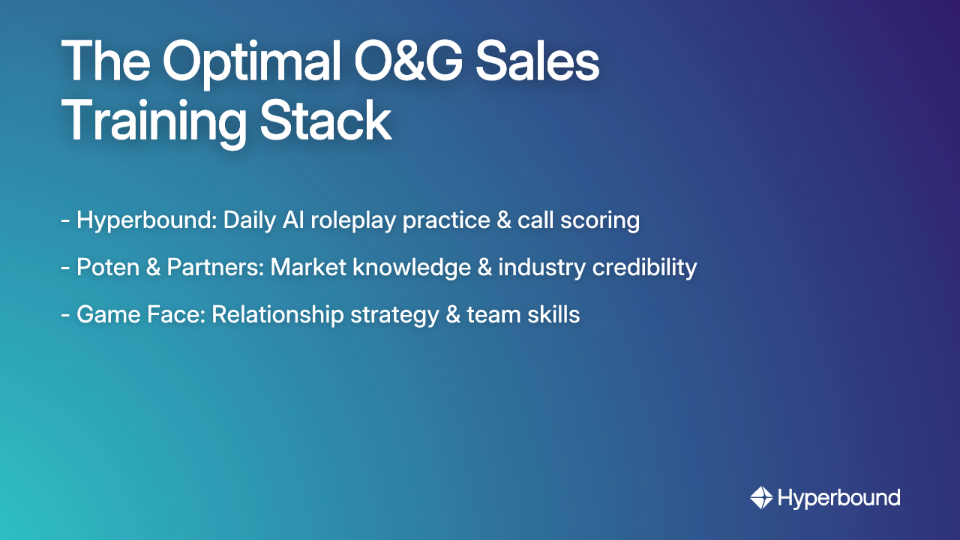
The optimal approach for sales leaders in oil and gas isn't a competition between these categories — it's a deliberate stack with a practice platform at its core:
- Hyperbound embedded in the daily workflow to ensure your reps can actually execute the knowledge and strategies they've learned when it counts.
- Poten & Partners for market knowledge and industry credibility.
- Game Face for relationship strategy and team-level skills development.
Each layer does something the others can't. Together, they address the full development arc from industry understanding, to relationship strategy, to conversational fluency under real pressure.
Oil and gas sales is too competitive, too cyclical, and too technically demanding to rely on any single training modality. The reps who survive the downturns aren't just the ones who attended the best workshops — they're the ones who put in the reps, refined their conversations, and built the muscle memory to handle whatever a procurement director or drilling superintendent throws at them.
Frequently Asked Questions
What is the best sales training for the oil and gas industry?
The best approach is a blended "smart stack" that combines different training types. This includes AI-native practice platforms like Hyperbound for daily skill reinforcement, market-focused courses from providers like Poten & Partners for industry credibility, and in-person workshops from experts like Game Face Inc. for relationship strategy. This combination addresses knowledge, strategy, and practical application.
Why is O&G sales training so unique?
O&G sales training is unique due to the industry's cyclical nature, the importance of long-term relationships, and the highly technical nature of buyers. Sales teams must navigate boom-and-bust cycles, build deep trust with stakeholders like drilling engineers and procurement directors, and master complex product knowledge. Effective training must be scalable for distributed teams and provide realistic practice for these specific challenges.
How can AI sales training improve conversations with technical buyers?
AI sales training improves conversations by providing realistic, repeatable practice against AI buyer personas. These personas are trained on real B2B sales data and can simulate the specific jargon, objections, and priorities of technical buyers (e.g., an upstream operations manager). This allows reps to build conversational muscle memory and refine their messaging before engaging with actual clients.
What is the "practice gap" and how does it affect O&G sales teams?
The "practice gap" is the difference between knowing sales theory and being able to apply it effectively under pressure. In O&G, this gap is significant because reps often learn by making mistakes on live calls, which can damage client relationships and lose revenue. AI practice platforms close this gap by giving reps a safe, on-demand environment to fail, iterate, and master their skills before a real conversation.
How can sales leaders measure the effectiveness of their training programs?
Sales leaders can measure training effectiveness using platforms that provide quantifiable data. AI-powered training tools like Hyperbound offer AI Scorecards for every practice session, tracking metrics like talk-to-listen ratios, methodology adherence, and skill improvements over time. This data provides objective insights into team-wide skill gaps and individual progress, moving beyond the subjective feedback of traditional workshops.
Can AI training replace traditional sales workshops?
AI training is not designed to replace traditional workshops but to complement them. While workshops are excellent for team cohesion and high-level strategy, AI practice platforms provide the daily, scalable reinforcement needed to turn those strategies into durable skills. The ideal model uses workshops for foundational learning and AI for continuous, measurable practice.
How does AI roleplaying help new sales reps ramp up faster?
AI roleplaying accelerates ramp time by giving new reps unlimited opportunities to practice challenging sales scenarios without risking live deals. This constant practice helps them quickly master product messaging, handle common objections, and build the confidence needed to hit quota sooner. Companies using this approach have seen up to a 50% faster ramp time and 2x faster time to the first won deal.
Book a demo with Hyperbound


