

.png)
Summary
- Without reinforcement, reps forget up to 90% of what they learn from one-time training programs, meaning the initial investment quickly loses its value.
- Certification programs like Medical Sales College are effective for initial credentialing but lack the ongoing practice needed to ensure skills are retained and applied on real calls.
- The most effective training strategy is a layered approach: use certification for foundational knowledge and an AI platform for continuous practice and performance measurement.
- AI-powered sales coaching platforms like Hyperbound protect your training investment by providing reps with unlimited practice to combat skill fade and measurably improve performance.
If you're a sales manager or L&D leader evaluating how to invest your training budget for a medical device team, you've probably already Googled both Medical Sales College and UNC Charlotte's certificate program. You've likely also stumbled onto the Reddit threads where the opinions are... not exactly glowing.
"It's a scam and a waste of money." One commenter put it bluntly: "I wish I thought of the idea first to get people to pay thousands of dollars for a fake piece of paper." Others countered: "Big Ortho loves Medical Sales College," and some companies even pay tuition themselves. The reality, as usual, sits somewhere in the middle — and it depends entirely on what problem you're trying to solve.
This guide cuts through the noise. We'll compare three distinct approaches to medical device sales training programs across the three factors that actually determine ROI for a sales organization:
.png)
- Initial Certification and Credentialing — getting reps to a baseline that earns interviews and entry-level trust
- Ongoing Skill Reinforcement and Retention — ensuring what was learned doesn't evaporate within weeks
- Measurable Behavior Change on Real Calls — proof that training is actually changing how reps sell
Spoiler: MSC and UNC Charlotte are strong answers to problem #1. But they have no mechanism for problems #2 or #3. That's where the third option comes in.
Factor 1: Initial Certification and Credentialing
Medical Sales College (MSC)
MSC is the most well-known specialist bootcamp in the space. The flagship TotalOrtho program runs 10 weeks — nine online, one in-person — and covers Foundations of Orthopaedics, Trauma, Spine, and Extremities, including hands-on "Saw Bones" cadaver sessions. Cost: $14,495.
According to MSC's own placement statistics, the program boasts an 82% job placement rate and claims graduates earn an average entry compensation of $95,057. They connect students with a network of 2,100+ employers.
The community feedback tells a more textured story. Experienced B2B reps often don't need it — "You do not need MSC if you have B2B experience" is a recurring refrain. But for career-switchers and recent grads trying to break into a highly competitive field where "everyone is trying to get into a limited pool of jobs," MSC delivers one thing reliably: a credential that signals technical commitment to device-specific hiring managers, especially in Big Ortho.
Verdict: Strong for entry-level credentialing. Worth it for the right candidate profile. Limited value if you already have strong B2B sales experience.
UNC Charlotte — Medical Device Sales Professional Certificate
The UNC Charlotte program, run in partnership with the Medical Sales Institute (MSI), is a 10-week program offered both in-person (with VR training) and online. Cost: $19,495 in-person / $14,495 online.
The curriculum mirrors MSC's focus: anatomy, sales fundamentals, and industry networking. MSI reports the same 82% job placement rate with comparable compensation outcomes for 0–2 year professionals.
Where UNC Charlotte differentiates is the university brand equity — for candidates targeting employers who filter by institutional credibility, the Charlotte name carries weight. The VR component also offers a more immersive simulation element than MSC's classroom approach.
Verdict: Functionally similar to MSC for the credentialing outcome. The university affiliation adds legitimacy for candidates concerned about how the credential reads to skeptical hiring managers.
AI Roleplay Training (Hyperbound)
Worth stating clearly: Hyperbound is not a certification program. It doesn't grant credentials, doesn't cover anatomy, and doesn't help a career-switcher land their first device rep interview.
For initial certification, this is not the tool. Its value comes at a different — and often more financially significant — stage of the rep development journey.
Factor 2: Ongoing Skill Reinforcement and Retention
This is where the budget conversation gets uncomfortable for traditional programs.
Hermann Ebbinghaus's Forgetting Curve has been validated repeatedly: without structured reinforcement, learners forget up to 90% of new information within weeks. Some studies show that 77% of new skills are forgotten within just six days. Compounding the problem, only 44% of companies formally follow up sales training with any reinforcement at all.
For a $14,495–$19,495 one-time program, those numbers should give any L&D leader pause.
MSC and UNC Charlotte are both point-in-time events. The curriculum ends, the cohort disperses, and there is no built-in mechanism to ensure that what was learned in week three of the online modules is still being applied on a sales call six months into a rep's first territory. As one Reddit commenter put it, "don't expect to apply anything you learned in class to your day to day wherever you land."
This isn't a knock specifically on these programs — it's a structural limitation of any certification-style training. The knowledge dump is real. The retention mechanism is absent.
The Third Option: Continuous Practice with Hyperbound Practice
This is the gap Hyperbound Practice is purpose-built to fill. Rather than replacing the foundational certification, it acts as the continuous reinforcement layer that makes the $15k investment actually stick.
Here's how it works in practice for a medical device sales team:
- Unlimited realistic scenario practice: Reps can run cold calls, discovery conversations, objection handles, and multi-party roleplays with AI buyer personas built from analysis of 2M+ hours of real B2B sales conversations — not generic scripts. In a medical device context, this means practicing the exact conversations they'll face with surgeons, procurement teams, and hospital administrators.
- Bitesized Roleplays: L&D leaders can assign short, targeted practice sessions to reinforce specific skills — handling a pricing objection, navigating a competitor comparison, or opening a cold call to a clinical director — on an ongoing cadence long after initial certification ends.
- Instant AI Scorecards and Coaching: After every simulation, reps receive objective feedback on talk ratios, methodology adherence, and specific missed moments. This provides scalable coaching without requiring a manager to sit in on every practice session.
The result is that the anatomy knowledge and orthopaedics vocabulary a rep picked up in their MSC Saw Bones week gets paired with actual selling proficiency — and that proficiency gets reinforced continuously rather than left to fade.
Verdict: AI roleplay is the only option of the three that provides a scalable, ongoing mechanism to combat the Forgetting Curve. It doesn't replace certification; it protects the investment.
Factor 3: Measurable Behavior Change on Real Calls
This is the ultimate ROI question, and it's where traditional medical sales training programs have their most significant blind spot.
MSC and UNC Charlotte measure program success by job placement rates. That's a meaningful metric for candidates evaluating whether to enroll — but it tells a sales organization nothing about what happens after a rep lands the job. Did the training change how they handle a surgeon's objection to a new implant system? Did it improve their discovery process when navigating a complex hospital account? There's no visibility, no measurement, and no feedback loop.
Closing the Loop: From Certification to Revenue Activation
The most effective medical device sales organizations don't treat training as a one-time event followed by hope. They build a closed-loop system where practice connects directly to performance on real calls.
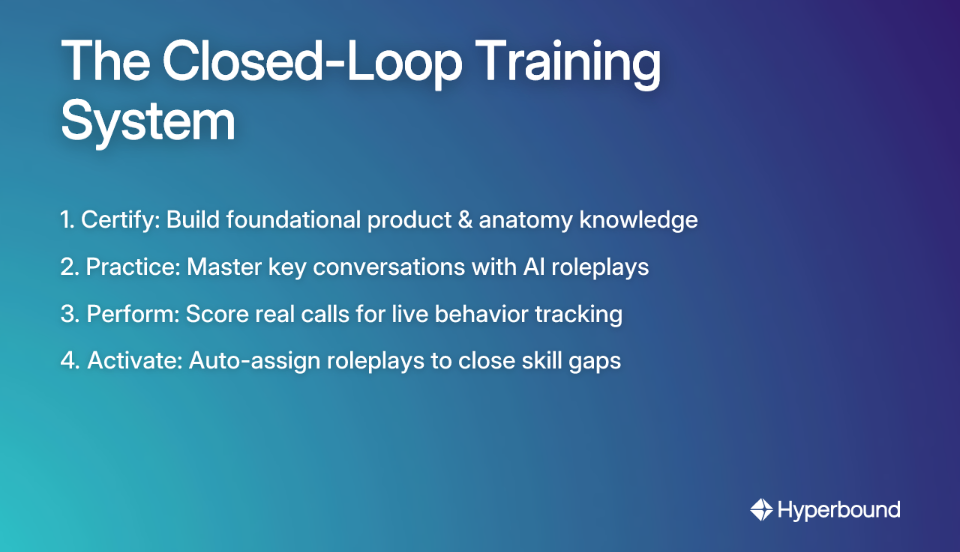
Here's what that loop looks like when Hyperbound is layered into a training stack:
- Certify: A new rep completes MSC or UNC's program (or an internal onboarding curriculum) to gain foundational product and anatomy knowledge.
- Practice: They reinforce and master sales conversations — cold call openers, clinical value articulation, objection handles — in a safe, repeatable environment using Hyperbound Practice AI roleplays.
- Perform: Hyperbound Perform deploys AI scorecards on real customer calls, measuring whether the rep is actually applying trained behaviors in live conversations. This isn't about monitoring — it's about identifying where deals are at risk and what specific skill gap is causing it.
- Activate: Kota, Hyperbound's AI Revenue Analyst, connects the dots between real call performance and practice gaps, automatically recommending targeted roleplays to close the specific skills a rep is missing in live conversations.
This operational loop — Score Real Calls → Identify Skill Gaps → Practice Roleplays → Score Real Calls — is what transforms training from a sunk cost into a measurable revenue driver.
The results from teams running this system speak directly to the problem medical device sales leaders care about most. Vanta reduced ramp time by 60% (from 210 days to 72 days) and grew pipeline 5x. Customers across industries have reported 50% faster ramp times, 150% increases in DM-to-demo conversion rates, and 2x faster time to first won deal.
These aren't outcomes that certification programs alone can produce — they require a continuous practice and measurement layer that connects training to behavior on real calls.
Verdict: AI-driven platforms are the only option that can objectively measure training's impact on real sales conversations, identify revenue risk tied to skill gaps, and provide proof of ROI that a certification program's placement statistics simply cannot.
The Comparison Table
.png)

Don't Just Certify Your Team — Activate Them
Here's the frame that actually helps: this isn't an either/or decision. Medical Sales College and UNC Charlotte solve a real problem — giving career-switchers and entry-level candidates the foundational knowledge and credential needed to compete for device rep positions. They are a legitimate starting point for the right candidate profile, even if the community skepticism around ROI is fair.
But for a sales organization, the goal isn't getting reps hired. It's getting them to consistent, measurable performance. And that requires more than a certificate.
The most effective medical device sales training programs are stacks, not single events:
- Layer 1 (Foundation): A credentialing program like MSC, UNC Charlotte, or a strong internal onboarding curriculum to establish product knowledge and baseline selling vocabulary.
- Layer 2 (Reinforcement & Performance): A continuous practice and coaching platform like Hyperbound to ensure skills are retained, applied, and their impact on real conversations is measured.
The second layer is what most organizations are missing — and it's what turns a credential into a performance outcome.
If you're building or scaling a medical device sales team and want to see how AI roleplay fits into your training stack, try a free demo of Hyperbound Practice and see exactly how it closes the gap between what your team learned in certification and what they're actually doing on calls.
Frequently Asked Questions
What is the difference between Medical Sales College and an AI tool like Hyperbound?
The primary difference is their purpose. Medical Sales College provides initial certification and credentialing to help new reps enter the industry, while an AI tool like Hyperbound provides ongoing skill reinforcement and performance measurement for existing sales teams. Certification programs focus on foundational knowledge (like anatomy), whereas AI practice platforms focus on retaining and mastering the sales skills needed for long-term success.
Is Medical Sales College worth the money for a sales team?
Medical Sales College can be a worthwhile investment for specific candidates, particularly those without prior B2B sales experience who need a credential to break into a competitive field like orthopedics. For a sales organization, however, its ROI is limited to initial hiring. Without a system for ongoing reinforcement, reps quickly forget new skills, meaning the initial training investment doesn't translate to sustained performance.
Why is ongoing training reinforcement crucial for medical device sales?
Ongoing reinforcement is crucial because of the "Forgetting Curve"—the proven principle that learners forget up to 90% of new information within weeks without structured practice. In the complex medical device market, sales skills like handling clinical objections, articulating value to surgeons, and navigating hospital procurement are perishable. Continuous practice ensures that the initial training investment leads to consistent, high-level performance on real sales calls.
How can I measure the ROI of my sales training program?
The most effective way to measure training ROI is by tracking measurable changes in rep behavior on live sales calls and connecting those changes to key performance metrics like ramp time, conversion rates, and average deal size. While certification programs measure success by job placement rates, AI-powered tools can score real conversations against your sales methodology. This provides a direct line of sight from your training investment to actual revenue outcomes.
Should I use a certification program like MSC or an AI training tool?
This isn't an either/or decision; the most effective sales organizations use both as part of a layered training stack. Use a certification program like MSC or a robust internal onboarding process to build foundational product and industry knowledge. Then, layer in an AI-powered platform like Hyperbound for continuous practice, reinforcement, and performance measurement. This combination turns certified reps into consistent top performers.
How does AI roleplay prepare reps for conversations with surgeons?
AI roleplay prepares reps by allowing them to practice unlimited, realistic sales scenarios with AI buyer personas that mimic real stakeholders like surgeons, procurement officers, and clinical directors. Reps can practice handling tough clinical questions and product objections in a safe environment. After each simulation, they receive instant, objective feedback on their performance, allowing them to refine their messaging and strategy before a high-stakes customer conversation.
Book a demo with Hyperbound


