

.png)
Summary
- The transition from SaaS to medical device sales requires more than strong sales skills; it demands deep knowledge of FDA regulations, clinical vocabulary, and complex hospital buying committees.
- Unlike B2B sales, medical device reps must simultaneously convince surgeons of clinical value, administrators of financial ROI, and procurement of contract compliance.
- Objections in this field are centered on clinical evidence, patient outcomes, and operational impact, moving far beyond typical discussions of price or features.
- To bridge this gap, reps need realistic practice handling multi-stakeholder conversations, which can be developed using AI Sales Roleplays that simulate hospital buying committees.
You've crushed your quota selling SaaS for three years. You know your MEDDIC from your BANT, you can run a discovery call in your sleep, and your pipeline hygiene is immaculate. Now you're eyeing medical device sales — better compensation, more meaningful work, and a chance to sell something that actually changes patient outcomes.
But there's a nagging question you keep running into on Reddit threads and LinkedIn posts: Is my experience transferable? Or do I need to start over with specialized training?
If you've felt the pressure of having to "convince companies of relevant skills" from a different sales background, you're not alone. The perception that prior experience is a barrier to entry is one of the most common frustrations for career-changers looking to break into medical devices.
Here's the honest answer: your B2B or SaaS sales background is genuinely valuable — but it's not sufficient on its own. The gap isn't about selling ability. It's about the environment, the language, the stakeholders, and the stakes.
General sales training teaches you how to sell. Medical device sales training teaches you what you're selling — in environments where mistakes are not recoverable.
This article breaks down the five key dimensions where these two worlds diverge.
1. Regulatory and Compliance Knowledge: The Non-Negotiable Foundation
In SaaS or B2B sales, your compliance training probably covered data privacy, contract terms, and maybe a module on business ethics. That's it.
Medical device sales operates under an entirely different legal reality. The FDA's regulatory framework governs not just what your company can manufacture and sell — it dictates what you, as a sales rep, can say about a product's safety and efficacy.
Here's what that looks like in practice:
- Device Classification matters. Class I devices (like elastic bandages) are relatively low-risk and largely exempt from Premarket Notification. Class II devices (like infusion pumps) typically require a 510(k) submission to prove substantial equivalence to an existing device. Class III devices (like heart valves) require full Premarket Approval (PMA) — a rigorous process backed by extensive clinical evidence. As a rep, you need to know which class your product falls into and what that means for your approved claims.
- Labeling rules are strict. You cannot make off-label claims in promotion. What's on the label and in the IFU (Instructions for Use) is what you're authorized to sell.
- Medical Device Reporting (MDR) obligations are real. If a device may have caused or contributed to a serious patient injury or death, there are legal reporting obligations. Reps who aren't trained on this create liability for themselves and their company.
A general sales rep who exaggerates a feature to close a deal risks losing the account. A medical device rep who overstates a clinical claim risks FDA sanctions, litigation, and patient harm. The compliance floor in this industry is vastly higher — and medical device sales training is built around teaching reps to operate confidently within it.
2. Clinical Vocabulary: Speaking the Language of the OR
In SaaS, you talk about ARR, churn, and time-to-value. In medical device sales, you're discussing anastomotic leaks, resection margins, and contraindications with people who spent a decade in medical school.
The vocabulary gap between general sales and medical device sales is one of the fastest ways to lose credibility. A surgeon evaluating a new surgical tool doesn't have time — or patience — for a rep who stumbles over anatomical terminology or confuses a procedure name. One wrong word signals that you're an outsider, and in a relationship-driven industry, that perception can be fatal to a deal.
As practitioners in the space have noted, "understanding the medical terminology and systems gave me a leg up when talking to prospects." This isn't just about sounding smart — it's about building the kind of clinical credibility that earns you a place in an OR conversation.
Effective medical device sales training immerses reps in anatomical terminology, procedural language, and clinical outcome metrics before they ever walk into a hospital. General sales training covers persuasion frameworks and objection-handling scripts. Both are useful. But only one prepares you to hold your own in a conversation with a cardiothoracic surgeon about device failure modes.
3. Stakeholder Complexity: Selling to a Committee, Not a Customer
General sales training does an excellent job of teaching you to identify a champion and navigate to an economic buyer. In most B2B deals, that's genuinely sufficient.
In a hospital system, that's just the beginning.
Healthcare purchase decisions involve a web of stakeholders with different — often conflicting — priorities:
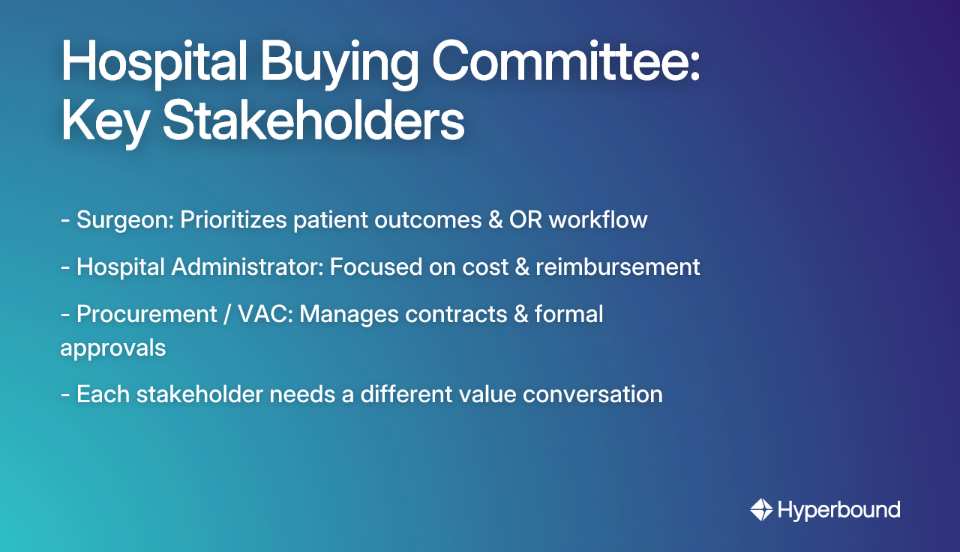
- The Surgeon (Clinical Buyer): Cares first and always about patient outcomes. They want to know your device is safe, effective, and won't add complexity to their OR workflow. They're your clinical champion, but they rarely control the budget.
- The Hospital Administrator (Economic Buyer): Focused on cost-per-procedure, reimbursement alignment, and how your product affects readmission rates and length of stay. A device that a surgeon loves is irrelevant if it blows the department budget.
- Procurement / Value Analysis Committee (VAC): Compares your pricing against GPO contracts, evaluates competitive alternatives, and manages the formal approval process. Getting through procurement often requires an entirely different conversation than the one you had with the surgeon.
In a single sales cycle, you may need to prove clinical superiority to one stakeholder, financial ROI to another, and competitive price positioning to a third — often with each group talking to the others between your visits.
General sales training doesn't prepare you for this level of multi-threaded complexity. Medical device sales training does — but knowing the theory is different from being able to execute it under pressure.
Bridging the Practice Gap: Simulating the Hospital Buying Committee
Understanding the stakeholder map is one thing. Handling a live conversation where a skeptical surgeon and a budget-conscious procurement officer are simultaneously pushing back on you — in the same room — is another.
This is where most training programs fall short. Classroom knowledge and role-play scripts can walk you through the theory, but they rarely replicate the real pressure of navigating competing priorities in a multi-party setting.
Hyperbound Practice is built to close exactly that gap for medical device reps. Its Multiparty Roleplay feature lets reps practice complex, multi-stakeholder conversations with multiple AI buyer personas simultaneously — before they ever sit across from a real buying committee.
The scenario looks like this: you're pitching a new surgical device. One AI persona plays the surgeon — asking pointed questions about clinical trial data, complication rates, and OR workflow impact. Another plays the procurement officer — immediately pushing back on price and asking whether the product is on the GPO contract. You have to manage both threads, address competing concerns, and move the conversation forward without losing either party.
This directly mirrors the hospital Value Analysis Committee dynamic that trips up so many otherwise strong sales reps. These AI personas aren't built from generic scripts — they're trained by analyzing your own team's winning sales conversations, making the practice hyper-realistic and tailored to what works for you. After each session, reps receive instant feedback from AI Scorecards and AI Coaching, surfacing where they lost the room, missed clinical objections, or failed to connect value to the right stakeholder.
For a career-changer building their medical device sales credibility, this kind of repetition in a risk-free environment is exactly what bridges the gap between sales instinct and clinical context.

4. Objection Types: Beyond Price and Features
.png)
In general sales, most objection-handling training prepares you for some version of four core pushbacks: it's too expensive, we're happy with what we have, the timing isn't right, or your competitor is cheaper. These are real objections, and knowing how to navigate them is genuinely useful.
Medical device sales objections operate on a different axis entirely.
Here's what objection-handling actually looks like in this field:
- "What does your long-term clinical data say about device failure rates over five years?"
- "This isn't on our GPO contract, so we'd need to go through a formal value analysis process."
- "Our surgical techs are already stretched thin. What's the realistic learning curve, and how will it affect OR turnover time?"
- "We had a negative experience with a device in this category two years ago. What's different about yours?"
These objections aren't about budget in the abstract — they're about clinical evidence, operational disruption, institutional memory, and compliance workflows. Medical device sales training programs specifically prepare reps to respond with peer-reviewed clinical studies, outcomes data, and implementation support plans — not just ROI calculators.
A general sales rep knows how to overcome price objections. A medical device rep needs to be able to reference comparative clinical literature on the spot. That's a fundamentally different preparation requirement.
5. The Consequences: When a Bad Sales Call Is More than a Lost Deal
This is the dimension that separates medical device sales from virtually every other sales role.
In most sales environments, a bad call has predictable consequences: you lose the deal, your manager is disappointed, and you miss your number for the month. That's real, and it matters — but the damage is financial and correctable.
In medical device sales, a bad call can trigger a chain of events that ends in a courtroom or, worse, in a patient outcome that can't be undone.
Consider what happens when a rep misrepresents a device's indications for use, or fails to adequately communicate contraindications to a surgical team. A clinician makes a procedural decision based on that information. The device is used in a context it wasn't designed for. A patient is harmed. At that point, the rep, the company, and the clinician are all exposed to significant legal liability — and no deal is worth that.
This isn't hypothetical. The FDA's Medical Device Reporting requirements exist precisely because these failures happen, and the regulatory framework is built around preventing them. Reps who aren't trained to understand the boundaries of their approved claims create risk at every customer interaction.
General sales training has no equivalent to this dimension. The stakes simply don't exist in the same way. This is why medical device sales training is structured not just around persuasion and pipeline management — but around product mastery, clinical fluency, and compliance discipline. Getting the sale is important. Getting it in a way that protects patients and keeps you out of legal jeopardy is non-negotiable.
Your Sales Skills Are the Engine. Specialized Training Is the GPS.
Let's bring this back to where you started: wondering whether your B2B or SaaS sales background is enough to make the move into medical devices.
Here's the summary across all five dimensions:
.png)
Your consultative selling skills, your pipeline discipline, your ability to build rapport and run structured discovery — that's your engine, and it's valuable. Companies like BD and Johnson & Johnson have long-standing sales development programs that actively recruit people with strong general sales foundations precisely because those instincts are hard to teach.
But the GPS — the specialized knowledge of the regulatory landscape, the clinical language, the multi-layered buying committee, the evidence-based objection handling, the understanding of what's truly at stake — that has to be built deliberately.
The good news: it's buildable. And you don't have to spend $7,800 on a course to do it. Start by getting foundational healthcare knowledge, study device classification and FDA basics, learn the clinical terminology for your target segment, and invest in realistic practice that puts you in the room with the full complexity of a hospital buying committee before you're actually there.
If you're building toward a role in medical device sales, Hyperbound Practice's Multiparty Roleplay feature gives you one of the most realistic ways to develop that muscle memory — practicing simultaneously against a clinical champion and an economic buyer, getting scored on how well you navigate the tension between their competing priorities.
Don't let the fear of a non-traditional background hold you back. The path into medical device sales is real, and your existing skills are a genuine asset. You just need to pair them with the domain expertise that makes the difference between a rep who sounds promising in an interview — and one who earns credibility in the OR.
Frequently Asked Questions
What is the biggest difference between SaaS sales and medical device sales?
The biggest difference is the consequence of failure and the level of required domain expertise, particularly in regulatory compliance and clinical knowledge. While SaaS sales focus on business value and ROI, medical device sales operate in a high-stakes environment where mistakes can impact patient outcomes and lead to legal liability. This requires a deep understanding of FDA regulations, clinical procedures, and complex stakeholder maps within hospital systems.
How can I learn the clinical vocabulary required for medical device sales?
You can learn the necessary clinical vocabulary by focusing on a specific medical specialty, studying anatomy and procedural language, and immersing yourself in relevant clinical literature. Start by choosing a specialty you're interested in (e.g., orthopedics, cardiology). Use online resources, medical dictionaries, and watch surgical procedure videos. Reading peer-reviewed clinical studies and product IFUs (Instructions for Use) for devices in that category will also rapidly build your clinical fluency.
Do I need a medical or science degree to get into medical device sales?
No, a medical or science degree is not a strict requirement to succeed in medical device sales, but a strong aptitude for learning complex technical and clinical information is essential. Many successful medical device reps come from diverse backgrounds, including B2B sales. Companies value core sales skills and expect you to demonstrate the ability to quickly master the necessary anatomical, procedural, and product-specific knowledge to engage credibly with clinicians.
What are the most important skills from my SaaS sales background that are transferable?
Your most transferable skills are consultative selling, structured discovery, pipeline management, and the ability to build rapport with sophisticated buyers. These foundational sales skills are highly valued because they are difficult to teach. The ability to ask insightful questions and manage a complex sales cycle is your "engine." Medical device companies look for this strong foundation and then provide specialized training on clinical knowledge and the regulatory environment.
Why is selling to a hospital buying committee so complex?
Selling to a hospital buying committee is complex because you must simultaneously address the conflicting priorities of multiple stakeholders, including clinical, economic, and administrative buyers. A surgeon cares most about patient outcomes, a hospital administrator focuses on cost, and the Value Analysis Committee (VAC) is concerned with contracts. A successful rep must navigate these different value propositions where each stakeholder can influence the final decision.
Is it necessary to take an expensive certification course to break into this field?
No, expensive certification courses are not a prerequisite for breaking into medical device sales. Self-directed learning can be a more effective and affordable approach. Focus on understanding FDA basics, learning the terminology for a specific medical segment, and studying the products of companies you want to work for. Demonstrating this initiative and knowledge in an interview is often more valuable than a generic certificate.
What does the FDA have to do with a sales rep's job?
The FDA heavily regulates what a sales representative can say about a medical device's safety, efficacy, and intended use, making compliance a core part of the job. FDA regulations govern device classification, labeling, and promotional claims. As a rep, you cannot make "off-label" claims and have legal obligations related to Medical Device Reporting (MDR) if a device is associated with a serious patient injury. Violating these rules can lead to severe legal consequences for you and your company.
Book a demo with Hyperbound


