

.png)
Summary
- Generic B2B sales training is insufficient for medical device sales, where deep clinical knowledge and procedural awareness are critical for credibility.
- To succeed, reps must master specialty-specific conversations, from handling clinical objections about orthopedic implants to discussing patient outcome data for cardiovascular devices.
- Foundational programs like Medical Sales College provide essential clinical knowledge, helping graduates achieve an 82% job placement rate.
- Reps can master high-stakes conversations and reduce ramp time by 50% using AI-powered tools like Hyperbound's AI Sales Roleplays to practice with realistic surgeon personas.
You've put in the work. You've studied the industry, maybe grinded through a year or two at ADP or Cintas because — as reps in the field will tell you bluntly — "it was what recruiters wanted to see." You've sent cold messages on LinkedIn hoping one of them turns into the connection that cracks open the door.
But here's what no one tells you until you're sitting across from a hiring manager at Stryker, CONMED, or Baxter: generic sales training isn't enough. Not even close.
These companies aren't screening for polished cold-call scripts or SPIN selling frameworks. They're looking for candidates who can walk into an OR with confidence, speak a surgeon's language, handle objections rooted in clinical skepticism, and navigate the high-pressure logistics of case coverage — all in the same breath. The gap between "trained in sales" and "ready for surgical sales" is wider than most aspiring reps realize.
That gap is exactly what the right medical device sales training programs are designed to close. In this article, we'll break down what specialty-specific training actually looks like across orthopedics, cardiovascular, and surgical robotics — and map each to the programs and tools that prepare reps for those specific conversations before day one.
Why Generic Sales Training Is a Dead End in Medical Device Sales
Most B2B sales training teaches you how to prospect, overcome objections, and close. That's fine for selling SaaS. It's table stakes — but dangerously incomplete — for selling an orthopedic implant to a surgeon mid-case.
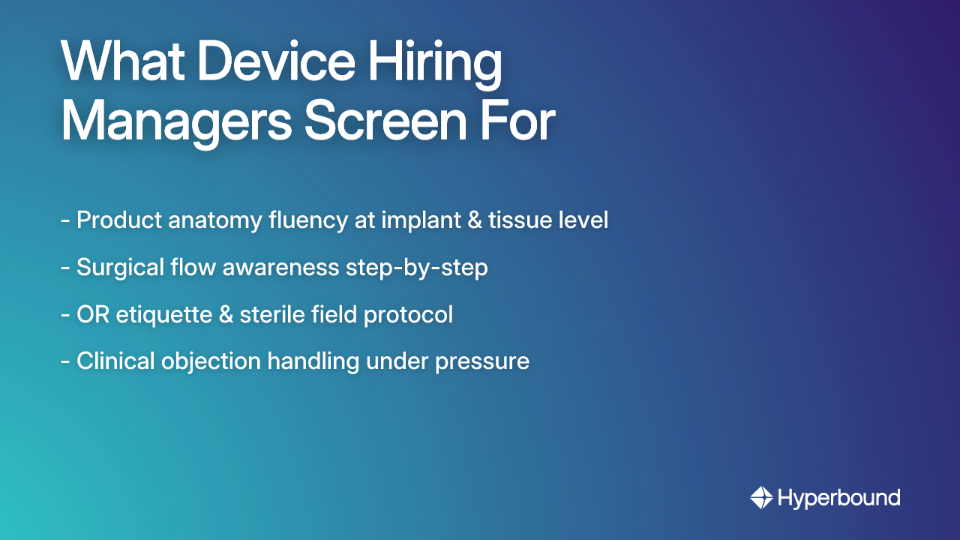
Here's what hiring managers at top-tier medical device firms are actually screening for:
- Product anatomy fluency: Can you explain how this device works at the tissue and implant level — not just from a brochure?
- Surgical flow awareness: Do you know where your product fits in the step-by-step flow of a TKA or THA? Can you anticipate what the scrub tech needs before they ask?
- OR etiquette: Do you understand the sterile field, your role during case coverage, and how not to get in the way?
- Clinical objection handling: Can you hold your ground when a surgeon questions the efficacy of your implant — without defaulting to a canned pitch?
As one rep put it in a widely shared thread on medical device sales, "Most of ownership comes from being in the trenches with the people actually using your products." Generic training can't put you in those trenches. It lacks the critical context of patient anatomy, implant management, and the lived reality of the OR environment.
Mapping Training to Your Specialty
Different specialties demand different knowledge bases. The conversations you'll have selling a robotic surgery system look nothing like those you'll have selling a total knee system or a cardiac stent. Your training needs to reflect that.
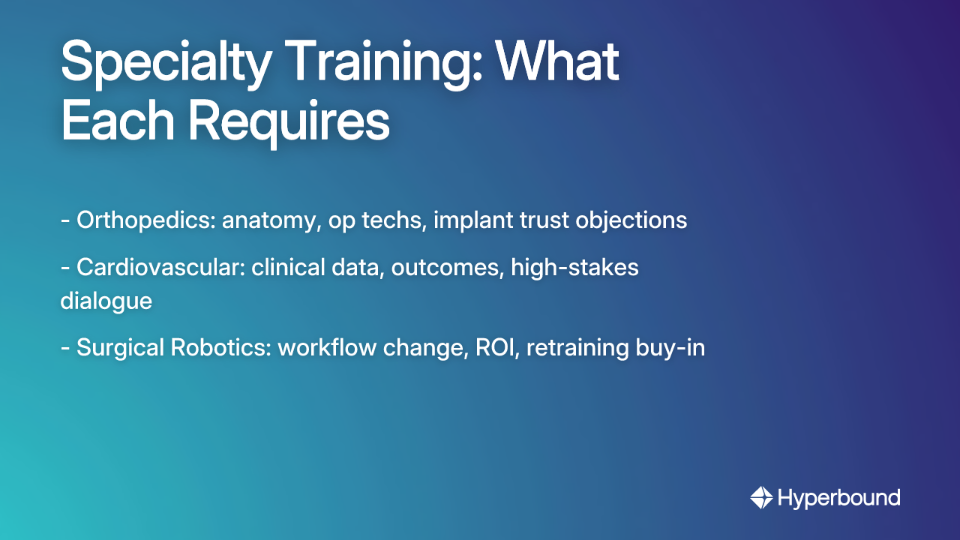
Orthopedics requires deep anatomical knowledge of bones, joints, and connective tissue — plus hands-on familiarity with op techs and technique guides for procedures like TKA, THA, and TSA. Common objections aren't about price first; they're about implant fit, procedural trust, and why a surgeon should switch away from the device they've used for a decade.
Cardiovascular demands understanding of cardiac anatomy and procedure management in life-critical contexts. Reps must be ready to discuss clinical trial data, long-term patient outcomes, and device performance in high-stakes moments alongside cardiologists who will test your knowledge quickly.
Surgical Robotics sits at the intersection of technical depth and change management. You're not just selling a device — you're selling a workflow transformation. Objections often center around surgeon learning curves, OR staff retraining, system integration, and ROI justification to hospital administrators.
Generic medical device sales training programs won't prepare you for any of these conversations specifically. Specialty alignment is everything.
The Top Medical Device Sales Training Programs for Aspiring Reps
1. Hyperbound Practice: AI-Powered Simulation for High-Stakes Clinical Conversations
The single biggest gap in most medical device sales training programs isn't knowledge — it's reps. Specifically, the lack of safe, repeatable practice for the exact conversations that actually decide whether you earn trust in the OR.
Hyperbound Practice is the only platform where reps can simulate a conversation with a skeptical orthopedic surgeon, a hospital value analysis committee, or a procurement officer pushing back on device costs — using AI personas built from real sales call data.
Unlike tools that rely on generic scripts or the broader internet as a training set (a real concern raised by sales reps evaluating AI training tools), Hyperbound's AI buyer personas are trained on 2M+ hours of real B2B sales conversations — meaning the objections feel real because they're drawn from what actually happens in high-stakes sales environments.
For medical device reps specifically, this means:
- Simulating a skeptical orthopedic surgeon who pushes back on why they should adopt your implant over their current preferred device
- Multiparty Roleplays where a surgeon and a procurement officer are both in the room — one focused on clinical outcomes, the other on contract terms
- Discovery call practice with a hospital's value analysis committee, where your job is to justify cost against patient outcomes data
- Objection handling drills tied to specialty-specific scenarios: surgical flow concerns, implant sizing logistics, or learning curves for robotic-assisted systems
After every simulation, AI Scorecards deliver instant, objective feedback — tracking talk ratios, clinical messaging adherence, and pinpointing the moments where your response missed the mark. AI Coaching then provides methodology-aligned guidance so you know exactly what to fix before the next attempt.
The results are measurable. Teams using Hyperbound see 50% faster ramp time, 2x faster time to first won deal, and in Vanta's case, ramp time dropped 60% — from 210 days to just 72. For surgical and orthopedic reps where early credibility can make or break a territory, that speed matters enormously.
Leading medical device teams are using Hyperbound to certify reps on specialty-specific call scenarios before their first OR visit — replacing the expensive, high-risk model of learning on the job with structured, scored, repeatable practice.
2. Medical Sales College: The Industry Benchmark for Foundational Ortho & Surgical Training
If Hyperbound builds the conversational muscle, Medical Sales College (MSC) builds the clinical foundation underneath it. For reps targeting orthopedics or surgical sales specifically, MSC has become the closest thing to an industry standard for pre-entry training.
Their flagship TotalOrtho and TotalOrtho+ programs run 10 weeks and cover ground that no generic sales training program touches:
- Weeks 1–2: Anatomical and directional terminology, clinical research literacy, and the rep's role in the OR
- Weeks 3–8: Specialty deep dives into Trauma, Extremities, Knees, Hips, Shoulders, and Spine — with attention to both surgical flow and implant management
- Week 9: Sales technique, negotiation, and territory planning through a medical lens
- Final Week: In-person hands-on training with saw bones, mock interviews, and sales role-plays
The numbers back the program up: MSC boasts an 82% job placement rate with 5,100+ placed graduates, and over 2,160 hiring managers actively recruit from their network. The average entry-level salary for graduates sits at $95,057 (per the MedReps Salary Survey).
For reps entering the orthobiologics or regenerative medicine space, MSC also offers a dedicated Orthobiologics & Regenerative Medicine program that covers advanced technology intersecting with the surgical process.
The practical benefit: MSC gives you the clinical vocabulary and procedural context to sound credible in the OR. Pair that with Hyperbound's simulation layer, and you're not just knowledgeable — you're practiced.
Your Playbook for Handling Surgeon Objections
.png)
Clinical knowledge gets you in the room. Objection handling keeps you there. Adapted from Jason Baker's framework for surgical sales reps, here are the objections you'll face most often — and how to respond:
- "I'm not interested." → Pivot to a specific patient case where your device demonstrably improved an outcome. Make it concrete and brief.
- "It's too expensive." → Shift the conversation to value. Reduced OR time, lower readmission rates, and improved recovery metrics all translate to cost savings that procurement officers care about.
- "My current device is good enough." → Acknowledge their comfort with their current tool, then introduce a specific, quantifiable advantage: "Our updated instrumentation has been shown to reduce procedural time by 15% in comparable TKA cases."
- "It's too much hassle to set up." → Offer white-glove support: "I'll be present for your first five cases. The surgical flow won't be disrupted — I'll make sure of it."
- "Another company has a better offer." → Don't compete on price. Reinforce clinical differentiation, R&D backing, and the quality of your service and support infrastructure.
- "I can't decide right now." → Simplify the path. Narrow to one or two options that match their primary procedures and offer specific comparison data.
- "It's just not for me." → Present peer evidence: "Several surgeons at [comparable hospital] felt the same way before reviewing the outcome data. Would you be open to a 10-minute look at that study?"
These aren't abstract sales concepts. They're the exact exchanges that happen in pre-op hallways and scrub sink conversations. Every response benefits from practice. Simulating these conversations against an AI that pushes back like a real surgeon is the fastest way to build this muscle memory.

The Bottom Line
Breaking into orthopedic or surgical device sales is genuinely hard. You may need to pay your dues at a Cintas or ADP to build your resume. You'll need to network strategically — because as anyone inside the industry will confirm, knowing someone still matters. And once you land the interview, you'll need to demonstrate clinical credibility that generic B2B experience simply doesn't provide.
The best medical device sales training programs close that gap methodically: Medical Sales College builds the foundational clinical knowledge, and Hyperbound Practice gives you the one thing most reps never get before their first OR visit — hundreds of realistic, scored practice conversations with AI personas that respond the way surgeons, procurement officers, and clinical stakeholders actually do.
The reps who succeed at Stryker, CONMED, and Baxter aren't just trained. They're prepared — for the exact conversations, objections, and clinical scenarios that define the role.
Frequently Asked Questions
What is the best training for medical device sales?
The best medical device sales training combines foundational clinical knowledge with specialty-specific conversational practice. Programs like Medical Sales College are excellent for building the clinical and anatomical foundation required for specialties like orthopedics. To prepare for real-world conversations, AI-powered simulation tools like Hyperbound Practice allow you to rehearse high-stakes dialogues with surgeons and hospital staff in a risk-free environment.
Why isn't generic sales training enough for medical device sales?
Generic sales training is not enough because it lacks the specific clinical, anatomical, and procedural context essential for credibility in a surgical environment. Medical device hiring managers screen for fluency in product anatomy, awareness of surgical workflows, and the ability to handle clinical objections. Standard B2B sales skills like prospecting and closing are table stakes but won't prepare you to discuss an implant's efficacy with a surgeon mid-procedure.
How can I practice for conversations with surgeons?
You can effectively practice for conversations with surgeons using AI-powered role-playing simulators. Platforms like Hyperbound Practice allow you to engage in realistic, simulated conversations with AI personas trained on real sales call data. You can practice handling specific clinical objections, navigating discussions with skeptical surgeons, and justifying value to hospital committees, receiving instant feedback and coaching to improve.
Do I need a clinical background for medical device sales?
No, a clinical background is not strictly required, but you must be able to acquire and demonstrate deep clinical and anatomical knowledge. Many successful reps come from B2B sales backgrounds. However, they succeed by investing in specialty-specific training to understand the procedures, terminology, and OR etiquette. This allows them to build trust and speak the same language as the surgeons and clinical staff they support.
What skills are most important for a medical device sales rep?
The most important skills for a medical device sales rep are clinical fluency, adaptability in high-pressure environments like the OR, and the ability to handle complex, evidence-based objections. Beyond traditional sales skills, you need a deep understanding of anatomy and surgical procedures. You must be able to think on your feet during a case, anticipate the needs of the surgical team, and confidently discuss clinical data and patient outcomes.
How do I handle objections from a surgeon about my product's cost?
When a surgeon objects to cost, shift the conversation from price to overall value and improved patient outcomes. Instead of defending the price tag, frame the discussion around economic benefits that matter to the hospital, such as reduced operating room time, lower patient readmission rates, or faster recovery times. This demonstrates how the device's clinical advantages translate into significant cost savings for the institution.
See how leading medical device teams use Hyperbound to certify reps on specialty-specific call scenarios before their first OR visit. Explore Hyperbound Practice →
Book a demo with Hyperbound


