

.png)
Summary
- Choose the right qualification framework for your team: MEDDIC for straightforward sales cycles, MEDDICC for competitive markets, and MEDDPICC for complex enterprise deals.
- Methodology adoption often fails, with adherence decaying by 40-50% within six months of training due to a lack of consistent reinforcement.
- Ensure your framework sticks by embedding it into daily workflows with continuous practice, not just one-time training events.
- Bridge the gap between theory and execution using AI Sales Roleplays to help reps master your chosen methodology through deliberate practice and automated feedback.
You've been tasked with implementing a sales methodology to improve your team's qualification process and close more deals. After some research, you discover the MEDDIC family of frameworks—but now you're faced with an alphabet soup of options: MEDDIC, MEDDICC, or MEDDPICC.
Which one should you choose? And more importantly, how do you ensure your team actually uses it instead of letting it become another forgotten training manual collecting digital dust?
If you're feeling overwhelmed by technical sales jargon or struggling to identify whether prospects are serious buyers or just "time wasters and tire kickers," you're not alone. Many sales professionals find these frameworks initially confusing but ultimately transformative for their sales process.
In this comprehensive guide, we'll demystify these powerful qualification frameworks, help you select the right one for your business, and provide a practical implementation plan that ensures your team actually uses it consistently in real deals.
Understanding the MEDDIC Family: From Foundation to Enterprise-Ready
Let's break down each framework in simple, jargon-free terms:
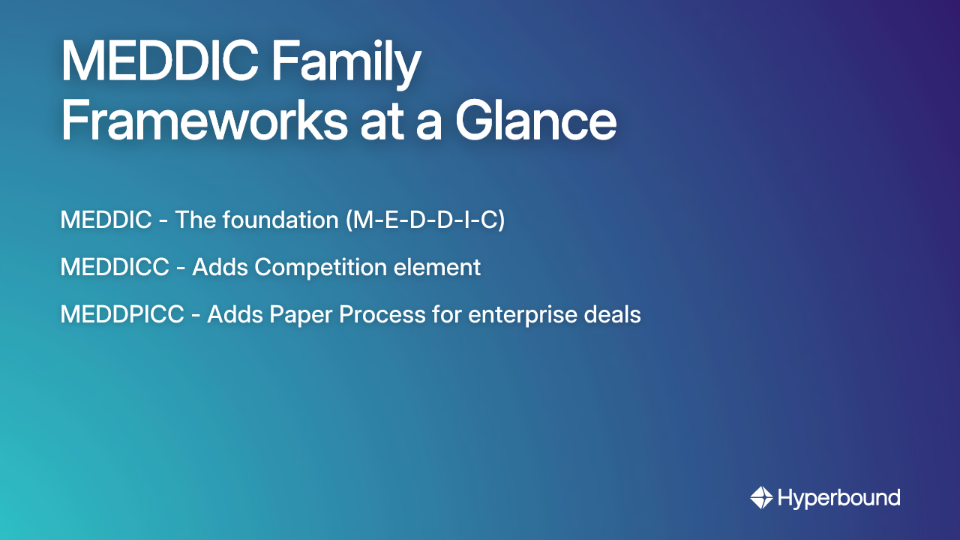
MEDDIC: The Original Blueprint
Developed in the 1990s at Parametric Technology Corporation (PTC) by Dick Dunkel, MEDDIC has become a gold standard for B2B sales qualification. Each letter in the acronym stands for a critical qualification component:
- M (Metrics): The quantifiable economic benefits your solution delivers. These are the specific numbers that justify the purchase—ROI, cost savings, efficiency improvements, revenue growth, etc.
- E (Economic Buyer): The person with ultimate authority to release budget and approve the purchase. This isn't necessarily your day-to-day contact but the executive who signs off on the deal.
- D (Decision Criteria): The formal criteria the prospect's organization uses to evaluate potential solutions. This includes technical requirements, pricing models, support expectations, and other factors they'll use to compare vendors.
- D (Decision Process): The specific steps, timeline, and people involved in making the final buying decision. This maps out exactly how decisions get made in the organization.
- I (Identify Pain): The critical business challenges or pain points that drive the need for your solution. The more urgent and costly the pain, the more motivated they'll be to solve it.
- C (Champion): Your internal advocate who has both influence and a vested interest in your solution succeeding. They'll sell on your behalf when you're not in the room.
MEDDICC: Adding the Competitive Edge
MEDDICC adds one crucial element to the original framework:
- C (Competition): A clear understanding of competitive alternatives the prospect is considering, including doing nothing or building in-house. This forces reps to proactively identify and address competitive threats.
This addition is vital in crowded markets where differentiation is key to winning deals. It ensures your team isn't blindsided by competitors and can position your solution's unique advantages effectively.
MEDDPICC: Mastering Complex Enterprise Deals
MEDDPICC adds one more critical component for enterprise sales:
- P (Paper Process): The procurement and legal process required to finalize the deal after the decision to buy has been made. This covers all administrative and contractual steps needed to get from verbal agreement to signed contract.
Many sales reps mistakenly roll this into "Decision Process," but they are distinct stages. The Paper Process often involves different stakeholders (legal, procurement) and can derail deals even after the buying decision is made.
A Practical Guide to Choosing Your Framework
Your choice between MEDDIC, MEDDICC, and MEDDPICC should align with your specific sales environment and deal complexity. Here's a simple guide to help you decide:
Choose MEDDIC if:
- Your sales cycles are relatively straightforward and short (typically under 3 months)
- You sell to small or mid-sized businesses with simpler decision-making processes
- Your typical deal sizes are under $250K
- You operate in a market with limited direct competition
MEDDIC provides a solid qualification foundation that works well for most B2B sales organizations without overwhelming teams with unnecessary complexity.
Choose MEDDICC if:
- You operate in a highly competitive market where differentiation is critical
- Your sales team frequently faces competitive displacement or "bake-offs"
- You need to consistently reinforce competitive positioning in your sales process
- Deal sizes are typically $250K-$500K, justifying deeper competitive analysis
The additional competition component helps sales reps proactively address competitive threats and position your solution's unique advantages more effectively.
Choose MEDDPICC if:
- You sell complex, high-value enterprise solutions ($500K+)
- Your sales cycles are long (6+ months) and involve multiple stakeholders
- Your deals require extensive legal review, security assessments, and procurement processes
- Getting from verbal "yes" to signed contract is often a lengthy, complex process
The Paper Process component is crucial for navigating the administrative and legal hurdles that could otherwise derail enterprise deals at the finish line.
The Implementation Challenge: Why Frameworks Fail
Here's an uncomfortable truth: most sales methodology implementations fail to deliver lasting results. In fact, without proper reinforcement, adherence to new methodologies can decay by 40-50% within just six months after training.
Why does this happen? Four primary reasons:
.png)
- Lack of Practice: Reps receive training but don't get enough safe, realistic practice to internalize the framework before using it on live deals.
- No Ongoing Coaching: Managers lack time to review every call and provide targeted feedback related to the methodology. Without reinforcement, reps gradually revert to old habits.
- Forgetting Under Pressure: When faced with tough objections or unexpected scenarios, reps often abandon the framework and fall back on comfortable but less effective approaches.
- Admin Burden: Manually updating CRM fields for each MEDDIC component feels like a chore rather than a valuable exercise, leading to poor adoption and incomplete data.
The reality is that one-time training events, no matter how inspiring, rarely create lasting behavior change. The missing link is consistent practice and reinforcement.
The Practice Guide: Mastering MEDDIC with AI Coaching
The bridge from theory to execution is deliberate practice. Modern sales organizations are increasingly turning to AI-powered coaching tools to ensure their chosen methodology sticks and delivers results.
Hyperbound, an advanced AI Sales Coaching platform, offers a solution to the implementation problem by embedding sales frameworks into daily workflows through practice and automated feedback. Here's how you can use AI coaching to master each element of your chosen framework:
1. Practice Uncovering Metrics
Challenge: Reps often struggle to convert vague pain points into quantifiable metrics that justify investment.
Practice Solution: Using AI Sales Roleplays, reps can practice discovery conversations with AI buyer personas to uncover and quantify metrics. They can practice asking powerful questions like:
- "What is the financial impact of this issue today?"
- "If we solved this problem, what efficiency gains would you expect in percentage terms?"
- "How are you measuring success for this initiative?"
Hyperbound's AI scorecard provides instant feedback on whether the rep successfully identified and quantified the metrics, allowing them to refine their approach before real customer conversations.
2. Practice Identifying the Economic Buyer
Challenge: Many deals stall because reps never reach the true economic buyer with budget authority.
Practice Solution: AI roleplays can simulate scenarios where the rep's contact is an influencer, not the economic buyer. This allows reps to practice asking for introductions to power without alienating their contact:
- "Who ultimately approves the budget for this type of initiative?"
- "Who else would need to be involved in the final decision?"
- "How have similar purchasing decisions been made in the past?"
Hyperbound's AI Coaching analyzes these conversations and gives reps immediate feedback on their approach to navigating organizational hierarchy.
3. Practice Validating Champions
Challenge: Many supposed "champions" lack either the influence or motivation to actually advocate for your solution.
Practice Solution: AI roleplays allow reps to practice testing their champion's influence and willingness to advocate:
- "Who else needs to be convinced this is a priority?"
- "Would you be willing to help me prepare for the meeting with the economic buyer?"
- "What objections do you anticipate from others on the team?"
The AI can assess the rep's ability to build a strong alliance and secure concrete next steps from their champion.
4. Practice Navigating Competition and Paper Process
For teams using MEDDICC or MEDDPICC, additional practice scenarios can focus on:
- Handling a prospect who mentions a competitor
- Responding when a prospect says "legal will need to review this"
- Proactively mapping out procurement requirements
Bringing It All Together with Real Deal Analysis
Beyond practice, tools like Hyperbound's AI Real Call Scoring can automatically analyze actual sales calls to ensure the MEDDIC framework is being applied consistently in real deals. This provides:
- Objective scoring of each MEDDIC element on every call
- Identification of missing components that need follow-up
- Coaching recommendations specific to each framework element
- Tracking of methodology adoption across the entire team
Conclusion
Choosing between MEDDIC, MEDDICC, and MEDDPICC depends on your specific sales complexity and competitive landscape, but success ultimately hinges on implementation. A framework is only valuable when it's consistently applied, and consistent application comes from continuous, realistic practice.
By incorporating AI-powered practice and coaching into your MEDDIC sales training, you can ensure that your chosen framework becomes an integral part of your sales process rather than just another acronym your team forgets after training.
Frequently Asked Questions
What is the main difference between MEDDIC, MEDDICC, and MEDDPICC?
The main difference lies in the added letters, which represent additional qualification areas for more complex sales environments. MEDDICC adds 'Competition,' and MEDDPICC adds both 'Competition' and 'Paper Process.' The foundational MEDDIC framework is excellent for most B2B sales, while MEDDICC is crucial for competitive markets, and MEDDPICC is designed for complex enterprise deals with significant legal and procurement hurdles.
How do I know which MEDDIC framework is right for my team?
You should choose your framework based on your typical deal complexity, sales cycle length, and competitive landscape. A good rule of thumb is to use MEDDIC for straightforward sales cycles (under 3 months), MEDDICC if you frequently encounter direct competitors, and MEDDPICC for long, high-value enterprise sales (6+ months) that involve extensive procurement and legal reviews.
Why do MEDDIC implementations often fail?
MEDDIC implementations often fail due to a lack of consistent practice and reinforcement after the initial training. Sales teams receive the theoretical knowledge but don't get enough opportunities to apply it in realistic scenarios. This leads to reps reverting to old habits under pressure, poor CRM adoption, and a failure to internalize the framework's principles.
How can I ensure my sales team actually uses the MEDDIC framework?
The most effective way to ensure adoption is through continuous, deliberate practice and coaching integrated into the team's daily workflow. Modern tools like AI-powered sales roleplays and real-call analysis help reps build muscle memory. This allows them to internalize the framework and apply it consistently, even in high-pressure situations, turning theory into real-world results.
What is an economic buyer in MEDDIC?
The Economic Buyer is the individual with the ultimate authority to approve spending and release the budget for your solution. This person has the final veto power over the purchase and is primarily focused on the financial impact and ROI. It is crucial to identify and engage this person, as they may not be your primary day-to-day contact but are essential for getting the deal signed.
How does a Champion differ from a regular contact?
A Champion is an internal advocate who has both influence within the organization and a personal vested interest in your solution's success, whereas a regular contact may just be an information source. A true Champion will actively sell on your behalf when you are not present, helping you navigate the organization, providing insider information, and advocating for you to the decision-makers.
Ready to ensure your team actually uses your sales framework? Schedule a demo of Hyperbound today to see how AI coaching can transform your methodology adoption and drive better sales results.
Book a demo with Hyperbound


