

.png)
Summary
- Traditional role-play assessment is often subjective and disconnected from business results, making it difficult to prove the ROI of your sales training.
- To make role-plays measurable, define clear goals, use realistic buyer personas, and establish objective winning criteria to track skill development consistently.
- Focus on key performance indicators (KPIs) like score improvement over time and time to competency to connect practice sessions (leading indicators) with business outcomes like win rates (lagging indicators).
- AI-powered platforms like Hyperbound automate this process by providing objective scoring and scalable practice, connecting training effectiveness directly to real-world sales performance.
You invest significant time and resources into role playing for sales training, but can you answer a simple question: Is it actually working?
This is the challenge that haunts sales leaders everywhere. While nearly everyone agrees that role playing is valuable for developing sales skills, most organizations struggle to measure its effectiveness in a way that connects practice scenarios to tangible business outcomes.
"We're overwhelmed by excessive metrics and analysis leading to inaction," admitted one sales director in a recent Reddit discussion about sales KPIs. This sentiment echoes across the industry—leaders want clear data on training effectiveness without overcomplicating the process.
The problem is clear: Traditional role play assessment is subjective, inconsistent, and disconnected from real-world performance. When feedback relies solely on a manager's gut feeling, you're left without concrete data to prove ROI or identify specific skill gaps across your team.
This article provides a framework to move beyond subjective feedback to objective measurement, helping you track the effectiveness of your role playing exercises and connect them directly to improved win rates, shorter sales cycles, and increased revenue.
The Gap in Traditional Role Play Assessment
Before we dive into solutions, let's understand why measuring role play effectiveness has been so challenging:
Subjectivity and Inconsistency
In traditional role playing for sales training, assessment quality varies dramatically based on who's evaluating:
- Manager A might focus on tone and rapport-building
- Manager B emphasizes talk track adherence and objection handling
- Manager C prioritizes discovery question quality and active listening
This inconsistency means reps receive conflicting feedback and organizations lack standardized benchmarks for performance improvement.
Lack of Scalability
Manager-led role plays are inherently time-intensive. It's simply impossible for sales managers to:
- Provide frequent, personalized practice for every rep
- Maintain consistent quality across all evaluations
- Document detailed feedback for tracking improvement over time
- Scale coaching as the team grows
The Forgetting Curve Challenge
Without consistent, repeatable practice and reinforcement, reps forget approximately 70% of what they learn within a week of training. Without measurement, you can't determine if the skills taught are actually being retained and applied.
Disconnect from Business Metrics
Perhaps most critically, traditional role play assessment fails to draw a straight line from practice sessions to actual sales performance. This disconnect makes it nearly impossible to justify the time and resources invested in role playing activities to executive leadership.
A Framework for Creating Measurable Role Plays
Effective measurement starts with designing role plays that have clear, objective criteria. You can't measure what you haven't defined.
Here's a step-by-step approach to crafting role plays built for measurement:
.png)
1. Prepare the Buyer Persona
Create a detailed buyer persona that closely matches your Ideal Customer Profile (ICP). Define:
- Title and industry
- Key pain points and challenges
- Budget considerations and timeline
- Common objections they raise
- Communication preferences and style
2. Set Clear, Measurable Goals
Define the specific objective for the sales rep in concrete terms. Examples include:
- Book a discovery call
- Uncover three specific pain points
- Handle a pricing objection without offering a discount
- Secure a next step with a specific decision-maker
3. Define the Background Scenario
Provide detailed context that mirrors real-world situations:
- Is this a cold call or a follow-up conversation?
- What previous interactions have occurred?
- What information does the prospect already have?
- What stage of the buyer's journey are they in?
4. Establish Winning Criteria
Create a binary (yes/no) scoring system for core competencies. For example:
- Did the rep successfully identify the prospect's primary pain point?
- Did the rep effectively handle the pricing objection?
- Did the rep secure the next step in the sales process?
- Did the rep maintain a talk-to-listen ratio of 40:60 or better?
5. Incorporate Common Objections
Include the top 3-5 objections your team faces in the real world to test their handling skills:
- Pricing concerns
- Competitor mentions
- Timing/urgency issues
- Budget constraints
- Implementation concerns
Key Performance Indicators (KPIs) to Track Role Play Effectiveness
Moving beyond simple "pass/fail" evaluations, here are specific metrics that provide actionable insights into role playing effectiveness:
Foundational Role Play Metrics
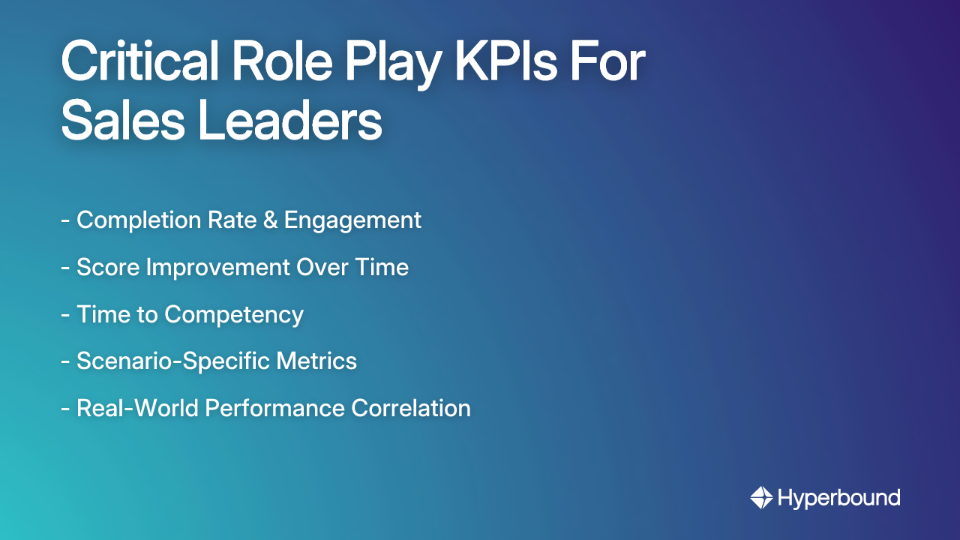
- Completion Rate: What percentage of assigned role plays are reps completing? Low completion rates may indicate issues with engagement or perceived value.
- Average Score Improvement: Track the average score of each rep over a series of similar role plays (e.g., cold call practice) over 30/60/90 days to measure skill development.
- Time to Competency: How many practice sessions does it take for a new hire to consistently achieve a target score on core scenarios? This is critical for measuring onboarding effectiveness.
Scenario-Specific KPIs
Different types of role plays require different measurement approaches:
For Objection Handling Role Plays
- Objection-to-Next-Step Conversion Rate: What percentage of the time does the rep successfully move the call forward after facing an objection?
- Time Before Offering Discount: In negotiation scenarios, how long does the rep hold firm on value before resorting to price cuts?
- Key Message Delivery: Does the rep consistently communicate the critical value propositions when handling objections?
For Discovery Call Role Plays
- Number of Pain Points Uncovered: Did the rep identify the critical business pains defined in your winning criteria?
- Talk-to-Listen Ratio: Is the rep dominating the conversation or letting the prospect speak? Aim for a ratio where the buyer talks more than the seller.
- Quality Question Score: How effective are the rep's questions at uncovering business challenges, goals, and decision processes?
For Competitive Selling Role Plays
- Successful Repositioning Rate: When a competitor is mentioned, what percentage of the time does the rep successfully pivot back to your unique value proposition?
- Competitive Knowledge Accuracy: How accurately does the rep position your solution's differentiators against specific competitors?
Leveraging Technology for Objective Role Play Measurement
As one sales leader noted on Reddit, "Most of this nonsense overcomplicates things." Traditional measurement approaches often create more work than value. This is where technology, specifically AI, transforms the equation.
Hyperbound AI Sales Roleplays
Hyperbound's AI-powered platform solves the core challenges of manual role play assessment by providing:
- Objective, AI-Powered Scorecards: Instead of relying on a manager's subjective opinion, AI scores every role play against a pre-defined, custom methodology. It tracks talk track adherence, keyword usage, talk-to-listen ratios, and other key selling moments automatically.
- Scalable Practice: Reps can practice dozens of scenarios—from cold calls and discovery to handling objections and renewals—on their own time, without requiring a manager's presence. This provides far more "at-bats" than traditional methods.
- Instant, Personalized Feedback: The AI provides immediate, granular feedback after each session, highlighting what the rep did well and where they can improve. This accelerates the learning loop and allows reps to practice continuously without waiting for manager availability.

Automated Call Scoring for Real-World Performance
The ultimate goal is to see if practice translates to reality. This is where tools like Hyperbound's AI Real Call Scoring come in, by:
- Automatically analyzing and scoring actual sales calls using the same scorecard/methodology as the role plays
- Creating a closed-loop system: practice with AI, perform on a real call, get objective scores on both
- Providing data that shows whether skills practiced in role plays are being applied successfully with real prospects
Data-Driven Insights for Managers
With AI-powered measurement, managers are no longer just listeners; they become strategic coaches who can:
- Identify skill gaps across the entire team
- Spot trends in which parts of the sales playbook aren't landing with customers
- Focus their 1:1 coaching time on high-impact areas rather than repetitive call reviews
Connecting the Dots: Tying Role Play KPIs to Business Outcomes
As one sales professional bluntly stated on Reddit, "Renewals, upsells, contracts signed, and revenue should be the end all be all." This section addresses how to connect your role playing metrics directly to these business outcomes.
Creating the Correlation
Step 1: Benchmark Performance
Before implementing a structured role play program, get a baseline of your key business metrics:
- Sales Funnel KPIs: Conversion rate from call-to-meeting, meeting-to-opportunity, opportunity-to-close
- Revenue KPIs: Average deal size, sales cycle length, win rate
- Expansion KPIs: Net Revenue Retention (NRR), upsell/cross-sell rates
Step 2: Track Role Play Improvement
Use a platform like Hyperbound to track the role play KPIs mentioned earlier, particularly focusing on:
- Improvement in scenario-specific scores (e.g., objection handling, discovery effectiveness)
- Consistency in message delivery and value articulation
- Reduction in common mistakes or knowledge gaps
Step 3: Analyze the Impact
After 60-90 days of consistent role playing and tracking, compare the two sets of data to test hypotheses such as:
- "Reps who improved their average discovery call score by 20% in role plays saw a 10% increase in their call-to-meeting conversion rate."
- "The team's overall improvement in handling pricing objections correlates with a 5% increase in average deal margin."
- "New hires who achieved competency in competitive differentiation role plays in under 30 days ramped to full quota 45 days faster than those who took longer."
The Power of Leading vs. Lagging Indicators
Frame your measurement approach as a relationship between:
- Role play scores as leading indicators (predictive of future success)
- Revenue and win rates as lagging indicators (results of past activities)
By improving the leading indicators through targeted role playing, you can reliably influence the lagging indicators that matter most to the business. This creates a compelling narrative for executives who care primarily about bottom-line results.
Conclusion: From Subjective to Objective Role Play Measurement
Effective measurement of role playing for sales training is not just possible—it's essential for building a high-performing sales team in today's competitive environment.
The key takeaways:
- Design for measurement: Create structured role play scenarios with clear goals and objective winning criteria.
- Track specific KPIs: Move beyond simple pass/fail to measure foundational and scenario-specific metrics that correlate with real-world success.
- Leverage AI technology: Implement tools like Hyperbound to provide objective scoring, scale your practice opportunities, and connect training to actual sales performance.
As sales environments become increasingly complex, the ability to systematically measure and improve role playing effectiveness will separate leading organizations from those left behind. With the right framework and tools, you can transform role playing from a subjective exercise into a data-driven engine for sales performance improvement.
Stop guessing if your sales training is working. Start measuring.
Frequently Asked Questions
How can I make my sales role-play exercises more measurable?
You can make role plays more measurable by creating a structured framework with objective, binary (yes/no) winning criteria. This involves preparing detailed buyer personas and realistic scenarios, setting clear goals for the rep (e.g., "book a discovery call"), and defining specific success metrics like successfully handling a key objection or maintaining a target talk-to-listen ratio. Moving away from subjective "gut feelings" to a defined scorecard is the first step toward effective measurement.
What are the most important KPIs to track for role-play effectiveness?
The most important KPIs include completion rates, score improvement over time, time to competency for new hires, and scenario-specific metrics like objection-to-next-step conversion rates. Foundational metrics like completion rates show engagement, while tracking score improvements demonstrates skill development. For specific scenarios, you should measure outcomes like the number of pain points uncovered in a discovery call or the successful repositioning rate when a competitor is mentioned.
Why is it important to measure role-play effectiveness?
Measuring role-play effectiveness is crucial because it connects training activities directly to tangible business outcomes and proves the ROI of your sales coaching efforts. Without objective measurement, role-playing remains a subjective exercise. By tracking specific metrics, you can identify skill gaps across your team, provide targeted coaching, and demonstrate to leadership how improved role-play scores (leading indicators) lead to better win rates and shorter sales cycles (lagging indicators).
How does AI improve sales role-play compared to traditional manager-led sessions?
AI improves sales role-play by providing objective, consistent scoring at scale and offering instant, personalized feedback without requiring a manager's presence. Unlike manager-led sessions, which can be subjective and time-consuming, an AI platform can score every session against a consistent methodology. This allows reps to practice far more frequently, receive immediate feedback to accelerate learning, and frees up managers to focus on strategic coaching rather than repetitive evaluations.
How do I connect role-play performance to real business outcomes like revenue?
You can connect role-play performance to business outcomes by correlating improvements in role-play scores (leading indicators) with changes in your key sales metrics (lagging indicators) over time. First, benchmark your current performance on metrics like conversion rates, average deal size, and win rates. Then, track improvements in role-play KPIs over a 60-90 day period. By analyzing the data, you can prove the direct impact of training on revenue.
How can I get my sales team to engage more with role-playing?
You can increase sales team engagement by making role-playing a valuable, low-pressure learning tool rather than a high-stakes performance evaluation. Using AI for practice allows reps to fail and learn in a safe environment without feeling judged by a manager or peers. When reps see that practice is directly tied to improving their real-world calls and their commission checks, they are far more likely to see it as a valuable tool for their own success.

Book a demo with Hyperbound


