.png)


.png)
We've all been there. You open LinkedIn to find your inbox stuffed with generic pitches from strangers who clearly know nothing about you or your business. Your feed has become a graveyard of unsuccessful, automated, thoughtless sales messages that make you question every connection request you receive.
Here's the uncomfortable truth for sales professionals: sending your monthly quota of 30 InMails isn't going to move the needle. Not even close.
The traditional high-volume, low-touch sales strategy that many SDRs (Sales Development Representatives) rely on is fundamentally broken. When you message a pitch to a prospect, 97% of the time they won't be ready to buy. And when you reach out again later? They still won't be ready—and now they'll remember you as "that sales person who keeps bothering me."
.png)
This article will show you how to transition from being the "weirdo" in someone's DMs to becoming a trusted resource through a quality-focused approach to LinkedIn prospecting. We'll explore how consistent engagement, value-driven content, and relationship building can transform your results.
Why Your High-Volume Strategy is Failing
The "more is more" philosophy has become deeply ingrained in sales culture. But this approach is failing for several critical reasons:
.png)
- SDR Burnout: Churning through too many low-quality leads leads to decreased motivation and burnout over time.
- Brand Damage: Each generic message you send damages both your personal and company brand. Decision-makers talk to each other, and your reputation spreads faster than you might think.
- Diminishing Returns: A LinkedIn Sales Navigator subscription only provides 50 InMails per month. Using them without strategy wastes a limited resource.
- Inefficiency: Increasing the volume of outreach typically leads to a decrease in conversion rates, meaning more work for fewer results.
The data doesn't lie: quality-focused approaches consistently outperform volume-based strategies. One campaign saw a 48% reply rate on LinkedIn versus just 6% with cold emails when using a more personalized approach.
The Pillars of a Quality-First Prospecting Approach
A successful LinkedIn prospecting strategy rests on three essential pillars:
- Building a Professional Brand
- Consistent Value-Driven Engagement
- The Art of the Message
Before diving into these pillars, it's crucial to optimize your LinkedIn profile. This includes using a professional picture, crafting a headline that communicates your value proposition, and detailing relevant experiences that build credibility. Your profile is the foundation of your professional brand—it needs to be solid before you start reaching out.
Let's explore each pillar in detail.
Pillar 1: Build Your Brand Before You Build Your Pipeline
Building a valuable reputation takes time and consistent effort, but it's a non-negotiable component of modern B2B sales. Your professional brand on LinkedIn is what opens doors before you even knock.
Strategic Audience Building
One of the biggest challenges in LinkedIn prospecting is that decision-makers often aren't highly engaged on the platform. The solution? Build a dual-focused audience:
"Build an audience of both the decision-makers as well as the end-users," recommends one successful sales leader. Follow an 80/20 approach: send 80% of your connection requests to end-users (e.g., Marketing Managers) and 20% to decision-makers (e.g., CMOs).
This strategy creates multiple touchpoints within target organizations and leverages the fact that end-users are typically more active on LinkedIn.
Content Creation That Matters
The more relevant your content is, the more engaged your audience will be. But creating valuable content consistently is challenging for many SDRs. Here are actionable tactics that don't require you to be a content marketing expert:
- Interview your CEO or a subject matter expert on industry trends
- Summarize key takeaways from popular industry podcasts or webinars
- Run a simple poll or survey and share the results
- Share case studies with specific, tangible outcomes
Remember, the goal isn't to create viral content—it's to provide value relevant to the industry you serve and position yourself as a thoughtful professional rather than just another salesperson.
Pillar 2: From Passive Follower to Active Engager
Engagement is where most B2B sales professionals fall short. The biggest mistake SDRs make is "they ask for a meeting immediately" instead of building rapport first.
The Daily Workflow
Implement this simple but powerful habit: "Every morning for 10 minutes, check your LinkedIn activity feed and respond to triggers." This consistent practice builds relationships organically over time.
What Are Triggers?
Triggers are opportunities for natural conversation:
- A prospect posts an article or asks a question
- They're promoted or change jobs
- Their company is mentioned in the news
- They comment on someone else's post
Sales Navigator makes tracking these triggers much easier through its home dashboard, but you can also do this manually by regularly checking your prospects' activity.
Meaningful Engagement
Don't just like posts—leave thoughtful comments that add to the conversation. Share their content with your own perspective. Ask genuine questions that demonstrate you've actually read what they shared.
This approach addresses a fundamental truth in sales: "Sales calls are not about giving information, it's about getting information." By engaging meaningfully before attempting to sell, you're gathering intelligence while building trust.

Pillar 3: The Art of the Message - Crafting Outreach That Converts
When you've built your brand and engaged consistently, your direct messages will be received in a completely different context. You're no longer a stranger—you're a familiar name who has already provided value.
When to Use InMail
Treat InMails as a last resort. Always try to connect first or find an email address. Your 50 monthly InMails through Sales Navigator are a limited resource—use them wisely.
The RABT Framework for Hyper-Personalization
When crafting messages, follow the RABT framework:
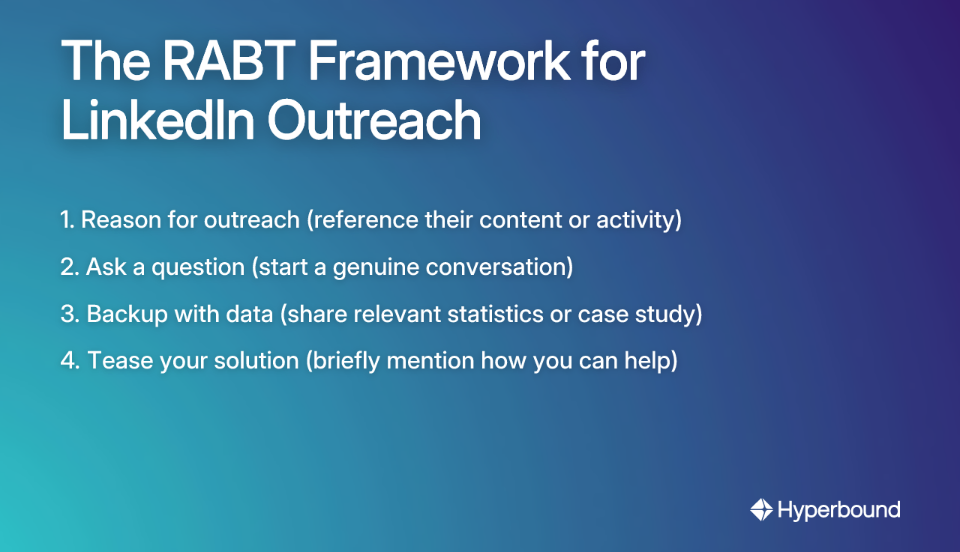
- Reason for outreach (e.g., "I saw your post on...")
- Ask a question (to start a conversation)
- Backup with data (e.g., a relevant statistic or case study)
- Tease your solution (briefly mention how you can help)
This structure ensures your outreach is focused on starting a conversation rather than making an immediate pitch.
Data-Backed Best Practices
LinkedIn data reveals several key insights for effective messaging:
- Keep it brief: Messages under 400 characters get 22% more replies
- Personalize: Personalized messages perform 15% better than generic ones
- Timing matters: Send between 6-8 am and 8-10 pm, and avoid Thursdays through Saturdays
- Subject lines: Use short, one-word subjects for higher open rates (up to 57.5%)
For follow-ups, always add new value instead of repeating your initial pitch. Share relevant content, testimonials, or insights that continue to demonstrate your understanding of their challenges.
Finding the Balance: A Framework for Scalable Quality
While quality is critical, sales is still a numbers game at some level. The key is finding the right balance.
The Tiered Approach
Implement a three-tier system to balance personalization with efficiency:
- Tier 1 (Top 10%): Hyper-personalized outreach using the RABT formula, referencing their content, and engaging deeply before reaching out
- Tier 2 (Next 30%): Semi-personalized messages with the first line customized based on their role, industry, or company news
- Tier 3 (Bottom 60%): Light automation focusing on well-defined, smaller audiences (50-700 individuals) for better engagement
This approach allows you to scale your efforts while maintaining quality where it matters most.
Leverage Tools Intelligently
Use tools to enhance your strategy, not replace the human element:
- LinkedIn Sales Navigator: Use Boolean Search to create highly targeted lead lists and track triggers on the home dashboard
- AI Sales Coaching Platforms: To ensure your team can execute this quality-first approach, use platforms like Hyperbound to practice personalized messaging and objection handling in a safe environment. This builds the skills and confidence needed for high-stakes conversations
- Automation tools: For safely automating multi-channel sequences with customizable messages, but only after you've established your approach
Measuring What Matters: Metrics Beyond "Messages Sent"
The metrics you track determine the behaviors you reinforce. If you're only measuring volume (messages sent), you'll naturally prioritize quantity over quality.
Leading vs. Lagging Indicators
- Leading Indicators: Predict future performance (e.g., reply rates)
- Lagging Indicators: Reflect past results (e.g., revenue)
Your quality strategy directly impacts leading indicators, which ultimately influence lagging indicators.
Key Metrics for a Quality Approach
Engagement Metrics:
- Reply Rate (InMail response rates average 18-25%, far higher than the 3% for cold email)
- Content Engagement (comments, shares)
- Profile Views
- Meetings Scheduled
Pipeline Metrics:
- Win Rate (closed-won deals / opportunities created)
- Average Sales Cycle Length
- MQL to SQL Conversion Rate
Stop Counting InMails, Start Making Connections
Success on LinkedIn isn't about volume; it's about value, reputation, and relationships. The platform simply doesn't reward a "quick win" strategy because it wasn't designed for that purpose.
The next time you're tempted to blast out generic InMails to hit your monthly quota, remember that those 30 messages won't move the needle. Instead, find one prospect today, research them for five minutes, and find a way to add value—comment on their post, share a relevant resource, or offer a genuine compliment—with no ask attached.
Over time, this approach builds a foundation of trust and reciprocity that makes your eventual ask for a meeting feel like a natural next step rather than a cold pitch from a stranger. And that's the ultimate goal of quality-focused LinkedIn prospecting: transforming cold outreach into warm conversations.
Frequently Asked Questions
What is a quality-focused LinkedIn prospecting approach?
A quality-focused LinkedIn prospecting approach prioritizes building relationships and providing value over sending a high volume of generic messages. It involves establishing a professional brand, engaging meaningfully with prospects' content, and sending hyper-personalized outreach to create warm conversations rather than cold pitches.
Why is my high-volume LinkedIn outreach not working?
High-volume LinkedIn outreach often fails because it leads to SDR burnout, damages your personal and company brand with generic messages, and yields diminishing returns. Most prospects (around 97%) are not ready to buy at any given time, so impersonal, automated messages are easily ignored and can harm your reputation for future outreach.
How can I build a professional brand on LinkedIn before pitching?
You can build a professional brand by first optimizing your profile with a professional photo and value-driven headline. Then, consistently create or share content that is relevant to your target audience, such as summarizing industry podcasts, sharing case studies, or interviewing experts. This positions you as a thoughtful resource rather than just another salesperson.
What is the best way to message a prospect on LinkedIn?
The best way to message a prospect is to start a conversation, not a pitch. Use the RABT framework: have a clear Reason for outreach (like their recent post), Ask a genuine question, Backup your point with data or a resource, and gently Tease your solution. Keep messages short (under 400 characters) for the best reply rates.
How do I balance quality prospecting with the need for sales volume?
Balance quality and volume by implementing a tiered outreach strategy. Dedicate your most intensive, hyper-personalized efforts to your Tier 1 top accounts (top 10%). Use semi-personalized templates for Tier 2 (next 30%), and light, carefully targeted automation for Tier 3 (bottom 60%). This ensures your highest-value prospects receive the most attention.
When should I use LinkedIn InMail?
You should use LinkedIn InMail as a last resort after other methods have failed. Since a Sales Navigator account typically limits you to 50 InMails per month, it's a scarce resource. Prioritize sending a personalized connection request or finding a direct email address first. Reserve InMails for high-value prospects you can't reach otherwise.
What are the most important metrics to track for this strategy?
Instead of just tracking "messages sent," focus on leading indicators that predict success. The most important metrics for a quality-focused strategy include reply rate, content engagement (likes, comments, shares), profile views, and meetings scheduled. These engagement metrics are better predictors of pipeline health than pure volume.
Book a demo with Hyperbound


