.png)


.png)
Summary
- Reps who successfully handle objections see a 64% higher close rate, making it a critical skill to master.
- Traditional practice like peer role-playing fails because it's inconsistent, subjective, and doesn't provide the objective feedback needed for improvement.
- The most effective sales simulations are hyper-realistic, deeply customized to your business, and provide instant, data-driven feedback.
- AI Sales Roleplays offer a scalable and risk-free environment for reps to master objection handling and other critical conversations.
You've spent thousands on sales training, but your reps still fumble when facing customer objections. They're either practicing on live prospects (risking valuable deals) or role-playing with peers (getting inconsistent, subjective feedback). It's a catch-22 that keeps your team from reaching their full potential.
Sales leaders everywhere face this practice paradox. As one sales rep on Reddit put it, "Real calls offer invaluable experience. However, with the stakes so high, I'm cautious about using real prospects for practice." This tension leaves many teams stuck in a cycle of underperformance.
The solution isn't just more practice—it's smarter practice. Today's interactive sales simulations are transforming how teams prepare for objections by providing a risk-free environment that's both realistic and scalable. In fact, sales reps who can successfully handle objections have a 64% success rate in closing deals. The question is: how do you build simulations that actually prepare your team for real-world scenarios?
Why Most Objection Handling Practice Misses the Mark
Traditional sales training approaches leave much to be desired:
The Manager Bottleneck
Sales managers simply don't have the bandwidth to conduct one-on-one roleplays with every rep regularly. This creates an inherent limit on how much personalized practice reps can get, leaving many unprepared for critical customer conversations.
Inconsistent Peer Roleplays
When reps practice with colleagues, the quality varies dramatically. Some peers may not take it seriously, others may not know how to accurately simulate a realistic customer, and most aren't equipped to provide constructive feedback.
Lack of Objective Feedback
Without data-driven insights, feedback remains subjective and inconsistent. This leads to what one sales enablement leader described as "reps developing bad habits from a lack of constructive feedback during practice." The result? Confidence issues and missed opportunities when facing real objections.
Understanding the Anatomy of Common Sales Objections
Before building effective simulations, it's crucial to understand what objections really are. A sales objection isn't a rejection—it's a request for more information or an indicator of a barrier that needs to be overcome.
The most common objection categories your simulations should address include:
.png)
- Price/Budget Objections: "We don't have the money right now" or "It's too expensive." These are opportunities to communicate value, not just offer discounts.
- Authority Objections: "I'll have to speak to my boss." This indicates you may not be talking to the decision-maker, or they need help building the business case internally.
- Need Objections: "Our company doesn't need that" or "We're happy with our current solution." These require skill in uncovering latent needs through thoughtful questioning.
- Urgency Objections: "That's not our priority at the moment." The goal here is to connect your solution to critical business drivers.
- Trust Objections: Stems from unfamiliarity with your company or solution. Reps need to leverage social proof effectively to build credibility.
An effective framework for handling these objections is the LAER Process: Listen, Acknowledge, Explore, Respond. This structure should be reflected in your interactive sales simulations.
The 3 Pillars of an Effective Sales Simulation
Many sales professionals remain skeptical about AI-powered simulations, with common concerns that they're "too robotic" or "lack realism." These are valid concerns—if your simulations don't feel authentic, they won't prepare reps for real conversations.
To build simulations that actually work, focus on these three essential pillars:
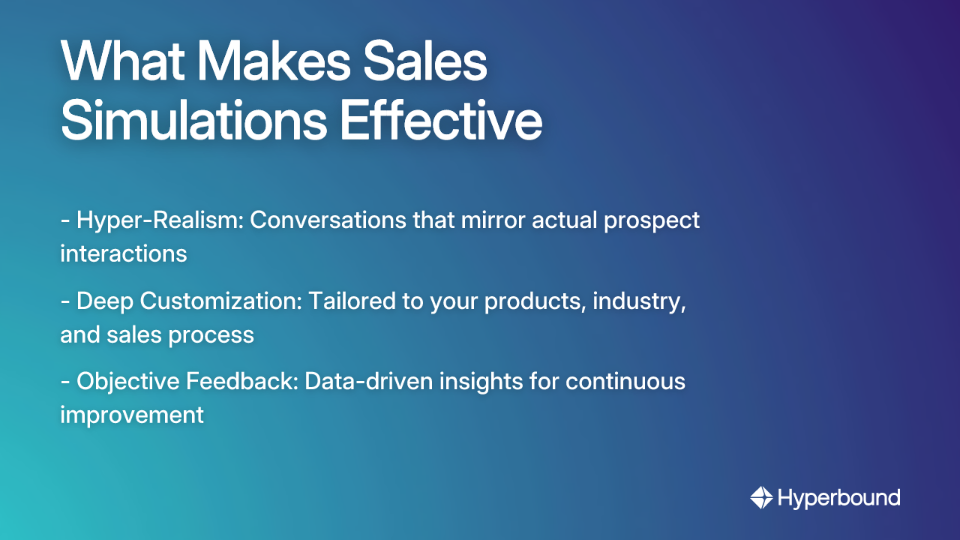
1. Hyper-Realism
Effective simulations must mirror reality, not generic scripts. This means:
- Creating dynamic buyer personas with distinct personalities, objection styles, and industry knowledge
- Incorporating your specific product terminology and market context
- Enabling natural conversational flow that feels like talking to a real prospect
Hyperbound's AI Sales Roleplays achieve this level of realism by analyzing your actual sales call recordings. The AI learns from your top performers' winning behaviors, your customers' real objections, and your specific terminology to create AI avatars that feel authentic, not like a canned demo.
2. Deep Customization
As one sales leader noted on Reddit, "Sales strategies often do not translate across different industries." Generic simulations fail because they don't address your unique selling environment.
Effective simulations must be tailored to:
- Your specific products and services
- Your ideal customer profiles (ICPs)
- Your sales methodology and messaging framework
- Common objections in your industry
With platforms like Hyperbound, you can create customized scenarios for any part of the sales cycle—from cold calls and discovery to demos, objection handling, and renewals—ensuring your team practices the exact conversations they'll have with prospects.
3. Instant & Objective Feedback
Without immediate, data-driven feedback, practice becomes far less effective. The best simulations provide:
- Real-time assessment of responses
- Scoring based on objective criteria (like talk-to-listen ratio, key message delivery, etc.)
- Specific suggestions for improvement
- Examples of better responses when appropriate
This addresses the common pain point expressed by one sales rep who wanted a system that could "score responses based on tonality, confidence and accuracy." Hyperbound's AI-Powered Scorecards deliver this kind of instant, objective feedback, tracking talk ratios, key selling moments, and objection handling effectiveness.
A Step-by-Step Guide to Implementing AI-Powered Sales Simulations
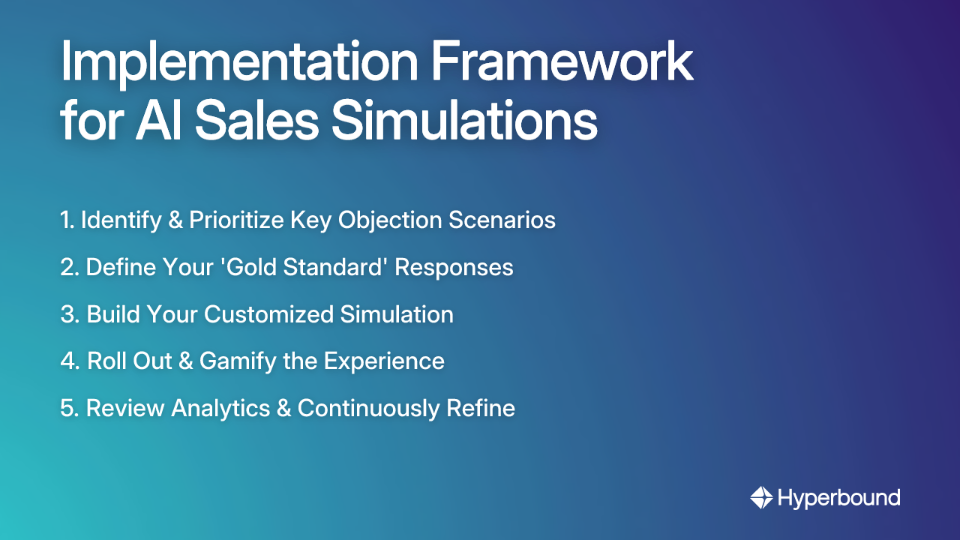
Ready to build interactive sales simulations for your team? Follow this framework:
Step 1: Identify and Prioritize Scenarios
Start by mapping the 3-5 most common and challenging objections your team faces. Review:
- Call recordings to identify patterns
- Deal loss reports to understand objection-related failures
- Rep feedback on where they feel least confident
Step 2: Define Your "Gold Standard" Responses
Document your best-practice talk tracks and objection handling frameworks. This includes:
- Specific language for addressing each objection type
- Questions to ask when exploring objections further
- Key value propositions to emphasize
- Stories and social proof to leverage
Step 3: Build the Simulation
With your scenarios and best practices defined, it's time to create your AI role-playing scenarios:
- Input your buyer personas with relevant details
- Program common objections and conversation flows
- Set up scoring criteria aligned with your sales methodology
With platforms like Hyperbound, this process is surprisingly quick. Initial setup for bots and scorecards can take less than 10 minutes, with most customers seeing value within 30 days.
Step 4: Roll Out and Gamify
The best implementation strategies include:
- Integrating simulations into your onboarding program
- Setting weekly practice requirements (e.g., 3 simulations per week)
- Creating leaderboards to foster healthy competition
- Highlighting and sharing top-performing responses
Hyperbound's gamified learning and leaderboards motivate reps through friendly competition, accelerating skill development while making practice enjoyable.
Step 5: Review Analytics and Refine
Use the platform's analytics to:
- Identify team-wide skill gaps
- Pinpoint individual coaching opportunities
- Continuously update scenarios based on market trends
- Track improvement over time
Beyond Objections: Expanding the Impact of Sales Simulations
While objection handling is a critical skill, interactive sales simulations deliver value across your entire sales organization:
Faster Onboarding
New hire ramp time is often painfully slow. By giving new reps a safe space to practice before their first live call, you can dramatically accelerate their development. Hyperbound customers have seen ramp time reduced by up to 50%.
Consistent Playbook Rollouts
When launching new products or messaging, simulations ensure every rep can practice and master the new talk tracks consistently. This leads to higher adoption rates and more consistent execution in the field.
Post-Sales Excellence
Customer success and account management teams benefit equally from simulation practice. Hyperbound's AI Post-Sales Roleplays prepare CSMs for difficult renewal conversations, upsell opportunities, and de-escalation scenarios—critical moments where practice makes the difference between retention and churn.
Hiring and Talent Assessment
Objectively screen sales candidates at scale by having them complete realistic sales call simulations. Hyperbound's Hiring Assessments help you identify top performers based on actual skill demonstration, not just resume claims or interview charisma.
Stop Practicing on Your Customers
The gap between high-risk live calls and ineffective traditional practice is now bridged by interactive sales simulations that feel real, provide objective feedback, and scale across your organization.
The most successful sales organizations are those that give their reps enough "at bats" to build muscle memory before facing real prospects. By implementing simulations built on the three pillars—hyper-realism, deep customization, and objective feedback—you empower your team with a safe, on-demand practice environment.
The result? Confident reps who can handle any objection, more closed deals, and a stronger sales organization overall.
Ready to prepare your team for any conversation? Learn how Hyperbound's AI Sales Roleplays can transform your sales coaching and objection handling capabilities.

Frequently Asked Questions
What are AI-powered sales simulations?
AI-powered sales simulations are interactive training tools that create realistic, risk-free practice environments for sales representatives. They allow reps to practice handling customer conversations, objections, and various sales scenarios with an AI-driven avatar that mimics a real prospect, providing instant, data-driven feedback on their performance.
Why is traditional role-playing not enough for sales training?
Traditional role-playing is often ineffective due to several key limitations: the "manager bottleneck" which limits the frequency of practice, inconsistent quality from peer-to-peer roleplays, and a lack of objective, data-driven feedback. This can lead to reps developing bad habits and lacking confidence in real customer interactions.
How do AI simulations ensure realism in practice scenarios?
Effective AI simulations achieve hyper-realism by creating dynamic buyer personas with distinct personalities and using your company's specific product terminology and market context. Advanced platforms like Hyperbound can even analyze your actual sales call recordings to learn from your top performers and real customer objections, ensuring the AI avatars are authentic and not robotic.
What types of sales objections should my team practice for?
Your team should practice for the five most common categories of sales objections: Price/Budget (e.g., "It's too expensive"), Authority (e.g., "I need to talk to my boss"), Need (e.g., "We're happy with our current solution"), Urgency (e.g., "This isn't a priority right now"), and Trust (e.g., concerns about your company's credibility).
How can AI sales simulations be customized for a specific business?
AI sales simulations can be deeply customized to fit your unique selling environment. This includes tailoring scenarios to your specific products and services, ideal customer profiles (ICPs), internal sales methodology, and the common objections specific to your industry. This ensures the practice is directly relevant to the real-world conversations your team will have.
What are the benefits of using AI simulations beyond objection handling?
Beyond objection handling, AI simulations deliver significant value across the entire sales organization. They can accelerate new hire onboarding by up to 50%, ensure consistent playbook rollouts for new products or messaging, train post-sales teams on renewals and de-escalations, and even be used in hiring to objectively assess a candidate's skills.
How quickly can a sales team start using AI simulations?
Implementing AI sales simulations can be a surprisingly fast process. With modern platforms, the initial setup for creating AI bots and defining scoring criteria can take less than 10 minutes. Most organizations begin to see tangible value and improved rep performance within the first 30 days of implementation.
Book a demo with Hyperbound


